



Aama Yangri, or Ama Yangri, is a scenic hill over the green valley of Helambu. People living in the area feel that it safeguards their land. It lies about 80–90 km northeast of Kathmandu, in Sindhupalchok (Helambu). The path to Aama Yangri passes through serene Sherpa and Tamang villages around Helambu, which lies within or adjacent to the Langtang region; parts fall under Langtang National Park depending on the route.
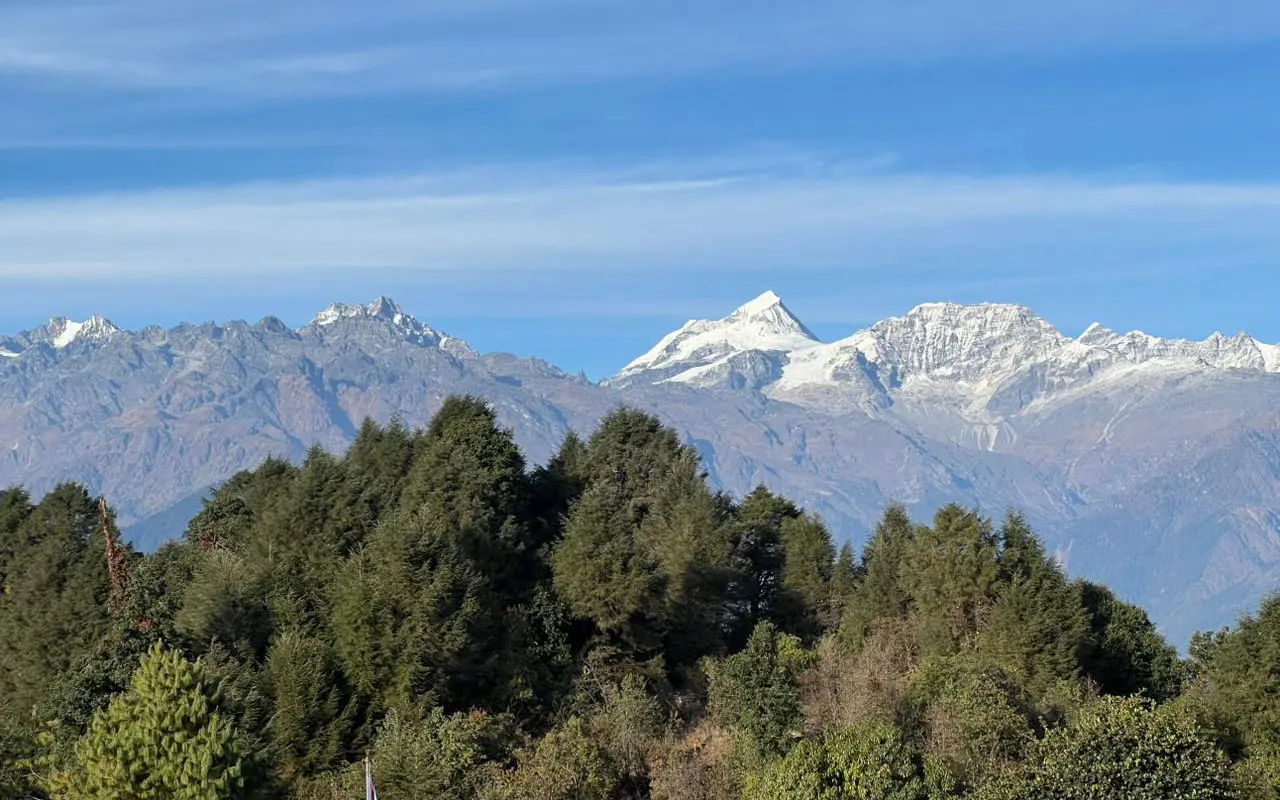
Clear days usually show Langtang, Jugal, and Ganesh ranges; distant Annapurna, Manaslu, and even Everest are sometimes visible. It is called the Poon Hill of Kathmandu by many visitors due to its easy accessibility as well as its amazing views of the mountains. The name Aama Yangri itself tells the story. In the local language, “Ama” means “mother” and “Yangri” is a revered feminine title – together, the peak is the “Mother Protector” of Helambu.
Hyolmo tradition holds that the mountain is a concerned dakini (female deity), whose snowy form brings blessings and safety to those who dwell in her shadow. Sherpa villagers often begin journeys by gazing once more at Aama Yangri, believing even a last glimpse of the peak imbues them with long life and fortune.
Spiritual Significance to Helambu’s Sherpas
For the Sherpa (Hyolmo) and Tamang people of Helambu, Aama Yangri is not just a mountain peak – it is a living goddess. Everyone knows Aama Yangri as a protective mother figure: for them, she is a Dakini, “a goddess protector of the entire region” whose compassionate power shields the valley from misfortune.
In fact, a Sherpa guide once noted that “Yang” can mean “wealth” in their language, and “Ri” means “peak,” so Ama Yangri could also be read as the “Peak of Wealth and Prosperity.” Locals believe that as long as she watches over Helambu, the crops will grow, the weather will be gentle, and accidents will be rare.
This belief shapes daily life. Monasteries and stupas in the region often honor Aama Yangri as a local deity. Along the trail, colorful prayer flags and mani stones bear her name. Even the ordinary village festivals can have small offerings to the mountain.
The guides at Himalayan Adventure Treks underline the fact that respect and sacrifice to Aama Yangri is an entrenched idea: failing to serve her or righting the statues are said to invite bad weather and misfortunes, whereas incense and butter lamp offerings are said to bring good harvests and community good fortune.
This fusion of nature worship and Buddhism gives the trek a uniquely spiritual feel. The monks of local gompas (monasteries) occasionally lead pilgrims on morning-long pujas (prayers) dedicated to Aama Yangri, and villagers listen for her answer in the rising sun.
Simply gazing up at the mountain is considered a blessing – the Hyolmo say even the act of seeing Aama Yangri can grant you health and good luck. In brief, this is a holy mountain and the mother who takes care of Helambu in short ,and climbing to its top is more of a spiritual pilgrimage than a physical one.
Tradition and Mythical Tales
The experience around Aama Yangri is rich with myth. According to local legend, at the start, one myth tells of a mighty serpent dragon that lives in a small lake on the mountain’s western flank. Hyolmo storytellers describe it as a “fierce” creature, and indeed a mural in the Tarkeghyang monastery portrays Aama Yangri riding this dragon into battle. This story belongs to the Hyolmo oral tradition and appears in local community blogs and monastery folklore; it is not a verified historical event.
The dragon’s muddy lake supposedly fills only after the monsoon and is considered the goddess’s hidden water spirit. This tale echoes how the locals see Aama Yangri as powerful and protective – even the wildlife around her base is wrapped into mythology.
Locals say another legend centers on a weather frog at the summit. Local people tell this as a myth explaining sudden storms on the mountain, not a documented fact. Above the main chorten (stupa) atop Aama Yangri is a small meditation shrine set before a lone prayer-flagged bush. Encased within it is a stone said to form a frog shape. By legend, if a trekker were ever bold enough to touch this frog-stone, immediate storms and bad weather would descend to punish the act.
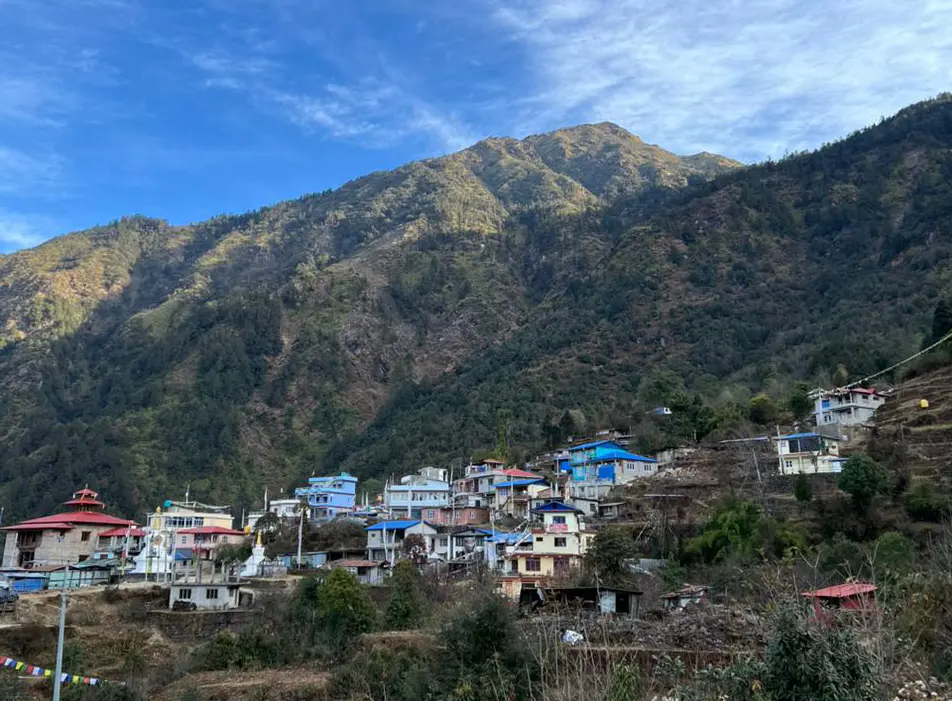
The villagers claim this stone’s water must never dry, or the rains will fail throughout the valley. These stories – of dragon guardians and mystical frogs – show how even the elements on Aama Yangri’s slopes are woven into its sacred aura. Centuries ago, local tradition tells of a monastery once standing at the summit.
According to Hyolmo oral legends, a tantric yogi named Meme Surya Seng-ge built a temple here around 1723, and lightning is said to have struck it seven times. These accounts come from oral history, not written records.
He and his followers consecrated the site, believing its energy so powerful that witnessing the rituals would free devotees from negative rebirth. Legend says that on the day of consecration, lightning struck the temple seven times, ultimately burning it down – but with the yogi still meditating unharmed inside.
The local stories suggest the mountain itself intervened to keep its powers pure. This lightning story is passed down in the Hyolmo oral tradition and is not supported by written historical records.
These mythical histories – protector dakini, dragon-entwined deity, living weather spirit – may sound fantastical, yet they embody Aama Yangri’s role in Helambu culture. They teach that this mountain is alive with its own spirit. Trekkers today may only see prayer flags and a crumbling chorten, but those symbols echo legends passed down through generations.
Pilgrimages and Rituals
To this day, Ama Yangri’s summit is a pilgrimage site. Every year on the full moon of Chaitra (around March/April), thousands of Sherpa and Tamang villagers make the trek to honor the “Mother Protector”. Predawn on that holy morning, torchlights snake up the mountain path as families carry butter lamps and offerings.
By sunrise, the summit is a festival: monks conduct hours-long pujas to greet Aama Yangri, and the community dances and sings in. Sherpa tradition pours out in local libations – chang (barley beer), raksi (corn or apple wine), and butter tea are shared freely as everyone soaks up the first rays of light. When the sun rises above the horizon, the mountain is bathed in gold, and the crowd cheers in unison, feeling the goddess’s blessing in the rosy dawn.
Even outside of the full-moon festival, the summit holds constant reminders of reverence. A white chorten (Buddhist shrine) crowns Aama Yangri’s highest point, circled by prayer flags left by pilgrims. Trekkers often add their own flag or kata (ceremonial scarf) before descending.
One local itinerary describes the summit chorten (shrine) – sometimes called Ama Yangri Zangdok Palri in local texts as a place “where the deity Ama Yangri protects the entire valley” and where wishes are believed to come true if prayed for at the top.
Through Himalayan Adventure Treks and local guides, visiting trekkers can sometimes participate quietly in these rituals – lighting incense or joining the morning chanting. Whether on festival day or a regular trek, the summit experience is solemn.
You might sip hot yak-tea as the sherpa owner tells tales of the mountain, or quietly stand among pilgrims in awe of the peaks. In either case, reaching Aama Yangri’s shrine feels like arriving at a natural temple, where the line between tourism and pilgrimage beautifully blurs.
The Ama Yangri Trek: Route, Difficulty, and Highlights
The trek to Aama Yangri is often offered as a short 2–3 day trip from Kathmandu, making it accessible to many adventurers. Typically, day one begins early with a drive to Helambu. From Kathmandu’s Chuchhepati bus stand or KTM airport, travelers can take a jeep or local bus toward Melamchi.
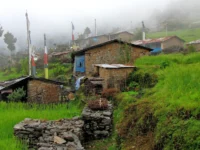
The scenic 5–7 hour drive winds through terraced farms, villages of Sindhupalchok, the market town of Melamchi Bazaar, and finally to the Sherpa village of Tarkeghyang (2,600m). Many routes pause at Timbu, a halfway village, where one can trek in or catch a vehicle on a dirt road to Tarkeghyang. Tarkeghyang is the jumping-off point: it lies just under Aama Yangri and has lodges and tea houses for a night’s rest.
The core hike is usually done very early on day two. Start from Tarkeghyang (2,600 m); climb about 1,100–1,170 m to reach 3,771 m; allow 4–6 hours for the ascent depending on pace. It is a moderate to challenging climb: steep switchbacks gain roughly 1,100 meters over about 4–6 hours. The initial forest sections are cool and mossy, then above the tree line, you emerge into the open alpine zone.
Along the way, colorful prayer flags and chortens mark the path in true Himalayan style. By around mid-morning or noon, trekkers reach the bare summit ridge at 3,771m. Despite the strenuous final ascent, the reward is unforgettable.
From the peak, 360-degree panoramas stretch to the giants of the Himalayas. Langtang Lirung and the Langtang range dominate one side, Ganesh and Dorje Lakpa peaks lie another, and even distant Annapurna and Manaslu can be seen if clouds allow.
Many guides compare this view to the famed Poon Hill lookout, only closer to Kathmandu. At sunrise especially, the light dances on the snowy summits and prayer flags alike. After soaking in the scene, hikers usually circumnavigate the small summit chorten (completing the sacred kora) and spend a respectful moment by the shrine
Finally, the descent follows the same ridge back down to Tarkeghyang. Though your legs will be tired, the morning light will have illuminated trails and tea houses by then, making the return trip safe. By afternoon or early evening, you can retrace the drive back to Kathmandu. Overall, the trek is often listed as moderately hard, with a short but steep climb making it more challenging than a simple hike.
Good trekking shoes and sticks help here. But its short distance means many people turn it into a quick weekend getaway. Himalayan Adventure Treks notes that this trek’s “beginner-friendly” nature – unlike longer high-altitude climbs – still rewards with full Himalayan vistas and deep cultural immersion.
Highlights of the Ama Yangri trek include
- Panoramic Himalayan vistas from the highest viewpoint near Kathmandu
- A dawn sunrise over the peaks, often watched as a pilgrim
- Dense rhododendron, oak, and pine forests that bloom with wildflowers in spring
- Charming Tamang and Sherpa villages (like Tarkeghyang) with ancient monasteries and friendly locals
- The summit chorten (shrine), prayer flags, and remains of earlier structures at the top — today, only a chorten/shrine stands on the summit; the monastery belongs to local oral history.
- The land of Himalayan white browed rosefinch (Carpodacus thura)
- A peaceful trail with fewer people than other popular treks
Flora, Fauna, and Scenic Beauty
Helambu’s forests and hillsides burst with natural beauty. The trail climbs through lush rhododendron groves and oak-pine forests, part of the Langtang National Park ecosystem. In spring (March–May), these rhododendrons blaze with red, pink, and white blossoms, making the woods glow.
Guides and locals say the trail looks unforgettable when the flowers are in bloom. Even outside of flowering season, the silent forest often reveals shy wildlife: Himalayan birds chorus in the morning, and one might glimpse a barking deer or langur monkey moving through the branches.
Because the trek skirts Langtang National Park, it’s an excellent chance to see exotic Himalayan fauna. Marvel Adventure notes that the region is home to red pandas, musk deer, Himalayan tahr, and even snow leopards.
While sightings of the rarer species are uncommon, trekkers often spot satyr tragopan pheasants darting through the underbrush or hear the wood snipe’s call. Himalayan Adventure Treks advises visitors to keep cameras ready and eyes peeled on the forest floor.
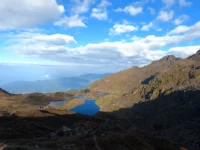
In late summer, the marshy pass below the summit can even attract yak herders with their herds feeding on alpine grasses. Above the tree line, the landscape turns to scrub and rocky slopes. Here, small shrubs, mosses, and the occasional juniper punctuate the granite.
The high ridge has its own stark beauty – rough ground strewn with prayer rocks and flags under an endless sky. From that height, on clear days, the view of Kathmandu Valley itself is almost surreal: the valley floor stretches southward. In all, Ama Yangri rewards not only with its peaks but also with the crisp mountain-air experience of Nepal’s highlands, where every turn offers a postcard vista of natural splendor.
Getting to the Trailhead from Kathmandu
Reaching Ama Yangri’s trailhead is an adventure in itself. Most itineraries start by heading to Timbu or Tarkeghyang on the Melamchi road. You can hire a jeep (shared or private) or take a local bus from Kathmandu to the outskirts of Helambu. The journey winds through the hills of Sindhupalchok: you drive past Khadichaur, over a ridge into the Melamchi Khola (river) valley, and then follow the river upstream.
About 5–6 hours out, the town of Melamchi Bazaar offers a lunch stop. Continuing uphill, you reach Timbu (1,600m), the last large village. From Timbu, the dirt road climbs more steeply and turns into a jeep trail through forests. Within 1–2 hours, you arrive at Tarkeghyang (also called Tarkeghyang) – a charming Sherpa village at 2,600m that sits below Ama Yangri’s western shoulder. Tarkeghyang is known for its red monastery and characteristic stone houses with prayer flags.
It has basic tea houses and lodges, making it a convenient base for trekkers. If you start early from Kathmandu (around 6 AM), you can comfortably reach Tarkeghyang by late afternoon, leaving time to explore the village and view nearby temples. For a bit more adventure, some groups choose to trek all the way from Timbu. A gentle footpath leads north from Timbu through terraced fields, offering a quieter, more scenic approach to Tarkeghyang over about 5 hours.
But regardless of whether by vehicle or foot, the key point is the same: Tarkeghyang is the jumping-off point. From here, your legs carry you up into the wilderness, and Himalayan Adventure Treks guides will have arranged permits like the Langtang National Park Entry Permit (foreigners NPR 3,000) + TIMS card. If entering via Shivapuri–Nagarjun NP, a separate entry fee applies.
A Spiritual and Visual Journey
Trekkers often describe the Ama Yangri experience as much a pilgrimage as a hike. Ascending the peak at dawn brings a quiet, otherworldly atmosphere. Below, the sleeping villages fade into mist; above, only the endless Himalaya. Many clients report feeling a palpable sense of calm and respect upon reaching the top.
At the summit, sticky prayer flags and the faded white chorten create a devotional shrine in the open air. Some close their eyes and offer silent wishes, mirroring the lamas they may have seen performing puja rituals. Visually, the trek is a constant succession of rewards. Walking through the bright forests, you catch glimpses of distant peaks framed between branches.
The steep slopes part to reveal sweeping valleys that seem to go on forever. Each ridge provides a grand vista – to the west the Annapurna range, to the north Langtang Lirung crowned in snow, to the east the Jugal and Gaurishankar massif. Trekkers with Himalayan Adventure Treks love to pause at these points for photos and to simply drink in the view.
One memorable highlight is the sunrise itself. If you time it right, you may reach the summit just as dawn breaks. The eastern sky turns pink and gold over the Himalayas, and the clouds lie low beneath you, transforming mountain peaks into islands in a sea of mist. Guides often remark that few places offer such a dramatic “motif” at sunrise, with prayer flags waving above the glowing clouds.
Down in the valley after sunrise, village rooftops and a winding river come into view as life wakes up. It is this blend of nature’s pageantry and spiritual calm that defines Aama Yangri: one moment you’re gazing at holy scripture in the sky, the next you’re snapping pictures of daisies underfoot on a quiet forest path.
Best Time to Visit
The optimal seasons for Aama Yangri coincide with Nepal’s general trekking windows. Spring (March–May) and autumn (September–November) offer the clearest weather and most comfortable conditions. In spring, the days are warming, the skies are usually clear, and rhododendrons lining the trail burst into bloom.
This season is particularly magical for photographers, as wildflowers add color to the forest floor beneath the snowy peaks. Autumn brings stable skies and crisp air, ideal for unobstructed mountain views. Although autumn is slightly busier, Ama Yangri is still far less crowded than the big treks, so you usually feel like you have the trail to yourself.
Winter (December–February) is colder and riskier. The view can be stunning under fresh snowfall, but nights dip below freezing, and higher trails may accumulate deep snow. Only very experienced trekkers attempt Aama Yangri in winter.
Monsoon season (June–August) brings green lushness but frequent rain and fog, making the trail slippery and the summits often shrouded. For these reasons, Himalayan Adventure Treks recommends avoiding the monsoon for this trek.
In summary: plan the Aama Yangri trek for spring or autumn. Carry layers: days can be mild, but mornings on the summit are very cold. Guides advise plenty of sunblock and sunglasses (the sun is strong at altitude). Pack light rain gear even in drier seasons (mountain weather can change fast). Trek preparation and gear are keys to a smooth journey.
Gear Recommendations and Travel Tips
Packing wisely ensures your Ama Yangri trek is comfortable and safe. As a rule, Himalayan Adventure Treks suggests using good-quality trekking boots with a sturdy grip and breaking them in before the trip. Footwear is crucial when the trail gets steep or muddy. Trek poles are highly recommended for extra stability on the ascent and descent.
Bring layers for warmth: even if days are mild, early mornings and the summit can be well below freezing. A moisture-wicking base layer, a fleece or down jacket, and a waterproof outer shell are essentials. Don’t forget a warm hat and gloves, because you’ll likely be cold during the early-hour climb.
Sunglasses and a high-SPF sunscreen are also must-haves – the UV rays are intense with the snow glare. A compact water bottle or hydration system is important (stay hydrated on the trail), and consider water purification tablets if you’ll refill at streams. Energy snacks (nuts, chocolate, trail mix) will help on the steep parts.
For overnight stays, Himalayan Adventure Treks provides simple teahouses with basic bedding. However, it is a good idea to carry a sleeping bag that will withstand -5 o C at night, as mountain lodges are very cold. An additional layer of warmth and cleanliness may be a sleeping bag liner. Earplugs and a headlamp can come in handy during a stay at the lodges as well. A few practical tips:
• Permits & Documents: Foreign trekkers need a Langtang National Park Entry Permit (USD 30, NPR 3,000 for adults; children under 10 free) and a TIMS card as per current Nepal Tourism Board rates. (See official NTB park-fee page for updates.). These will be assisted by Himalayan Adventure Treks. You should always have copies of permits and a passport.
• Local Guide: Hiring a local guide is strongly recommended. Guides not only navigate, but they also explain cultural customs and translate Nepali terms. Our guides also arrange the festival timings if you hope to witness the full-moon ceremony.
• Respect Local Culture: Be Respectful to the Local Culture. Tarkeghyang and other villages are conservative. Wear plain (do not wear shorts), but seek permission to take photos of individuals, and graciously accept when one is invited to take tea or meals. Before, it was customary to take off shoes before entering monasteries. Keep it holy: remember that Aama Yangri is holy: be careful of noise on the summit, respect for prayer flags and shrines.
• Health & Safety: At 3,771 m, mild AMS is possible. Ascend slowly, stay hydrated, and consult a doctor before using acetazolamide (Diamox). Carry a basic first-aid kit. Action Excellent guide, heed his advice on paces and rests.
• Cash: There are no ATM in Helambu. Carry enough Nepalese rupees in small notes to feed, stay (tea houses take cash), and tip.
• Connectivity: Limited mobile signal. It is helpful to have an offline map or notes of key landmarks. Electrical power is intermittent in the lodges – a power bank will be a savior.
By preparing well, you can focus on the trek’s joys. Himalayan Adventure Treks suggests packing light but smart: good clothing, reliable gear, and an open heart for the cultural immersion. And of course, don’t forget your camera (or smartphone)! You’ll want to capture the alpine skies, prayer flags, and that breathtaking peak sunrise.
Conclusion
Aama Yangri is not just a mountain; it is the holy Mother of Helambu, a living book of Nepali folklore. This hike combines beautiful Himalayan scenery with the vibrant Sherpa and Tamang culture. On your route, you will breathe mountain air fragranced with pine, be greeted with the laughter of the villages, and you will be where thousands of pilgrims have prayed.


