

Duration
6 Days

Annapurna Base Camp Budget Trek


Trip Grade
Moderate
Group Size
1-16 People
Max Altitude
4,200m. / 13,780ft.
Best Season
Mar- May/ Sept- Nov
Activity
Trekking
Meals
Breakfast, Lunch & Dinner
Accommodation
Tehouses
Transportation
Private Vehicle
Trip Customization
On request (click here)


Highlights of Annapurna Base Camp Budget Trek
- A budget-friendly guided trek through the Annapurna Sanctuary to the Annapurna Base Camp.
- Walk through rhododendron forests and rich Himalayan flora.
- Visit to Gurung and Magar villages and get to know more about the culture.
- Scenic mountain views of Annapurna, Machhapuchhre and Dhaulagiri.
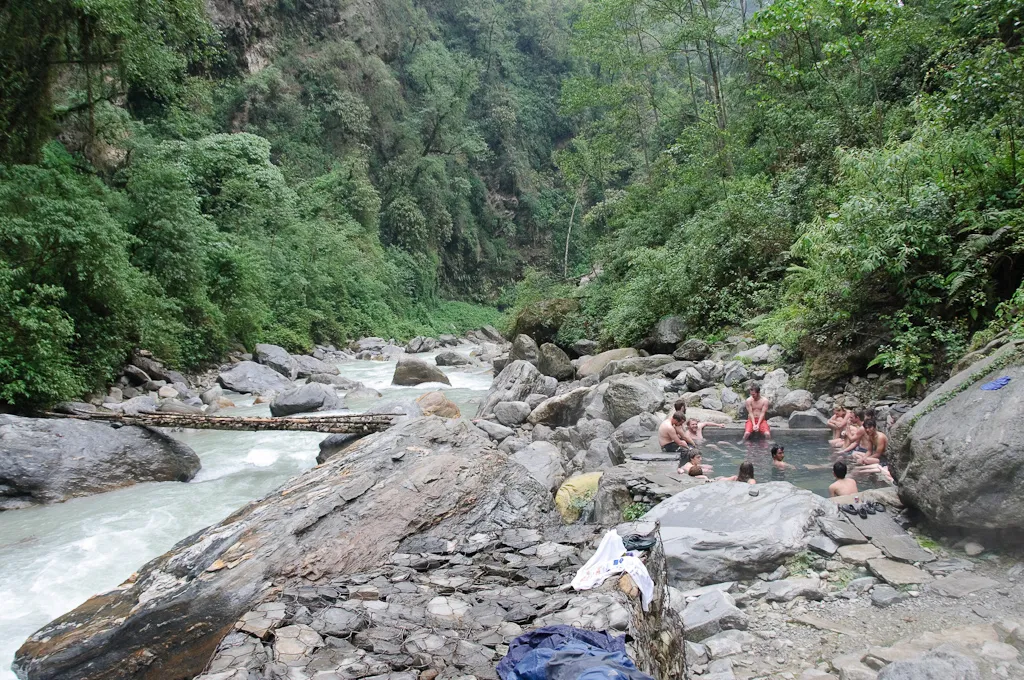
- Relaxation in the hot springs at Jhinu Danda village.
- Cozy accommodation in teahouses with authentic Nepali food.
- Travel with an experienced guide for safety and local knowledge.
Trip Introduction
The Annapurna Base Camp Budget Trek is a 6 days exciting trip through the middle of the Himalayas. It takes you on a path from the green valley of Pokhara up to the high mountains of the Annapurna Conservation Area. This six-day trip to the Annapurna Base Camp starts by traveling from Kathmandu to Pokhara, which’s an adventure in itself. Then you go to the village of Nayapul. From Nayapul the path goes along the Modi Khola river.
As you walk the busy lakeside of Pokhara becomes quieter. Turns into farmland. Every day you see landscapes and experience the local culture. The Budget Annapurna base camp trek changes from forests to alpine meadows with wildflowers as you go higher. You will see rice fields and small villages at heights and then you walk through dense woods of bamboo, rhododendron and fir.
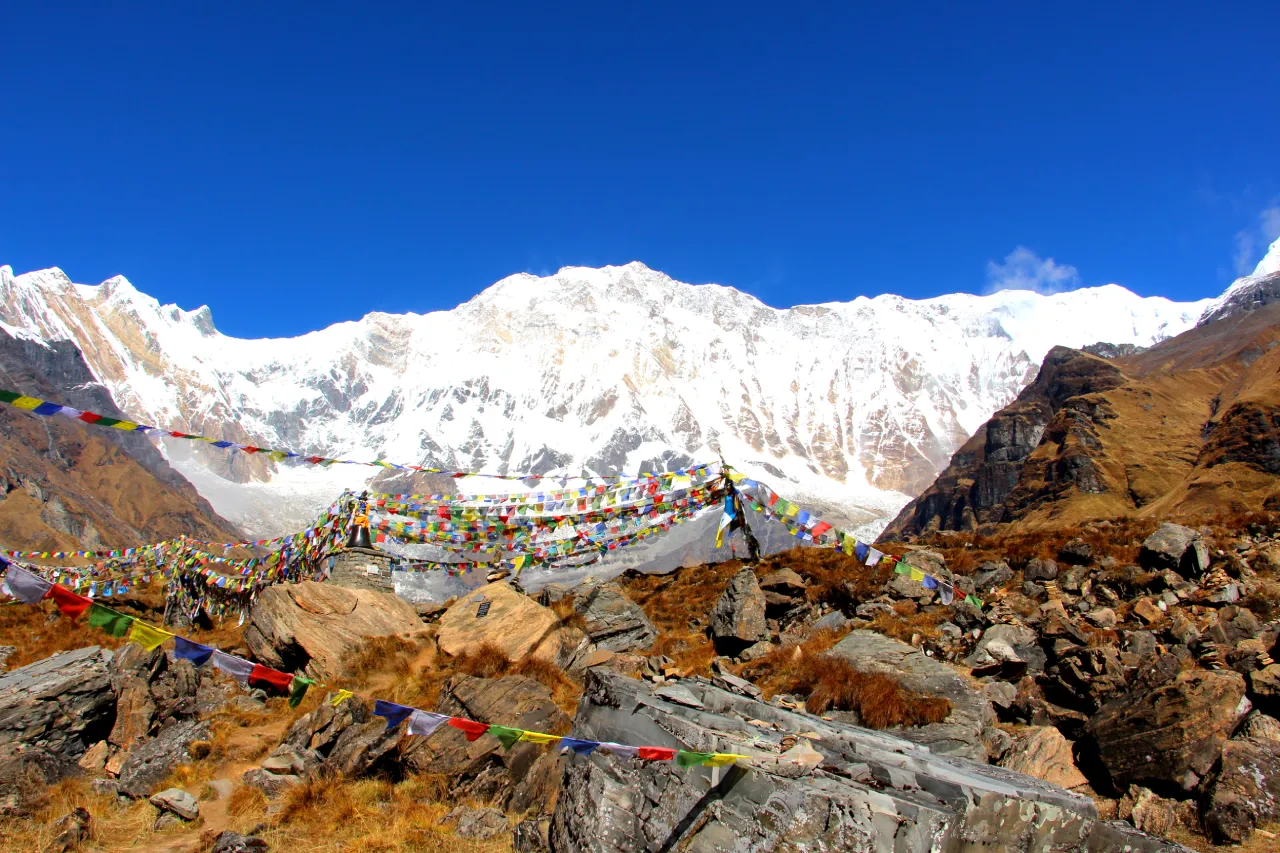
The Annapurna base camp trek really shows you the beauty and village life of the Annapurna region. On the way you meet the Gurung and Magar communities, who are known for their rich traditions and hospitality. The best part of the trip is reaching the Annapurna Base Camp, which’s a amazing high-altitude meadow surrounded by big mountains. The Annapurna Base Camp is 4,130 meters high and gives you great views of the Annapurna massif and the famous fishtail mountain, Machhapuchhre.
Getting to the base camp is the goal of the Annapurna Base Camp Budget Trek and it feels great to have accomplished it. You also get to see the sunset and sunrise from this spot with golden sunlight on the snow-covered mountains. Every moment at the Annapurna Base Camp shows you how big and beautiful the Himalayas are.
After taking in the views at the Annapurna Base Camp you go down through the Annapurna Sanctuary. On the way you can relax in the natural hot springs at Jhinu Danda, which helps your tired muscles after days of walking. The last day of the trek ends in Nayapul.
Then you take a pretty drive back to Pokhara, where you can rest by the beautiful Phewa Lake. The Annapurna Base Camp Budget Trek makes sure you stay in teahouses with simple food and a warm fire every evening, which gives you a chance to share stories with other hikers.
The Annapurna Base Camp Budget Trek is for people who love adventure and are on a budget. It has challenging but manageable walking, rich cultural experiences and great mountain scenery. Over six days you walk 55-60 kilometers with moderate distances and steady height gain every day. By staying in teahouses and having group meals the costs are lower than luxury tours. Even though it is a budget trip the Himalayas still give you an experience.
The Annapurna Base Camp Budget Trek is run by Himalayan Adventure Treks, a local company. Our experienced guides know the path well and will tell you about the mountains and local life. They make sure you are safe and have an experience.
Outline Itinerary of Annapurna Base Camp Budget Trek
Day 01: Drive from Pokhara to Nayapul and Trek to Chhomrong
Day 02: Trek from Chhomrong to Himalaya (2,920 m)
Day 03: Trek from Himalaya to Annapurna Base Camp (4,200 m) via Machhapuchhre Base Camp
Day 04: Trek from Annapurna Base Camp to Bamboo (2,310 m)
Day 05: Trek from Bamboo to Jhinu Danda (Hot Springs, 1,750 m)
Day 06: Trek from Jhinu Danda to Pokhara, via Nayapul
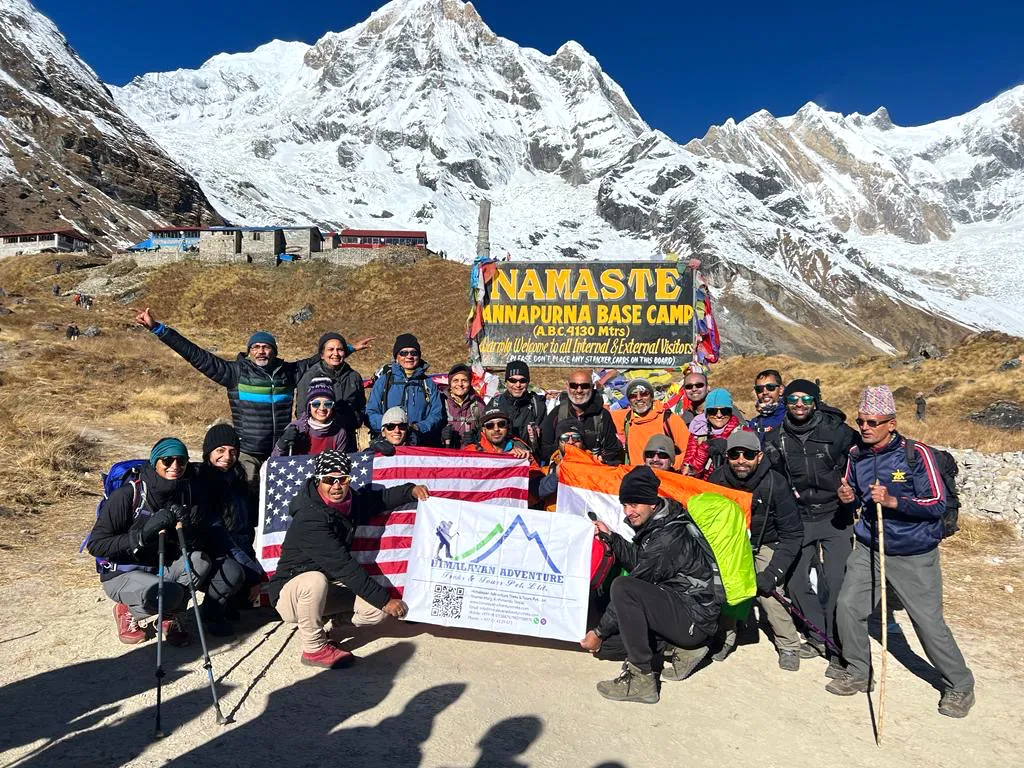
Our guests sharing their experiences (Photo/Video Gallery)



Detail itinerary of Annapurna Base Camp Budget Trek
01
Day 01: Drive from Pokhara to Nayapul and Trek to Chhomrong
The Annapurna Base Camp Budget Trek will start with a scenic drive, starting at Pokhara to Nayapul on Day 1. The road cuts across small hamlets, terraced land and river valleys. The path begins at Nayapul on a trail much used, which passes, without haste, through fields and small villages.
We will pick our way through pavements of stone and natural walks with a view of green hills and rivers. The first day has a smooth trail. In the evening, we will arrive at Chhomrong where we will have a warm meal and rest in a teahouse.

Activity: Drive & Trek, 6-7 hours

Max. Altitude: 2,170m/7,119ft. Chhomrong

Meal: Breakfast, Lunch, Dinner

Accommodation: Teahouse
02
Day 02: Trek from Chhomrong to Himalaya (2,920 m)
Today, we will continue the Annapurna Base Camp Budget Trek with a descent from Chhomrong followed by a steady climb through forest trails. The route goes through rhododendron and bamboo woodlands, and it has a serene environment. On the way to Bamboo village, we will cross small streams and suspension bridges and have a brief rest.
After lunch, we will continue trekking toward Himalaya village. The higher the altitude, the quieter the environment is. The walk is moderate and allows time to adjust to the surroundings. We will spend the night in a teahouse in Himalaya village.
Activity: Trek, 5-6 hours
Max. Altitude: 2,920m/9,580ft. Himalaya
Meal: Breakfast, Lunch, Dinner
Accommodation: Teahouse
03
Day 03: Trek from Himalaya to Annapurna Base Camp (4,200 m) via Machhapuchhre Base Camp
It is one of the most fulfilling days of the ABC budget trek. We will follow a gradual uphill trail through alpine landscapes with fewer trees and wider mountain views. A stop is made at Machhapuchhre Base Camp to rest and enjoy the scenery.
From here, we will continue toward Annapurna Base Camp. The latter part provides open valley vistas with high mountains. We will be able to spend time in the serene environment and the mountainous landscape on arrival. The evening is spent at a teahouse with time to relax and recover.
Activity: Trek, 6-7 hours
Max. Altitude: 4,200m/13,780ft. Annapurna Base Camp
Meal: Breakfast, Lunch, Dinner
Accommodation: Teahouse
04
Day 04: Trek from Annapurna Base Camp to Bamboo (2,310 m)
In the morning, we will have early mountain views and then commence the descent. This section of the Annapurna Base Camp trail takes the same path back, with a new view of the landscape. We will walk downhill through alpine areas and gradually return to forest sections.
The path has stone steps and shaded paths, which make the descent gradual. A lunch stop is made along the way before continuing toward Bamboo. The environment is becoming more comfortable and greener as we descend in altitude. The night is booked in a teahouse at Bamboo.
Activity: Trek, 5-6 hours
Max. Altitude: 2,310m/7,579ft. Bamboo
Meal: Breakfast, Lunch, Dinner
Accommodation: Teahouse
05
Day 05: Trek from Bamboo to Jhinu Danda (Hot Springs, 1,750 m)
Today we will resume the Annapurna budget trek with both uphill and downhill trail. The path travels through woodlands, small towns and terraced agriculture. We will take a break along the way before descending toward Jhinu Danda.
This village is a village of natural hot springs along the river. Once we get to Jhinu Danda we will be able to rest in the hot water which will make us feel less exhausted. The peaceful environment makes it a comfortable stop before the final day. Overnight stay will be in a teahouse.
Activity: Trek, 5-6 hours
Max. Altitude: 1,750m/5,741ft. Jhinudanda
Meal: Breakfast, Lunch, Dinner
Accommodation: Teahouse
06
Day 06: Trek from Jhinu Danda to Pokhara, via Nayapul
On the final day of the ABC budget trek, we will follow a gentle trail from Jhinu Danda toward Nayapul. The walk takes you through villages, farmland and river tracks thus making it an easy end to the trek.
The route is easier compared to previous days. After reaching Nayapul, we will take a drive back to Pokhara. And the trip provides a final glimpse of hills and countryside. By evening we will reach in Pokhara and the trek will be complete and we have time to rest.
Activity: Trek & Drive, 6-7 hours
Max. Altitude: 850m/2,789ft. Pokhara
Meal: Breakfast, Lunch, Dinner

Note:
If you have your own private group and want to make your trip private, we can run the custom trip all the day as per your requirements and group size.
Includes and Excludes
What are included with package?
- Trekking permit (ACAP): The Annapurna Conservation Area Permit (ACAP) is included, which is required for trekking in the Annapurna region.
- Trekkers’ Information Management System (TIMS) Permit: The TIMS permit is included, which is a mandatory document for trekkers in Nepal.
- All necessary paperwork: All necessary documentation and permits for your trek will be handled by us.
- Pokhara to Nayapul and Nayapul to Pokhara by private vehicle: Private vehicle transportation will be provided for the journey from Pokhara to Nayapul and Nayapul back to Pokhara.
- All accommodations in tea houses during the treks: Accommodation in local tea houses throughout the trek will be arranged.
- An experienced, helpful, and friendly guide: A professional and friendly guide will accompany you throughout the trek to ensure your safety and enhance your trekking experience.
- The arrangement of travel rescue: In case of an emergency, we will arrange for necessary rescue services.
- Medical supplies (first aid kit): A first aid kit will be available with the guide, including basic medical supplies for any minor issues during the trek.
What are not included with package?
- Kathmandu to Pokhara and Kathmandu transportation: This includes the costs for the bus or flight between Kathmandu and Pokhara, which will be at your own expense.
- Porter: A porter is not included in the package. If you wish to hire one, it will be an additional cost.
- Hotels in Kathmandu and Pokhara: Accommodation in Kathmandu and Pokhara, apart from the trekking days, is not included. You will need to arrange and pay for these separately.
- Travel and rescue insurance: This is not included in the package. It’s essential to arrange your own travel and rescue insurance before the trek.
- Personal expenses: Any personal expenses, such as phone calls, laundry, bar bills, battery recharge, extra porters, bottled or boiled water, and showers, are not covered and will be at your own cost.
Pick Your Suitable Date
US$ 350
Book a Private Trip
Private & Group Discount Price
-
1 -
1 personUS$ 500
-
2 -
2 peopleUS$ 350
-
3 -
5 peopleUS$ 300
-
6 -
10 peopleUS$ 250
-
11 + people
9999
US$ 200
1 Travelers x US $ 2000
Total Cost:
US$ 500
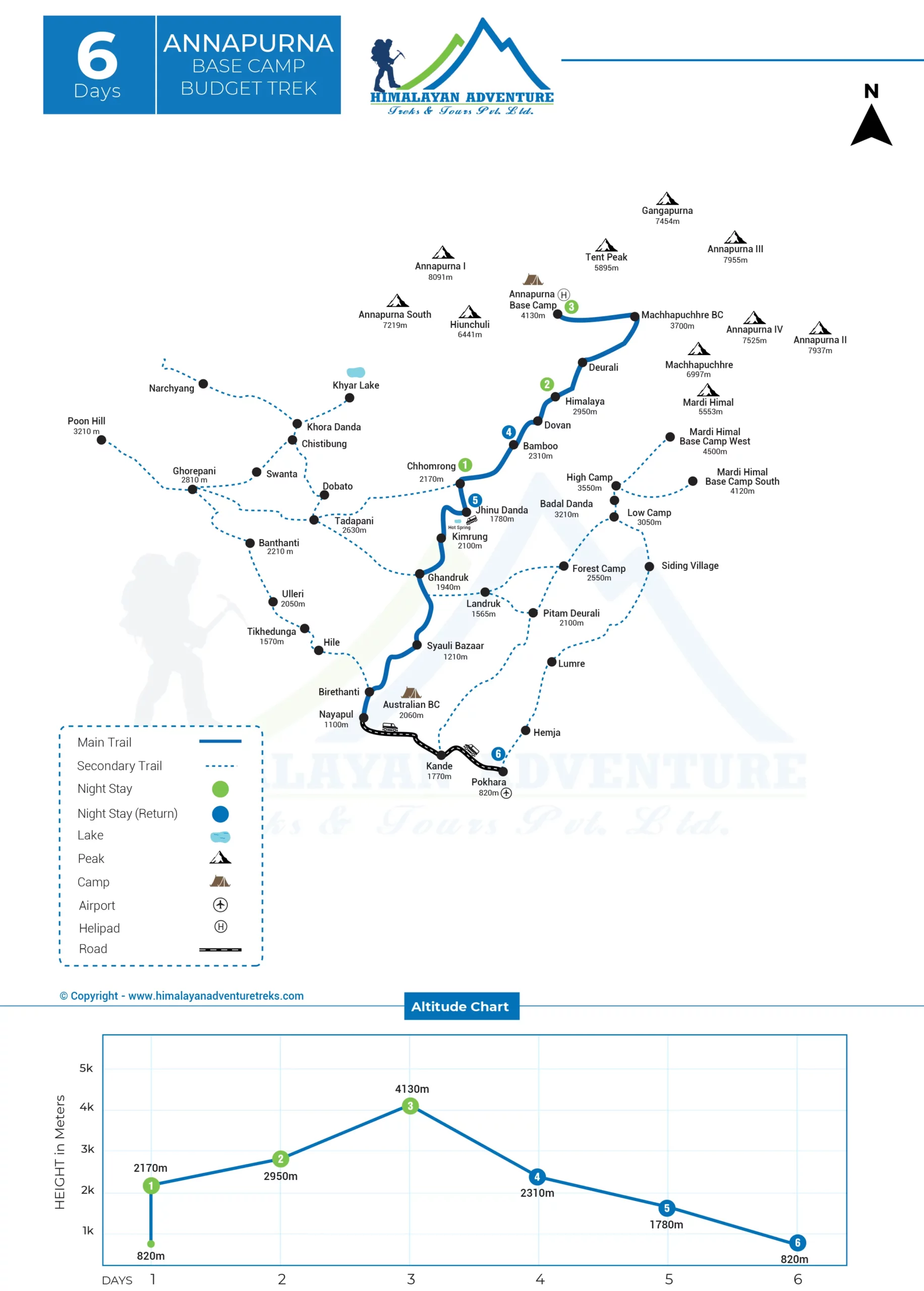
Route Map & Altitude Chart
Pokhara Hotel
Start/End point
Pokhara Hotel
Trip Information
What is the difficulty of the Annapurna Base Camp Budget Trek?
The Annapurna Base Camp Budget Trek is classified as an average trek that can be done by individuals with simple fitness. It involves walking about 5 to 7 hours per day on uneven paths. The path contains rocky steps, slow inclines and few steep areas. The trek starts at a lower altitude and reaches up to 4,130 meters at base camp. The trail is easy to follow, but it might seem difficult because of the hours of walking. No technical climbing skills are required, but good stamina is important.
Annapurna budget trek is on a gradual climb comprising of uphill and downhill trails. There are sections that consist of long staircases and may be exhausting. The higher the altitude, the thinner the air will be and walking can be more difficult. Feeling fatigued after a tiresome day of trekking is normal. The challenges are managed by proper pacing and rest. The trek is not too hard to most individuals with proper preparation and guidance.
Weather and Best season for Annapurna Base Camp budget trek
Annapurna Base Camp Budget Trek is ideal in spring and autumn when the weather is stable. Days tend to be clear, with good mountain views. During the day, the temperatures are pleasant to walk and during the night, they are lower. During spring, the trail has blooming rhododendron forests. During autumn, the air is clear and visibility is extremely high.
In these seasons, the ABC budget trek is more enjoyable as the conditions are better. The average temperatures during the day may vary between 18 C and 25 C in the lowlands. The nights are colder and below the freezing point at high altitudes. During the trek, festivals such as Dashain, Tihar, and Holi can be experienced. It is a monsoon season and trails are wet. It may be very cold during winter and there may be snow, and the trek becomes harder.
Accommodation Food & Drink
In the Annapurna Base Camp Budget Trek the teahouses are simple and are available all over the trail. Basic but comfortable rooms are good to relax after a long day. Food is homemade and offers sufficient power to trek. The most typical food is dal bhat and is popular among trekkers. Other alternatives are noodles, soups, pasta and local dishes. Breakfast normally comprises of eggs, porridge, and toast.
Annapurna base camp trek also involves the availability of warm meals and beverages during the trek. Clean drinking water cannot be overemphasized and boiled or bottled water should be used. It is a good idea to have a reusable bottle and purification tablets. Ice and raw food should be avoided to avoid health problems. Hot beverages and simple meals will boost energy and comfort on the trek.
Altitude sickness
During the Annapurna Base Camp Budget Trek, trekkers might develop altitude sickness especially in areas where the altitude is above 3,000 meters. The symptoms can be headache, nausea, and fatigue. The schedule will be designed to enable gradual ascending to enable better acclimatization. Prevention is important by drinking plenty of water and having frequent rest. Cyntoia should also avoid alcohol and stick to a gradual pace to minimize risk.
The ABC budget trek still requires careful attention to altitude changes. Guides are trained on how to observe the symptoms and offer assistance where necessary. Simple safety gears like oxygen and monitors are brought on the trek. In case of severe symptoms, it is required to descend to a lower altitude. When properly aware and prepared the journey can be safe and comfortable.
Preparation and Fitness for the Annapurna budget trek
To get ready for the Annapurna budget trek you need to prepare yourself and get fit. The Annapurna budget trek requires preparation and fitness training. You should start exercising two to three months before you leave. The Annapurna base camp trek is a trek and not hiking so you need to focus on workouts that are good for your heart like running, biking or swimming. You should do these workouts least three times a week for thirty to sixty minutes.
The Annapurna budget trek also requires strength training so you should try hiking with a weighted backpack to build legs and core muscles. You should practice walking up stairs or hills because the Annapurna base camp trek has paths that go up and down. You need to be able to walk for four to five hours without stopping on paths that’re not even. Every week you should try to walk a bit longer and faster.
If you can you should do a practice hikes wearing your trekking boots so they are comfortable when you wear them on the Annapurna budget trek. You should also make sure you have a sleeping bag and other gear and try them out before you leave. It is an idea to learn how to breathe and pace yourself when you are hiking. If you have any health problems you should see a doctor before you leave. You should try to hike on paths that’re not even so you get used to walking on stone steps and rocky paths.
You should start buying and breaking in your gear a month before the trek. If you live near hills you should try to go on hikes on the weekends.
Here is an example of a training plan for the Annapurna budget trek:
- For the four weeks: jog or cycle for thirty to forty-five minutes three times a week and climb stairs or use a step machine for fifteen minutes two times a week.
- For the four weeks: increase your cardio workouts to sixty minutes and add a long hike on the weekends.
- For the four weeks: focus on hiking with a weighted backpack and do one or two long hikes with a backpack, plus your regular cardio workouts.
This kind of training makes a difference for the Annapurna budget trek. You should carry your backpack when you practice hike so it feels like the real trek. You should make sure your boots and clothes are comfortable. You should have a list of things to pack so you can try out your gear at home: clothes, a rain jacket, personal medicine and so on. Eating food and drinking plenty of water during your training also helps your body get ready for the Annapurna base camp trek.
Following these steps will help you get ready for the Annapurna Base Camp Budget Trek. It will make the experience more fun and safer for people who are trekking for the first time.
Visa and Permits
If you want to visit Nepal you need to have a visa. You can get a tourist visa when you arrive at the airport in Kathmandu or Pokhara or at the border. A fifteen-day visa costs thirty US dollars a thirty-day visa costs about fifty US dollars and a ninety-day visa costs about one hundred twenty-five US dollars. You need to pay for your visa in cash. You need to have a passport that is valid for at least six months and two passport-size photos.
The Annapurna budget trek also requires permits. You need to have the Annapurna Conservation Area Permit, which costs about three thousand rupees. You also need to have the Trekkers’ Information Management System permit, which costs about two thousand rupees. Our team will take care of all the permit paperwork before the trek. You need to carry your permit card with you on the trail at all times.
You should also carry passport photos in case you need them. If you want to stay or change your route you should check if you need any other permits. In summary you need to get a tourist visa and make sure you have the Annapurna Conservation Area Permit and our team will take care of all the permit paperwork for the Annapurna Base Camp Budget Trek. Having these documents ready is part of getting ready for any trek, in Nepal including the Annapurna budget trek.
Health and Safety
During the Annapurna Base Camp Budget Trek, health and safety are significant. It is recommended to carry a basic first aid kit with items such as painkillers, altitude medicine, bandages, and antiseptic cream. Consuming boiled or bottled water will help to avoid diseases. Avoiding the use of street food and unwashed fruits or vegetables on the trek is also better.
Personal hygiene is important in the Annapurna budget trek. The risk of infection can be reduced by washing hands regularly and using hand sanitizer. Protection from weather is also necessary. A hat, sunscreen, and sunglasses are also helpful in the daytime, whereas a warm jacket can be used in cold and windy weather.
The ABC budget trek still requires proper safety awareness. It is valuable to remain with the group and obey the instructions of the guide. Guides are equipped to deal with emergencies and to bring along simple safety gear. It is highly recommended to take travel insurance that includes high-altitude trekking and evacuation.
Energy is maintained by proper rest, hydration, and regular meals. One should not take alcohol at elevated levels and should not drink river water. The trek is safe and comfortable with minimal preparation and care.
Transportation
Transportation for the Budget Annapurna base camp trek usually begins from Kathmandu. Pokhara can be accessed by flying in within a 25-minute flight or by taking a tourist bus, a trip that takes approximately 6 to 7 hours. The road trip itself is beautiful and it is surrounded by rivers, hills and small towns. The two are usually utilized based on budget and time.
The Annapurna budget trek starts at Pokhara and proceeds by a 1.5-hour drive to Nayapul. The road cuts across villages and agricultural lands as the Modi River is seen along the road. Nayapul is the starting point of the trekking trail. The greater part of the way here is by foot, by marked paths and suspension bridges.
The Budget Annapurna base camp trek with cheap price includes transport in the country between Pokhara and Nayapul. A jeep or van ride back to Pokhara is organized at the conclusion of the trek. Pokhara has easy access to local transport including taxis and buses to travel further. In mountainous regions, weather can alter the conditions of the roads, and it is always advisable to be flexible with time.
Travel Insurance for Annapurna budget trek
You should definitely get travel insurance before you go on the Annapurna Base Camp Budget Trek. This is not included in the package so you need to buy it. Make sure your policy covers trekking up to an altitude of least 4500 meters and includes emergency evacuation by air or ground.
It should also cover expenses, trip cancellation or delay and lost baggage. Many insurance companies have plans for adventure or mountain travel. Make sure that you read the policy because you should be sure you have everything you require.
In case you fall ill or injured during the trek, the insurance can assist you to receive care. It can also cover the cost of a helicopter rescue, which can be very expensive. Make a copy of your insurance policy and a list of emergency contacts numbers with you.
You should also have a credit card with you in case you need to pay for something.
The following is a list of items that should be covered in your insurance policy:
- Trekking up to an altitude of 4500 meters
- Emergency evacuation by air or ground
- Trip cancellation/ delay.
- 24-hour English-speaking helpline.
There are companies that offer travel insurance, such as World Nomads, Safety Wing or IMG. You can also buy insurance from travel agencies or airlines in Kathmandu or Pokhara.
Even if you do not plan to use a helicopter rescue insurance can still help you if you get sick or hurt. It is like having a safety net to protect you on the Annapurna Base Camp Budget Trek. Many trekkers carry a printed and digital copy of their policy with them.
You can also buy insurance from companies, in Nepal but you should compare the benefits and prices before you buy.
Alternative Routes
There are a few alternative routes and extensions for the Annapurna Base Camp Budget Trek. The standard route follows Nayapul–Ghandruk–Chhomrong as described above. One variation is to include the Ghorepani–Poon Hill Trek at the start: from Ghandruk you can detour to Poon Hill for sunrise views, then rejoin the ABC trail via Tadapani and Deurali.
This adds 1–2 extra days. Another alternative is to start the trek at Ghandruk instead of Nayapul, skipping the lower uphill through Tikhedhunga (this makes Day 1 shorter). For an even faster trek, you could hire a jeep to reach a higher trailhead like Phedi or Dhampus to begin hiking, effectively skipping the steep stairs of Ulleri and Tikhedhunga. On the return, some trekkers loop through Jhinu Danda to Ghandruk and back to Pokhara via Landruk.
For those with more time, you can combine ABC with parts of the Annapurna Circuit (e.g. cross the Thorong La pass to Muktinath), which requires many extra days. In special cases, helicopter flights are an option: you can helicopter to or from ABC to save time or for dramatic aerial views (weather permitting, high cost). In practice, the Annapurna Base Camp Budget Trek is very flexible.
Other nearby trails are the Dhampus Viewpoint trek or Mardi Himal trek branch off from the ABC region if you want additional hiking days. Talk to your guide or travel planner about these alternatives. Do note that any alternative route may require different permits or transportation. Trekkers should always follow designated paths to protect the environment and avoid hidden dangers. Annapurna Conservation Area staff recommend sticking to marked trails.
Other routes:
- Ghorepani–Poon Hill Loop (adds 2–3 days, great sunrise)
- Ghandruk start (skips Nayapul–Chhomrong segment)
- Helipad trek (helicopter to Deurali for upper approach)
- Landruk pass (return via Landruk–Ghandruk for loop)
Each option offers new views. Your guide will plan the best route based on weather and group condition. On the Annapurna Base Camp Budget Trek, the main route is chosen for both scenery and acclimatization.
Your extra expenses
Most costs are covered in the trek package (permits, accommodation, most meals), but trekkers should budget for personal expenses. Meals and drinks: Tea, coffee, and snacks at teahouses are not included (a cup of tea is $1–2). Soft drinks or bottled water cost $1–2 each. Alcoholic drinks (beer, spirits) cost more ($5–7 per bottle).
- Charging & laundry: Washing or laundry service is not available on the trail (hand-wash clothing as needed).
- Hot showers: Hot showers at lodges typically cost $2–3. Charging your devices (phone, camera) is possible at lodges for a fee (about NPR 300-500 per device per charge).
- Gear: A sleeping bag is usually provided by us. If not, sleeping bag rental is $5–10 per day. If you hire a porter to carry extra gear ($25 per day), that is extra.
- Transportation and pre/post trek: Flights or buses between Kathmandu and Pokhara are not included (each US$50-100).
- Accommodation: Hotel stays in Kathmandu or Pokhara, and meals outside the trek itinerary, are additional costs.
- Tips and gratuities: Guide and porter tips are optional, and as you wish.
- Other costs: Travel insurance, visa fee (US dollar 50), bar bills, phone/data shopping (NPR 1000 to buy SIM card), and any recreational activities (boat rides, massages in Pokhara) must be estimated.
- Money: Have enough Nepali rupees in case of expenses: There are ATMs in Pokhara and Kathmandu, but none on trek. Small denominations (100/500 NPR) are useful.
Typical extras (approx):
- Hot shower: US$2–3 per shower.
- Phone charging: 300 NPR per device.
- Snacks (chocolates, chips): $1–2 each.
- Alcoholic drinks (beer/rum): $5–7.
- Porter hire: $25/day (optional).
These extras do not impact safety or itinerary, but keep you comfortable. Our staff will help manage costs each evening so you know what’s covered.
Language and Communication
Most travelers will not have a difficult time communicating during the Budget Annapurna base camp trek. Nepali is the official language of Nepal, but English is widely spoken by guides, lodge owners, and many young people along the trail. This facilitates easy communication even in major trekking spots.
In the Annapurna budget trek, other local communities like Gurung and Magar use their own languages at home, together with Nepali. It is always welcome to learn some simple words in Nepali language and establish a warm rapport with locals. Simple words such as Namaste, meaning greetings, and Dhanyabad, meaning thank you are common and easily comprehended words.
Guides are experienced and usually speak fluent English. Others also might speak other languages to help foreign trekkers. In distant villages, it can be very simple and simple gestures and an attitude of friendliness are usually sufficient. Higher areas have internet and mobile networks limited and lower areas and towns have internet and mobile networks available. In general, the language is not an obstacle, and communication is not a problem during the journey.
Mobile Network, Internet and Charging Facilities
Connectivity during the Annapurna Base Camp Budget Trek is limited, especially at higher altitudes. Internet services and mobile networks are weak above 3,000 meters, and are typically unavailable at base camp. There are also teahouses with Wi-Fi, but it is slow and can be useless during bad weather. Before starting the trek, it is always advisable to download maps and store valuable information in your phone. It is also handy to have a power bank to keep devices charged.
In the Annapurna budget trek, teahouses have charging facilities at an additional fee. Dining areas typically have power outlets which are available only a few hours in the evening. It is advisable to carry a universal adapter because it can be different in different places. It can be extremely useful when one carries a personal power bank or solar charger on the journey.
Local SIM cards can be purchased in Kathmandu or Pokhara for basic communication. Network coverage is better in lower areas but remains limited for calls and messages. Keeping digital copies of important documents such as passport and insurance is advised. Limited connectivity is best prepared to help provide a more comfortable and easy trekking experience.
Trip Extension
There are many ways to extend your trip. You can spend days in Pokhara and enjoy boathouse stays on Phewa Lake or take a sunrise hike to Sarangkot. You can also go paragliding. On a zipline adventure in Pokhara. In Kathmandu you can take tours of Durbar Squares or visit the Swayambhunath stupa. You can also add the Ghorepani/Poon Hill Trek after the Annapurna Base Camp Budget Trek.
You can also visit Chitwan National Park for a jungle safari. Combine the Annapurna Base Camp Budget Trek with part of the Annapurna Circuit. If you have budget flexibility you can take a one-way helicopter ride to or from Base Camp. There are other treks you can do like the Mardi Himal or Kanchenjunga base camp trek. You can also organize white-water rafting on the Trisuli River. Attend a Nepali cultural show.
Photography And Drone Rules
During the trek to the Annapurna Base Camp, photography is permitted and has numerous chances to take pictures of landscapes and local people. It is important to be respectful while taking photos. It is always prudent to seek the consent of the local individuals before taking a photograph, particularly in villages. When in temples or other religious places, it is advisable not to flash, since this can disrupt the atmosphere. Courtesy and consideration can contribute to designing an enjoyable experience to the visitors and locals.
In the low cost trek to Annapurna Base Camp, it is advisable to carry basic and simple camera gear. Battery extensions and memory cards would come in handy since there are few charging points along the trail. It is noteworthy to keep your camera packed up safely as well to avoid dust and weather changes.
In the majority of trekking regions in Nepal, there are restrictions on the use of drones. Drones must be registered with the Nepal Civil Aviation Authority and special permits are required. It can be a complicated and expensive process. This is the reason why it is not advisable to bring a drone unless all the permissions are made beforehand. Responsible photography is the way to go in order to have a smooth and respectful trekking experience.
Some Drone Guidelines
- You have to register your drone and pay the fees before traveling.
- You should not fly your drone above Annapurna Base Camp or in the Sanctuary without permission.
- You should respect wildlife. Not disturb birds and animals with your drone.
If you follow these rules you will be safe and legal, during the Annapurna Base Camp Budget Trek.
Mobile Network, Internet and Charging Facilities
The Mobile Network and Internet are not very good during the trek. You will not have Mobile Network and Internet when you are above 3,000 meters. The Mobile Network and Internet are very weak or not available all at Annapurna Base Camp. Some teahouses have Wi-Fi.
You have to pay for it and it is very slow. The Wi-Fi is not very good especially when the weather is bad. So it is better not to rely on the Mobile Network and Internet for things. Before you start the trek download maps. Save important information on your phone. Bring a battery bank and a camera and make sure they are fully charged.
You can charge your devices at the teahouses. It will cost you some money. The teahouses have a power outlets but they are only available in the dining area. The power outlets are. The power is only on for a few hours in the evening. It is an idea to bring a universal adapter because the plugs are different in Nepal. A personal power bank or solar charger is very useful. Our guides have batteries and power strips in case of an emergency.
If you want to use the Mobile Network and Internet you can buy a SIM card in Kathmandu or Pokhara.. The Mobile Network and Internet are only available for calls and texts at lower altitudes. It is an idea to keep a copy of your important documents like your passport and insurance on your phone in case it is needed. You should also bring a memory card for your camera because uploading photos is very hard.
Tips for First-Time Visitors
- Pack Light and Smart: Get a backpack with padded straps. This will make it easier to carry. Only bring the things you really need: some clothes for temperatures, a waterproof jacket, a hat and some gloves. Ensure your boots are comfortable, and you have worn them previously. Take a few pairs of socks, which will not make your feet wet.
- Hydrate Well: Drink a lot of water each day. Try to drink least 2-3 liters of clean water. Bring a bottle that you can use again and again and some tablets to make the water clean. Drink water often, even if you do not feel thirsty. You can also bring some tablets that will help your body.
- Eat High-Energy Foods: Bring some snacks like nuts, chocolate and energy gels. Eat them when you are not having a meal. Try to eat food that has a lot of carbohydrates. It is an idea to bring an extra snack it can be very helpful on hard days.
- Acclimatize Slowly: Listen to your guide. Go at their pace. They will tell you to go and this is very important. Take breaks often. Rest when you need to. If you feel dizzy or tired. Rest. We will also have a day to help you get used to the high altitude.
- Dress in Layers: The temperature can change a lot in Annapurna Region. It can be a bit hot during the day and cold at night as weather too plats a curial role. Wear clothes that you can easily add or remove. Bring a raincoat and a hat they can be very useful.
- Carry Cash: Bring some Nepali rupees with you. You will need them for things like drinks, showers and tips. There are no machines to get money in the villages. Try to bring 2,000-3,000 Nepali rupees per day.
- Stay Warm at Night: It can get very cold at night. Always wear a hat and add some extra clothes under your sleeping bag. If you need to sleep with your clothes on inside your sleeping bag.
- Use Trekking Poles: They can be very helpful. They will save your knees when you are going down and help you balance when the trail is not even. If you do not have any you can rent them in Kathmandu or Pokhara.
- Battery Backup: Bring a battery that you can charge and use to charge your devices. Charge all your devices in Pokhara. Charge your phone every night on the trek.
- Travel Insurance: Make sure you have insurance that will cover you in case of an emergency. This is very important. You should not skip it.
- Local Etiquette: Be respectful of the people. Do not put your feet on the tables. Try to smile often. Learn some Nepali phrases the locals will appreciate it.
- Emergency Preparedness: Make a copy of your passport and insurance. Let your family know where you will be and when. Our guides have phones that can be used in case of an emergency.
- Positive Attitude: Trekking in the mountains can be challenging. You need to be patient and remember that it is all part of the adventure. Help each other in the group. You will make new friends.
Quick tips:
- Wear socks that will keep your feet dry and prevent blisters.
- Bring a small bag with a rain cover for the things you need every day.
- Wear your boots before the trek to make sure they are comfortable. If you need to put some tape on your toes.
- Use lip balm with protection, from the sun. The cold wind can dry your lips quickly.
- Bring some cash, like 1,000 Nepali rupees in case of an emergency.
These tips will help you have an Annapurna Base Camp Budget Trek experience. The Annapurna Base Camp Budget Trek is a rewarding experience.
Essential Packing Gear List for Annapurna Base Camp Budget Trek
If you have decided to go on the short budget trek, the Annapurna Base Camp Budget Trek in Nepal, we assure you that you will have a fantastic time ahead. But what should you pack for your Adventure? What will be the right gear to make your trip more fabulous? To help you with this, we have compiled a packing list of essential items that you mustn’t forget to bring along.
- Passport ( min 6 months valid)
- Cash, credit card
- List of important addresses and contact details
- 2-3 passport photos (optional)
- Copies of all important travel documents (passport, visa, airline ticket, insurance policy, etc.)
- A sturdy 70 L trekking backpack which will be carried by your porter (please note that our assigned 1 porter will carry 2 clients’ luggage up to 20-25 kg.
Note: We will provide each participant with a spacious 70 to 75 L Company logo duffle bag to conveniently carry your trekking gear, which you have to return once the trek is complete. - A 30 L Daypack that has room for your essentials such as camera, mobile, Passport, important documents, water bottle, day use medicine, chocolate bars, raincoat, etc., which will be carried by you.
- Protective cover for a backpack or travel bag.
- Hiking Boots: Preferably ankle-high boots to prevent ankle sprain
- Regular Shoes: For small strolls and exploration around the city
- Crampons: During the winter December- March
- Second, a light pair of shoes and possibly sandals
- Micro Spikes or Ice Cleats for the winter trekking over snow and ice
- Gaiter for added protection in snow
- A rain and wind-resistant, lightweight down jacket for warmth, with a good helmet hood
- Summer-light, as well as winter warm clothing
- Quick-drying shirts made of synthetic fabrics
- Warm and cool vests or T-shirts
- Functional synthetic underwear
- Sports Bra for Female Trekker
- A waterproof pair of trousers
- Regular trousers of quick-drying fabric
- Hiking shorts
- Cargo Pants with multiple pockets to hold your small items, such as knives or chocolates
- Woolen or fleece pants
- Trekking socks, both thick and woolen fabric, and lighter wool socks
- Wool hat, gloves, and scarf
- A light cotton scarf or a bandanna for protection of your head, neck, ears, and mouth
- Sun hat, and sunglasses with 100% UV protection (for trekking trips, even with stray light and nose protection)
- Sunscreen cream or lotion with a high sun protection factor (at least 15, for trekking trip,s even at least 30)
- Sunscreen lipstick with a high SPF (at least 20, for trekking trips, even at least 30 or sunblock)
- Mosquito repellent (Optional)
- Comfortable light night clothes and shoes
- A drinking bottle that can be used as a hot water bottle on frosty nights
- Flip-flops or bathing shoes for using the showers
- Water purifiers: if you need to refill water from the tap or stream en route
- Headlamp: for a midnight or pre-dawn trip towards the viewpoint
- Quick-drying towel and sample-size toiletries for washing your feet and face
- Your Personal first-aid kit: with basic medical supplies such as bandages for sprains, antidiarrheal and antibiotics, iodine wipes for scrapes and cuts, plasters, aspirin, or ibuprofen, moleskine for preventing blisters, Diamox (acclimatizing medicine), and your Personal medication
- Sleeping bag appropriate for all-season treks (we can hire in Kathmandu)
- Waterproof money belt, chest bag, leg bag, or belt bag for storing important travel documents or valuables
- Toothpaste, Toothbrush, and soap
- Deodorants
- Moisturizer
- Nail clippers
- Feminine hygiene products (Sanitary Pads)
- Small mirror
- Wet wipes
- Hand sanitizer
- Comb
- Camera with sufficient memory cards and spare batteries, or a battery charger
- Small padlock for your travel bag
- Crampons ( during winter, Dec- Feb)
- Thermos flask
- Water bag
- Toilet paper (2-3 rolls without)
- Ear Plugs
- Matchbox, or lighter
- Compass or GPS
- Map
- Alarm clock
- Multi-tool kit
- Binoculars
- Books
- Whistle
Equipment Note:
- Please note that there is no need for you to bring all these heavy items, such as a Sleeping bag, a down Jacket, Trekking Poles, and items from your home. You can easily rent or purchase high-quality to standard-quality items in the Kathmandu Thamel area and Pokhara.
- Items are available from international brands such as The North Face, Sherpa Adventure, Marmot, Mountain Hardware, Black Yak, Karma Gear, and local brands like Goldstar and locally made products etc.
- Plus, we will also gift you a company logo T-shirt as a token of your experience in Nepal with us.
Renting Cost:
- Sleeping Bag & Down Jacket (-10-20 degree Celsius), Per Piece per day US$ 1.5
Frequently Asked Questions
What is the Annapurna Base Camp Budget Trek?
The Annapurna Base Camp Budget Trek is a 6-day guided trek from Pokhara to the base of the Annapurna Himalaya. You will be using teahouses and meals.
Is the Budget Annapurna base camp trek difficult?
The Annapurna Base Camp Budget Trek is moderately difficult. You will hike 5–7 hours daily on mountain trails. To do this trek you need to have fitness. No special climbing is required.
What is the best time to trek Annapurna Base Camp?
The best time for Annapurna Base Camp Budget Trek is during Autumn, which’s from September to November and Spring which is from March to May. During these times the skies are clear. The weather is stable. The days are warm. The views are excellent.
How long is the Budget Annapurna base camp trek?
The Budget Annapurna base camp trek is 6 days of trekking. You will cover 60 km in total. The highest point of the trek is 4,130 m.
Do I need permits?
Yes you need the Annapurna Conservation Area Permit and a TIMS card. The Annapurna Base Camp Budget Trek will. Include all required permits for you.
What fitness level is required?
You need fitness to do the Annapurna Base Camp Budget Trek. You must hike 5–6 hours a day on terrain. It is recommended that you train before the trek.
Is altitude sickness a concern on this trek?
Yes altitude sickness can be a concern on the Budget Annapurna base camp trek. Altitude sickness may occur above 3,000 m. You need to climb hydrate often and rest if symptoms appear.
How can I prevent altitude sickness during ABC budget trek?
To prevent altitude sickness you need to ascend and drink plenty of water. You should also eat carbohydrate- meals and avoid alcohol. Acclimatizing rest days can help. Some people take Diamox.
Do I need a guide for the Budget Annapurna base camp trek?
It is highly recommended that you have a guide for the Budget Annapurna base camp trek. Guides handle navigation, safety and logistics. The Annapurna Base Camp Budget Trek provides guides.
What kind of food is provided during ABC?
The Annapurna Base Camp Budget Trek provides buffet-style meals at teahouses. You can expect Nepali dal bhat and some Western dishes. Breakfast and dinner are included,. Lunch is usually at trail lodges.
Is the water safe to drink during Annapurna Base Camp Budget Trek?
No the water is not safe to drink. You should only drink boiled or bottled water. You can. Buy filtered water. Lodges often sell drinking water for a small fee.
Will I have phone signal in ABC budget trek?
Phone signal is limited on the Budget Annapurna base camp trek. You can get some signal in lower villages but there is usually no service above 3,000 m. The Annapurna Base Camp has no cell signal.
Can I charge my devices?
Yes you can charge your devices at teahouses. They have power outlets. Power is limited. You usually need to pay around US$2–3 per device to charge. You should bring a power bank.
What currency should I use?
You should use Nepali Rupees. You need to bring cash in small denominations. ATMs and credit cards are only available in Pokhara and Kathmandu not on the trek.
Is ABC budget trek safe?
Yes the Annapurna region is generally safe. You need to follow guide instructions be cautious on trails and take altitude precautions. Local people are friendly and helpful.
Should I hire a porter?
You do not need to hire a porter but you can if you want to. The Annapurna Base Camp Budget Trek does not include a porter. You can hire one locally for around US$25 per day.
What if I get tired or sick and can’t continue?
If you get tired or sick and can’t continue you need to inform your guide. They can arrange a jeep pick-up from villages. In cases helicopter evacuation is available but you need to have insurance.
Are snacks and drinks available?
Yes snacks and drinks are available at lodges. They sell tea, coffee, sodas and packaged snacks. You need to pay for them which’s around US$1–2 for tea and US$2–3 for snacks.
What about drinking or smoking on trek?
Drinking and smoking on the trek are discouraged. Smoking indoors or near stoves is forbidden. Alcohol is not banned, you should consume it moderately.
should I tip the guide?
Tipping the guide is optional but t is very appreciated. You can tip around 10–15% of the trek cost. It is later, usually shared between the guide and porters.
What if the weather is bad?
If the weather is bad you need to stay flexible on such conditions. Bad weather can delay trekking sometimes or flights too. You need to follow your guide’s advice and carry rain gear and warm layers.
Are there any health facilities on trek?
No there are no clinics on the trail. Guides carry first-aid kits. For issues you need to be evacuated to Pokhara or Kathmandu.
Can children join the Annapurna Base Camp Budget Trek?
Yes children over 10 years old can join the trek if they are fit. You can arrange family treks. You need to discuss details in advance.
Is laundry available on trek?
No there is no service on the trail. You need to bring clothes or hand-wash small items in your hotel room. Clothes air dry quickly in the mountain sun.
What will be the condition of toilets on trail?
Toilets on the trail are basic and shared but provided with clean way. You need to carry toilet paper and hand sanitizer. Facilities are simple at higher camps.
Can I extend my trek after ABC budget trek?
Yes. You can add Ghorepani/Poon Hill before or after the Budget Annapurna base camp trek. Combine it with the Annapurna Circuit. You can also do city tours, in Kathmandu and Pokhara.
Related Blogs & Articles


Reviews on Annapurna Base Camp Budget Trek






Related trips