



Annapurna Region of Nepal: A Trekking Microcosm
Nestled in the heart of the Nepal Himalayas, the Annapurna Conservation Area is the most popular trekking destination in the country, attracting over 60% of Nepal’s trekkers. While epic journeys like the Annapurna Circuit Trek (18-21 days) capture much of the glory, the region is equally renowned for its accessible, shorter treks. These “Short Treks” offer a concentrated dose of Himalayan majesty, rich cultural encounters, and diverse landscapes, all within a timeframe of 3 to 10 days. They are perfect for those with limited time, families, first-time trekkers, or anyone seeking a less strenuous but equally rewarding Himalayan experience.
This overview will dissect the most popular and iconic short treks in the Annapurna region, detailing their routes, highlights, logistical requirements, and the unique experiences they offer.
Introduction to the Annapurna Region & Trekking Fundamentals
Geography and Environment:
The Annapurna massif is a colossal mountain range containing one peak over 8,000 meters (Annapurna I at 8,091m), thirteen peaks over 7,000m, and sixteen over 6,000m. The conservation area spans 7,629 sq. km., encompassing a breathtaking variety of ecosystems: from tropical lowland forests and bamboo groves to alpine meadows and the arid, high-altitude desert reminiscent of Tibet. The Kali Gandaki Gorge, which runs through the region, is considered the deepest gorge in the world.
Cultural Tapestry:
The trails wind through a mosaic of ethnic communities. In the lower hills, you’ll find the Gurung and Magar villages, with their distinctive stone houses, terraced farms, and rich traditions of hospitality. As you ascend, Thakali communities dominate, renowned for their entrepreneurship and cuisine. Tibetan Buddhism influences the region strongly, manifested in prayer walls, spinning prayer wheels, and ancient monasteries like Braga and Muktinath. Hinduism is also prevalent, especially at the sacred site of Muktinath, a pilgrimage destination for both Hindus and Buddhists.
Trip not found.
Best Seasons for Trekking:
-
Autumn (Mid-September to Late November): The premier season. Stable weather, clear skies, moderate temperatures, and excellent mountain views.
-
Spring (March to May): Second-best season. Warmer weather, blooming rhododendron forests (especially spectacular in April), and lush landscapes. It can be hazier than autumn.
-
Winter (December to February): Cold, especially at night and higher elevations, but days can be clear and sunny. Some high passes may be closed.
-
Monsoon (June to Early September): Persistent rain, leeches, cloudy skies obstructing views, and landslides make trekking challenging and less recommended.
Permits:
All trekkers in the Annapurna region require two permits:
Annapurna Conservation Area Permit (ACAP): Funds conservation and community projects.
Trekker’s Information Management System (TIMS) Card: A registration card for safety and data management.
These are arranged by trekking agencies for guided treks or can be obtained independently in Kathmandu or Pokhara.
Access Hub – Pokhara:
All short treks originate from the lakeside city of Pokhara (820m). A 25-minute flight or a 6-7 hour scenic drive from Kathmandu, Pokhara serves as the perfect staging ground with its abundance of hotels, gear shops, restaurants, and stunning views of the Annapurna range across Phewa Lake.
Detailed Route Breakdowns of Major Short Treks
The Ghorepani Poon Hill Trek (4-5 Days)
The Classic Introduction
Overview: The most popular short trek in Nepal, often called the “gateway to the Himalayas.” It combines manageable daily hikes with one of the most famous viewpoints in the world—Poon Hill.
Standard 4-Day Itinerary:
-
Pokhara to Tikhedhunga (1,540m) via Nayapul: A 1.5-hour drive from Pokhara to Nayapul, the trailhead. The trek begins with a gentle walk along the Modi Khola, passing through Birethanti (checkpoint for permits) and ascending through villages and terraced farms to Tikhedhunga. (Drive: 1.5 hrs; Trek: 3-4 hrs).
-
Tikhedhunga to Ghorepani (2,860m): The most challenging day features a steep ascent of over 3,300 stone steps to Ulleri village, offering the first major mountain glimpses. The trail then climbs more gradually through magnificent rhododendron and oak forests (spectacular in spring) to the large village of Ghorepani. (Trek: 5-6 hrs).
-
Ghorepani to Poon Hill (3,210m) to Tadapani (2,630m): Pre-dawn start for the 45-60 minute climb to Poon Hill. The 360-degree panoramic sunrise view is the trek’s crown jewel, encompassing the entire Annapurna and Dhaulagiri massifs—Dhaulagiri I (8,167m), Annapurna I (8,091m), Annapurna South, Himchuli, Machhapuchhre (Fishtail), and more. Return to Ghorepani for breakfast, then trek through forests to Tadapani. (Trek: 6-7 hrs).
-
Tadapani to Ghandruk (1,940m) to Pokhara: A descent to the beautiful Gurung village of Ghandruk, a model village with slate-roofed houses, a fascinating Gurung museum, and close-up views of Annapurna South and Machhapuchhre. Explore the village before descending to Kimche or Syauli Bazaar for a drive back to Pokhara. (Trek: 3-4 hrs; Drive: 3-4 hrs).
Key Highlights:
-
Poon Hill Sunrise: Unparalleled panoramic vista.
-
Rhododendron Forests: A sea of red, pink, and white in spring.
-
Cultural Immersion: Gurung villages of Ulleri and Ghandruk.
-
Accessibility: Suitable for most fitness levels.
Variations:
-
Extended Loop (5-6 days): Continue from Ghandruk to Landruk, descend to the Modi Khola, and trek up to Jhinu Danda for its famous natural hot springs, then exit via Nayapul.
The Mardi Himal Trek (5-7 Days)
The Hidden Gem & Off-the-Beaten-Path Adventure
Overview: A relatively new and rapidly growing trek that offers a more intimate, less crowded experience with stunning alpine scenery. It ventures close to the iconic Machhapuchhre (Fishtail) and the towering south face of Mardi Himal.
Standard 5-Day Itinerary:
-
Pokhara to Kande (1,770m) to Forest Camp (2,520m): Drive to Kande (1 hr). The trail climbs through forests to Australian Camp (2,060m) for excellent views, then continues through villages like Pothana and Deurali before entering deep forest to Forest Camp (also called Kokar). (Drive: 1 hr; Trek: 5-6 hrs).
-
Forest Camp to Low Camp (2,990m): A steady climb through enchanting, moss-covered forests of oak, maple, and rhododendron. The tree line begins to thin, offering occasional glimpses of Machhapuchhre. Low Camp is a small settlement with basic teahouses. (Trek: 4-5 hrs).
-
Low Camp to High Camp (3,580m): A spectacular day. The trail emerges above the tree line into alpine meadows with jaw-dropping, unobstructed views of Machhapuchhre, Mardi Himal, and the Annapurna giants. The path is steep and rocky at times. High Camp is a dramatic location perched on a ridge. (Trek: 4-5 hrs).
-
High Camp to Mardi Himal Base Camp (4,500m) and back to High Camp/Low Camp: An early, challenging ascent to the Mardi Himal Base Camp. The final stretch is a steep, often snowy climb along a narrow ridge, culminating in one of the most breathtaking viewpoints in Nepal—right at the foot of Machhapuchhre and Mardi Himal. Return to High Camp or descend further to Low Camp. (Trek: 6-8 hrs round trip).
-
High Camp/Low Camp to Siding Village (1,750m) to Pokhara: A long descent through forests and terraced farms to the ethnic village of Siding (or Lumre). From there, a drive back to Pokhara. (Trek: 5-6 hrs; Drive: 2-3 hrs).
Key Highlights:
-
Proximity to Machhapuchhre: Arguably the closest and most dramatic views of the sacred Fishtail mountain.
-
Alpine Experience: Feels more remote and rugged than Poon Hill.
-
Less Crowded: For those seeking solitude.
-
Dramatic Landscape Transition: From dense forest to high alpine ridge walking.
Variations:
-
Combine with the Australian Camp start for easier initial days and great initial views.
-
Side Trip: From Low Camp, a detour can be made to the beautiful Badal Danda (“Cloud Hill”).
The Annapurna Base Camp (ABC) Short Approach (7-10 Days)
A Direct Ascent to the Sanctuary
Overview: While the full ABC trek often takes 10-12 days, a direct and shorter route allows fit trekkers to reach the heart of the Annapurna Sanctuary—a breathtaking amphitheater surrounded by a ring of colossal peaks—in a compressed timeframe.
Standard 7-Day Itinerary:
-
Pokhara to Ghandruk (1,940m) by drive/trek: Drive to Nayapul or Kimche and make the short ascent to Ghandruk. Acclimatize here with magnificent views. (Drive: 2-3 hrs; Trek: 1-2 hrs).
-
Ghandruk to Chhomrong (2,170m): Descend to the Kimrong Khola, cross a suspension bridge, and make a steep ascent to the large, terraced village of Chhomrong, the gateway to the Sanctuary. (Trek: 4-5 hrs).
-
Chhomrong to Bamboo (2,310m): A steep descent on stone steps to the Chhomrong Khola, cross a bridge, then an ascent through forest to Sinuwa. A further descent and walk through bamboo and rhododendron forests leads to Bamboo. (Trek: 4-5 hrs).
-
Bamboo to Deurali (3,230m): The trail climbs steadily through lush, damp forest (prime habitat for wildlife) to Himalaya Hotel and Dobhan, following the Modi Khola gorge. The vegetation starts to thin as you approach Deurali. (Trek: 4-5 hrs).
-
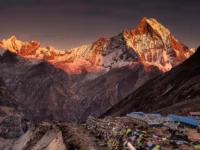
Deurali to Annapurna Base Camp (ABC) (4,130m) via Machhapuchhre Base Camp (MBC) (3,700m): A dramatic day. The valley opens up into the Sanctuary. Pass the “Baggage” area (avalanche risk zone, best crossed early) to MBC for incredible views. The final climb to ABC reveals the staggering 360-degree panorama: the south face of Annapurna I, Annapurna South, Himchuli, Machhapuchhre, Gandharvachuli, and more. (Trek: 5-6 hrs).
-
ABC to Bamboo or Sinuwa: An early morning for sunrise on the peaks, then a long descent back through MBC and Deurali to lower elevations. (Trek: 6-7 hrs).
-
Bamboo/Sinuwa to Jhinu Danda (1,780m) to Nayapul/Pokhara: Descend to Chhomrong, then take a side trail down to Jhinu Danda for a rewarding soak in its natural hot springs by the river. A final descent to Nayapul and a drive to Pokhara. (Trek: 5-6 hrs; Drive: 2 hrs).
Key Highlights:
-
The Sanctuary Itself: The awe-inspiring, immersive experience of being surrounded by Himalayan giants.
-
Cultural Start: The vibrant Gurung culture of Ghandruk and Chhomrong.
-
Diverse Landscapes: From subtropical forests to glacial moraine.
-
Natural Hot Springs: Perfect for soothing muscles after the descent.
Key Consideration: This is a more strenuous trek due to rapid altitude gain. Acclimatization days (e.g., in Chhomrong or Deurali) are highly recommended, extending the trek to 8-9 days.
The Khopra Danda Trek (6-8 Days)
A Community-Based, Ridge-Walking Alternative
Overview: Also known as the Khopra Ridge Trek, this is a community-based tourism initiative that offers Poon Hill-style views with a fraction of the crowds. It uses a combination of teahouses and community-managed lodges.
Standard 6-Day Itinerary:
-
Pokhara to Ghandruk (1,940m): As per ABC/other treks.
-
Ghandruk to Tadapani (2,630m): A beautiful forest walk, joining the Poon Hill route.
-
Tadapani to Dobato (3,420m) via Bayeli Kharka: Diverging from the main trail, the path climbs through forests to the open grazing area of Bayeli Kharka and on to Dobato, with stunning sunrise/sunset views from nearby Muldai viewpoint.
-
Dobato to Chistibung (3,020m) to Khopra Danda (3,660m): Traverse to Chistibung and then make the final climb to the main goal: Khopra Danda (Ridge). The vista is phenomenal, encompassing Dhaulagiri, the Annapurnas, and the deep Kali Gandaki Gorge.
-
Khopra Danda to Swanta Village (2,270m): A descent through forests to the charming, traditional village of Swanta.
-
Swanta to Ulleri (2,080m) or Ghorepani, then descend to Tikhedhunga/Nayapul and drive to Pokhara. Can optionally include Poon Hill.
Key Highlights:
-
Spectacular, Crowd-Free Vistas: Khopra Ridge view rivals Poon Hill.
-
Community Focus: Supports local village cooperatives.
-
Optional Side Trek: A demanding day trip from Khopra to the sacred Khayer Lake (4,600m) near Annapurna South Base Camp.
-
Cultural Authenticity: Visits less-commercialized villages like Swanta.
The Mohare Danda Trek (5-6 Days)
The Eco-Trek with Stunning Dhaulagiri Views
Overview: Another excellent community-based trek, south of the main Annapurna range, focusing on sustainability and offering breathtaking views of Dhaulagiri and the Annapurnas from a different angle.
Route: Starts from Galeshwor (drive from Pokhara), ascends through villages to Mohare Danda (3,300m), the main viewpoint, often compared to Poon Hill for its panorama but without the crowds. Continues to another viewpoint at Khopra Danda (different from the one on the Khopra Ridge Trek) before descending to Tikot and driving back to Pokhara. Known for its eco-lodges and strong community management.
Comparative Analysis & Choosing Your Trek
| Feature | Ghorepani Poon Hill | Mardi Himal | Annapurna Base Camp (Short) | Khopra Danda |
|---|---|---|---|---|
| Duration | 4-5 days | 5-7 days | 7-10 days | 6-8 days |
| Max Altitude | 3,210m (Poon Hill) | 4,500m (MBC) | 4,130m (ABC) | 3,660m (Ridge) |
| Difficulty | Easy to Moderate | Moderate to Challenging | Moderate to Strenuous | Moderate |
| Crowds | High | Moderate (Increasing) | High near ABC | Low |
| Key Scenery | Panoramic sunrise views, villages, rhododendron forests | Intimate alpine views, ridge walking, Machhapuchhre close-up | Glacial amphitheater, 360-degree high mountain walls | Broad ridge panoramas, Kali Gandaki Gorge views |
| Cultural Focus | Strong (Gurung villages) | Moderate | Strong (Gurung villages at start) | Strong (Community-based, authentic villages) |
| Best For | First-timers, families, photographers, limited time | Those seeking a quieter, more alpine feel, good fitness | Dedicated trekkers wanting a classic high-mountain goal | Trekkers wanting views & culture without crowds, community tourism supporters |
Choosing Your Trek:
-
For First-Timers & Families: Ghorepani Poon Hill is the undisputed champion. It’s well-serviced, manageable, and delivers incredible rewards.
-
For an Alpine Adventure with Fewer People: Mardi Himal is the current favorite for those looking beyond Poon Hill. It feels more rugged and remote.
-
For the Ultimate Mountain Immersion: If you have the time (7+ days) and fitness, the direct Annapurna Base Camp route is a life-changing experience.
-
For a Culturally-Immersive, Community-Focused Journey: Khopra Danda or Mohare Danda offer incredible value, stunning views, and the satisfaction of supporting local initiatives.
Practical Considerations & Responsible Trekking
Guided vs. Independent: All these treks can be done independently (FIT) by experienced trekkers, as the trails are clear and teahouses are abundant. However, for first-timers, a guided trek through a reputable agency is highly recommended. Guides handle logistics, provide cultural interpretation, ensure safety, and help with acclimatization. Porter services are also available to carry your main bag, making the trek significantly more enjoyable.
Teahouse Trekking: This is the standard style. You stay in family-run lodges (teahouses) that offer basic private rooms (twin beds, sometimes with attached bathroom) and serve meals (dal bhat, noodles, pancakes, etc.) in a communal dining hall.
Packing Essentials: Layered clothing (moisture-wicking base, insulating mid-layer, down jacket, waterproof shell), sturdy broken-in trekking boots, sleeping bag (4-season recommended), trekking poles, water purification (tablets/filter), sun protection (hat, sunglasses, high SPF sunscreen), basic first-aid kit, headlamp, and a good daypack.
Health & Safety:
-
Acclimatization: Ascend slowly, especially on ABC and Mardi Himal. The rule of thumb is not to sleep more than 300-500m higher than the previous night, once above 3,000m. Listen to your body.
-
Water: Stay hydrated. Use purified water only. Avoid single-use plastic bottles; carry a reusable bottle and purification means.
-
Insurance: Mandatory. Must cover emergency helicopter evacuation and medical treatment at high altitude.
Leave No Trace & Responsible Trekking:
-
Support Local: Buy local food, use local guides/porters, and shop in village stores.
-
Minimize Waste: Carry out all non-biodegradable waste. Use refillable water bottles. Many teahouses now offer boiled/filtered water for a small fee.
-
Respect Culture: Ask permission before photographing people. Dress modestly. Respect religious sites (circumambulate chortens and mani walls clockwise).
-
Environmental Care: Stick to established trails. Do not disturb wildlife or pick plants.
FAQs about Annapurna Short Treks
1. What is the best short trek in Annapurna for first-timers?
The Ghorepani Poon Hill Trek (4-5 days) is the best for first-timers, offering manageable hikes, teahouse comforts, and a spectacular Himalayan sunrise view.
2. What permits do I need?
For Annapurna Short Treks, you need two permits: the Annapurna Conservation Area Permit (ACAP) and the Trekker’s Information Management System (TIMS) card.
3. When is the best time for Short Annapurna Treks?
The best seasons are Autumn (Sept-Nov) for clear skies and Spring (Mar-May) for blooming rhododendron forests and warmer weather.
4. Do I need a guide for a short trek?
While the popular routes like Poon Hill can be done independently, a local guide is highly recommended for safety, cultural insight, and logistical support.
5. How difficult are Annapurna short treks?
They range from Easy-Moderate (Poon Hill) to Moderate-Challenging (Mardi Himal, ABC), depending on the route, your fitness, and the pace you choose.
6. What is the accommodation like?
You stay in teahouses—basic, family-run lodges offering private rooms (twin beds) and shared dining halls serving meals like dal bhat, noodles, and pancakes.
7. What is the maximum altitude on these treks?
For the most popular short treks: Poon Hill (3,210m), Mardi Himal Base Camp (4,500m), and Annapurna Base Camp (4,130m).
8. Can I trek if I have limited time (e.g., 3 days)?
Yes. A 3-day version of the Poon Hill trek is possible by driving further to/from the trailhead, or you can opt for an even shorter trek to Australian Camp.
9. How do I get to the trek starting point?
All treks start from Pokhara. You take a short drive (1-3 hours) from Pokhara to trailheads like Nayapul, Kande, or Phedi.
10. What should I pack?
Essentials include sturdy trekking boots, layered clothing (including a down jacket), a daypack, water purification, sun protection, a headlamp, and a sleeping bag.
Conclusion
The short treks of the Annapurna region are a testament to the incredible accessibility and diversity of the Nepal Himalayas. They prove that one does not need to embark on a multi-week expedition to experience the soul-stirring majesty of the world’s highest mountains, the warmth of its indigenous cultures, and the profound sense of accomplishment that comes from journeying on foot through such legendary landscapes.
Whether you choose the classic panorama of Poon Hill, the intimate ridge walks of Mardi Himal, the awe-inspiring sanctuary of ABC, or the community-focused paths of Khopra and Mohare, you are guaranteed an unforgettable adventure. Each step on these ancient trails is a step into a world where nature’s scale is overwhelming, human resilience is inspiring, and the memories forged will last a lifetime. With careful planning, respect for the environment and culture, and a spirit of adventure, your Annapurna short trek will be far more than just a hike—it will be a transformative journey into the heart of the Himalayas.


