notification

Great News, From June 2025 Mount Kailash is open for individuals holding Indian Passports

Lukla Airport: The Ultimate Gateway to the Everest Region

A Comprehensive Guide to History, Thrills, and Sustainable Trekking

Nestled precariously on a cliff edge in the formidable Khumbu region of Nepal, Tenzing-Hillary Airport, universally known as Lukla Airport, is far more than just a strip of tarmac. It is a legend, a bottleneck, a nerve-wracking spectacle, and for thousands of adventurers each year, the unequivocal starting pistol for the journey of a lifetime to the foot of Mount Everest. This comprehensive guide delves into every facet of Lukla, from its heart-pounding aviation and rich history to its critical role as the gateway to the world’s most famous trekking routes, all while integrating the latest trends and keywords shaping the modern Everest trekking experience.

The Airport Itself – An Engineering Marvel and Adrenaline Primer

Lukla Airport is not merely an airport; it is an experience that begins the moment you board the tiny twin-engine aircraft in Kathmandu. Its reputation as one of the world’s most dangerous airports is both a source of trepidation and a badge of honor for those who traverse it.

Location and Topography: A Recipe for Drama
Situated at a dizzying elevation of 2,845 meters (9,334 feet), the airport is carved into the side of a mountain. The topography dictates its unique and challenging design:

  • The Runway: It features a single runway, famously coded as 06/24, which is only 527 meters (1,729 feet) long and 20 meters (66 feet) wide. For context, a standard international airport runway is over 3,000 meters long. This brevity is non-negotiable.

  • The Gradient: The runway has a staggering 12% gradient. It slopes uphill for landings (from the 06 end) and downhill for takeoffs (from the 24 end). This ingenious design helps slow landing aircraft naturally and assists taking-off aircraft in gaining speed more quickly, acting as a mechanical assist for the thin mountain air.

  • The Drop: The northern end of the runway (06) terminates at a stone wall and the village of Lukla, while the southern end (24) drops off precipitously into a deep valley hundreds of meters below. There is no room for error—an overshoot on landing or an undershoot on takeoff has catastrophic consequences.

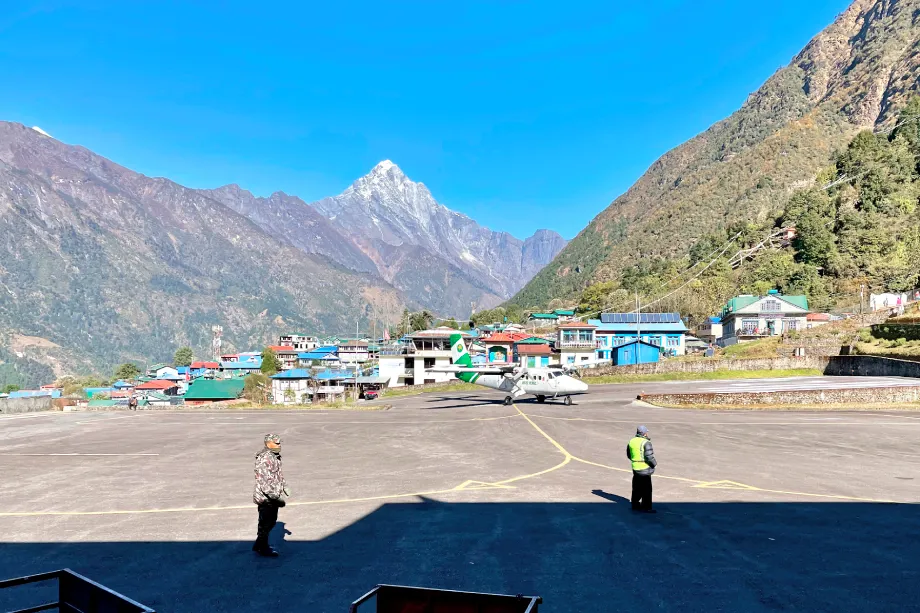
    Luggage Loaded at Plane in Luka
    Luggage Loaded at Plane in Luka

The “Lukla Experience”: Flying from Kathmandu
The flight from Tribhuvan International Airport (KTM) in Kathmandu to Lukla (LUA) is a bucket-list item in itself.

  • Aircraft: The route is exclusively served by small STOL (Short Take-Off and Landing) aircraft, primarily the De Havilland Canada DHC-6 Twin Otter and Dornier Do 228, operated by reputable Nepali airlines like Yeti Airlines, Tara Air, and Summit Air.

  • The Scenic Flight: On a clear day, the 25-35 minute flight offers unparalleled, jaw-dropping views of the Himalayan range. The sight of peaks like Langtang Lirung, Ganesh Himal, and eventually, the Everest massif itself, is a breathtaking prelude to the trek.

  • Weather Volatility: The keyword here is “Lukla weather forecast.” The weather in the mountains is notoriously fickle. Conditions can change in minutes, leading to frequent “Lukla flight delays” and “Lukla flight cancellations.” Pilots require visual flight rules (VFR) conditions, meaning they must be able to see the runway to land. Low cloud cover, high winds, or precipitation can halt all operations, sometimes for days. This inherent uncertainty is a critical factor for trekkers to build into their itineraries.

Safety Record and Modernization: Addressing the “World’s Most Dangerous” Tag
Lukla’s reputation, while dramatic, has been the focus of significant safety improvements.

  • Pilot Expertise: The pilots flying to Lukla are among the most experienced and highly trained in Nepal, undergoing rigorous certification specifically for this route.

  • Infrastructure Upgrades: Recent years have seen improvements, including the paving of the runway (it was previously gravel), enhanced drainage, and better perimeter fencing.

  • Technology: While still a visual approach, communication and navigation aids have been incrementally improved. The discourse around an “alternative to Lukla flight” is growing, primarily pointing to the road network and helicopter services.

  • Safety Statistics: It is crucial to contextualize the “dangerous” label. While accidents have occurred, the vast majority of the tens of thousands of annual flights operate without incident. The airlines and regulatory bodies treat this route with the utmost seriousness.

The Gateway to the Everest Region – Stepping into the Khumbu

Touching down in Lukla is a moment of pure elation and relief. You have arrived. The airport ramp is a chaotic, fascinating hub of activity—trekkers donning boots, porters loading impossible weights, and planes roaring in and out. From here, the adventure on foot truly begins.

Immediate Acclimatization: The First Step is in Lukla
Lukla’s altitude (2,845m) is your body’s first introduction to “high-altitude trekking.” It is strongly advised to spend at least one night in Lukla or a nearby lower village like Phakding to begin the vital process of acclimatization, a core principle of “AMS prevention” (Acute Mountain Sickness).

The Core Trekking Routes from Lukla
Lukla is the access point for a network of trails that cater to a wide range of ambitions, fitness levels, and timeframes.

  • The Everest Base Camp Trek (EBC Trek): The classic, world-famous journey. The standard itinerary is 12-14 days round-trip from Lukla. The trail winds through the Dudh Koshi valley, passing through villages like Namche Bazaar (the bustling Sherpa capital), Tengboche (with its iconic monastery), Dingboche, and Lobuche, before culminating at Gorak Shep and the final push to Everest Base Camp (5,364m). The side trip to Kala Patthar (5,645m) for the best panoramic view of Mount Everest is a non-negotiable highlight.

  • The Three Passes Trek: For the more adventurous and experienced, this is the ultimate Khumbu challenge. This demanding 18-20 day circuit crosses three high passes over 5,000m: Kongma La, Cho La, and Renjo La. It incorporates the EBC trail but offers a more complete, less crowded, and spectacularly rugged experience of the region.

  • The Everest View Trek: A shorter, less strenuous option ideal for those with limited time or who wish to avoid the highest altitudes. This 5-7 day trek typically goes as far as Namche Bazaar and the Everest View Hotel, offering stunning vistas of Everest, Lhotse, and Ama Dablam without the commitment to reach Base Camp.

  • Gokyo Lakes Trek: A beautiful alternative to the classic EBC route, this trek leads to the turquoise, pristine Gokyo Lakes. It involves climbing Gokyo Ri (5,357m) for a different but equally magnificent view of Everest and the massive Ngozumpa Glacier.
    Everest Base Camp Trek is not an ordinary journey, and thus, you may have watched many films on YouTube about […]
    14 Days
    Moderate

    US$ 1300

    View Detail

The Evolution of the Trekking Experience
The experience of trekking in the Everest region has evolved dramatically, influenced by technology, comfort, and a growing awareness of sustainability.

  • Teahouse Trekking: The classic “Everest teahouse trek” remains the standard. This involves staying in family-run lodges along the route, providing a bed and meals. The quality and comfort of these teahouses have improved significantly, with many now offering hot showers (for a fee), Wi-Fi, and extensive menus.

  • Luxury Trekking: The rise of luxury Everest Base Camp trek caters to those who want the adventure without sacrificing comfort. This involves staying in upgraded lodges (like the Yeti Mountain Home chain) or even on “Everest glamping” trips, where trekkers sleep in comfortable, heated pods or domes. These packages often include private bathrooms, finer dining, and more comprehensive support.

  • Helicopter Tours and Sagarmatha National Park: “Everest helicopter tour” has become a popular keyword. For those who cannot trek or wish to cap their journey with an unforgettable flight, helicopter services from Kathmandu or Lukla offer day trips to Base Camp or the Gokyo Valley. Furthermore, entering the “Sagarmatha National Park” (a UNESCO World Heritage Site) is mandatory, and the permit checkpoint is just beyond the entrance at Monjo.

  • Digital Connectivity: The question “Is there Wi-Fi on the Everest Base Camp trek?” is now commonplace. The answer is yes, but it comes at a cost. Services like Everest Link provide paid Wi-Fi cards at most teahouses, allowing trekkers to stay connected, albeit with limited bandwidth.

Beyond the Flight – Alternatives, Logistics, and Preparation

The Lukla flight is the primary gateway, but it’s not the only one. Understanding the alternatives and preparing for the logistics is crucial for a successful trip.

The Lukla Flight Alternative: A Ground-Based Approach
The uncertainty of Lukla flights has popularized an “alternative to Lukla flight.” The most common is to take a 4-5 hour drive from Kathmandu to Manthali Airport in Ramechhap during the peak trekking seasons (Spring and Autumn). From Manthali, the flight to Lukla is shorter and more reliable, as it is less prone to the morning fog that often blankets Kathmandu. This adds a logistical step but significantly increases the chance of flying on schedule.

For the ultimate adventurer, a “road trip to Jiri” or Salleri, followed by a multi-day trek to join the main trail at Phakding or Namche Bazaar, is possible. This was the original approach used by early expeditions before Lukla Airport existed and adds a week or more to the journey, but it provides a more gradual acclimatization and a deeper cultural immersion.

Helicopter Services: Rescue, Tours, and Transfers
Helicopters are an integral part of the Khumbu ecosystem.

  • Emergency Evacuation: In cases of “AMS” or other medical emergencies, helicopter rescue is often the only option. “Travel insurance” that covers high-altitude helicopter evacuation is not a recommendation; it is an absolute necessity.

  • Lukla Helicopter Transfer: For groups or individuals facing prolonged flight cancellations, chartering a helicopter to or from Lukla can be a time-saving, albeit expensive, solution.

  • Helicopter Return from EBC: A growing trend is the “Everest Base Camp trek with helicopter return.” This involves trekking all the way to Base Camp but then taking a helicopter from Gorak Shep back to Lukla or even Kathmandu, saving several days of return trekking and offering a phenomenal aerial perspective.
    Everest Base Camp Trek with Helicopter Return is a package that allows you to dive into the enormous nature of […]
    11 Days
    Moderate

    US$ 3600

    View Detail

Critical Pre-Trek Preparation

  • Permits: Two permits are required for the EBC trek: the “Sagarmatha National Park Entry Permit” and the “Khumbu Pasang Lhamu Rural Municipality Entrance Permit.” The latter can now be obtained in Lukla itself, simplifying the process.

  • Guides and Porters: The debate of “Everest Base Camp guide vs independent trek” is ongoing. While independent trekking is possible, hiring a local guide from a “reputable trekking agency in Nepal” is highly recommended. Guides provide invaluable support for navigation, acclimatization, cultural interpretation, and dealing with teahouses. Porters can carry your main bag, vastly improving your trekking experience and supporting the local economy.

  • Physical Fitness: The trek is demanding. A dedicated “Everest Base Camp training” regimen for 2-3 months prior, focusing on cardiovascular endurance and leg strength, is essential.

  • Packing List: A precise “Everest Base Camp packing list” is key. It must include broken-in hiking boots, a high-quality down jacket, a four-season sleeping bag, layered clothing, a comprehensive first-aid kit, and water purification methods.

The Human and Environmental Dimension – A Changing Khumbu

Trekking to Everest is not just about the mountain; it’s about the people and the fragile environment.

The Sherpa Culture: The Heart of the Himalayas
The Khumbu is the homeland of the Sherpa people. Their rich “Buddhist culture” is evident in the numerous “monasteries” (like Tengboche), “mani walls,” and “prayer flags” that line the trails. Respecting their traditions and religion is paramount. The term “Sherpa” itself refers to an ethnic group, not just a profession. Many Sherpas work as high-altitude guides and porters, and their unparalleled strength and knowledge of the mountains are the backbone of the trekking and climbing industry.

Sustainable Trekking and Environmental Concerns
The immense popularity of the region brings significant environmental challenges. The concepts of “sustainable tourism in Nepal” and “zero-impact trekking” are more critical than ever.

  • Waste Management: The issue of litter, particularly “plastic bottles on Everest,” is a major problem. Trekkers are strongly encouraged to use reusable water bottles and purification tablets/filters. “Packing out what you pack in” is a minimum standard.

  • Climate Change: The effects of “climate change on the Himalayas” are visibly accelerating. Glaciers like the Khumbu are receding at an alarming rate. This not only alters the landscape but also affects water sources for local communities.

  • Supporting the Local Economy: Choosing local teahouses, hiring local guides and porters, and buying local crafts are ways to ensure that tourism revenue benefits the communities that make the trek possible.

  • Social Initiatives: Many trekking companies now partner with or support “Sagarmatha Pollution Control Committee (SPCC)” and other local NGOs focused on clean-up, education, and sustainable development.

    Lukla Airport View
    Lukla Airport View

The Future of the Gateway – Challenges and Innovations

Looking ahead, Lukla Airport and the Everest region face a future shaped by increasing demand and the need for sustainable management.

  • Infrastructure Pressures: The single-runway airport at Lukla is operating at or near capacity during peak seasons. There is ongoing discussion about building a new, larger airport in the region, perhaps at a lower altitude like in Surkhe, to handle more traffic and larger aircraft. However, this is a complex and controversial proposition.

  • Managing Overtourism: The trails, especially to Namche Bazaar and around Gorak Shep, can become congested. Staggering trekking seasons, promoting alternative routes like the Gokyo Lakes or Three Passes, and implementing stricter visitor management policies may be necessary to preserve the wilderness experience.

  • Technological Integration: The continued improvement of “digital payment in Nepal” (like e-sewa and Khalti) is slowly making its way to the mountains, reducing the need for trekkers to carry large amounts of cash.

  • The Helicopter Question: The increasing use of helicopters for tourism, while economically beneficial, raises concerns about noise pollution, environmental impact, and a potential shift in the character of the trekking experience from a wilderness pursuit to a more commodified adventure.

Conclusion: More Than a Runway, A Rite of Passage

Lukla Airport is a symbol. It symbolizes the immense challenge and allure of the Himalayas. The white-knuckle flight, the short, sloping runway, and the sudden immersion into the thin, cold air of the Khumbu are a potent initiation ritual. It is the dramatic, unforgettable prologue to an epic story—a story of walking among giants, of pushing personal limits, of encountering a resilient culture, and of standing in the shadow of the world’s highest peak.

From the essential logistics of “Lukla flight booking” and “AMS prevention” to the modern trends of “luxury lodges” and “helicopter returns,” a journey through Lukla requires careful planning and a respectful approach. It is a fragile ecosystem, both environmentally and culturally, that demands responsible travel. To pass through Lukla is to become part of a long lineage of adventurers, and in doing so, to take on the responsibility of preserving this extraordinary gateway for the generations of dreamers who will follow.
Manaslu Circuit Trek Permit Cost 2026: Fees and Requirements

What is the Manaslu Circuit Trek?

The Manaslu Circuit Trek is a spectacular Himalayan journey that circumnavigates Mount Manaslu (8,163m / 26,781ft), the world’s eighth-highest mountain. Located in the west-central part of Nepal, this trek is often considered a fantastic alternative to the more popular Annapurna Circuit, offering a more remote, pristine, and culturally authentic experience.

For years, it was a restricted area, requiring a special permit, which helped preserve its unique character. It was only opened to trekkers in 1991.

Why is it So Special? Key Highlights

  1. Stunning & Varied Landscapes: The trek takes you through an incredible diversity of scenery. You’ll pass through:

    • Lush, terraced farmland in the lower valleys.

    • Deep, dramatic gorges carved by the Budhi Gandaki River.

    • Vibrant rhododendron and pine forests.

    • Tibetan-style high-altitude villages with unique architecture.

    • The dramatic, high-altitude Larkya La Pass (5,106m / 16,751ft), the trek’s climax.

    • The barren, arid landscapes of the Tibetan Plateau are on the other side of the pass.

  2. Rich Cultural Immersion (Tibetan Buddhism): The Manaslu region is a stronghold of Tibetan culture. You’ll pass through villages with ancient monasteries, chortens (stupas), and mani walls (stone walls carved with prayers). The people are primarily of Tibetan origin (Nubri and Tsum peoples), and their traditions are deeply preserved.

  3. The Challenge of Larkya La Pass: Crossing the Larkya La Pass is a challenging but incredibly rewarding experience. It’s a long, high-altitude day that requires good fitness and acclimatization, but the panoramic views of the surrounding peaks like Manaslu, Himlung Himal, and Cheo Himal are absolutely breathtaking.

  4. A Sense of Remote Adventure: Compared to the Everest and Annapurna regions, the Manaslu Circuit sees significantly fewer trekkers. The infrastructure is more basic, and the feeling of being on a true wilderness adventure is much stronger. The Tsum Valley, a sacred side valley, can be added for an even more remote extension.

  5. Controlled Tourism: The restricted area permit system helps manage the number of visitors, ensuring the region’s environment and culture are better protected than in more commercialized trekking areas.

A Typical Manaslu Circuit Itinerary (12-14 Days)

A standard circuit trek typically takes 14 to 18 days, depending on your pace and any acclimatization days. Here’s a simplified 14-day outline:

  • Days 1-3: Drive from Kathmandu to Soti Khola or Machha Khola and begin trekking. The trail follows the Budhi Gandaki River, ascending through subtropical forests and villages like Jagat and Deng.

  • Days 4-6: The landscape becomes more alpine. You’ll pass through Namrung with its great views and enter the Nubri Valley. Key stops are Lho Gaon (with a stunning view of Manaslu’s North Face) and Samagaon, a major village where you’ll spend a crucial acclimatization day.

  • Day 7: Acclimatization in Samagaon. A day hike to Birendra Tal (a glacial lake) or Manaslu Base Camp (Pungyen Gompa) is highly recommended.

  • Days 8-9: Trek to Samdo, a high-altitude village very close to the Tibetan border. Another short acclimatization day here is useful.

  • Day 10: Larkya La Pass Day. A very early start to cross the Larkya La Pass (5,106m). This is the toughest but most rewarding day. After celebrating at the top, you descend to Bimthang on the other side.

  • Days 11-14: The descent continues through beautiful valleys and rhododendron forests. The trek typically ends at Dharapani, where you meet a road. From here, you drive back to Kathmandu via Besishahar.

Are you looking to touch the sky with your fingers and have the world stop completely? Are you longing for […]
14 Days
Moderate

US$ 1400

View Detail

Practical Information & Requirements

Aspect Details
Best Time to Trek Autumn (Post-Monsoon): October to November. Stable weather, clear skies, and excellent mountain views. Spring (Pre-Monsoon): March to May. Warmer weather, blooming rhododendrons, but hazier skies.
Permits (CRUCIAL) 1. Manaslu Restricted Area Permit (RAP): Must be obtained through a registered trekking agency. You cannot trek independently.
2. Manaslu Conservation Area Permit (MCAP)
3. Annapurna Conservation Area Permit (ACAP) (for the section after the pass).
Difficulty Strenuous to Challenging. The high altitude, the long ascent to Larkya La Pass, and the basic facilities make this a trek for those with good physical fitness and some prior trekking experience.
Teahouse Trek? Yes, but more basic. It’s a teahouse trek, meaning you stay in local lodges. However, the teahouses are more rustic than in Annapurna or Everest, with fewer amenities (e.g., shared bathrooms, limited menus, occasional solar-heated showers).
Guide & Porter Mandatory. Due to the restricted area permit, you must be part of an organized trek with at least a licensed guide. Hiring a porter is highly recommended to carry your main backpack, making the high-altitude crossing safer and more enjoyable.
Independent Trekking? Not Allowed. The rules are strictly enforced. You must book through a licensed Nepali trekking agency that will arrange your permits, guide, and logistics.
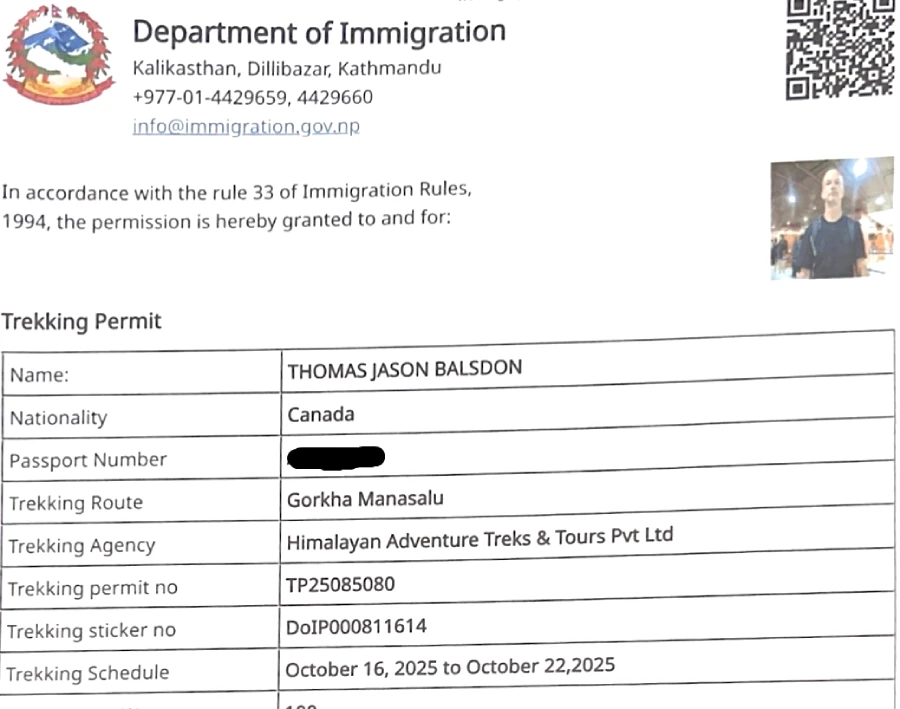
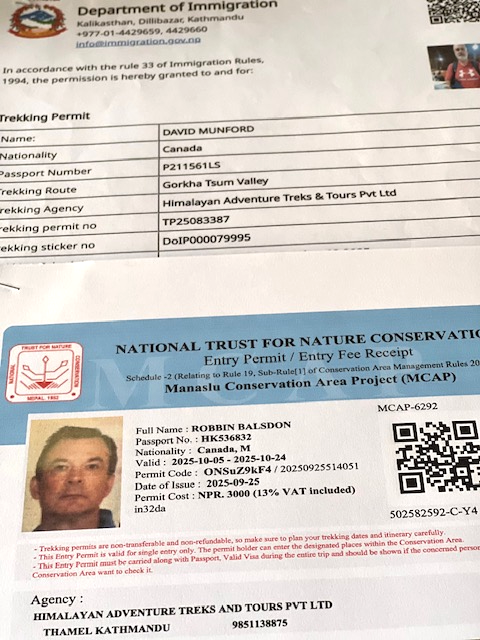
Manaslu Restricted Area Permit (RAP)

Manaslu Circuit vs. Annapurna Circuit

  • Manaslu: More remote, fewer trekkers, stronger Tibetan cultural influence, more basic teahouses, a single major pass (Larkya La), restricted area (guide mandatory).

  • Annapurna: More developed infrastructure, many more trekkers, greater variety of landscapes and cultures (Hindu lowlands to Tibetan highlands), more teahouse choices, can be done independently.

The Three Essential Permits for Manaslu

You cannot trek the Manaslu Circuit without these three permits, and you must obtain them through a registered Nepali trekking agency.

1. Manaslu Restricted Area Permit (RAP)

This is the most important and expensive permit. The cost is not fixed; it varies based on the season and the number of days you spend in the restricted zone.

  • Cost Structure (Per Person):

    • September – November (Autumn Season):

      • USD 100 per person for the first week (1-7 days)

      • USD 15 per person per day thereafter (e.g., 14 days = $100 + (7 x $15) = USD 205)

    • December – August (All Other Months):

      • USD 75 per person for the first week (1-7 days)

      • USD 10 per person per day thereafter (e.g., 14 days = $75 + (7 x $10) = USD 145)

  • When is it checked? The first checkpoint is in Jagat, and you will not be allowed to proceed beyond this point without it.

2. Manaslu Conservation Area Permit (MCAP)

This permit funds the conservation and maintenance of the Manaslu region.

  • Cost (Per Person):

    • SAARC Nationals: NPR 1,000 (approximately USD ~$8)

    • All Other Foreign Nationals: NPR 3,000 (approximately USD ~$23)

  • Validity: Single entry for the duration of your trek.

3. Annapurna Conservation Area Permit (ACAP)

You need this because the trek exits the Manaslu region and enters the Annapurna Conservation Area after crossing the Larkya La Pass (typically when you reach Dharapani).

  • Cost (Per Person):

    • SAARC Nationals: NPR 1,000 (approximately USD ~$8)

    • All Other Foreign Nationals: NPR 3,000 (approximately USD ~$23)

  • Validity: Single entry for the duration of your trek.

Total Estimated Permit Cost for a 14-Day Manaslu Trek (2026)

Let’s calculate for a typical 14-day itinerary in the peak season (Autumn):

  • Manaslu RAP (14 days in Autumn): USD 205

  • MCAP: USD ~23

  • ACAP: USD ~23

  • Total Estimated Cost: Approximately USD 251 per person.

For the same trek in the Spring (March-May), the cost would be lower because the RAP is cheaper:

  • Manaslu RAP (14 days in Spring): USD 145

  • MCAP & ACAP: USD ~46

  • Total Estimated Cost: Approximately USD 191 per person.

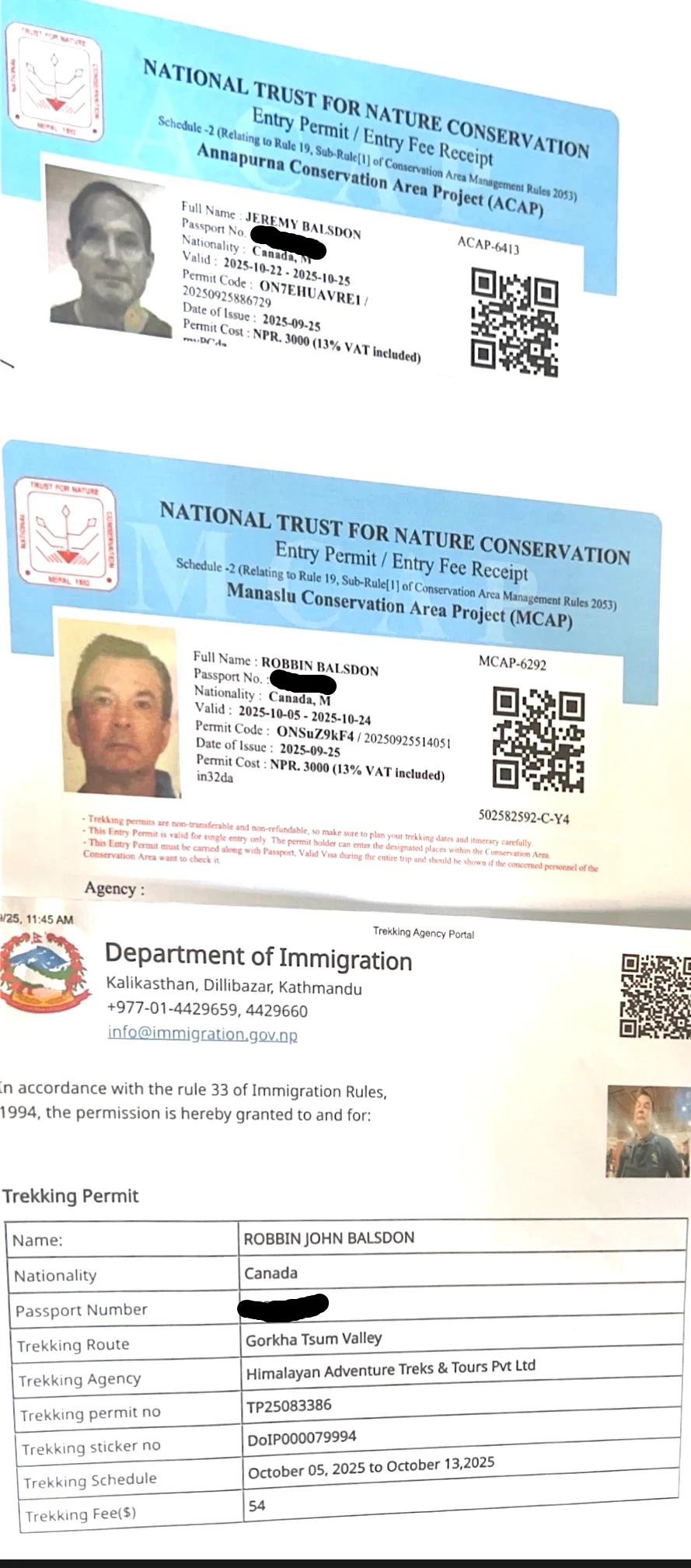
ACAP Permit
ACAP Permit

Mandatory Requirements & Process to Get the Permits

You cannot get these permits independently. The process is strictly regulated.

  1. Licensed Trekking Agency: You must book your trek with a government-licensed trekking agency in Nepal. This is non-negotiable for the Manaslu Restricted Area.

  2. Registered Guide: You must be accompanied by a licensed trekking guide. The agency will provide this guide.

  3. Minimum Group Size Rule (The Critical Rule):

    • As of now, a minimum of two trekkers is required to obtain the Manaslu RAP.

    • Solo trekkers cannot get the permit on their own. A solo traveler must either:

      • Join an existing group trek.

      • Pay for a second “ghost” permit, effectively doubling the cost of their RAP. Your agency will handle this, but it significantly increases the price.

  4. Required Documents for the Agency:

    • A clear, color copy of your passport.

    • Passport-sized photos (digital copies are usually sufficient).

    • Your Nepal visa copy (you get this on arrival at the airport).

    • Travel insurance details (sometimes requested).

    • Your trekking itinerary.

  5. The Process:

    • You provide the documents to your chosen trekking agency.

    • They apply for all three permits on your behalf from the Nepal Tourism Board in Kathmandu.

    • The permits are typically ready within a day.

    • Your guide will carry the original permits, which will be checked at various police checkpoints along the trail (Jagat, Dharapani, etc.).

Summary Table: Manaslu Trek Permits & Costs (2026 Projection)

Permit Name Cost (Foreign Nationals) Cost (SAARC Nationals) Mandatory Guide? Where to Obtain
Manaslu Restricted Area Permit (RAP) USD 100 (1st week Autumn) + $15/day after
USD 75 (1st week Other) + $10/day after
Same as Foreign Nationals YES Via Licensed Trekking Agency Only
Manaslu Conservation Area Permit (MCAP) ~USD 23 (NPR 3,000) ~USD 8 (NPR 1,000) YES Via Licensed Trekking Agency Only
Annapurna Conservation Area Permit (ACAP) ~USD 23 (NPR 3,000) ~USD 8 (NPR 1,000) YES Via Licensed Trekking Agency Only
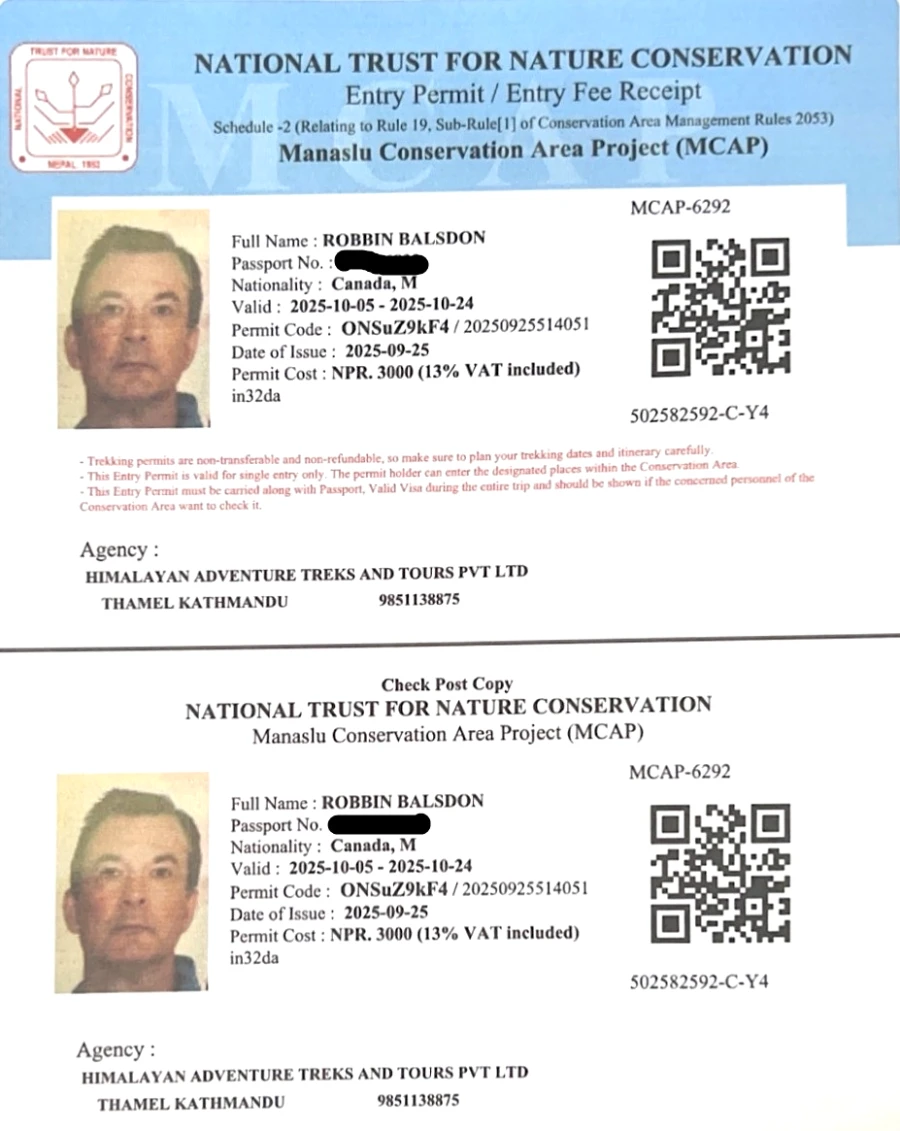
MCAP Permit
MCAP Permit

Key Takeaway for 2026 Planning

  1. Budget: Allocate ~USD $250-260 per person for permits if trekking in the peak season (Autumn).

  2. Book with an Agency: Your first and most important step is to choose a reputable, licensed trekking agency. They will handle the entire permit process.

  3. Confirm the Group Rule: When getting quotes, explicitly ask the agency about the “minimum two trekkers” rule and how it applies to your situation, especially if you are a solo traveler.

  4. Provide Documents Promptly: Send clear copies of your passport and other required documents to your agency as soon as you book to ensure a smooth permit application process.

FAQ

1. What are the mandatory permits for the Manaslu Circuit Trek in 2026?
You need three permits:

  1. Manaslu Restricted Area Permit (RAP): The main permit for the restricted zone.

  2. Manaslu Conservation Area Permit (MCAP): For conservation efforts in the Manaslu region.

  3. Annapurna Conservation Area Permit (ACAP): Required as you exit the trek into the Annapurna area.

2. How much will the Manaslu permits cost in 2026?
Costs are projected based on current rates. For a typical 14-day trek:

  • Autumn (Oct-Nov): ~$250-$260 per person.

  • Spring (Mar-May): ~$190-$200 per person.
    This total includes the variable-cost RAP and the fixed-cost MCAP & ACAP.

3. Can I get the Manaslu permits independently as a solo trekker?
No. You must use a licensed Nepali trekking agency. Furthermore, the Manaslu RAP requires a minimum of two trekkers. Solo trekkers must join a group or pay a double permit fee.

4. Is a guide mandatory for the Manaslu Circuit?
Yes. A licensed guide is mandatory. The restricted area permit will only be issued to a registered agency that provides a guide for your trek.

5. Why is the Manaslu Restricted Area Permit (RAP) cost variable?
The RAP cost depends on the season and the number of days you spend in the restricted zone. It’s cheaper in Spring/Summer/Winter than in the peak Autumn season, and the cost increases for each day beyond the first week.

6. What documents do I need to provide to the agency for the permits?
You need to provide your trekking agency with:

  • A clear, color-scanned copy of your passport.

  • A digital passport-sized photo.

  • A copy of your Nepali visa (obtained on arrival).

  • Your travel insurance details.

  • Your trekking itinerary.

7. Where and when are the permits checked?
Your guide will carry the original permits. They are checked at official police checkpoints in Jagat (the entry point), Philim, Dharapani, and sometimes other villages along the route.

8. If I add the Tsum Valley, do I need an additional permit?
Yes. The Tsum Valley is a separate restricted area. Adding it requires an additional Tsum Valley Restricted Area Permit, which has its own fee structure, increasing the total permit cost.

9. Can I get a refund if my trek is cut short?
Generally, no. Permits are issued for a specific duration and are non-refundable if you leave the restricted area early.

10. What is the single most important rule for Manaslu permits?
The non-negotiable rule is that you must book through a licensed trekking agency and have a guide. Independent trekking is strictly prohibited in the Manaslu restricted area.

Conclusion

In summary, the Manaslu Circuit Trek stands out as a premier Himalayan adventure for those seeking a less-crowded trail. This journey provides an unparalleled blend of stunning landscapes and deep Tibetan Buddhist culture within a remote and authentic setting. Its status as a restricted area mandates that all trekkers use a licensed trekking agency and a mandatory guide, a regulation that supports controlled tourism. Success on this challenging trek, especially the crossing of the high Larkya La Pass, demands excellent physical fitness, careful acclimatization, and thorough preparation. For experienced trekkers looking for a true wilderness exploration away from the crowds, the Manaslu Circuit is an exceptionally rewarding choice, made possible by securing the necessary permits, including the crucial Manaslu Restricted Area Permit (RAP).

Nepal Trekking Permit and Fees (2026)

Nepal Trekking Permit and Fees (2026)

Nepal is a small, landlocked country in South Asia, nestled between the giants of India and China. But geographically and in the hearts of adventurers, it’s a giant itself. It is most famous for:

  • The Himalayas: Nepal is home to eight of the world’s fourteen highest peaks over 8,000 meters, including Mount Everest (Sagarmatha), the highest point on Earth.

  • Incredible Diversity: The terrain rises from the low, subtropical jungles of the Terai plains (as low as 60 meters) to the arctic conditions of the high Himalayas in just about 150 km, creating an astonishing range of ecosystems and cultures.

  • Rich Culture: It’s a multicultural, multi-ethnic, and multi-lingual country with a deep history of Hinduism and Buddhism, evident in its countless temples, monasteries, and festivals.

Trekking is the primary way to experience Nepal’s majestic mountains. Unlike hiking, trekking in Nepal often involves a multi-day journey from village to village, staying in teahouses (small mountain lodges), and immersing yourself in the local culture and breathtaking landscapes.

The “Why” Behind Trekking Permits

The fees you pay for permits are not just tourist taxes. They serve crucial purposes:

  1. Conservation: The funds from National Park and Conservation Area permits go directly towards maintaining trails, managing waste, and preserving the fragile ecosystems of the Himalayas.

  2. Local Development: Fees, especially the local municipality permits (like in Everest), are used for building schools, health posts, and infrastructure in remote villages that see thousands of trekkers but have limited resources.

  3. Trekkers’ Safety: The TIMS card was specifically created to maintain a database of trekkers. In case of natural disasters or emergencies, authorities know who is in the region, aiding search and rescue operations.

  4. Regulating Tourism: Restricted Area Permits control the flow of tourists into culturally sensitive and environmentally vulnerable regions, ensuring that tourism is sustainable and benefits the local communities.

A Detailed Breakdown of Nepal Trekking Permit Fees (2026)

Fees are generally stable, but always confirm with a registered trekking agency or the Nepal Tourism Board before your trip.

Category 1: The Standard Permits (For most major trekking regions)

Permit Name Required For Cost (Per Person) Where to Get It
TIMS Card
(Trekkers’ Information Management System)
Annapurna Region, Langtang, Rara Lake, etc.
*Not required for Everest.
Individual (FIT): NPR 2,000
With Agency (Group): NPR 1,000
Nepal Tourism Board (Kathmandu/Pokhara) or Trekking Agencies’ Association of Nepal (TAAN).
National Park Permit
(e.g., Sagarmatha, Langtang)
Entering specific national parks. ~NPR 3,390
(NPR 3,000 + 13% VAT)
Department of Tourism (Kathmandu) or at the park entrance gate.
Conservation Area Permit
(e.g., ACAP, KCAP)
Entering specific conservation areas. ~NPR 3,390
(NPR 3,000 + 13% VAT)
Nepal Tourism Board (Kathmandu/Pokhara) or at the entry checkpoint.

Example: Annapurna Circuit Trek
You need both an Annapurna Conservation Area Permit (ACAP) and a TIMS Card. Total cost: ~NPR 3,390 + NPR 1,000/2,000 = ~NPR 4,390 to 5,390.

Category 2: Special & Restricted Area Permits (Require a Licensed Guide)

These are for remote, culturally sensitive regions. You must book through a registered trekking agency, and a minimum of two trekkers is usually required. Fees are in USD.

Restricted Area Permit Cost (Peak Season: Sep-Nov) Permit Cost (Off-Season: Dec-Aug) Minimum Duration
Upper Mustang USD 500 (for 10 days) + USD 50/day after USD 500 (for 10 days) + USD 50/day after 10 Days
Manaslu Circuit USD 100 (for 7 days) + USD 15/day after USD 75 (for 7 days) + USD 10/day after 7 Days
Upper Dolpo USD 500 (for 10 days) + USD 50/day after USD 500 (for 10 days) + USD 50/day after 10 Days
Tsum Valley USD 35 (for 7 days) + USD 5/day after USD 25 (for 7 days) + USD 5/day after 7 Days
Kanchenjunga USD 100 (for 10 days) + USD 25/day after USD 100 (for 10 days) + USD 25/day after 10 Days

Category 3: The Everest Region Special Case

The Everest region has had its own unique system since 2018.

  1. Sagarmatha National Park Permit: Standard NPR ~3,390.

  2. Khumbu Pasang Lhamu Rural Municipality Permit: NPR 2,000 per person.

Important: The TIMS Card is NOT required for the Everest region. These two permits replace it. You can buy the local permit at the entrance gate in Lukla or Monjo.

Which Permit Do You Need?

Trekking Region Required Permit(s) Why It’s Needed
Everest Region 1. Sagarmatha National Park Permit
2. Khumbu Pasang Lhamu Rural Municipality Permit
The TIMS Card is no longer required for the Everest region. These two permits replace it.
Annapurna Region 1. Annapurna Conservation Area Permit (ACAP)
2. TIMS Card (Trekkers’ Information Management System)
The two classic, mandatory permits for this popular region.
Manaslu Region 1. Manaslu Restricted Area Permit (RAP)
2. Annapurna Conservation Area Permit (ACAP) (for the southern part)
A restricted area requiring a licensed guide and a minimum of 2 trekkers.
Upper Mustang 1. Upper Mustang Restricted Area Permit (RAP) A high-cost, restricted area preserving Tibetan culture. Requires a guide.
Upper Dolpo & Lower Dolpo 1. Dolpo Restricted Area Permit (RAP)
2. Shey Phoksundo National Park Permit
Very remote and expensive permits, especially for Upper Dolpo.
Kanchenjunga Region 1. Kanchenjunga Restricted Area Permit (RAP)
2. Kanchenjunga Conservation Area Permit (KCAP)
Remote eastern trek requiring a guide and two trekkers.
Langtang Region 1. Langtang National Park Permit
2. TIMS Card
An easily accessible trek from Kathmandu.

Breakdown of Permits and Fees

1. TIMS Card (Trekkers’ Information Management System)

Required for: Annapurna, Langtang, and other general trekking regions. Not required for: Everest and any Restricted Area.

  • Purpose: To ensure trekkers’ safety and maintain a database.

  • Cost (2026 Expected – in NPR):

    • Individual Trekkers (Free Independent Trekkers – FIT): NPR 2,000 per person

    • Trekkers with a Licensed Guide/Agency (Group): NPR 1,000 per person

  • Where to Get It:

    • TAAN Office in Kathmandu or Pokhara.

    • Nepal Tourism Board (NTB) Office in Kathmandu or Pokhara.

  • Documents Required: Passport, 2 passport-sized photos, a copy of your Nepal visa, and insurance.

2. National Park & Conservation Area Permits

These are entry fees for protected areas.

  • Sagarmatha NP (Everest), Langtang NP, Shey Phoksundo NP (Dolpo), etc.

    • Cost: NPR 3,000 per person (plus 13% VAT, so total ~NPR 3,390).

    • Available at: DoT in Kathmandu, or the park entrance gate.

  • Annapurna Conservation Area (ACAP), Kanchenjunga Conservation Area (KCAP)

    • Cost: NPR 3,000 per person (plus 13% VAT, so total ~NPR 3,390).

    • Available at: DoT in Kathmandu, NTB in Pokhara, or the entry gate in Besisahar or Dunre.

3. Restricted Area Permits (RAP)

These are the most expensive and regulated permits. They require you to be with a licensed trekking agency and a guide. A minimum of 2 trekkers is usually required.

Restricted Area Permit Cost (September – November) Permit Cost (December – August) Minimum Days
Upper Mustang USD 500 per person (for 10 days) + USD 50 per day thereafter USD 500 per person (for 10 days) + USD 50 per day thereafter 10 Days
Manaslu USD 100 per person (for 7 days) + USD 15 per day thereafter USD 75 per person (for 7 days) + USD 10 per day thereafter 7 Days
Upper Dolpo USD 500 per person (for 10 days) + USD 50 per day thereafter USD 500 per person (for 10 days) + USD 50 per day thereafter 10 Days
Lower Dolpo USD 100 per person (for 10 days) + USD 25 per day thereafter USD 100 per person (for 10 days) + USD 25 per day thereafter 10 Days
Kanchenjunga USD 100 per person (for 10 days) + USD 25 per day thereafter USD 100 per person (for 10 days) + USD 25 per day thereafter 10 Days
Humla (Lim Valley) USD 100 per person (for 7 days) + USD 25 per day thereafter USD 100 per person (for 7 days) + USD 25 per day thereafter 7 Days

4. Khumbu Pasang Lhamu Rural Municipality Permit

Required for: All treks in the Everest region (replaces the TIMS requirement here).

  • Cost: NPR 2,000 per person.

  • Where to Get It: This can be purchased at the Lukla Entrance Gate or the Nepal Tourism Board office in Kathmandu. It’s very easy to get upon arrival in Lukla.

How to Obtain the Permits: A Step-by-Step Guide

  1. For Independent Trekkers (Non-Restricted Areas like Annapurna/Langtang):

    • Go to the NTB or TAAN office in Kathmandu or Pokhara.

    • Fill out the TIMS and ACAP/Langtang NP forms.

    • Provide your passport, photos, visa copy, and cash.

    • Receive your permits on the spot.

  2. For Trekkers with an Agency (All Areas, including Restricted):

    • This is the easiest and recommended method.

    • Your chosen trekking agency will handle all permit paperwork.

    • You need to provide them with a clear copy of your passport, Nepal visa, and travel insurance.

    • The agency will get the permits a day or two before your trek starts.

Essential Tips for 2026

  • Carry Multiple Copies: Have at least 2-3 photocopies of your passport, visa, and all permits. You will need to show them at various checkpoints.

  • Cash is King: Permits are paid in Nepalese Rupees (NPR) for TIMS, National Park, and Local Permits. USD is used for Restricted Area Permits, but the agency will usually handle this. Have small bills for entry gates.

  • Check for Updates: Rules, especially for the Everest region, have changed recently. Confirm the latest requirements before you go.

  • Guide Mandatory for Restricted Areas: You cannot get a Restricted Area Permit without a licensed guide. This is a non-negotiable safety and regulation rule.

  • Keep Permits Accessible: Do not pack them in your main duffel bag. Keep them with your passport in a waterproof bag or your daypack.

    Summary and Key Takeaways

    • Not One-Size-Fits-All: The permits you need depend entirely on where you are trekking.

    • Guide Mandatory for Restricted Areas: You cannot enter regions like Manaslu, Upper Mustang, or Dolpo without a licensed guide and a trekking agency.

    • Cash in Local Currency: Have Nepalese Rupees (NPR) for standard permits and TIMS. Your agency will handle the USD payments for restricted areas.

    • The Easiest Method: For any trek, the simplest way to get permits is to hire a reputable local trekking agency. They will handle all the paperwork, saving you time and hassle.

    • Carry Copies: Always carry multiple photocopies of your passport, visa, and permits, as you will need to show them at checkpoints along the trail.

    By paying these permit fees, you are directly contributing to the preservation of the incredible Himalayan environment and supporting the local communities that make trekking in Nepal such a unique and rewarding experience.

    FAQ: Nepal Trekking Permit and Fees (2026)

    1. What trekking permits are required in Nepal?

    Most trekkers need a TIMS (Trekkers’ Information Management System) card and a specific National Park or Conservation Area Permit, depending on the trekking region.

    2. What is a TIMS card?

    The TIMS card is a registration system managed by the Nepal Tourism Board and trekking agencies to ensure trekkers’ safety and record their details.

    3. How much does a TIMS card cost in 2026?

    For foreign trekkers, the TIMS card generally costs around NPR 2,000–3,000, depending on whether you trek independently or through an agency.

    4. Do I need a permit for Everest Base Camp Trek?

    Yes, you need the Sagarmatha National Park Permit and a local Khumbu Municipality permit for trekking in the Everest region.

    5. What is the permit fee for Annapurna region?

    Trekkers in the Annapurna region must obtain the Annapurna Conservation Area Permit (ACAP), which costs around NPR 3,000 for foreign nationals.

    6. What is a Restricted Area Permit (RAP)?

    A Restricted Area Permit is required for special regions like Upper Mustang, Upper Dolpo, and Manaslu, and must be arranged through a registered trekking agency.

    7. How much does the Manaslu Restricted Area Permit cost?

    The Manaslu RAP fee varies by season but generally starts from USD 100 per person for the first 7 days during peak season.

    8. Where can I obtain trekking permits in Nepal?

    You can get permits from the Nepal Tourism Board office in Kathmandu or Pokhara, or through a registered trekking agency.

    9. Are SAARC nationals eligible for discounted permit fees?

    Yes, trekkers from SAARC countries usually receive discounted rates for national park and conservation area permits.

    10. Do children need trekking permits?

    Yes, children generally require permits, but some conservation areas may offer free or discounted permits for minors.

Free Travel Guide
Your Perfect, Personalized Journey Awaits
profile
Bhagwat Simkhada Seasoned Travel Expert with Years of Experience