


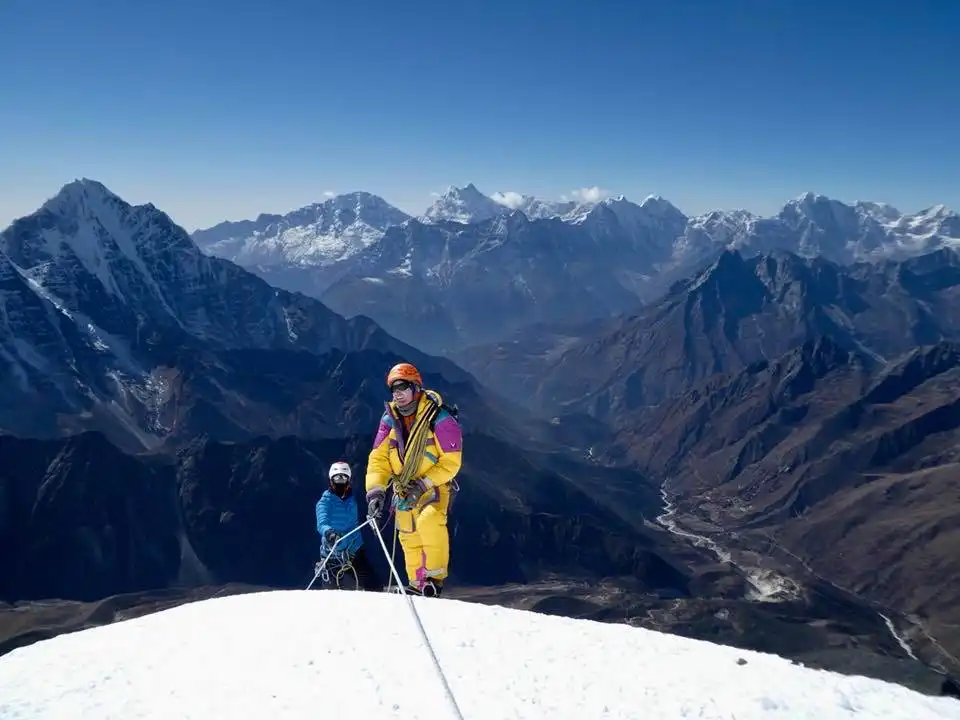

Imja Tse (Island Peak) is part of the Everest region which is one of the most famous adventure trekking destinations in the world. Nepal is also called the land of the mighty Himalayas. Imja Tse (Island Peak) (6189m) is located in the northeastern part of the country and is protected by the Sagarmatha National Park and Makalu Barun National Park in Khumbu Region.
Imja Tse (Island Peak) (6189m) is one of the most beautiful and popular peaks in the Khumbu. It is also, better known as Island Peak. The island peak was named by Eric Shipton 1951 a member of the British Mount Everest Expedition because it appears as an island in a sea of ice when viewed from Dingboche (4410m). The peak was renamed later in 1983 to Imja Tse but Island Peak remains the popular choice and easy to pronoun and spell. The peak is actually an extension of the ridge coming down off the south end of Lhotse Shar mountain. Imja Tse the first summit was climbed in 1956 by Hans-Rudolf Von Gunten and two Sherpas, who were the members of a Swiss team that went on to make the second ascent of Mount Everest Base Camp Trek and the first ascent of Mt.Lhotse (8516m). Tenzing Norgay sherpa was the first Nepali climber who climbed the Imja Tse with Charles Evans, Alfred Gregory, Charles Wylie, and seven other Sherpas. It is one of the most popular trekking peaks in Nepal and given its difficulty (alpine PD+) and accessibility especially when supported by a Nepalese climbing Sherpa guide.
Imja Tse, also known as Island Peak, is a popular trekking peak located in the Himalayas of Nepal. It rises to an altitude of 6,189 meters (20,305 feet) above sea level, making it one of the most accessible and sought-after climbing peaks in the Everest region. Here are some key points about Imja Tse (Island Peak):
Location: Imja Tse is situated in the Sagarmatha National Park, in the Everest region of northeastern Nepal. It lies between the Khumbu and Imja valleys, hence the name “Island Peak.”
Climbing Difficulty: While Island Peak is considered a technical climb, it is suitable for climbers with previous trekking experience and basic mountaineering skills. The ascent involves glacier travel, moderate snow and ice climbing, and the use of ropes and crampons. It is often chosen as an introductory peak for climbers aiming to gain experience in high-altitude mountaineering.
Base Camp: The typical starting point for climbing Imja Tse is the village of Chhukung, located at an elevation of around 4,730 meters (15,518 feet). From Chhukung, climbers trek to Island Peak Base Camp, situated at approximately 5,200 meters (17,060 feet), where they acclimatize and prepare for the ascent.
Summit Route: The ascent of Imja Tse follows a well-defined route, starting with a steep climb to the high camp at around 5,600 meters (18,373 feet). From the high camp, climbers ascend a glacier and negotiate a narrow ridge before reaching the summit. The final section involves a short but exposed climb on a steep snow slope.
Scenic Views: The summit of Imja Tse offers spectacular panoramic views of the surrounding Himalayan peaks, including Mount Everest (8,848 meters/29,029 feet), Lhotse (8,516 meters/27,940 feet), Nuptse (7,861 meters/25,791 feet), and Ama Dablam (6,812 meters/22,349 feet), among others.
Permit Requirements: Climbing Imja Tse requires obtaining a climbing permit from the Nepal Mountaineering Association (NMA) and a Sagarmatha National Park entry permit. Additionally, climbers are typically accompanied by experienced guides and support staff.
Season for Climbing: The primary climbing seasons for Imja Tse are during the pre-monsoon (spring) season from March to May and the post-monsoon (autumn) season from September to November. These periods generally offer stable weather conditions and clear skies, making them ideal for mountaineering activities.
Island peak climbing difficulties:
Climbing Island Peak (Imja Tse) is considered moderately challenging in terms of technical difficulty, but it requires a good level of physical fitness, proper acclimatization, and basic mountaineering skills. Here are some factors that contribute to the difficulty level of climbing Island Peak:
Altitude: Island Peak stands at an elevation of 6,189 meters (20,305 feet) above sea level. At such high altitudes, climbers are susceptible to altitude-related illnesses such as acute mountain sickness (AMS), high-altitude pulmonary edema (HAPE), and high-altitude cerebral edema (HACE). Proper acclimatization and gradual ascent are essential to minimize the risk of altitude sickness.
Technical Terrain: While Island Peak is classified as a trekking peak rather than a full-scale expedition peak, it still involves technical climbing skills. Climbers encounter steep snow and ice slopes, glacier travel, and potentially challenging sections with fixed ropes. Basic mountaineering skills such as proper use of crampons, ice axe, and roped travel are necessary.
Weather Conditions: Weather in the Himalayas can be unpredictable and harsh, especially at higher elevations. Climbers on Island Peak may encounter cold temperatures, high winds, and snowfall, which can significantly affect climbing conditions and safety. Choosing the right climbing season and being prepared for changing weather is crucial.
Physical Demands: Climbing Island Peak requires a good level of physical fitness and endurance. Climbers must be able to trek for several days at high altitudes while carrying a backpack with essential gear and equipment. The ascent to the summit involves long days of climbing, often starting before dawn to reach the summit and descend before adverse weather conditions set in.
Technical Gear and Equipment: Climbers need to have appropriate gear and equipment for mountaineering, including crampons, ice axes, harnesses, helmets, and clothing suitable for cold and windy conditions. Technical gear and proper clothing are essential for safety and comfort during the climb.
Guided Expeditions: Many climbers choose to join guided expeditions led by experienced mountaineering guides and support staff. While this can enhance safety and provide logistical support, climbers should still be prepared for the physical and technical challenges of the climb.
Overall, while Island Peak is considered a feasible objective for climbers with some prior trekking and mountaineering experience, it is essential to approach the climb with respect for its challenges and to be adequately prepared both physically and mentally. Proper training, acclimatization, and adherence to safety protocols are crucial for a successful and enjoyable ascent of Island Peak.
Here’s a typical itinerary for climbing Island Peak (Imja Tse) in Nepal:
Day 1: Arrival in Kathmandu
- Arrive in Kathmandu, the capital city of Nepal.
- Transfer to your hotel and rest.
- Attend a pre-climbing briefing with your trekking agency or guide.
Day 2: Kathmandu Sightseeing and Preparation
- Visit Kathmandu’s UNESCO World Heritage Sites, including Durbar Square, Swayambhunath (Monkey Temple), and Boudhanath Stupa.
- Finalize climbing permits and equipment preparations.
- Meet your climbing guide and discuss the expedition plan.
Day 3: Fly to Lukla and Trek to Phakding
- Take an early morning scenic flight from Kathmandu to Lukla (2,800 meters).
- Begin trekking from Lukla to Phakding (2,652 meters), a small village along the Dudh Kosi River.
- Overnight stay in Phakding.
Day 4: Trek from Phakding to Namche Bazaar
- Trek from Phakding to Namche Bazaar (3,440 meters), the main trading center and gateway to the Everest region.
- Cross several suspension bridges and ascend gradually along the trail.
- Overnight stay in Namche Bazaar.
Day 5: Acclimatization Day in Namche Bazaar
- Spend a rest day in Namche Bazaar for acclimatization.
- Take a short hike to nearby viewpoints such as Everest View Hotel or Khumjung Village.
- Explore Namche Bazaar’s markets, shops, and cafes.
- Overnight stay in Namche Bazaar.
Day 6: Trek from Namche Bazaar to Tengboche
- Trek from Namche Bazaar to Tengboche (3,860 meters), home to the famous Tengboche Monastery.
- Enjoy panoramic views of Everest, Lhotse, Ama Dablam, and other peaks along the way.
- Visit Tengboche Monastery and attend evening prayers.
- Overnight stay in Tengboche.
Day 7: Trek from Tengboche to Dingboche
- Trek from Tengboche to Dingboche (4,410 meters), a picturesque village nestled beneath Ama Dablam.
- Cross the Imja Khola and ascend gradually through rhododendron and juniper forests.
- Overnight stay in Dingboche.
Day 8: Acclimatization Day in Dingboche
- Spend another day in Dingboche for acclimatization.
- Take a day hike to Nagarjun Hill or Chhukung Ri for acclimatization and panoramic mountain views.
- Rest and hydrate to prepare for the climb.
- Overnight stay in Dingboche.
Day 9: Trek from Dingboche to Island Peak Base Camp
- Trek from Dingboche to Island Peak Base Camp (5,200 meters), located above the moraine of the Imja Glacier.
- Set up camp and prepare for the climb.
- Rest and hydrate in preparation for summit day.
- Overnight stay at Island Peak Base Camp.
Day 10: Summit Day – Island Peak Summit (6,189 meters) and Return to Base Camp
- Start early in the morning for the summit push.
- Ascend steeply towards the high camp (5,600 meters) and then to the summit.
- Enjoy panoramic views from the summit, including Everest, Lhotse, Nuptse, and Ama Dablam.
- Descend carefully back to Island Peak Base Camp.
- Overnight stay at Base Camp.
Day 11: Reserve Summit Day and Return to Dingboche
- Reserve an extra day for the summit attempt in case of unfavorable weather conditions.
- Descend from Island Peak Base Camp to Dingboche.
- Celebrate the successful climb with your team.
- Overnight stay in Dingboche.
Day 12: Trek from Dingboche to Namche Bazaar
- Trek from Dingboche back to Namche Bazaar, retracing your steps along the trail.
- Enjoy the descent and panoramic views of the Himalayas.
- Overnight stay in Namche Bazaar.
Day 13: Trek from Namche Bazaar to Lukla
- Trek from Namche Bazaar to Lukla, the final day of trekking.
- Reflect on your achievements and experiences during the trek.
- Celebrate with your team upon reaching Lukla.
- Overnight stay in Lukla.
Day 14: Fly from Lukla to Kathmandu
- Take an early morning flight from Lukla to Kathmandu.
- Transfer to your hotel in Kathmandu.
- Rest and relax or explore the city’s markets and restaurants.
- Overnight stay in Kathmandu.
Day 15: Departure from Kathmandu
- Depart Kathmandu for your onward journey or extend your stay to explore more of Nepal.
- Transfer to the airport for your flight back home.
Climbing Route:
To climb Imja Tse has few options climb one is starting from Base Camp at 5,087 meters (16,690 ft) called Pareshaya Gyab and starting to climb in the early morning between 2/3. Another popular option is to ascend to Island Peak High Camp at around 5,600 meters (18,400 ft) which helps to reduce and save the amount of effort and time needed for summit day. However, adequate water supply, Oxygen level, less high altitude sickness issue, and concerns about sleeping at a higher altitude may dictate starting from Base camp.
Island Peak climbing is one of the most Adventurous peak climbing in the Everest Region. At the top of the gully, old ice glacier travel begins and proceeds up to a steep snow and ice slope. From here, fixed ropes may be set up by the sherpa guides for the strenuous ascent to the steep slope of rocky mountains of nearly 100 meters (330 ft) to the summit ridge. The climbing up to the summit is somehow difficult due to steep climbing. On the top of the Imja Tse, Mount Everest saw very close not more than ten kilometres away to the north, the view will be blocked by the massive wall of Mt. Lhotse (8,516m)and Cho Oyu (8201m), towering 2,300 m (7,500 ft) above the summit.
Not only the high mountains view from the top of the Imja Tse, but Imja Glacier which originates on the western face of Kali Himal, 7,057 meters (23,153 ft), and skirts the southern slopes of Imja Tse or Island Peak, south-east of Mount Everest and Imja Tsho (5004m) or Imja lake is a glacial lake created after meltwater began collecting at the foot of the Imja Glacier on the lower part of the Imja Tse glacier in the 1950s.


