



What is the Manaslu Circuit Trek?
The Manaslu Circuit Trek is a spectacular Himalayan journey that circumnavigates Mount Manaslu (8,163m / 26,781ft), the world’s eighth-highest mountain. Located in the west-central part of Nepal, this trek is often considered a fantastic alternative to the more popular Annapurna Circuit, offering a more remote, pristine, and culturally authentic experience.
For years, it was a restricted area, requiring a special permit, which helped preserve its unique character. It was only opened to trekkers in 1991.
Why is it So Special? Key Highlights
-
Stunning & Varied Landscapes: The trek takes you through an incredible diversity of scenery. You’ll pass through:
-
Lush, terraced farmland in the lower valleys.
-
Deep, dramatic gorges carved by the Budhi Gandaki River.
-
Vibrant rhododendron and pine forests.
-
Tibetan-style high-altitude villages with unique architecture.
-
The dramatic, high-altitude Larkya La Pass (5,106m / 16,751ft), the trek’s climax.
-
The barren, arid landscapes of the Tibetan Plateau are on the other side of the pass.
-
-
Rich Cultural Immersion (Tibetan Buddhism): The Manaslu region is a stronghold of Tibetan culture. You’ll pass through villages with ancient monasteries, chortens (stupas), and mani walls (stone walls carved with prayers). The people are primarily of Tibetan origin (Nubri and Tsum peoples), and their traditions are deeply preserved.
-
The Challenge of Larkya La Pass: Crossing the Larkya La Pass is a challenging but incredibly rewarding experience. It’s a long, high-altitude day that requires good fitness and acclimatization, but the panoramic views of the surrounding peaks like Manaslu, Himlung Himal, and Cheo Himal are absolutely breathtaking.
-
A Sense of Remote Adventure: Compared to the Everest and Annapurna regions, the Manaslu Circuit sees significantly fewer trekkers. The infrastructure is more basic, and the feeling of being on a true wilderness adventure is much stronger. The Tsum Valley, a sacred side valley, can be added for an even more remote extension.
-
Controlled Tourism: The restricted area permit system helps manage the number of visitors, ensuring the region’s environment and culture are better protected than in more commercialized trekking areas.
A Typical Manaslu Circuit Itinerary (12-14 Days)
A standard circuit trek typically takes 14 to 18 days, depending on your pace and any acclimatization days. Here’s a simplified 14-day outline:
-
Days 1-3: Drive from Kathmandu to Soti Khola or Machha Khola and begin trekking. The trail follows the Budhi Gandaki River, ascending through subtropical forests and villages like Jagat and Deng.
-
Days 4-6: The landscape becomes more alpine. You’ll pass through Namrung with its great views and enter the Nubri Valley. Key stops are Lho Gaon (with a stunning view of Manaslu’s North Face) and Samagaon, a major village where you’ll spend a crucial acclimatization day.
-
Day 7: Acclimatization in Samagaon. A day hike to Birendra Tal (a glacial lake) or Manaslu Base Camp (Pungyen Gompa) is highly recommended.
-
Days 8-9: Trek to Samdo, a high-altitude village very close to the Tibetan border. Another short acclimatization day here is useful.
-
Day 10: Larkya La Pass Day. A very early start to cross the Larkya La Pass (5,106m). This is the toughest but most rewarding day. After celebrating at the top, you descend to Bimthang on the other side.
-
Days 11-14: The descent continues through beautiful valleys and rhododendron forests. The trek typically ends at Dharapani, where you meet a road. From here, you drive back to Kathmandu via Besishahar.
Practical Information & Requirements
| Aspect | Details |
|---|---|
| Best Time to Trek | Autumn (Post-Monsoon): October to November. Stable weather, clear skies, and excellent mountain views. Spring (Pre-Monsoon): March to May. Warmer weather, blooming rhododendrons, but hazier skies. |
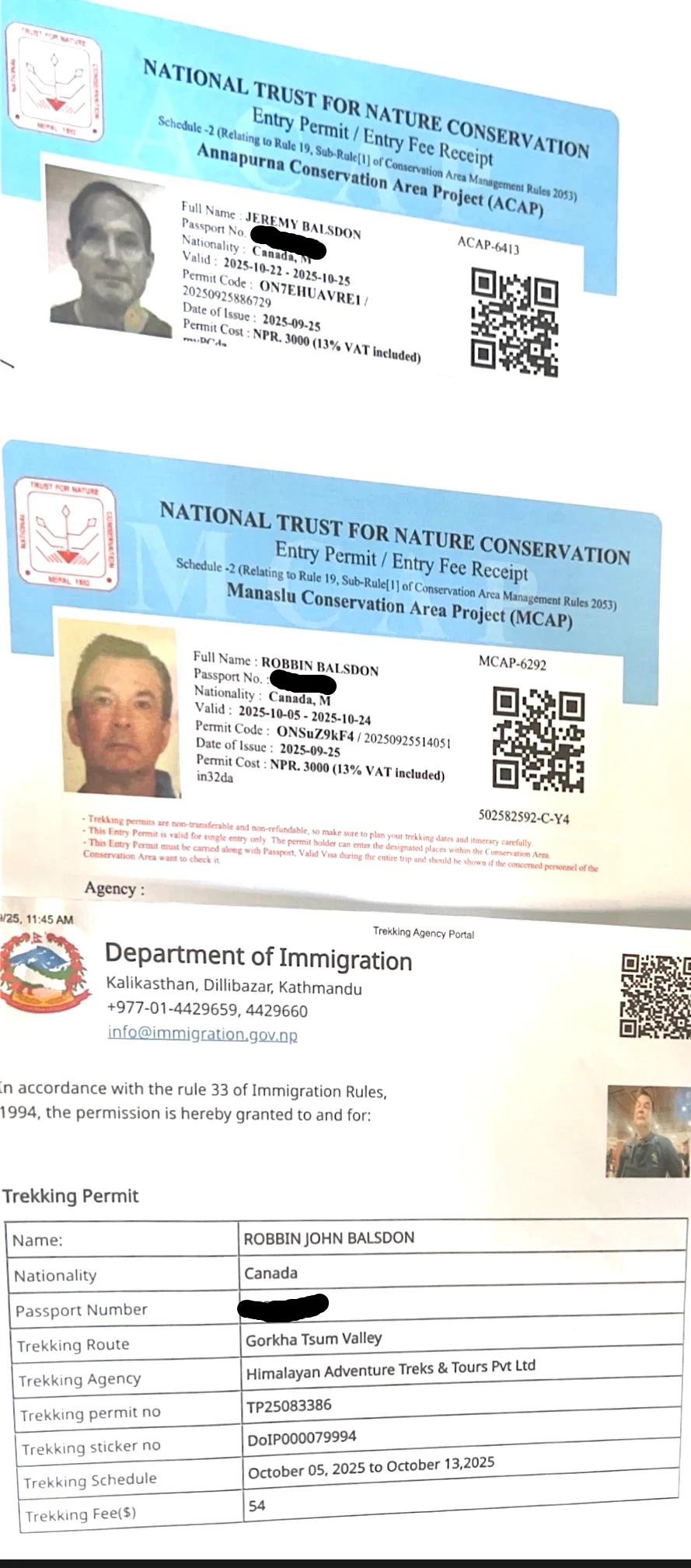
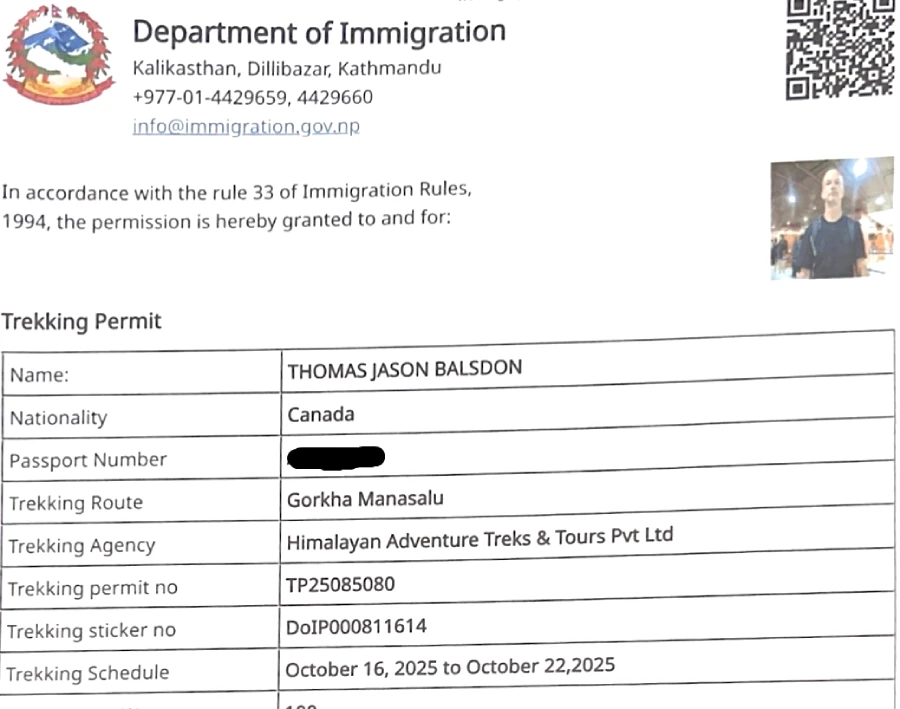
| Permits (CRUCIAL) | 1. Manaslu Restricted Area Permit (RAP): Must be obtained through a registered trekking agency. You cannot trek independently. 2. Manaslu Conservation Area Permit (MCAP) 3. Annapurna Conservation Area Permit (ACAP) (for the section after the pass). |
| Difficulty | Strenuous to Challenging. The high altitude, the long ascent to Larkya La Pass, and the basic facilities make this a trek for those with good physical fitness and some prior trekking experience. |
| Teahouse Trek? | Yes, but more basic. It’s a teahouse trek, meaning you stay in local lodges. However, the teahouses are more rustic than in Annapurna or Everest, with fewer amenities (e.g., shared bathrooms, limited menus, occasional solar-heated showers). |
| Guide & Porter | Mandatory. Due to the restricted area permit, you must be part of an organized trek with at least a licensed guide. Hiring a porter is highly recommended to carry your main backpack, making the high-altitude crossing safer and more enjoyable. |
| Independent Trekking? | Not Allowed. The rules are strictly enforced. You must book through a licensed Nepali trekking agency that will arrange your permits, guide, and logistics. |
Manaslu Circuit vs. Annapurna Circuit
-
Manaslu: More remote, fewer trekkers, stronger Tibetan cultural influence, more basic teahouses, a single major pass (Larkya La), restricted area (guide mandatory).
-
Annapurna: More developed infrastructure, many more trekkers, greater variety of landscapes and cultures (Hindu lowlands to Tibetan highlands), more teahouse choices, can be done independently.
The Three Essential Permits for Manaslu
You cannot trek the Manaslu Circuit without these three permits, and you must obtain them through a registered Nepali trekking agency.
1. Manaslu Restricted Area Permit (RAP)
This is the most important and expensive permit. The cost is not fixed; it varies based on the season and the number of days you spend in the restricted zone.
-
Cost Structure (Per Person):
-
September – November (Autumn Season):
-
USD 100 per person for the first week (1-7 days)
-
USD 15 per person per day thereafter (e.g., 14 days = $100 + (7 x $15) = USD 205)
-
-
December – August (All Other Months):
-
USD 75 per person for the first week (1-7 days)
-
USD 10 per person per day thereafter (e.g., 14 days = $75 + (7 x $10) = USD 145)
-
-
-
When is it checked? The first checkpoint is in Jagat, and you will not be allowed to proceed beyond this point without it.
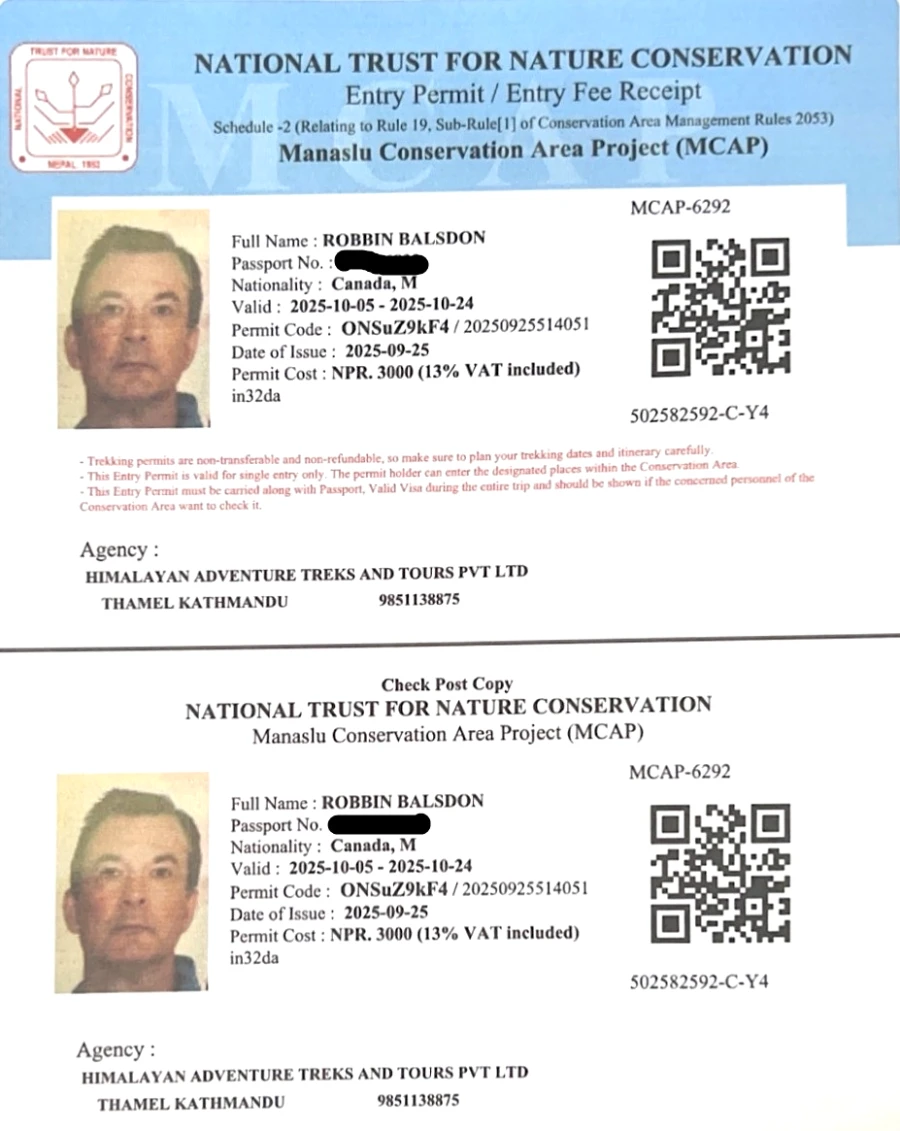
2. Manaslu Conservation Area Permit (MCAP)
This permit funds the conservation and maintenance of the Manaslu region.
-
Cost (Per Person):
-
SAARC Nationals: NPR 1,000 (approximately USD ~$8)
-
All Other Foreign Nationals: NPR 3,000 (approximately USD ~$23)
-
-
Validity: Single entry for the duration of your trek.
3. Annapurna Conservation Area Permit (ACAP)
You need this because the trek exits the Manaslu region and enters the Annapurna Conservation Area after crossing the Larkya La Pass (typically when you reach Dharapani).
-
Cost (Per Person):
-
SAARC Nationals: NPR 1,000 (approximately USD ~$8)
-
All Other Foreign Nationals: NPR 3,000 (approximately USD ~$23)
-
-
Validity: Single entry for the duration of your trek.
Total Estimated Permit Cost for a 14-Day Manaslu Trek (2026)
Let’s calculate for a typical 14-day itinerary in the peak season (Autumn):
-
Manaslu RAP (14 days in Autumn): USD 205
-
MCAP: USD ~23
-
ACAP: USD ~23
-
Total Estimated Cost: Approximately USD 251 per person.
For the same trek in the Spring (March-May), the cost would be lower because the RAP is cheaper:
-
Manaslu RAP (14 days in Spring): USD 145
-
MCAP & ACAP: USD ~46
-
Total Estimated Cost: Approximately USD 191 per person.

Mandatory Requirements & Process to Get the Permits
You cannot get these permits independently. The process is strictly regulated.
-
Licensed Trekking Agency: You must book your trek with a government-licensed trekking agency in Nepal. This is non-negotiable for the Manaslu Restricted Area.
-
Registered Guide: You must be accompanied by a licensed trekking guide. The agency will provide this guide.
-
Minimum Group Size Rule (The Critical Rule):
-
As of now, a minimum of two trekkers is required to obtain the Manaslu RAP.
-
Solo trekkers cannot get the permit on their own. A solo traveler must either:
-
Join an existing group trek.
-
Pay for a second “ghost” permit, effectively doubling the cost of their RAP. Your agency will handle this, but it significantly increases the price.
-
-
-
Required Documents for the Agency:
-
A clear, color copy of your passport.
-
Passport-sized photos (digital copies are usually sufficient).
-
Your Nepal visa copy (you get this on arrival at the airport).
-
Travel insurance details (sometimes requested).
-
Your trekking itinerary.
-
-
The Process:
-
You provide the documents to your chosen trekking agency.
-
They apply for all three permits on your behalf from the Nepal Tourism Board in Kathmandu.
-
The permits are typically ready within a day.
-
Your guide will carry the original permits, which will be checked at various police checkpoints along the trail (Jagat, Dharapani, etc.).
-
Summary Table: Manaslu Trek Permits & Costs (2026 Projection)
| Permit Name | Cost (Foreign Nationals) | Cost (SAARC Nationals) | Mandatory Guide? | Where to Obtain |
|---|---|---|---|---|
| Manaslu Restricted Area Permit (RAP) | USD 100 (1st week Autumn) + $15/day after USD 75 (1st week Other) + $10/day after |
Same as Foreign Nationals | YES | Via Licensed Trekking Agency Only |
| Manaslu Conservation Area Permit (MCAP) | ~USD 23 (NPR 3,000) | ~USD 8 (NPR 1,000) | YES | Via Licensed Trekking Agency Only |
| Annapurna Conservation Area Permit (ACAP) | ~USD 23 (NPR 3,000) | ~USD 8 (NPR 1,000) | YES | Via Licensed Trekking Agency Only |
Key Takeaway for 2026 Planning
-
Budget: Allocate ~USD $250-260 per person for permits if trekking in the peak season (Autumn).
-
Book with an Agency: Your first and most important step is to choose a reputable, licensed trekking agency. They will handle the entire permit process.
-
Confirm the Group Rule: When getting quotes, explicitly ask the agency about the “minimum two trekkers” rule and how it applies to your situation, especially if you are a solo traveler.
-
Provide Documents Promptly: Send clear copies of your passport and other required documents to your agency as soon as you book to ensure a smooth permit application process.
FAQ
1. What are the mandatory permits for the Manaslu Circuit Trek in 2026?
You need three permits:
-
Manaslu Restricted Area Permit (RAP): The main permit for the restricted zone.
-
Manaslu Conservation Area Permit (MCAP): For conservation efforts in the Manaslu region.
-
Annapurna Conservation Area Permit (ACAP): Required as you exit the trek into the Annapurna area.
2. How much will the Manaslu permits cost in 2026?
Costs are projected based on current rates. For a typical 14-day trek:
-
Autumn (Oct-Nov): ~$250-$260 per person.
-
Spring (Mar-May): ~$190-$200 per person.
This total includes the variable-cost RAP and the fixed-cost MCAP & ACAP.
3. Can I get the Manaslu permits independently as a solo trekker?
No. You must use a licensed Nepali trekking agency. Furthermore, the Manaslu RAP requires a minimum of two trekkers. Solo trekkers must join a group or pay a double permit fee.
4. Is a guide mandatory for the Manaslu Circuit?
Yes. A licensed guide is mandatory. The restricted area permit will only be issued to a registered agency that provides a guide for your trek.
5. Why is the Manaslu Restricted Area Permit (RAP) cost variable?
The RAP cost depends on the season and the number of days you spend in the restricted zone. It’s cheaper in Spring/Summer/Winter than in the peak Autumn season, and the cost increases for each day beyond the first week.
6. What documents do I need to provide to the agency for the permits?
You need to provide your trekking agency with:
-
A clear, color-scanned copy of your passport.
-
A digital passport-sized photo.
-
A copy of your Nepali visa (obtained on arrival).
-
Your travel insurance details.
-
Your trekking itinerary.
7. Where and when are the permits checked?
Your guide will carry the original permits. They are checked at official police checkpoints in Jagat (the entry point), Philim, Dharapani, and sometimes other villages along the route.
8. If I add the Tsum Valley, do I need an additional permit?
Yes. The Tsum Valley is a separate restricted area. Adding it requires an additional Tsum Valley Restricted Area Permit, which has its own fee structure, increasing the total permit cost.
9. Can I get a refund if my trek is cut short?
Generally, no. Permits are issued for a specific duration and are non-refundable if you leave the restricted area early.
10. What is the single most important rule for Manaslu permits?
The non-negotiable rule is that you must book through a licensed trekking agency and have a guide. Independent trekking is strictly prohibited in the Manaslu restricted area.
Conclusion
In summary, the Manaslu Circuit Trek stands out as a premier Himalayan adventure for those seeking a less-crowded trail. This journey provides an unparalleled blend of stunning landscapes and deep Tibetan Buddhist culture within a remote and authentic setting. Its status as a restricted area mandates that all trekkers use a licensed trekking agency and a mandatory guide, a regulation that supports controlled tourism. Success on this challenging trek, especially the crossing of the high Larkya La Pass, demands excellent physical fitness, careful acclimatization, and thorough preparation. For experienced trekkers looking for a true wilderness exploration away from the crowds, the Manaslu Circuit is an exceptionally rewarding choice, made possible by securing the necessary permits, including the crucial Manaslu Restricted Area Permit (RAP).


