



Introduction
The Paro Airport in Bhutan is frequently listed among the world’s most dangerous and challenging airports to land at. Located in a narrow valley in the Himalayas, it requires excellent pilotage and precision.
Only a small number of pilots (who are professionally certified) are permitted to make flights here. The airport’s geography demands rigorous flight tests; it is vital to count on the expertise of the most skilled Pilots during sharp descents and tight maneuvers.
The flight to Paro offers stunning views of soaring Himalayan peaks. The approach is a thrilling yet nerve-testing ride due to those stunning mountains, and it is unlike most other airports that you end up passing through.
This airport is a unique place to be, combining both danger and natural beauty. Its spectacular setting accentuates the stunning landscapes of Bhutan and makes for an unforgettable arrival that highlights the beauty of human talent in conjunction with the grandeur of nature at one of the world’s highest altitudes.
Overview of Paro International Airport
The Paro International Airport is in a tranquil setting in Paro Valley, merely 6 kilometers from Paro town in Bhutan. This distant location contributes to the peculiarity of the airport and the difficulty landing of pilots to land.
Paro is one of the highest airports in the world, with an elevation of about 2,235 meters (7,332 feet) above sea level. The high altitude and thin air make aircraft performance more demanding during take-off and landing.
One of the fun facts about Paro Airport is that it is the only international airport in the state of Bhutan. It is the main entry point of foreigners into this Himalayan kingdom through which Bhutan is connected with its neighbors and the whole world.
The airport authority is also coordinated by the Department of Air Transport under the Ministry of Information and Communications (MoIC) to make sure that safety standards and working conditions are maintained. There are stringent rules and further training of experts in piloting that ensure the Paro airport has brought about the reputation of a secure and awe-inspiring airport.
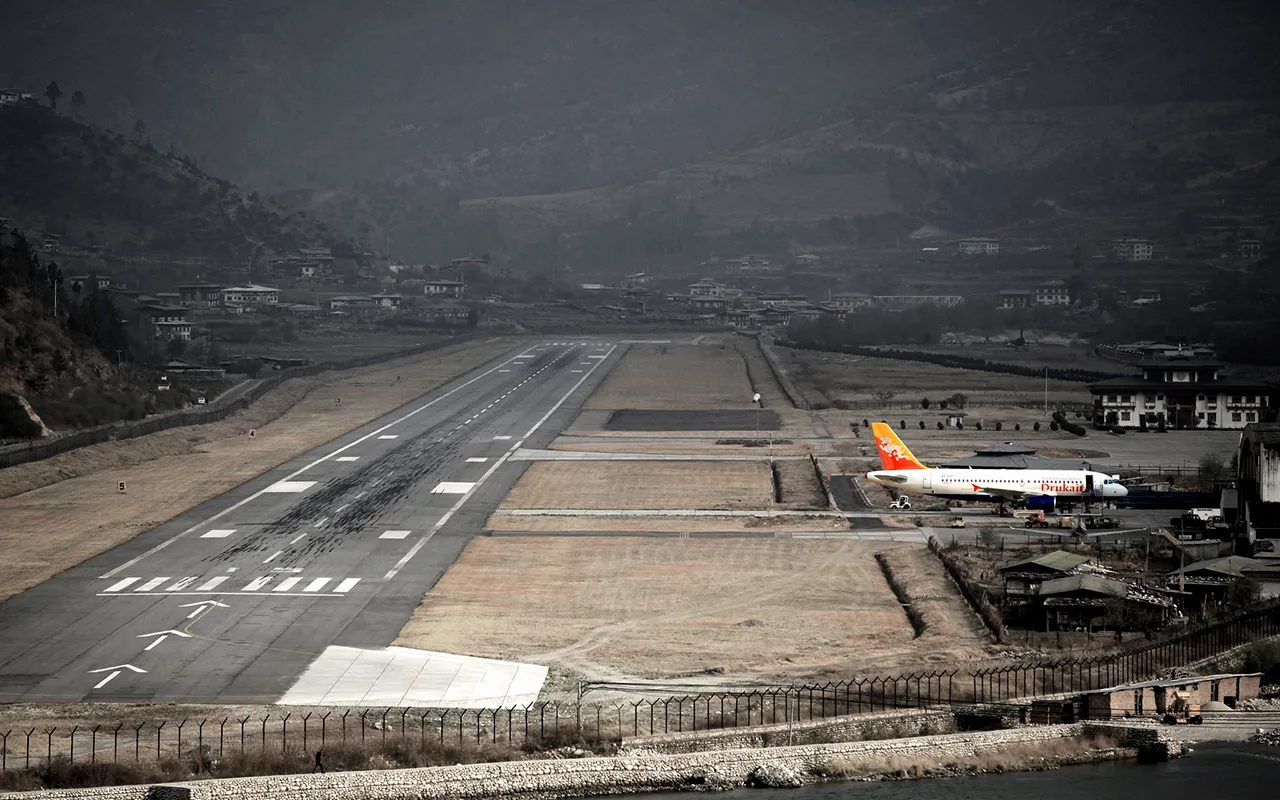
Why Paro Airport Is Known as the World’s Most Dangerous Airport
Geography and Terrain
The airport of Paro is surrounded by high mountains of the Himalayas up to 5,500 meters. These massive mountains make the surroundings a lot dramatic and challenging, and the surroundings demand a very precise means of navigation and have minimal room for error when landing or taking off.
The approach-departure routes of the airport are restricted to a narrow valley. Pilots have to be good enough to turn sharply and make steep descents that can fit safely into the runway amid the mountainous areas.
The single runway is just 1,964 meters long, requiring precise control during both take-off and landing. The short runway requires a well-managed speed and precision of the pilots to make sure of safe landings and non-excessive takeoffs.
Weather and Visibility
Paro Airport is subject to sudden weather such as heavy wind, changes in cloud formation, and poor visibility. Unpredictability in severe weather conditions further complicates the act of flying in the area and poses challenges even to the most experienced pilots.
The flights at Paro are conducted from sunrise to sunset under very stringent visual flight rules (VFR). This implies that good weather and good visibility are predominant when the pilots can fly safely, restricting the flight schedule and improving safety measures.
Unfavorable weather conditions happen frequently, whereby delays or cancellations are made as the utmost consideration is safety. The terrain of the mountains also increases the weather problems in the airport, making its scenario one of the hardest to be in terms of landing and taking off.
Pilot Expertise
There are fewer than 25 pilots allotted globally to land at Paro Airport. This is a cool group attending to which tough evaluations take place, as the airport is highly challenging and requires professional skills to facilitate safe processes.
The training of these pilots is very intensive, with the use of simulators that reflect the tough conditions found on Paro Island. The training can help them get used to the steep landing or runway, sharp turns, and specific landings needed at the airport.
Training also encompasses in-country experience training under Drukair and Bhutan Airlines that the pilots are able to know the role geography and weather patterns of the region firsthand. This is a massive cumulative program necessary to ensure the safety record of Paro Airport.
The Beautiful Side of Paro Airport
Scenic Landing through the Himalayas
Passengers can enjoy breathtaking aerial views of Himalayan giants such as Everest, Kanchenjunga, and Jomolhari before descending over Paro Valley. These grand mountains form a beautiful scenery, with the dramatic approach to the airport.
The plane, as it slowly goes down, gives exciting air scenes over Paro Valley to the passengers. The countryside is dotted with old monasteries, twisted streams, and green meadows, which complicates the time before the suspense touchdown to the last moments, making the scenery exceptionally memorable and emotionally beautiful.
A great deal of natural beauty and a high level of adventure reward are found in this remarkable landscape. Approaching the flight is also an experience one can never forget, as it introduces one to the rugged setting of Bhutan and the mountain setting at its best.
Traditional Bhutanese Architecture
The terminal at Paro Airport has an authentic Bhutanese architecture that has highly carved wooden structures and colorful traditional paintings. The design corresponds to the rich cultural background of Bhutan, and the country offers a feeling of belonging, which provides value to a traveler.
The artistic fine details and craftsmanship reflect both Bhutan city spiritually and aesthetically. Tourists can be given a cultural overload the moment they arrive, with a message that Bhutan has consistently embraced of maintaining its own distinct culture.
A hospitable environment is created by this type of architecture. It connects the contemporary role of an airport to the historical and cultural background of Bhutan in a very beautiful and purposeful manner.
Serene Environment
Paro Airport is located in a provincial landscape between pine trees and hills and is devoid of any traffic and congestion. The airport’s peaceful surroundings reflect Bhutan’s philosophy of harmony with nature, offering travelers a rare sense of tranquility.
The serene atmosphere adds a spiritual touch that is typical of this airport. The beauty of the natural environment encourages rest and reflection, and this tendency is welcomed beyond Bhutan’s nature culture in harmony with nature.
The peaceful nature of Paro is relaxing and cleansing to the tourists. It provides a unique feeling of relaxation and touch with the surroundings, as it is not simply a transit center.

What Makes Flying to Paro a Once-in-a-Lifetime Experience
Flying to Paro is an unmatched experience of excitement and beauty that is fascinating to all travelers. The adrenaline rush of going through rough terrain is completely blended with the serene landscape of the Himalayas and makes the journey incomparable to any other.
Each landing in Paro is an act of excellence, almost like a ballet act. Pilots have to make perfect maneuvers that will ensure they land safely on the short runway, and those maneuvers demonstrate professionalism, which leaves passengers with not only admiration but also respect.
Pilots often describe the descent as “threading a needle” through the mountains — a combination of precision, beauty, and controlled adrenaline unlike any other airport approach in the world. This is the metaphor that portrays the impossibility and delicateness of the challenges faced by a pilot on the single-path valley and mesmeric hills surrounding the landing airstrip.
Such a combination of natural magnificence and the technology of flying to Paro makes it an experience of a lifetime. It questions and entertains simultaneously and provides the visiting travelers with picturesque memories of the magnificent gateway of Bhutan.
Practical Travel Tips for Flying Into Paro Airport
Best Time to Fly: March to May and September to November are the best months that one can effortlessly fly to Paro. These days have the best skies and the best conditions under which to fly.
Airlines flying to Paro: Only Drukair and Bhutan Airlines operate scheduled international flights to Paro. They are competent and long-time serving at the airport.
Flights To: Flights are received at Kathmandu, Delhi, Bangkok, Dhaka, and Singapore. These are the principal foreign ports to Bhutan.
Landing Instruction: Seat on the left side when flying into Paro from Kathmandu for the best mountain views. This offers the most desirable landings of the Himalayan Mountains.
Entry Requirements: Visitors must have a Bhutan visa in order to travel to this country. Furthermore, it is mandatory that a ticket purchased by Drukair or Bhutan Airlines is needed to fly.
Extra Tip: No night landings are allowed; all flights operate in daylight hours only.
Nearby Attractions after Landing
After landing, visitors can explore iconic landmarks such as Rinpung Dzong, the cliff-side Tiger’s Nest Monastery, and the ancient Kyichu Lhakhang temple — each offering insight into Bhutan’s timeless culture. Its giant walls and intricate architecture symbolize Bhutan’s spiritual and artistic heritage.
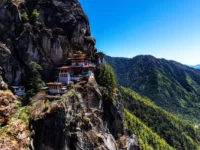
Tiger Monastery or Taktsang Monastery stands greatly perched on a cliff. The visit to this most significant spiritual site is recommended in a short drive, after which a rewarding hike, along with the stunning view of the mountain vistas, will come to the visitors of Paro.
Kyichu Lhakhang is among the oldest but most sacred temples of Bhutan. It also reflects the ancient religious life in Bhutan, and the serene environments also give the opportunity for one can reflect and contemplate the cultural heritage.
Paro town is small yet lovely. It offers an ideal place to go on a leisurely walk once the landings are complete, with small shops and cafes, and the local cultures that immerse the visitor in the peaceful conditions of Bhutan.
Conclusion
Paro Airport is a combination of risk and attraction that is going to be tough on piloting, but also presents a spectacular view of the Himalayas. One of the most incredible environments to challenge competence and compensate with breathtaking scenery makes every takeoff an unforgettable harmony between human skill and natural grandeur.
The attitude of aviation in Bhutan is minimal and mindful at the same time, as it is part of the Bhutanese culture. The nation puts safety and environment in the first place and tries to operate flows to experienced pilots to save the peaceful and spiritual atmosphere, which is the signature of the kingdom.
Traveling to Bhutan through Paro Airport is not merely a flight; it’s a breathtaking introduction to the Kingdom’s serenity and splendor. To the tourists interested in this amazing adventure, by reserving Bhutan tours with us, you will receive professional guidance on the adventures to experience and have hassle-free transportation plans.


