



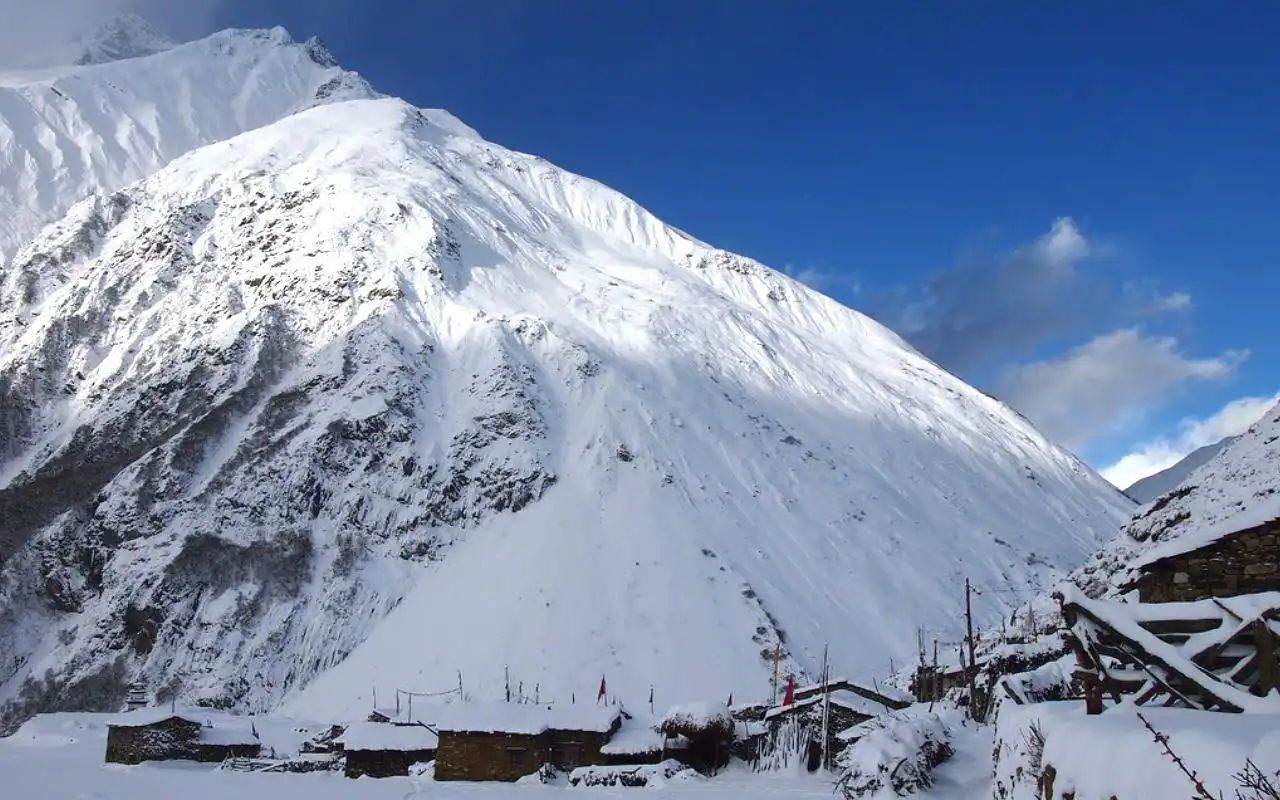
Nestled high in the Manaslu Conservation Area of Nepal, Samdo is a tiny, remote village that feels worlds away. Perched at about 3,875 meters (12,713 feet) above sea level, Samdo village is the final inhabited stop on the classic Manaslu Circuit trek before the Larkya La (5,106m) pass. Framed by the soaring ridges of the Manaslu Himalaya, the village consists of stone-built houses, fluttering prayer flags, and one small gompa (monastery).
As trekkers ascend through subalpine forests and meadows, Samdo suddenly appears across a broad valley – a “Himalayan natural gem” and a Tibetan cultural hub in the rugged Nepalese highlands. For many, reaching Samdo is a milestone: the last taste of village life before the truly high-altitude trails beyond.
Samdo is celebrated for its dramatic scenery and deep Tibetan Buddhist traditions. From the village, there are uninterrupted views of the massive snow-capped peaks around – not least Mount Manaslu (8,163m), the world’s eighth highest mountain, which towers overhead from the southeast. Ngadi Chuli (7,871m) and Himalchuli (7,893m) loom to the south, while Larkya Peak guards the approach to the pass.
The mighty ones below these are Alpine meadows in the beauty of spring, and surmounted by moraine ridges and mani walls of the Buddhists, and Samdo is one of the most spectacular outlooks of the trek.
It is against this striking backdrop of the native Tibetan-descended inhabitants of Samdo who continue with a genuine highland lifestyle, inclusive of prayer wheels, butter lamps, and livestock such as yaks and dzos tied outside their houses. The village feels like a living museum of Tibetan highland culture, an active settlement that keeps this culture alive at the very border of Nepal.
Historical and Cultural Heritage
The people of Samdo are primarily of Tibetan identity, and most of their families migrated to the Kyirong region in the 1950s and 1960s. Their Tibetan dialect is kyirong, and they practice traditional Tibetan Buddhism but centered around Samdo Gompa, which is surrounded by thangkas, statues, and juniper incense, where monks recite evening prayers.
Outside the monastery, there are long mani walls that are built with carved prayer stones. Trekkers also take a clockwise walk around them, which turns prayer wheels like the locals. These traditions remain authentic because of the remote location of Samdo: families spin yak wool, care for livestock, and live a lifestyle very similar to their ancestors.
Such festivals as Losar also include masked dances, music, and common meals, which are usually accessible to visitors. Samdo is a very real insight into the Tibetan culture of the high Himalayas.
Getting There: Route, Permits, and Difficulty
It takes at least 7–8 days of walking through the Budhi Gandaki valley to reach Samdo. Trekkers first travel by jeep or bus from Kathmandu to Soti Khola or Machha Khola — the drive takes about 7–9 hours to Soti Khola and 9–11 hours to Machha Khola, depending on the road and vehicle.
The Manaslu Circuit route begins at the trailhead and gradually climbs through forests, agricultural land, and river crossings toward key villages such as Jagat, Deng, Namrung, Lho, and Samagaon.
Permits are checked at Jagat. In order to walk to Samdo, you require the Manaslu Restricted Area Permit (RAP) and the Manaslu Conservation Area Permit (MCAP). You also need the Annapurna Conservation Area Permit (ACAP), which is checked at Dharapani.
This permit must be obtained in advance in Kathmandu or Pokhara. All permits have to be organized by a licensed trekking agency; it is not permissible under Nepali law to travel alone and unguided.
Teahouse lodging is basic, yet dependable on the track. There are simple rooms, shared bathrooms, and there could be little electricity or hot water. The meals are mostly warm Nepali or Tibetan cuisine with a central stove heating the dining room during the nights.
Difficulty:
The trek to Samdo is not technical but is moderately challenging due to long walking hours and steady altitude gain. Assume 6-8 hours daily walking on various surfaces, constant increase in level. Samdo is close to 3,900 m with Dharmasala (4,460 m) and Larkya La Pass (5,106 m) some distance ahead, hence acclimatization is required.
Here, lots of trekkers spend an additional day in Samdo or make brief acclimatization hikes prior to proceeding higher. Autumn and spring are the most favorable periods. Monsoon is accompanied by rain and landslides, and the winter snow may also block the trail. Most trekkers arrive in Samdo quite comfortably with moderate fitness and with reasonable acclimatization.
Landscape, Scenery, and Altitude
The terrain near Samdo varies rapidly with altitude. During spring and summer, the forests and terraced fields are utilized to open and alpine meadows sprinkled with wildflowers. Samdo is located beyond the tree line in a long and windy valley with clear, thin air and acute mountain scenes.
The Spring (March-May) is a sunny season, with rhododendrons in the lower hills beginning to bloom, and the Autumn (September-November) is a pleasant period with temperatures of 10–15°C in the daytime and nights freezing down.
The village is framed by gigantic hills on all sides. The Manaslu massif erects itself straight to the south and is united with Ngadi Chuli and Himalchuli, whose snowy mountains are gleaming in the sunlight. The trails around the village have mani stones, chortens, and lines of prayer flags, and the place is filled with the soothing spiritual air.
It is at this altitude that wildlife is sparse, although trekkers may still observe marmots and Himalayan choughs. Bar-headed geese appear occasionally during migration. Night is chilly and very clear, frequently showing a blazing Milky Way over the mountains. Samdo is a Tibetan world unto itself with its blue sky and white mountains and its silent Tibetan culture.
Samdo Village – Life and Traditions
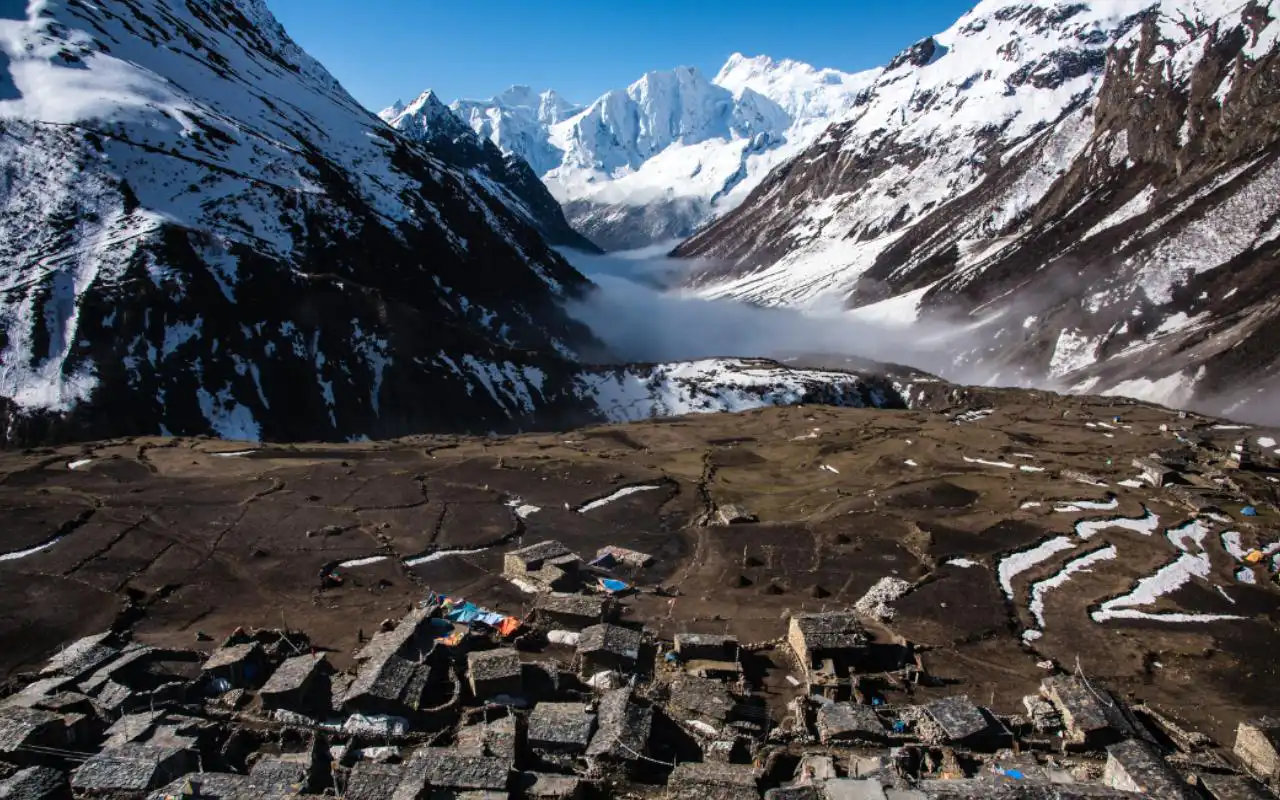
It is as though Samdo is silent and lonely when you come in. The number of such families permanently residing here is but a few dozen, in close-built stone houses, with flat roofs, and yak barns under them.
The homes above are warmed with the smoke of dung stoves. The locals wear huge wool and fur hats, children are seen playing in the small lanes, and they are usually very inquisitive about other trekkers as they pass by.
Every day routine is done by the old routine. Families cultivate barley and potatoes, keep yaks at summer pastures, and make cheese and butter, as well as woolen products. You can find women spinning, older people grinding barley flour, or villagers hoarding yak dung to use during winter. These activities are evidence of a way of life that has not changed much across generations.
The people of Samdo are truly hospitable. There is a reduced number of tourists compared to other trails, and the interactions are natural and not in a hurry. Even a simple greeting or a cup of tea can lead to warm interactions with locals.
Evenings in the teahouses are gatherings of people around the stove, where the aroma of the yak butter tea and incense covers the room. These are some of the times that trekkers feel that Samdo is not a tourist destination but a living Himalayan village.
Samdo Monastery and Mani Walls
At the northern end of the village stands the Samdo Gompa – a small monastery built of stone and wood. The courtyard contains a statue and prayer wheels; a cylinder of butter lamps often burns in the dusk. It’s not a major pilgrimage site, but it’s the living religious center for villagers. When monks pray, they chant in Tibetan and strike long horns and cymbals, creating a solemn rhythm.
Visitors may slip inside the main hall (with permission) to see the colorful murals and hand-cast statues. A novice or nun may pour butter tea for trekkers, and you’ll likely be asked to spin prayer wheels placed along the wall.
Nearby are Samdo’s Big Mani Walls – walls of stacked stones carved with prayers. These are sacred and should be approached respectfully. The proper etiquette is to walk clockwise around them (a kora), spinning any wheels you can as you pass.
Local belief holds that each stone continuously radiates blessings, so even for a passerby, it is a quiet form of prayer to circle these walls. Take your time, move slowly, and soak in the murmuring mantra that each stone contains. These ancient mani walls, weathered by centuries of wind and sun, connect Samdo to the broader Himalayan Buddhist tradition.
Cuisine and Accommodations
Samdo has a few basic teahouses like Snowland Lodge, Samdo Peak Lodge, Yak Kharka, and Samdo Guest House. The rooms are simple and have common facilities, a scarcity of electricity, and use of squat toilets outside. Hot showers are not the norm, and therefore, a warm bucket wash is the order of the day.
The central Bukhari stove of the dining room provides most of the warmth, as trekkers sit around it at night. The accommodation is not luxurious, but rather clean and comfortable enough to have a good sleep.
Food is of Tibetan and Nepali traditions. The key components are Dal bhat, thukpa, momos, tsampa, and salty butter tea, and yak meat or dried sukuti is usually taken as an additional source of energy. Dinners are substantial and will help to warm up the chilly weather, yet it is better to have a few snacks on board.
The food is also served in a common manner, and trekking guests and villagers sit around the stove and observe life in the village outside, yaks, eagles, and children running between the prayer flags. These silent moments make dining in Samdo both realistic and unforgettable.
Trekking Around Samdo
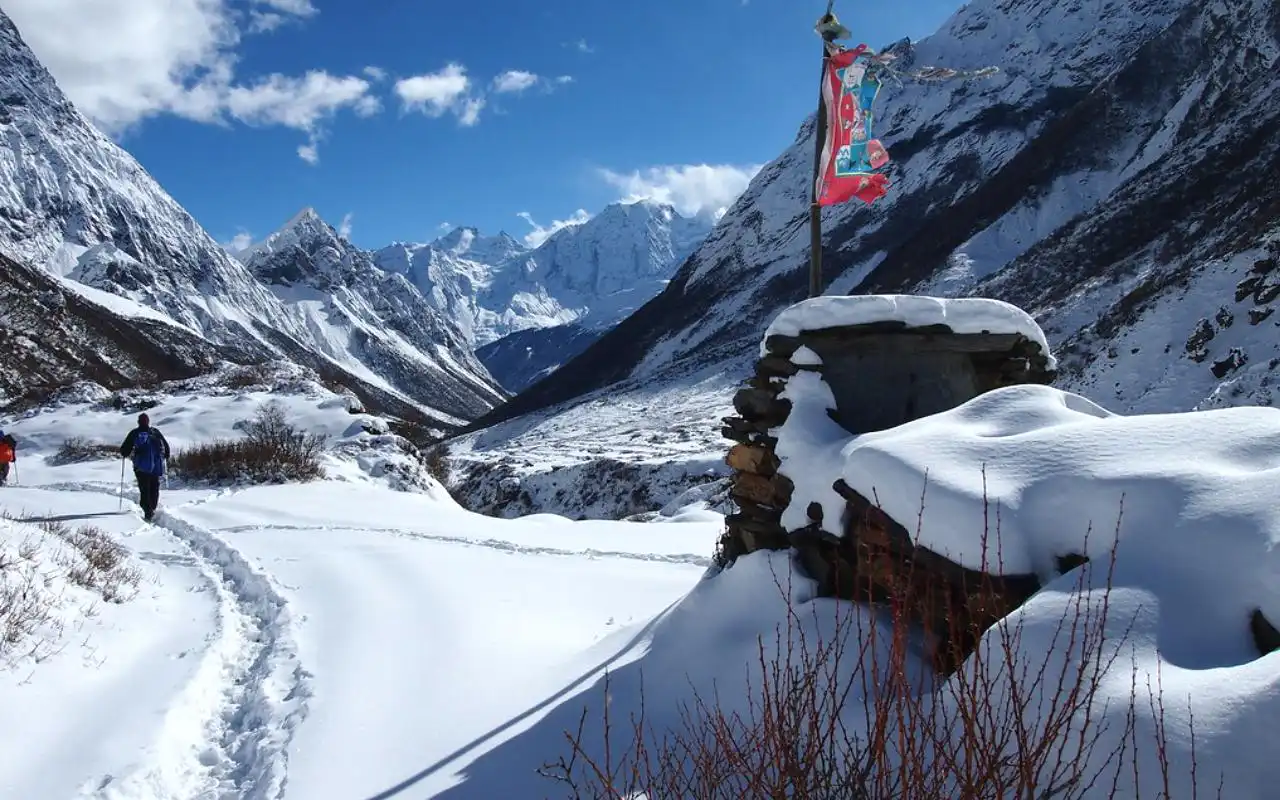
Rest and acclimatization: The majority of Manaslu routes are designed to allow one or two nights at Samdo (3,875 m) to allow trekkers to become acclimated prior to the higher altitude climb to Larkya La. A rest day does not imply sitting around; however, the guides often propose little, easy walks to nearby ridges or yak pastures to aid acclimatization by the so-called hike high, sleep low rule.
Side trip – Samdo Ri: With a healthy dose of stamina, Samdo Ri is a great place to start and enjoy an enjoyable ascent of a non-technical peak of approximately 5,200 m. It is approximately a 6-8 hour round trip, with rocky areas (some may be snow-covered or scree-covered) that get steep towards the summit.
It is also at the summit where you can view Manaslu and its surrounding ranges in a spectacular 360-degree perspective. Only do this on a good day, when there are no altitude symptoms, and the conditions are favorable, then this can be a trip that is unforgettable and an acclimatization experience.
Exploring the village: The small lanes of Samdo and the river walk are the areas to explore on short walks to feel a quiet rhythm of everyday life. You are likely to come across monks doing puja, villagers preparing yak cheese, or prayer flags fluttering. Even a silent hour by the riverbank may be very soothing here in the high Himalayan environment.
Interactions with locals: The warm smiles are usually received through a polite Tashi Delek. Upon entering a house, take off your shoes, and please take tea. Ask permission before taking pictures, particularly in places of worship. Basic discussions- usually accompanied by signs- form important exchanges and understanding of life at high altitude.
The calmness of Samdo, the culture, and the dramatic view of the place have made it one of the most unforgettable places to visit on the Manaslu Circuit.
Practical Tips: Acclimatization and Ethics
Altitude instructions: It is important to be acclimatized at Samdo because of its elevation. The trip normally has rest days at Namrung and Samagaon before arriving in the village. When you get to Samdo, take your time, keep hydrated, and have plenty to eat. In case you have a headache, nausea, or dizziness, inform your guide in time.
It is very common to see many trekkers walking a short hike high, sleep low to the closest ridge or Samdo Ri, and then returning to sleeping in the village. Bring altitude medicine, such as Diamox, only if advised by a medical professional.
Essentials: Nights in Samdo can drop to around -3°C to -8°C in autumn and -10°C or lower in winter, so a warm sleeping bag (-15°C), thermals, a windproof jacket, hat, and gloves are necessary. Sunglasses, sunscreen, lip balm, and a water purification method are necessities. Trekking poles are used to assist on steep or icy paths. Packing out bags, extra bags, small snacks, and a headlamp will make your stay more comfortable.
Travel ethically: Use village lodges to eat and drink to support the local economy. Ask permission before taking photographs and observe the local tradition, e.g., walking clockwise around mani walls and prayer wheels. Dispose of all non-biodegradable materials and do not disturb the livestock or wildlife.
Use toilet lodges, disinfect your water, and avoid making noise in and around residential and religious places. Responsible travel challenges keep Samdo clean, peaceful, and see to visitation by local and future trekkers.
Samdo’s Role in the Manaslu Circuit
Samdo’s significance goes beyond its own borders. On the Manaslu Circuit, it serves as a crucial linchpin. First, in practical terms, it is the last village before Larkya Pass. There are no roads here – Samdo is only reachable by foot – so it is the final chance for trekkers to interact with settled life on the Nepal side.
The next settlements after Samdo are the seasonal camps at Samdo Phedi (Larkya Base) and then Dharamsala on the pass’s other side. In that sense, Samdo is both a gateway and a buffer: a place to acclimatize and prepare mentally for the pass, while also symbolizing the threshold between the gentle valley trek and the high, barren world above 5,000 meters.
Culturally, Samdo stands at the northern edge of Nepal’s Gurung and Tibetan regions. It lies on the old trade path toward Tibet, and retains a deep Tibetan Buddhist character. Walking into Samdo is like stepping through a time portal to Tibet – even though you are in Nepal, the atmosphere, language, and spirituality feel distinctly Tibetan.
For trekkers, Samdo’s Tibetan heritage is one of the most memorable parts of the Manaslu route. Many guides say that the combination of Samdo’s cultural richness, spectacular mountain vistas, and its essential acclimatization role makes it “one of the most memorable stops on the Manaslu Circuit Trek”.
As one of the travel authors stated, Samdo is the place that can be described in one word as overwhelming natural beauty and rich cultural heritage, which is why it has become famous due to its authenticity and scenery.
Lastly, Samdo is significant since it is a high-altitude community revealing how life continues to exist in extreme conditions. It is not just the mountains that make the Himalaya trek special, but the people who dwell around the mountains.
Samdo reminds us brightly that the path is not only a way to be linked with nature, but also with human experience: the family prayer in the morning, a welcome to a monk, or a harvest of a herder. In that sense, Samdo is significant to the Manaslu Circuit because it embodies the human heart of the trek.
Planning Your Visit: If you’re organizing a Manaslu Circuit trek that includes Samdo, remember that permits and guide arrangements must be arranged in advance. Trekking permits (RAP, MCAP, and ACAP) can only be obtained through a licensed Nepalese operator.
A TIMS card is not required for the Manaslu Circuit when you have a RAP. Sample itineraries typically spend 7–8 days reaching Samdo, followed by the Larkya pass, then descent via Bimthang and Dharapani to exit into the Annapurna area. Prepare for cold nights and sun-filled days, and pack layers accordingly.
Best time to go: The ideal seasons are spring (March–May) and autumn (September–November). Spring shows off blooming rhododendrons on the lower trail, and autumn has clear skies after the monsoon.
Summer is the wet monsoon (muddy and risky), and winter brings deep snow and extreme cold (which only expert trekkers attempt). Always check local conditions before setting out and heed your guide’s advice.
Conclusion: For trekkers interested in the Manaslu Circuit, Samdo is not just another waypoint – it’s the crown jewel of the high valley. It is a combination of history, culture, scenery, and challenge that will represent the Himalayan trekking experience.
Samdo makes an impression, whether you are rounding a mani wall, having a butter tea in front of a stove, or looking away at Manaslu mountain glowing at the sunset. It reminds us that despite such a torturous journey, there is always the next turn that holds with it moments of tranquility, spirituality, and human contact.


