


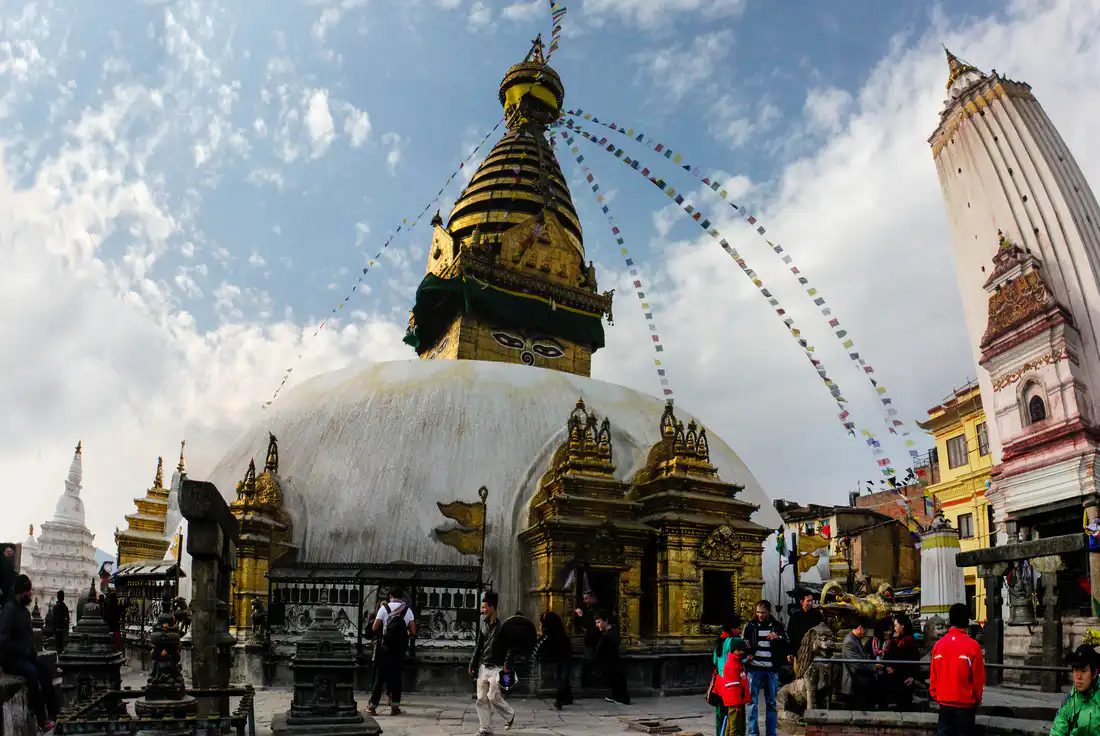

Swayambhunath is one of the famous Buddhist religious sites in the Kathmandu valley, west of Kathmandu city. Swayambhunath, which is also known as Simbhu in the local language derived from the word Singgu, meaning ‘self- Sprung’. It is also called the Monkey Temple among foreigners. For the local Newars, it is the most sacred Buddhist pilgrimage site. For Tibetans and followers of Tibetan Buddhism, it is the second major religious site after Boudhanath.
The complex consists of a stupa, a variety of shrines, and temples, some dating back to the Licchavi period. A Tibetan monastery, museum, and library are more recent additions. The stupa has Buddha’s eyes and eyebrows painted on. Between them, there is a mark like a question mark; called Sukhawati (way to heaven), the site has two access points: a long staircase leading directly to the main platform of the temple, which is from the top of the hill to the east, and a car road around the hill from the south leading to the southwest entrance. The first sight on reaching the top of the stairway is the Vajra (thunderbolt sceptre).
Swayambhunath’s iconography comes from the Vajrayana tradition of Newar Buddhism. However, the complex is also an important site for Buddhists of many schools and is also revered by Hindus. According to the Gopalrajvamsabali, it was founded by the great-grandfather of King Manadeva (464-505 CE), King Virsadeva, about the beginning of the 5th century CE. This seems to be confirmed by a damaged stone inscription found at the site, which indicates that King Virasadeva ordered work done in 640CE. According to Percival Brown, Swayambhu was 2000 years old. According to J.C Regmi, Swayambhu was built during the Kirat period, earlier to Lichhavis.
According to the Swayambhu Purana, the entire valley was a lake where nag (snake) used to reside where Bipaswi Buddha planted a seed of lotus which grew a lotus flower. Knowing about the Jyotirswarup(crystal flame) Manjusiri came from Mahachin(China) with King Dharmakar, his two wives, farmers, and monks to worship it. Seeing that the valley can be a good settlement and to make the site more accessible to human pilgrims, he cut a gorge at Chovar. Water drained out of the lake and made a settlement. The lotus was transformed into a hill and the flower became the stupa.
In 1349 Samasuddhin Ilyas of the Bengal sultanate invaded the Kathmandu valley and damaged the Swayambhu stupa by the Muslim army and later repaired by King Saktimalle Bhalloka. In 1505, the yogin Sangye Gyaltsen added the wheel and spire to the stupa’s dome. In 1614 the 6th Shamarpa had built shrines into the stupa in the four cardinal directions. Several important Kagyu Lamas held a consecration ceremony in 1750 after a major renovation. The famous Bhutanese master Lopon Tsechu Rinpoche (1918-2003), the late abbot of the Bhutanese Drugpa Kagyu Monastery on the western side of the stupas, came to Nepal in order to assist his uncle, the Drukpa Lama Sherab Dorje, in restoring and maintaining the stupa during the early 20th century. The most recent renovation of the Swayambhu stupa was completed in May 2010.
The valley came to be known as Swayambhu, meaning self-created. The name comes from an eternal self-existent flame (Syambhu) over which a stupa was later built. However, emperor Ashoka is said to have visited the site in the third century BC and built a temple on the hill which was later destroyed but historically it was not proved.
Although the site is considered Buddhist, the place is revered by both Buddhists and Hindus. Numerous Hindu Monarchs have paid their homage to the temple, including Pratap Malla, the powerful king of Kathmandu, who is responsible for the construction of the eastern stairway in the 17th century. Pratap Malla had built Pratap Pur and Anantapur temples on the premises. The stupa was completely renovated in May 2010, its first major renovation since 1921, and its 15th in the nearly 1,500 years since it was built. The dome was re-gilded using 20kg of gold. The renovation was funded by the Tibetan Nyingma Meditation Center of California and began in June 2008.
At around 5 am on 14 February 2011, Pratapur temple in the Swayambhu Monument Zone suffered damage from a lightning strike during a sudden thunderstorm. The Swayambhunath complex suffered damage in the April 2015 massive earthquake.


