


Duration
4 Days

Annapurna View Short Trek


Trip Grade
Easy
Group Size
1-16 People
Max Altitude
3,210m. / 10,531ft.
Best Season
Feb- May/ Sept-Nov
Activity
Trekking, Sightseeing
Meals
Breakfast, Lunch & Dinner
Accommodation
Hotel
Transportation
Private Vehicle
Trip Customization
On request (click here)


Highlights of Annapurna View Short Trek
- The view of the golden sunrise over Dhauligiri, Annapurna, and Machhapuchhre at Poon Hill.
- Get to enjoy breathtaking views of snow-capped peaks during the trek.
- Walk in colorful woods, even prettier in spring.
- Taste the hospitality of the people under Magar and Gurung.
- Delicate walkway up and down through rivers, falls, and terraced fields.
- Take breath-taking sceneries, village life, and mountain scenes.
- Enlightening hike that incorporates beauty, culture, and adventure.
Trip Introduction
The Annapurna View Short Trek is one of the most frequented short treks in the Annapurna region in Nepal. It is both a great blend of natural beauty, cultural experience, and stunning mountain scenery, thus suitable both to the novice and to the experienced trekker. The trek typically begins with a short journey by car, between Pokhara and Nayapul, and then the beautiful scenery walking through, quaint villages, woodlands, and terraced agricultural farms.
During the trek, the traveler is able to get to experience the serene lifestyle of rural Nepal. The trail goes by several traditional Gurung and Magar villages like Tikhedhunga, Ulleri, and Ghorepani, where one can observe the simple lifestyle of people living there. The Magar culture, particularly in Ghorepani, is also characterized by its warm hospitality and traditional houses, as well as its colorful culture.
Also, you can find farmers in the fields, children smiling at you on the road, and herds of mules passing along the path with deliveries. Poon Hill is one of the most prominent spots in the trek (3,210 meters). It has been ranked among the finest walks in Nepal to observe the sunrise over the magnificent Himalayas.
In the morning, the trekkers can hike to Poon Hill and observe the golden sun rays on Dhauligiri (8,167 m), Annapurna I (8,091m), Annapurna South (7,219m), Machhapuchhre (6,993m), as well as various other mountains. The perspective is just breathtaking and unforgettable. Even the trail is rich and beautiful. You pass through the rhododendron and oak woods and side by side over little brooks and cascades and breathe in the cool mountain air.
The rhododendron forest, which is bright red and pink, also releases blossoms during spring, and thus the landscape becomes even more impressive. The singing of birds and the breeze of coolness give calmness to the traveler. The Annapurna View Short Trek will typically require 4-5 days to finish, and there are comfortable Teahouses that can be used to dine and sleep on the trail.
The hike is of moderate effort and can be taken out by individuals of any age, provided they are of an athletic level of fitness. It is an incredible adventurous trip that provides a memorable access to the mountain beauty and the local culture, as well as to the hospitality in Nepal.
The trek is an excellent adventure that enables the trekkers to experience nature in a very close way, understand the life of the Himalaya people, and make memorable experiences amidst the magnificent views of the Annapurna area.
Outline Itinerary of Annapurna View Short Trek
Day 01: Drive from Pokhara to Nayapul and Trek to Tikhedhunga
Day 02: Trek from Tikhedhunga to Ghorepani
Day 03: Trek from Ghorepani to Tikhedhunga via Poon Hill
Day 04: Trek from Tikhedhunga to Pokhara via Nayapul
Our guests sharing their experiences (Photo/Video Gallery)


Detail itinerary of Annapurna View Short Trek
01
Day 01: Drive from Pokhara to Nayapul and Trek to Tikhedhunga
We start our day in Pokhara, then choose a 1-to-1.5-hour trip to Nayapul, which is an attractive place to begin our trip. The road has pleasant scenery, with green hills, terraced fields, and local villages that are seen on the route. Nayapul, which is New Bridge, where most treks in the Annapurna region start.
Here we begin to walk on a path that is not hard, this is along the river and enters villages which are small, such as the Birethanti, where we can find local shops, tea houses, and friendly villagers. The road leads gradually but steadily up through terraced farmlands and woodlands full of the noise of birds and running water.
The landscape is more serene as we approach Tikhedhunga, where there are old houses made of stone and distant hills. We walk approximately 3-4 hours to Tikhedhunga, a small village in the midst of nature, and spend the night in a lovely house.

Activity: 3-4 hrs trek

Max. Altitude: 1,570m/5,151ft. Tikhedhunga

Meal: Breakfast, Lunch & Dinner

Accommodation: Teahouse
02
Day 02: Trek from Tikhedhunga to Ghorepani
The present walk begins with a difficult climb out of Tikhedhunga. It is a steep ascent, and it takes approximately 1.5 hours to reach Ulleri, a Magar village that is very beautiful as well as hospitable. At Ulleri, the way gets smoother on the way to Banthanti and the groves of the rhododendrons and oaks.
On the route, we are likely to have beautiful sights of snowcapped mountains, such as Machhapuchhre (Fishtail), Hiunchuli, Annapurna South, etc., which can justify the effort. The sound of birds and the cool mountain breeze give tranquility to the trip. As we climb further, the trail cuts through the colorful forests, which are mostly beautiful during spring when rhododendrons are in blossom.
In 6 to 7 hours of walking, we arrive at Ghorepani, a lovely village of Magar with thick woods around it. Ghorepani has stunning views of the mountains and comfortable teahouses where we will stay for a night.
Activity: 6-7 hrs trek
Max. Altitude: 2,860m/9,383ft. Ghorepani
Meal: Breakfast, Lunch & Dinner
Accommodation: Teahouse
03
Day 03: Trek from Ghorepani to Tikhedhunga via Poon Hill
Our day begins in the early mornings when we make a brief walk-up hill to Poon Hill, which is one of the most popular sites in the Annapurna region. We can observe a spectacular sunrise against the snowy peaks of Dhaulagiri, Annapurna, Machhapuchhre, as well as numerous other mountains shining in golden hue at the top. It is an amazing panorama and a place to take photos.
We take time to enjoy the scenery, after which we get back to Ghorepani for breakfast. Then we start a walk back to Tikhedhunga. The path continues to go beneath the thick rhododendron, bamboo, and oak trees and is full of the sound of birds and the view of little waterfalls.
In the process, we enter lovely villages and winding hills. It is a long, peaceful hike of approximately 6 to 7 hours. By afternoon, we get to the small and beautiful village of Tikhedhunga, on the river, and we rest the night in a pretty teahouse.
Activity: 6-7 hrs trek
Max. Altitude: 3,210m/10,531ft. Poon Hill
Meal: Breakfast, Lunch & Dinner
Accommodation: Teahouse
04
Day 04: Trek from Tikhedhunga to Pokhara via Nayapul
We start our last day of the trek after breakfast by descending Tikhedhunga towards Nayapul. The track is mostly down and through beautiful terraced fields, small villages, and serene woods. On our way, we follow the running river, listening to that soft murmur of water and singing of the trees by the birds. We can sense the beauty of nature surrounding us since the path is not as challenging as it was before.
We take lunch at Birethanti, a beautiful village lying along the banks of the river, where we can have good food and see the scenic view of the Modi River. We walk a little and arrive at Nayapul, where our trekking adventure ends. With this, we embark on an idyllic journey to Pokhara on a scenic road passing through green hills and local settlements.
Our trip comes to an end in our hotel in Pokhara, where we will have time to rest and look back at the great trekking experience.

Note:
If you have your own private group and want to make your trip private, we can run the custom trip all the day as per your requirements and group size.
Includes and Excludes
What are included with package?
- Pick up & Drop from the Hotel in Pokhara by Private Vehicle: Private transportation will be provided to and from your hotel in Pokhara.
- Meals During Trekking (Lunch, Dinner, and Breakfast): All meals during your trek (lunch, dinner, and breakfast) will be provided.
- National Park Permit (ACAP): The cost of the Annapurna Conservation Area Permit (ACAP) is included.
- Trekkers’ Information Management System (TIMS) Permit: The TIMS permit required for trekking is included.
- All Necessary Paperwork: All required paperwork and permits will be arranged by the company.
- Accommodations in Lodges/Tea Houses: Accommodation will be provided in tea houses or lodges during the trek.
- Experienced Guide and Porter: An experienced and friendly guide will be provided, along with a porter (1 porter for every 2 clients).
- Medical Supplies (First Aid Kit): A basic first aid kit will be available during the trek to handle any medical emergencies.
What are not included with package?
- Hotel in Pokhara: Accommodation in Pokhara is not included in the package unless otherwise specified.
- Travel and Rescue Insurance: Travel insurance that includes coverage for trekking and rescue services is not included. You will need to arrange and pay for this separately.
- Personal Expenses: Costs such as phone calls, laundry, bar bills, battery recharge, extra porters, bottled or boiled water, hot showers, and any other personal items are not included in the package and are your responsibility.
Pick Your Suitable Date
US$ 350
Book a Private Trip
Private & Group Discount Price
-
1 -
1 person
US$ 500
-
2 -
2 people
US$ 350
-
3 -
5 people
US$ 300
-
6 -
10 people
US$ 250
-
11 + people
9999
US$ 200
1 Travelers x US $ 2000
Total Cost:
US$ 500
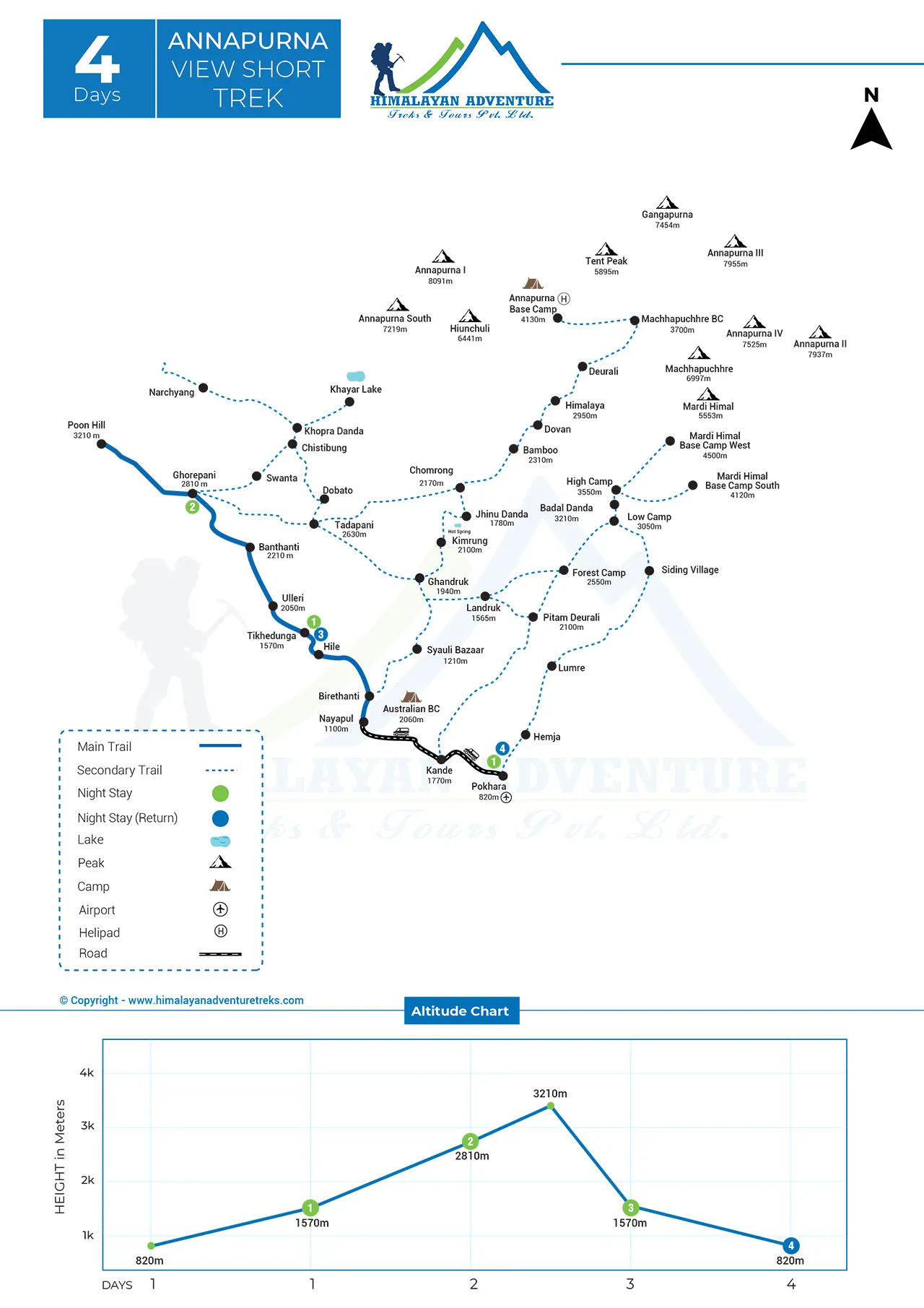
Route Map & Altitude Chart
Pokhara
Start/End point
Pokhara
Trip Information
Best Time
The Annapurna View Short Trek may be carried out at any time of the year, yet with every season, it will be a different one. Being aware of the expectation of every weather will mean that you can prepare in advance and make the journey more comfortable.
One of the best times of this trek is during spring (Mar–May). It is warm, and the skies are generally clear with the rhododendron forests in their full bloom, bringing about colorful scenes on the trail. It is possible to see clear view of Annapurna, Dhauligiri, and Machhapuchhre. Days are favorable, and mornings and evenings are a little cool. This time of the year will suit light layers and a windproof jacket.
The monsoon season (June–Aug) is connected with heavy rain, and therefore, the trails are wet and slippery. But the woods turn fresh and green, and the waterfalls are in their finest. The mountain views are intersected by the clouds, which occasionally cover the mountain views, but the air is fresh and clean.
You must have a good raincoat, a waterproof pair of boots, and insect repellent. The season is also not very crowded, which may be an advantage for quiet trekking.
The most popular season to go trekking is autumn (Sep-Nov). It is very stable in the weather, and the air is clear with visibility being excellent visibility. You will have beautiful mountain scenery, colorful woodland scenery, and cool, pleasant temperatures.
It is the most opportune time to go out and take pictures and experience the culture. Remember to take some light clothes during the day and cuddly clothes during cold nights.
Winter (Dec–Feb) is cool and with crystal clear views of the mountains, with very cold temperatures, especially in the mornings and evenings. The upper sections of the trail could be snowed. The trail is less noisy and involves a smaller number of trekkers. There is a need for warm jackets, gloves, thermal, and heavy boots.
Elevation and Distance
The Annapurna View Short Trek is a moderate and short trek that traverses various altitudes, through warm river valleys to cool mountain villages. The trek starts from Pokhara an elevation is approximately 850 meters, and the top of the trip is Poon Hill, which towers at 3,210 meters.
The approximate trekking distance of this path is about 35-40 kilometers based on the direction of the trail taken and other side trips. It is a pleasant walk, and considering that an average person with average fitness takes around 3 to 7 hours to do a daily walk.
On the first day, the trail starts with a slight drive between Pokhara and Nayapul (1,050m) and then to Tikhedhunga (1,570m). This section is plain and rather smooth, along the paths of rivers and villages.
Day 2 consists of a steep climb to Ulleri (2,070m), then a gradual climb in forests to Ghorepani (2,860m). It is among the toughest yet satisfying parts of the trek.
Day 3 is the climax of the trip, as the summit of the trip will be Poon Hill (3,210m) and the ascent will be in the early morning. This is where the trekkers have a spectacular sunrise view of the Annapurna and Dhaulagiri Mountain ranges. Subsequently, the trail goes down to Tikhedhunga (1,570m) through forests and villages.
And lastly on Day 4, the journey goes on down to Nayapul (1,050m) and is concluded by a drive back to Pokhara (850m). The trek presents a moderate combination of ascending and descending walks, which make the trekkers progressively adjust to the altitude; they are entertained with varying scenery where riverside walks and forest walks are experienced, as well as close-up views of the mountain.
Difficulty and Altitude Sickness
Annapurna View Short Trek is said to be one of the relaxed and less difficult treks in the Annapurna region. It is also relatively easy-moderate, family-friendly trek. The walk is not technical and does not need any special training, as it consists of steep climbs and long walking time.
Overall, the average trekking time taken by the trekkers is 4 to 7 hours per day when they pass through stone steps, forest trails, and mountain villages. The hardest aspect of the trek is the tormenting uphill move between Tikhedhunga and Ulleri that has more than 3,000 stone steps.
This part is a tiring one, though it is easy when one takes things slowly with periodic breaks. The remaining part of the walk is not very steep, there are well-marked tracks, and teahouses on the way to have food and have a rest. Poon Hill (3,210 meters) is the summit of the trek. The altitude is not as high as compared to most treks in the high Himalayas, and the chances of developing altitude sickness are thus minimal.
Nevertheless, other trekkers might experience light symptoms, including the feeling of mild shortness of breath, slight headache, or fatigue as a result of elevation change. To avoid getting altitude sickness, one should walk slowly, take lots of water, eat lots of food, and get ample rest.
There should also be no rush to an uphill area, because slow-paced running will enable your body a natural cycle to adapt to the elevation naturally. The body also becomes acclimated to spending the nights at low elevations, such as in Ghorepani and Tikhedhunga. Annapurna View Short Trek is a moderate and easy trek that most of normal people can manage.
Trekking equipment is not complex, and with the right kind of mindset, good walking shoes, and some basic preparation, the trekkers would find doing it quite simple, and thus they would be able to appreciate the spectacular scenery and the cultural magnificence of the Annapurna area.
Maximum and Minimum walks per day
In the Annapurna View Short Trek, the number of hiking hours per day changes with the route, terrain, and altitude. Trekkers also cover an average of 3-7 hours every day. The hike is made comfortable and fun, and has ample space to relax, have a meal, and enjoy the scenic mountain nature.
The shortest walking time is on Day 1, where you walk between Nayapul (1,050m) and Tikhedhunga (1,570m). This stage of the trip spans about 3 or 4 hours. The road is mainly natural, and it goes through small towns, rivers, and farmlands, which make it a light and comfortable beginning of the hike.
Day 2 is the most walking day as you walk between Tikhedhunga and Ghorepani (2,860m). It is approximated to take 6 to 7 hours and contains a long and sharp climb of over 3,000 stone steps to get to Ulleri. The trail after Ulleri is also more gradual, but still ascends uphill through the rhododendron forests, and the trail ends at Ghorepani.
It is made worth it despite it being the hardest day by the mountainous scenery surrounding it and the serene forest. There will be the same amount of 6 to 7 hours of walking, including the early sunrise trip to Poon Hill (3,210m) and later down the hill to Tikhedhunga (1,570m) on Day 3. On this day, there is some uphill and downhill walking, although it feels easier because most of it is downhill.
On Day 4, when the last destination will be Tikhedhunga to Nayapul, it will require around 3 to 4 hours of walking, and then a short drive towards Pokhara. The trek gives a moderate to easy walk, whereby trekkers will be able to relax and take in the scenic view as they take their time during the trek.
Accommodations, Foods, and Drinks
In the Annapurna View Short Trek, trekkers spend their nights in tea houses or lodges. They are small and homely guesthouses and are operated by local families and offering clean rooms with bare bones. The majority of lodges have single beds, blankets, and communal or individual bathrooms.
The tea houses will be a way of staying behind in the cozy comfort of the locals and enjoying a relaxing time in a tranquil mountain village. The tea houses serve all meals, including breakfast, lunch, and dinner (BLD). The food is simple but nutritious and will provide you with sufficient strength to go trekking.
Breakfast will commonly feature such dishes as eggs, toast, porridge, pancakes, or noodles, commonly accompanied by tea or coffee. Lunch is typically either daal bhat (rice with lentil soup), vegetable curry, noodles, or sandwiches. Eating takes place around dinner time, which mostly consists of dal bhat, soups, vegetable or meat curry, and occasionally pasta or rice.
The food is healthy, and it is prepared fresh using the small kitchens within the lodges. Anything that is not included in the delivered meals, like additional snacks, chocolates, biscuits, soft drinks, alcohol, or mineral water, has to be charged separately. There are tea houses with all types of snacks and drinks; the prices are most likely to be higher than in towns.
It will be nice to pack some power bars, chocolates, or individual snacks for the trail. As far as drinks are concerned, people can have boiled water, tea, coffee, or hot chocolate can be bought. Other trekkers carry water filters in the form of bottles or water purification tablets to get safe drinking water.
The Annapurna View Short Trek provides comfortable and reliable accommodation and meals. Spending the night in local lodges and taking basic Nepali dishes with you will provide you with an additional touch of culture, and your trekking trip will not only be staged with beautiful views, but it will be a warm and pleasant experience.
Alternative Routes
The Annapurna View Short Trek does offer some alternative paths that can be walked by the trekkers to visit the various villages, forests, and sceneries. Though the standard trail would be Nayapul, Tikhedhunga, Ulleri, Ghorepani, Poon Hill, Tikhedhunga, and Nayapul, it is possible to extend the trek to a longer, shorter, or more picturesque route. The alternative of taking off trek at Ghandruk rather than Nayapul is rather popular.
Most trekkers proceed as many as Ghorepani to Tadapani and subsequently to Ghandruk, a traditional Gurung village with excellent views of Annapurna South and Machhapuchhre and then drive back to Pokhara. This provides additional cultural time in Ghandruk.
Other alternatives are that this trek can be added to the Annapurna Base Camp (ABC) Trek. Trekking, establishing Ghorepani or Chhomrong as the base, one can proceed to ABC by either Tadapani or Chhomrong to see additional glaciers and cascades of the Himalaya, and high villages. It is appropriate for the trekkers who desire a longer adventure.
Some of the trekkers who are short of time skip Tikhedhunga or Ulleri by using a jeep nearer to Ghorepani but you must still trek to reach Ghorepani. This minimizes the time spent walking and simplifies the trek, but at the same time, you will be able to enjoy the sunrise and mountain view at Poon Hill. Also, the route of returning may be different.
Rather than taking the same route, hikers have an opportunity to go through a route via Banthanti or Hile, which offer them new forests, waterfalls, and rivers. This provides another look at the Annapurna foothills and the villages. These are the alternate trails that are flexible for any kind of trekker.
The Annapurna View Short Trek can be tailored to your time, fitness, and interests to have a short and easy walk, or more adventurous events lasting longer in length and providing breathtaking mountain sights and cultural adventure.
Can a beginner do this trek?
Yes, the Annapurna View Short Trek is beginner friendly. The trek is not difficult and is one of the simplest and most common hikes that are in the Annapurna region. This journey not very long and commonly takes 4 to 5 days; the paths are well-traced and secure. It does not have technical climbs, risky routes, or severe weather conditions, making it a descent option for those being introduced to trekking.
The time spent walking is moderate, between 3 and 7 hrs/day, and may be individually varied as you prefer. The roads are tarmac on most days, going through villages, forests, and rivers, and the places in which to rest are numerous. The climb up Tikhedhunga to Ulleri (which has more than 3,000 stone steps) is the most demanding section of the trek, which is possible to cope with by moving slowly and taking a break after every few steps.
This hike will also be rewarding to beginners since it will enable them later to enjoy breathtaking mountain landscapes, beautiful forests, and the culture. The summit point (Poon Hill 3,210 meters) is elevated enough to get the superb sunrise view in the backdrop of the other peaks, such as Dhauligiri, Annapurna, and Machhapuchhre, but not so high that altitude sickness would really be a severe issue for the majority.
The tea houses and lodges on the way offer ease of accommodation and meals, hence the logistical work is easy for novice users. You do not have to carry heavy equipment or camping gear. The beginners must also possess basic fitness, walk steadily, consume plenty of water, and wear comfortable shoes in order to complete the trek successfully.
Although this is an experience that those who do not hike often must train a bit before taking it, it can still be enjoyed. The Annapurna View Short Trek is an ideal introduction to trekking in Nepal, with its natural splendor, mountain lookouts, culture in a secure and procureable manner. It will provide amateurs with confidence and an experience of the Himalayan adventure to remember.
Preparation and Fitness
Although the Annapurna View Short Trek is regarded as a moderate and novice-friendly trek, one is worth some preparation to enjoy the trek in fine comfort. Physical preparation assists in making you walk long distances, scale steep routes, and adjust to the fluctuating weather and altitude.
Cardiovascular fitness Trekkers ought to be in possession of basic cardiovascular fitness. Walking, jogging, swimming, or cycling few weeks before the trek can help build stamina. Walking on hills or stairs can also be useful to get used to, because there are some steep inclinations on the trail, particularly between Tikhedhunga and Ulleri.
Building your leg muscles, core, and back stronger, you can carry a daypack less frequently. The most basic things, such as squats, lunges, and planks, can work at home. One should also learn to have a few hours of uninterrupted walking. Begin with brief walks and then slowly begin to increase the amount of time spent walking.
It is better to use trekking shoes during the practice to avoid blisters and enhance comfort. What is also useful is to have a small backpack with water, snacks, and other necessary things when walking and practicing. Take a lot of water and have regular meals to stay energized. Ensure you are healthy and visit a doctor in case you are having any medical conditions.
To have a basic first aid kit, including painkillers, bandages, and some medicine against altitude sickness, is recommended. Hiking may be a physically exhausting activity, and, therefore, one should relax and have a positive attitude. Slowness, patience, and readiness to take a break when one requires it make the trek fun.
Most individuals can comfortably go on the Annapurna View Short Trek, bearing good health practices, proper walking habits, and exercise. The trek is easier with preparation as well as you are in a position to appreciate the beautiful forests, the pretty villages, and the magnificent Himalayan scenery that can be seen in the course of the way.
Gadget Charging, Communication, and Internet
On the Annapurna View Short Trek, it is possible to be connected and have your gadgets charged, although you must plan. Most of the tea houses and lodges on the trail charge phones, cameras, or power banks. Nevertheless, electricity is available but may have load-shedding, and in some cases, it is only provided for several hours in the evening.
Certain lodges charge a little amount of fee to charge your devices, typically between 200-500 NPR per device. One should consider carrying a fully charged power bank in order to charge their gadgets even when trekking, particularly at times when their walking hours are very long. In this trek, coverage by mobile networks is not effective for communication.
In some places, such as Tikhedhunga, Ghorepani, and Nayapul, Nepalese SIM networks occasionally get signal through Ncell or Nepal Telecom. The network can be low or nonexistent in high or distant parts of the trail. Viber, WhatsApp, or phone calls will work in a village that has a signal, but do not expect to be connected the whole way up the trail. Access to the internet is also restricted.
The wireless Internet is available at most lodges, but it can be slow with a certain fee associated. The easiest thing to do would be to alert friends or family before you head to an area and spend no more than a small amount of internet time. As an accessory to carry, a power bank, charging cables, and an adapter (depending on necessity).
Also, make sure that you switch devices to low battery when not in use and, when possible, take advantage of charging in lodges. Although the trek has a low level of connectivity and the ability to charge gadgets, it gives a nice opportunity to lose the connection with the digital reality and experience nature, forests, and Himalayan scenery.
Pre-planning will help you to have the ability to take pictures and keep in touch whenever it is necessary without worries.
Permits Required
All the trekkers must possess the required permits in order to trek in the Annapurna region. The required permits for Annapurna View Short Trek is Annapurna Conservation Area Permit (ACAP) which cost around NPR 3000 for foreigners and the Trekkers’ Information Management System (TIMS) card which cost around NPR 2000.
These permits assist the government in controlling the trekking in the area, preserving the natural environment, and well as the safety of the trekkers. An ACAP permit will enable you to enter and walk through the Annapurna Conservation Area, which is a preserved national park. It assists in promoting conservation activities and local communities on the trail.
One of the services is the TIMS card, which is a trekker registration system to act as a source of important information that will help in safeguarding them and also assist the authorities in monitoring the trekkers in the field. The two permits are required by whoever takes this trail. When you reserve a trek with us, you should not worry about paperwork.
All the documents and the acquisition of the permits are done on our behalf. Your trekking package will include both the ACAP permit and TIMS card; therefore, you will have no worries of having to carry any baggage, you will be able to fully focus on your adventure, and enjoy the beautiful scenery with no inconvenience.
Once you reach Pokhara, you will find all your permits are already prepared, and a copy of the same will be given to you to use personally. Our team also makes sure that the permits are valid at all times during the trek. The permits are easy to acquire, and there is no stress of acquiring them, especially when acquiring them through a structured trekking package.
There is no need to wait in the long queues or fear of completing the forms, as all that is attended to. This will enable you to begin your adventure without any problem and make the most of the magnificent sightseeing, villages of the locals, and the Himalayan scenes of the Annapurna View Short Trek in full tranquility.
Transportation
In the Annapurna View Short Trek, transport is mostly utilized at the beginning and the end of the trek, and this makes the trek more comfortable and easier. The majority of the treks start with a journey outside Nayapul, starting at Pokhara, and take a scenic 1.5 hours along the mountain roads. This conserves time and power, and the trekkers are free to embark on their trek and are willing to enjoy the trail.
Once the trek is done, one gets to be carried back to Nayapul to Pokhara on transportation, which makes it a relaxing end to the adventure. Road transfers are done by private vehicles. Depending on the number of the group, the kind of vehicle will be selected so that everyone can travel comfortably.
Cars are in good condition, clean and safe, which provides a smooth ride over hilly and winding roads. Regardless of the size of your group, whether small or large, private transportation means flexibility, privacy, and convenience. You can also customize your transportation based on your budget.
As an illustration, you may decide to have a normal car or an SUV, or even a minibus, depending on the size of your group and whether to be comfortable or not. This will enable you to make plans to execute the trek based on your requirements, whilst spending a hassle-free time.
Traveling by personal vehicles is also beneficial in terms of saving time because the comfort of traveling by buses in the area may be insufficient and not very fast. You will have an opportunity to stop on the way and take some photos, have some fun in the local villages, or just relax your legs. The Annapurna View Short Trek includes an element of transportation.
With comfortable and private mode of transportation, trekkers can spend time appreciating the beautiful sceneries, beautiful villages, and Himalayan vistas, rather than long-lasting, tiresome transport solutions, and have to keep up with the time schedules of public transportation.
The ease and comfortable nature of personal transport will make the journey easy, fun, and stress-free at any point of the way.
Insurance
During the trekking in Nepal, the presence of travel and trekking insurance is not compulsory, yet it is strongly suggested to stay safe and sound. This is due to any accident, like slips, falls, and episodic injuries, happening in the process of trekking, as it requires walking over rough tracks, mountains, and even wet routes.
Accidents such as medical emergencies, illness, baggage loss, or flight cancellations are also some of the unexpected events that can be covered by insurance. In the case of the Annapurna View Short Trek, insurance would particularly come in handy, should the medical evacuation or helicopter rescue cover be required in case of emergency, even though the trek is moderate and the peak of the trek is Poon Hill, 3,210 meters, which is quite safe compared with the higher Himalayan treks.
It is also a guarantee in case you miss your trip due to weather or other personal disruptions. The trekking package does not cover insurance, and there is therefore the need by the trekkers need to organize insurance beforehand. Most insurance companies have trekking policies that cover a maximum altitude of a particular amount, normally 4,000-5,000 meters, which is adequate to cover this trek.
Insurance should include trekking, emergency evacuation, as well as medical treatment in Nepal when buying insurance. Even though the Annapurna View Short Trek is carried out with relative ease when most of the trekkers go through without hassles, the insurance offers a job that any hassles that come their way are sorted smoothly.
It is a minor price to pay in comparison to the tranquility and the safety it will grant you in the course of your Himalayan adventure. Travel and trekking insurance are not obligatory but highly recommended. It also provides coverage in case of accidents, emergencies, and unforeseen disruptions, so to speak, thereby enabling you to enjoy the beautiful, cultural, and adventurous aspects of the Annapurna View Short Trek without any worries.
What to Expect
Annapurna View Short Trek is a brief but most satisfying trek in the Annapurna region of Nepal. The sightseers will have a mixture of panoramic mountain ranges, forested areas, and cultural experiences in the Himalayan traditional villages. It is perfect in case of beginners, family members, and the ones seeking a Himalayan experience that is neither so high nor so hard to an extreme extent.
The sunrise at Poon Hill (3,210m) is one of the attractions of this trip. It is possible to view the beautiful mountains of Dhauligiri, Annapurna I, Annapurna South, Machhapuchhre, and hundreds of others shining in golden light. The scenery is memorable and a great photo shoot.
There are a variety of landscapes on the trek, as well variety of riverside trails, terraced farmlands, and small settlements, can be found in addition to dense Rhododendron, bamboo, and oak forests. During spring, there are stunning rhododendron flowers brought upon by the forests, and the rest of the seasons are calm and green.
There are also chances that you would come across waterfalls, local birds, and at times, wildlife. The other important aspect of this trek is cultural experiences. On your way, you will cross the villages of Magar and Gurung, where you have the opportunity to experience the traditional houses, village farming culture, and a warm welcome.
There are tea houses on the road, which offer good places to stay and have meals, and, therefore, having a good rest and sampling the local food is easy. Moderate walks can be anticipated by the trekkers, and the hardest climb would be the steps of stone between Tikhedhunga and Ulleri.
The hike can be used by individuals of average physical fitness, and the gradual increment in altitude minimizes the chances of being affected by altitude sickness. It is a fairly even trekking experience: neither too long days walking, a comfortable stay, breathtaking views of the Himalayas, and genuine cultural experiences.
Annapurna View Short Trek is the best tour to introduce its visitors to the Nepalese mountains. It is an adventure tour that is rich in natural beauty and local culture, and offers a memorable trip that is not too long to take.
Essential Packing Gear List for Annapurna View Short Trek
If you have decided to go on the easy short trek, Annapurna View Short Trek in Nepal, we assure you that you will have a fantastic time ahead. But what should you pack for your Adventure? What will be the right gear to make your trip more fabulous? To help you with this, we have compiled a packing list of essential items that you mustn’t forget to bring along.
- Passport ( min 6 months valid)
- Cash, credit card
- List of important addresses and contact details
- 2-3 passport photos (optional)
- Copies of all important travel documents (passport, visa, airline ticket, insurance policy, etc.)
- A sturdy 70 L trekking backpack which will be carried by your porter (please note that our assigned 1 porter will carry 2 clients’ luggage up to 20-25 kg.
Note: We will provide each participant with a spacious 70 to 75 L Company logo duffle bag to conveniently carry your trekking gear, which you have to return once the trek is complete. - A 30 L Daypack that has room for your essentials such as camera, mobile, Passport, important documents, water bottle, day use medicine, chocolate bars, raincoat, etc., which will be carried by you.
- Protective cover for a backpack or travel bag.
- Hiking Boots: Preferably ankle-high boots to prevent ankle sprain
- Regular Shoes: For small strolls and exploration around the city
- Second, a light pair of shoes and possibly sandals
- Micro Spikes or Ice Cleats for the winter trekking over snow and ice
- Gaiter for added protection in snow
- A rain and wind-resistant, lightweight down jacket for warmth, with a good helmet hood
- Summer-light, as well as winter warm clothing
- Quick-drying shirts made of synthetic fabrics
- Warm and cool vests or T-shirts
- Functional synthetic underwear
- Sports Bra for Female Trekker
- A waterproof pair of trousers
- Regular trousers of quick-drying fabric
- Hiking shorts
- Cargo Pants with multiple pockets to hold your small items, such as knives or chocolates
- Woolen or fleece pants
- Trekking socks, both thick and woolen fabric, and lighter wool socks
- Wool hat, gloves, and scarf
- A light cotton scarf or a bandanna for protection of your head, neck, ears, and mouth
- Sun hat, and sunglasses with 100% UV protection (for trekking trips, even with stray light and nose protection)
- Sunscreen cream or lotion with a high sun protection factor (at least 15, for trekking trip,s even at least 30)
- Sunscreen lipstick with a high SPF (at least 20, for trekking trips, even at least 30 or sunblock)
- Mosquito repellent (Optional)
- Comfortable light night clothes and shoes
- A drinking bottle that can be used as a hot water bottle on frosty nights
- Flip-flops or bathing shoes for using the showers
- Water purifiers: if you need to refill water from the tap or stream en route
- Headlamp: for a midnight or pre-dawn trip towards the viewpoint
- Quick-drying towel and sample-size toiletries for washing your feet and face
- Your Personal first-aid kit: with basic medical supplies such as bandages for sprains, antidiarrheal and antibiotics, iodine wipes for scrapes and cuts, plasters, aspirin, or ibuprofen, moleskine for preventing blisters, Diamox (acclimatizing medicine), and your Personal medication
- Sleeping bag appropriate for all-season treks (we can hire in Kathmandu)
- Waterproof money belt, chest bag, leg bag, or belt bag for storing important travel documents or valuables
- Toothpaste, Toothbrush, and soap
- Deodorants
- Moisturizer
- Nail clippers
- Feminine hygiene products (Sanitary Pads)
- Small mirror
- Wet wipes
- Hand sanitizer
- Comb
- Camera with sufficient memory cards and spare batteries, or a battery charger
- Small padlock for your travel bag
- Crampons ( during winter, Dec- Feb)
- Thermos flask
- Water bag
- Toilet paper (2-3 rolls without)
- Ear Plugs
- Matchbox, or lighter
- Compass or GPS
- Map
- Alarm clock
- Multi-tool kit
- Binoculars
- Books
- Whistle
Equipment Note:
- Please note that there is no need for you to bring all these heavy items, such as a Sleeping bag, a down Jacket, Trekking Poles, and items from your home. You can easily rent or purchase high-quality to standard-quality items in the Kathmandu Thamel area and Pokhara.
- Items are available from international brands such as The North Face, Sherpa Adventure, Marmot, Mountain Hardware, Black Yak, Karma Gear, and local brands like Goldstar and locally made products etc.
- Plus, we will also gift you a company logo T-shirt as a token of your experience in Nepal with us.
Renting Cost:
- Sleeping Bag & Down Jacket (-10-20 degree Celsius), Per Piece per day US$ 1.5
Frequently Asked Questions
How many days does the trek take?
The trek is commonly 4 to 5 days.
What is the maximum height of the trek?
It reaches its peak at Poon Hill at an elevation of 3,210 meters (10,531 ft).
Would this trek be beginner-friendly?
Yes, it is beginner-friendly, it is not difficult, but with moderate exercise and clearly marked routes.
When is the appropriate moment to perform such a trek?
The months of spring (March-May) and Autumn (September-November) are the most suitable in terms of clear views and beautiful weather.
Do I need a trekking permit?
Yes, an ACAP permit and a TIMS card are necessary, and they are covered in the package.
What is the available accommodation?
Trekkers stay in local teahouses along the route.
Will there be food supplied throughout the trek?
Breakfast, lunch, and dinner (BLD) are available in lodges, yes. Additional snacks and beverages are ordered from outside.
Is there any altitude sickness?
This risk is low because the maximum point is at 3,210m, but through slow walking and keeping hydrated, it will aid.
Do I need to carry cash?
Yes, a little amount of cash is required for snacks, drinks, tips, or additional services.
Is travel insurance necessary?
Not compulsory, but in case of medical emergency or accidents, it is recommended.
How much walking do you do a day?
Walking takes between 3 and 7 hours per day, although Day 2 has the maximum number of hours.
Is transportation included?
Yes, the drive between Pokhara and Nayapul, and vice versa, is done by private vehicles.
Is this walk possible during winter?
Yes, but it is cold, particularly at Poon Hill. Warm clothing is needed.
Should I undergo special fitness training?
You don’t need technical climbing experience but some light exercise and training on stairs are recommended.
Is it possible to prolong the journey or use other paths?
Yes, you may go up to Ghandruk or Annapurna Base Camp time and wish.


