

Duration
9 Days

Ganga Jamuna Trek


Trip Grade
Moderate
Group Size
1-16 People
Max Altitude
3,244m. / 10,643ft.
Best Season
Feb- May/ Aug- Nov
Activity
Trekking and Hiking
Meals
Breakfast, Lunch & Dinner
Accommodation
Hotels & Teahouses
Transportation
private Vehicle & Bus
Trip Customization
On request (click here)


Highlights of Ganga Jamuna Trek
- Crossing the Dhara River’s steel suspension bridge at 1,450 meters elevation where the structure sways underfoot.
- Witnessing Tamang women pound buckwheat in metal and stone mortars using centuries-old techniques at Karki Gaon.
- Spotting endangered Himalayan Monal pheasants.
- Walking past stone chortens along historic salt trade routes.
- Experiencing Gurung Ghantu folk dances with madal drums during Sonam Lhosar celebrations on January 14 (if you schedule your date accordingly).
- Climbing Swayambhunath’s 365 stone steps for valley views past resident monkeys.
- Observing silent cremation rituals at Pashupatinath Temple’s sacred Bagmati River ghats.
- Seeing crimson Rhododendron blooms from March through May across trails at 3,244 meters.
- Navigating the Budhi Gandaki River’s locally maintained suspension bridges.
- Participating in Tamang Buddhist prayer flag ceremonies at dawn in Ganga Jamuna village.
Trip Introduction
The Ganga Jamuna Trek immerses you in Dhading District’s living culture, where Tamang communities cultivate terraced slopes using methods unchanged for centuries.
You hear Tamang greetings before seeing villagers, ‘Laso’ echoes from fields where women harvest buckwheat with sickles forged in local blacksmith shops. Gurung farmers guide water through ancient canals built by community forest user groups. Their Ghantu dances pair with madal drums during Sonam Lhosar celebrations every year.
Salt trade history shapes your path. Porters once carried 30-kilogram loads balanced on forehead straps along these trails until the 1950s. Stone chortens line the route, constructed using ancient religious guides still taught in Karki Gaon.
The Budhi Gandaki River carved the deep gorges you cross over 10 suspension bridges maintained by local communities. Biodiversity surrounds you daily. Crimson Rhododendron flowers bloom in the spring season, making it one of the best seasons to do the Ganga Jamuna Trek.
Cultural landmarks anchor your journey physically and spiritually. Boudhanath Stupa’s 36-meter mandala structure near Kathmandu requires clockwise circumambulation, spinning the prayer wheels like all locals.
At Pashupatinath Temple, you can observe cremations along the Bagmati River, but some parts of the temple are still prohibited for non-Hindus. Swayambhunath’s hilltop complex demands climbing 365 stone steps past the forested slopes for valley views. In Budathum, Gurung women plant rice seedlings barefoot in muddy, terraced farmlands.
Community tourism drives conservation, and the Department of Tourism monitored initiatives to fund trail maintenance. Tamang porters sing local songs while securing loads of goods with ropes, a practice that has remained largely the same for decades.
Your presence supports these efforts directly through teahouses, homestays, and locally sourced meals. The Ganga Jamuna Trek delivers unforgettable engagement beyond scenic views. You can even pound different crops in stone mortars with the Tamang families. You learn river navigation from guides who grew up crossing these same tributaries.
Every kilometre reveals active cultural preservation in one of the Himalayas’ least commercialized regions. Nepal’s recent census shows 52.1 per cent Tamang and 18.3 per cent Gurung populations here maintaining traditions through daily practice.
Your journey contributes to their continued resilience while experiencing authentic Himalayan life unchanged by time. Sonam Adventure handles every logistical detail so you focus solely on the trail experience. Our Kathmandu team meets your flight at 4 AM with name signs, ensuring immediate transfer to Thamel hotels.
We secure permits through Nepal’s Department of Tourism portal after your arrival, eliminating queue waits that delay independent travellers. Pre-verified teahouses along the route guarantee clean rooms with solar power and boiled water, saving you hours of daily negotiation.
We coordinate all transport using safe and verified vehicles with good suspensions for the Kathmandu to Dhading Besi road, where parts of the Trisuli Highway remain unpaved. Our porters carry a total of about 25 kilograms of personal loads, freeing your hands for trekking poles while managing gear distribution.
Emergency protocols include satellite phones carried by lead guides and helicopter evacuation covering all trail sections above 2,000 meters. We monitor weather via credible forecasts, adjusting schedules for monsoon risks. Pre-paid teahouse deposits prevent cash shortages in remote areas where ATMs don’t exist.
Your guide conducts equipment checks using checklists, verifying rain covers and boot conditions before the start of the Ganga Jamuna Trek. We schedule cultural site visits during off-peak hours, avoiding crowds at Boudhanath Stupa and Pashupatinath Temple.
This operational precision lets you engage deeply with Tamang communities instead of solving transport puzzles. Your journey flows because we are here to manage the complexities you never see.
Outline Itinerary of Ganga Jamuna Trek
Day 01: Arrival at Kathmandu Airport.
Day 02: Sightseeing in Kathmandu Valley & Preparation.
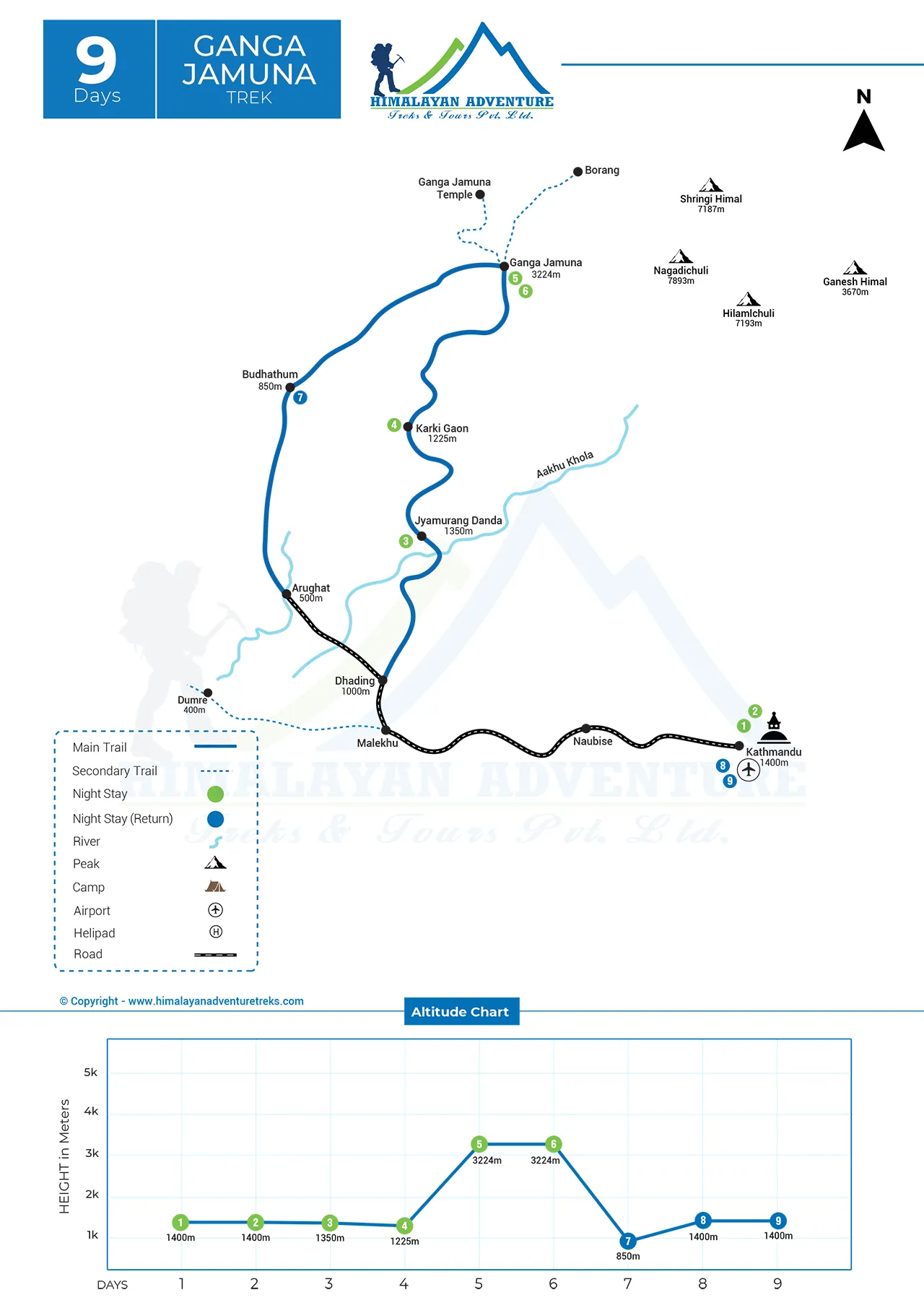
Day 03: Drive from Kathmandu to Dhading Besi and Trek to Jyamrung Danda (1350 m).
Day 04: Trek from Jyamrung Danda to Karki Gaon (1225 m).
Day 05: Trek from Karki Gaon to Ganga Jamuna.
Day 06: Rest day at Ganga Jamuna; explore the local village.
Day 07: Trek from Ganga Jamuna to Budathum.
Day 08: Trek from Budathum to Arughat Bazaar, then drive to Kathmandu.
Day 09: Departure from Kathmandu Airport.
Our guests sharing their experiences (Photo/Video Gallery)


Detail itinerary of Ganga Jamuna Trek
01
Day 01: Arrival at Kathmandu Airport.
Day 1 of the Ganga Jamuna Trek focuses on arrival and preparation. You land at Tribhuvan International Airport in Kathmandu at 1,400 meters. Our team greets you with a signboard and assists with luggage.
A private vehicle transfers you to your hotel in Thamel, the trekking hub. The drive takes 30 minutes through bustling streets. Kathmandu sits in a valley surrounded by hills, offering your first glimpse of Nepal’s urban rhythm.
Settle into your hotel room and rest. Jet lag often affects travellers arriving from distant time zones. We recommend light movement to adjust.
By afternoon, your guide will visit for a briefing. You discuss the trek itinerary, safety protocols, and equipment checks.
This session ensures you understand daily routines and emergency procedures. Kathmandu’s air carries a mix of incense and diesel. Street vendors sell momo dumplings and trekking gear.
You might explore nearby markets to buy souvenir items. A local SIM card or cash exchange often tops your list. ATMs dispense Nepalese rupees near Thamel’s main square.
Elevation here is 1,400 meters, low enough to avoid altitude issues but high enough to signal mountain proximity. Spend evening hours hydrating and reviewing your packing list. We provide a detailed Ganga Jamuna Trek gear checklist during the briefing.
Missing items like waterproof jackets or spare batteries get addressed tonight. Dinner typically includes dal bhat, Nepal’s staple meal of lentil soup, and rice. You meet fellow trekkers over shared plates. Sleep comes early as you are likely tired.
Day 2 begins with cultural sightseeing before the real trek starts, so rest well. Tomorrow demands walking through ancient temples and crowded alleys. Your journey into the Ganesh Himal foothills begins after this essential grounding day.

Activity: Airport Pickup, 30 min

Max. Altitude: 1,400m/4,593ft. Kathmandu

Accommodation: Hotel
02
Day 02: Sightseeing in Kathmandu Valley & Preparation.
Cultural immersion defines today’s purpose. Kathmandu Valley shelters seven UNESCO World Heritage Sites formed by centuries of Hindu and Buddhist exchange.
We visit four critical locations before mountain travel. Boudhanath Stupa’s 36-meter mandala structure dominates the skyline. Pilgrims spin prayer wheels while monks chant nearby.
You walk the perimeter path with locals. This practice builds trail mindfulness for the 2nd day of the Ganga Jamuna Trek.
Pashupatinath Temple sits on the Bagmati River. Sacred cremation ceremonies operate continuously here. Visitors can observe rituals from designated viewing areas.
Photography stops at temple entrances since the insides of the actual shrines are very sacred. Devotees offer marigolds and milk to Shiva lingams.
We allocate two hours for this spiritual hub. Respect local customs by dressing modestly. Next up, Kathmandu Durbar Square showcases Newari craftsmanship. Hanuman Dhoka Palace’s carved windows and tiered temples date to the 12th century.
Kumari Bahal houses the living goddess. Her balcony appearances draw crowds. Bargain for last-minute supplies at nearby stalls. Dried fruit and water purification tablets prove essential later.
Swayambhunath Stupa crowns a western hilltop. The 2,500-year-old complex offers one of the best viewpoints within the city. Golden spire and Buddha eyes dominate the whitewashed dome. Circumambulate the stupa clockwise as locals do. Spend 90 minutes absorbing this energy.
Elevation is held at 1,400 meters all day. No altitude adjustments are needed yet. This stability lets us focus on gear readiness.
We conduct final Ganga Jamuna Trek equipment checks at our nightly accommodation. Confirm rain covers fit your pack size. Trekking permits get cross-verified during lunch breaks.
Wear broken-in shoes for temple exploration. Carry water bottles and about 500 Nepalese rupees for donations. Sites shut by 5 PM sharp, so we return to accommodations by 4:30 for packing. Remove non-essential clothing and keep medications in accessible pockets.
Charge power banks before tomorrow’s drive. Cultural understanding strengthens your mental readiness. These ancient sites smooth your transition from city to trail. Tomorrow’s road to Dhading Besi demands this grounded preparation.
Activity: Sightseeing, 5-6 hours
Max. Altitude: 1,400m/4,593ft. Kathmandu

Meal: Breakfast
Accommodation: Hotel
03
Day 03: Drive from Kathmandu to Dhading Besi and Trek to Jyamrung Danda (1350 m).
On the 3rd day of the Ganga Jamuna Trek, the road from Kathmandu to Dhading Besi tests your patience. Six hours of winding mountain highways replace city noise with engine strain and dust. Vehicles crawl along narrow routes carved into steep slopes.
You pass terraced fields where farmers work with hand tools. River valleys flash between sharp turns. This drive covers 90 kilometres through Nepal’s Middle Hills region. Dhading Besi sits at 850 meters elevation near the Trisuli River.
The trek begins immediately after lunch. You step onto dirt trails while porters adjust overloaded baskets. The first hour follows riverbanks. Water rushes over boulders below, while stone steps appear as the trail climbs.
Elevation gain starts slowly with a couple of hundred meters of climb. The forest thickens with cedar and oak. You cross bamboo bridges spanning smaller streams. Each bridge crackles slightly underfoot. The air thins gradually but noticeably.
Trail markers are rare, so look for prayer flags tied to trees. They signal turns where paths split. Porters overtake you with effortless strides. Their loads include tents and food sacks. You match their rhythm with short steps and steady breathing.
By 3 PM, the climb intensifies. Switchbacks cut through pine forests. Sweat soaks your shirt despite cool air. Jyamrung Danda emerges at 1,200 meters. Stone houses gather around a small teahouse. There are no grand views today as clouds can obscure mountain peaks.
The first trekking day of the Ganga Jamuna Trek covers 10 kilometres. Five hours of continuous ascent make your legs burn. Your lungs work harder than in Kathmandu. Remove boots immediately upon arrival and elevate your feet for a couple of minutes.
Hydrate with ginger tea afterwards. Tomorrow’s trail descends before rising again. Sleep comes fast after this physical shift. Your body adapts overnight.
Tonight, focus on recovery. Dinner is simple: vegetable soup and rice, served early for ample rest time.
Darkness falls by 6 PM, and silence replaces daytime exertion. This nightstop teaches immediate trail discipline. Every step taken to get here builds tomorrow’s stamina.
Activity: Drive & Trek, 6-7 hours
Max. Altitude: 1,350m/4,429ft. Jyamrung Danda
Meal: Breakfast, Lunch & Dinner
Accommodation: Teahouse
04
Day 04: Trek from Jyamrung Danda to Karki Gaon (1225 m).
We start walking before sunrise when temperatures hover near ten degrees Celsius at Jyamrung Danda’s 1,200-meter elevation point.
The initial descent follows ancient footpaths worn smooth by generations of porters carrying grain and tools. Stone steps descend sharply through oak forests where morning mist clings to tree trunks.
You feel the impact on your knees immediately, requiring controlled movements with each downward step.
Porters pass us frequently, balancing heavy loads on their heads using traditional ropelines across their foreheads. Their route shortcuts save time but demand greater agility on narrow ledges.
We follow the main trail, which loses elevation steadily toward the Dhara River valley. Streams cross our path multiple times, forcing jumps between mossy boulders or careful crossings on log bridges secured with ropes.
The steel suspension bridge over the Dhara River marks our lowest point of the day, at 1,450 meters elevation. Crossing requires both hands on the rope rails as the structure sways with each step.
Beyond the river, the trail climbs through rhododendron forests where birds call loudly in the morning air. Karki Gaon appears after five hours of continuous movement, its stone houses surrounded by terraced buckwheat fields.
This segment covers twelve kilometres with significant elevation changes requiring constant adjustment. Store two litres of water in your pack since streams become scarce after the river crossing. Teahouses here rely on spring water carried by locals, so conserve every drop.
Apply sunscreen early because UV exposure increases on open ridges. Karki Gaon sits at 1,200 meters elevation, matching our starting point but feeling different after the physical demands of the 4th day of the Ganga Jamuna Trek.
Dinner may arrive by candlelight since solar power can shut off in the evening hours of the day. Sleep helps your body process the day’s twelve thousand steps logged by standard trekking apps. Tomorrow’s trail follows exposed ridges where wind management becomes critical.
Rest now while the stars emerge clearly above the valley. Your legs need recovery before dawn’s next challenge.
Activity: Trek, 5-6 hours
Max. Altitude: 1,225m/4,019ft. Karki Gaun
Meal: Breakfast, Lunch & Dinner
Accommodation: Teahouse
05
Day 05: Trek from Karki Gaon to Ganga Jamuna.
We climb steadily from Karki Gaon’s stone houses into higher terrain where the air thins noticeably above 2,000 meters elevation.
Your breathing deepens with each step as the trail gains 350 meters over fourteen kilometres toward the Ganga Jamuna campsite. Juniper and dwarf bamboo replace the rhododendron forests.
The path follows ancient trade routes used for centuries by salt caravans moving between Tibet and Nepal. Loose rocks and shifting gravel demand constant attention to foot placement.
We navigate switchbacks carved into steep slopes where one misstep risks ankle strain. Porters move efficiently with loads while you adjust trekking poles for stability on uneven surfaces.
Stream crossings become less frequent, requiring careful water management from your two-liter supply.
Sun exposure intensifies on open ridges. Apply sunscreen every ninety minutes despite cool temperatures. You feel the altitude through heavier breathing and mild fatigue by midday.
Rest for five minutes every hour to let your body acclimate. Teahouses along this section operate seasonally. The Ganga Jamuna Trek guide confirms food availability before departing Karki Gaon. Lunch consists of packed dal bhat wrapped in foil to retain heat.
Avoid drinking untreated stream water due to silt contamination risks. Store extra water in insulated bottles since temperatures drop below freezing overnight.
Ganga Jamuna emerges after six hours of continuous ascent at 3,244 meters. A stone shelter group near a spring source used by all trekkers. No electricity exists here, so charge devices during daylight hours.
Your legs feel the cumulative effect of three trekking days, requiring immediate boot removal and foot inspection. Check for blisters caused by new terrain patterns. Dinner features potato soup and steamed rice served by 7 PM when darkness arrives.
Sleep comes slowly as your body processes the day’s physical demands. Tomorrow’s rest day allows essential recovery before pushing higher. Your breathing stabilizes gradually through the night.
Activity: Trek, 5-6 hours
Max. Altitude: 3,244m/10,643ft. Ganga Jamuna
Meal: Breakfast, Lunch & Dinner
Accommodation: Teahouse
06
Day 06: Rest day at Ganga Jamuna; explore the local village.
Rest days serve critical physiological purposes at 3,244 meters elevation, where oxygen saturation drops below 90 per cent according to guidelines. Ganga Jamuna’s stone shelters provide essential recovery space after three consecutive trekking days.
We monitor your resting heart rate each morning using portable pulse oximeters. Normal readings fall between 65-75 beats per minute at this altitude based on Himalayan Rescue Association protocols.
You explore the village systematically, avoiding strenuous activity. Tamang community members harvest barley in terraced fields surrounding the campsite. Their traditional sickles cut golden stalks in rhythmic motions unchanged for centuries.
Observe how women carry bundles uphill using forehead straps, distributing weight evenly. Children herd goats along ridgelines where prayer flags mark safe paths. These observations build cultural understanding without physical strain.
Water management requires active participation today. We boil all spring water for ten minutes to eliminate any risks. Hydration levels directly impact acclimatization success, measured through urine colour charts provided by your guide.
Dark urine indicates insufficient fluid intake requiring immediate correction. Sit in shaded areas during midday hours. Your guide demonstrates proper SPF layering techniques for fluctuating temperatures.
Evening activities focus on preparation. Inspect footwear for worn patches causing blisters. Reapply waterproofing treatments to gear using solutions available at teahouses.
Charge all electronic devices before 7 PM when solar power diminishes. Dinner features high-carbohydrate meals like potato dumplings to replenish energy stores.
Sleep duration increases to nine hours, supporting red blood cell production essential for higher altitude segments.
This deliberate pause prevents acute mountain sickness, which affects about 25 per cent of trekkers above 2,000 meters. Tomorrow’s journey to Budathum requires fully adapted lungs and muscles. Rest remains your primary task today.
Your breathing stabilizes gradually with each hour of recovery. The stars appear sharper tonight as your body processes accumulated fatigue.
Sleep deeply while the village settles into darkness by 7 PM. Your legs rebuild strength for the next phase.
Activity: Hike, 5-6 hours
Max. Altitude: 3,244m/10,643ft. Ganga Jamuna
Meal: Breakfast, Lunch & Dinner
Accommodation: Teahouse
07
Day 07: Trek from Ganga Jamuna to Budathum.
We transition from Ganga Jamuna’s high-altitude rest to Budathum’s forested descent, covering eighteen kilometres through three distinct terrain zones. Your lungs adjust to lower oxygen demands as elevation drops from 3,244 meters to 1,000 meters.
The initial trail section cuts through fields where loose scree requires precise foot placement on each downward step.
Porters demonstrate efficient descent techniques using a wooden staff to absorb impact on steep 35-degree slopes. They shorten their stride length while maintaining a forward lean to protect their knees.
You adopt this method immediately, reducing joint stress during the first 500-meter descent. Stream crossings multiply as melting snow feeds tributaries of the Budhi Gandaki River. Day 7 of the Ganga Jamuna Trek is going to be a long day.
Midday brings entry into the subtropical forest, where humidity rises sharply. Banana leaves brush against your shoulders while leeches emerge on muddy paths after recent rainfall in the monsoon.
Apply salt liberally to exposed skin as local guides recommend for effective prevention. Trail markers shift from stone cairns to painted tree trunks, indicating safe passage through overgrown sections. Water sources become abundant, requiring frequent purification with iodine tablets.
The final approach to Budathum follows terraced rice paddies carved into hillsides by Gurung farmers. Stone staircases connect cultivation levels where farmers plant seedlings.
Your breathing stabilizes noticeably below 1,500 meters of elevation, allowing a faster pace without fatigue. Sunset timing extends by twenty minutes compared to Ganga Jamuna due to the lower latitude.
Adjust trekking pole length every hour as terrain changes affect stability needs. Remove boots within ten minutes of arrival to prevent moisture-related skin damage.
Teahouses here use spring-fed systems, so request boiled water specifically. Boiled water expenses are not a part of the Ganga Jamuna Trek package.
Dinner features locally grown vegetables cooked with mustard oil, providing essential fats for recovery. Your resting heart rate drops, indicating successful acclimatization.
Sleep occurs earlier as valley humidity induces natural drowsiness. Tomorrow’s route to Arughat demands attention to river navigation techniques learned today.
Rest while listening to frog calls, replacing yesterday’s mountain silence. Your muscles rebuild strength through tonight’s deep sleep cycles.
Activity: Trek, 5-6 hours
Max. Altitude: 850m/2,789ft. Budathum
Meal: Breakfast, Lunch & Dinner
Accommodation: Teahouse
08
Day 08: Trek from Budathum to Arughat Bazaar, then drive to Kathmandu.
We transition from Budathum’s forest trails to Arughat Bazaar’s riverfront chaos, covering fifteen kilometres before a seven-hour road journey back to Kathmandu.
Your legs feel the cumulative effect of five trekking days as elevation drops from 1,000 meters to 600 meters near the Budhi Gandaki River confluence. The final Ganga Jamuna Trek segment follows muddy paths where monsoon rains wash out sections requiring careful navigation around deep ruts.
Porters move with urgency today, knowing their work concludes at Arughat. They carry dismantled tents and empty food sacks balanced on narrow trails alongside rushing water.
You notice their changed mannerism without heavy loads yet maintain a steady pace to match the rhythm of the rest of the crew. River crossings increase with each kilometre as seasonal streams swell. Test each log bridge with your full weight before committing to the crossing.
Arughat Bazaar emerges as a transport hub with vehicles lining the riverbank. Board a shared jeep immediately after arriving since departure times follow strict schedules.
The vehicle accommodates twelve passengers plus gear in cramped conditions. Seat cushions provide minimal relief against the severely degraded road surface. Dust penetrates every opening despite closed windows.
The Trisuli Highway journey tests endurance through six hours of constant vibration. Road conditions worsen between Gorkha and Kathmandu, with around 40 per cent unpaved sections causing violent jolts.
Keep neck support ready to prevent strain during sudden stops. Hydrate consistently using stored water, or you can also get mineral water at roadside stops. Track progress via GPS as mobile signals remain intermittent through river gorges.
Kathmandu’s urban assault begins at the city limits. Horns blare continuously while exhaust fumes replace mountain air. Traffic congestion adds unpredictable delays requiring patience.
Your Ganga Jamuna Trek guide handles all negotiations with the driver, ensuring direct hotel drop-off. Settle into your Thamel accommodation by late evening after verifying the room temperature and clean linens.
Immediate recovery actions matter most tonight. Soak feet in warm salt water for twenty minutes to reduce swelling. Consume electrolyte drinks to counter dehydration from the dusty journey. Inspect footwear for structural damage needing repair before future trips.
Dinner should include protein-rich foods like lentil soup and boiled eggs to rebuild muscle tissue. Sleep occurs later than mountain nights due to city noise, but remains essential.
Tomorrow’s departure requires early morning energy reserves built through proper rest. Your body processes the transition from wilderness to urban environment throughout the night.
Activity: Trek & drive, 7-8 hours
Max. Altitude: 1,400m/4,593ft. Kathmandu
Meal: Breakfast & Dinner
Accommodation: Hotel
09
Day 09: Departure from Kathmandu Airport.
We wake before dawn to complete final departure tasks at 1,400 meters in Kathmandu. Hotel staff prepare breakfasts based on your flight schedule confirmed through an online portal. Check room inventory against your arrival checklist, ensuring no items remain behind.
Settle all outstanding bills using Nepalese rupees or credit cards, but the processing can cause delays at this hour. Airport transfers require precise timing. Vehicles depart Thamel for Tribhuvan International Airport’s international check-in opening.
The 5-kilometer route takes 25 minutes via busy roads, doing our best to avoid daytime traffic congestion. Our Ganga Jamuna Trek reps handle luggage loading while verifying all travel documents, including passports and boarding passes.
Security screening demands preparation. Remove electronics from bags before the X-ray checkpoint. Airport staff enforce these rules consistently, so organize items during the vehicle ride. Store essential medications in carry-on luggage with original pharmacy labels.
Exchange remaining Nepalese rupees at the airport currency counter, where rates drop a couple of per cent. Your journey concludes with the aircraft leaving the city as Kathmandu’s valley lights fade below the clouds.
Reflect on the Ganga Jamuna Trek’s physical achievements while reviewing photos of Ganesh Himal peaks captured through clear lenses. Your successful completion follows all safety protocols established from Day 1 preparations.
Activity: Airport drop, 30 min
Max. Altitude: 1,400m/4,593ft. Kathmandu Airport
Meal: Breakfast

Note:
If you have your own private group and want to make your trip private, we can run the custom trip all the day as per your requirements and group size.
Includes and Excludes
What are included with package?
- Pick up from Airport and Transfer to the hotel: Upon arrival at the Kathmandu airport, a representative will greet you and transfer you to your hotel.
- Three night’s 3-star hotel in Kathmandu with Breakfast: Enjoy three nights of accommodation in a comfortable 3-star hotel in Kathmandu, with breakfast included each morning.
- Kathmandu sightseeing by private vehicle with an experienced tour guide: Explore the cultural and historical landmarks of Kathmandu with a professional guide, using private transportation for convenience.
- Lunch, Dinner, and Breakfast during trekking: All meals (lunch, dinner, and breakfast) are provided during the trekking portion of the trip, ensuring you are well-nourished while you hike.
- Kathmandu/Dhading Besi/Arughat Bazaar/Kathmandu by bus: This includes your transportation by bus from Kathmandu to Dhading Besi and Arughat Bazaar and back to Kathmandu.
- Trekking Park Permit: A permit for the trekking park is included, which allows you access to the designated trekking areas.
- Trekkers’ Information Management System (TIMS) Permit: The TIMS permit, which is necessary for trekking in certain areas, is included.
- All necessary paperwork: All necessary documents for trekking, including permits and registrations, will be handled by the company.
- All accommodations in lodges/tea houses/local people’s houses during the treks: Stay in local lodges, tea houses, or people’s houses along the trekking route, providing a comfortable and authentic experience.
- An experienced, helpful, and friendly Guide, porters (1 porter for 2 clients): The package includes an experienced trekking guide to lead the way, as well as porters to carry your luggage (one porter for every two clients).
- An arrangement of Travel rescue: In case of emergency, rescue arrangements will be in place to ensure your safety.
- Medical supplies (first aid kit will be available): A first aid kit will be available during the trek to address minor medical issues.
- All government taxes: All applicable government taxes are included in the package.
- Last Night’s farewell dinner at an authentic Nepalese restaurant with a cultural performance: Enjoy a traditional farewell dinner with cultural performances to celebrate the completion of your journey.
What are not included with package?
- Nepal Visa fee: The visa fee for Nepal is not included in the package and can be obtained easily upon arrival at Kathmandu airport.
- Entrance fee in Kathmandu: Entrance fees for specific sites and attractions in Kathmandu are not included in the package.
- International airfare to and from Kathmandu: Your international flight tickets to and from Kathmandu are not covered by the package.
- Travel and rescue insurance: Travel insurance, including coverage for emergencies, rescue operations, and medical expenses, is not included and should be arranged separately.
- Personal expenses: Any personal expenses such as phone calls, laundry, bar bills, battery recharges, extra porters, bottled or boiled water, and hot showers are not included in the package and will be at your own expense.
Pick Your Suitable Date
US$ 800
Book a Private Trip
Private & Group Discount Price
-
1 -
1 person
US$ 900
-
2 -
2 people
US$ 800
-
3 -
5 people
US$ 750
-
6 -
10 people
US$ 700
-
11 + people
9999
US$ 650
1 Travelers x US $ 2000
Total Cost:
US$ 900
Route Map & Altitude Chart
Kathmandu
Start/End point
Kathmandu
Trip Information
Difficulty
Difficulty requires physical readiness for sustained elevation changes across eight consecutive trekking days. You face daily distances of 10 to 18 kilometres with net elevation gains reaching 350 meters on ascent days like Day 5.
Your resting heart rate increases above 2,000 meters of elevation as recorded by pulse oximeters following the Himalayan Rescue Association protocols. Knees absorb repeated impact on downhill sections such as the 500-meter descent toward Dhading Besi, where loose scree demands precise foot placement.
tream crossings multiply after monsoon rains, requiring careful crossing at locations like the Dhara River’s steel suspension bridge. Porters demonstrate efficient techniques using forehead straps to distribute weight, but you still carry 5-kilogram packs containing essential water and layers.
Teahouse accommodations lack running water above the Ganga Jamuna, forcing water management discipline. The Ganga Jamuna Trek’s highest point at 3,244 meters exposes you to oxygen saturation levels dropping to 90 percent, requiring hourly rest stops.
Cumulative fatigue becomes evident by Day 7 when descending through Budathum’s muddy paths after five days of continuous movement. Proper footwear prevents blisters caused by extended downhill sections.
Acclimatization success depends on sufficient hydration, preventing any kind of altitude-related inconveniences. This trek demands consistent physical output without technical climbing but tests endurance through terrain variety and elevation shifts.
Best seasons
Best seasons align with credible climate data showing that October and November offer optimal conditions. October offers extended sunshine hours monthly with daytime temperatures averaging 15 degrees Celsius at Ganga Jamuna’s 3,244 meters elevation.
Clear skies reveal Ganesh Himal’s eight peaks exceeding 7,000 meters without monsoon cloud cover. Daytime humidity drops to 45 percent, reducing leech risks prevalent during June through September rains. November maintains stable weather patterns with minimal precipitation, allowing safe river crossings at locations like the Budhi Gandaki’s suspension bridges.
March through May provides a secondary window when Rhododendron blooms, crimson red flowers popping up across the Ganga Jamuna Trek trails. Daytime temperatures reach 18 degrees Celsius during this spring period, but afternoon winds intensify on exposed ridges, requiring windproof layers.
Monsoon season brings 400 to 600 millimetres of monthly rainfall, sometimes washing out trail sections near Budathum, as confirmed by state reports, winter months below freezing at higher elevations risk trail ice formation on stone steps near Jyamrung Danda.
October’s stable conditions coincide with the Tamang community harvest festivals, providing cultural engagement opportunities. These periods balance manageable temperatures with minimal precipitation for safe trail navigation.
Can a beginner join this trip?
Beginners succeed with proper preparation and our structured support system. We limit daily distances to 10-12 kilometres during initial trekking days like the Kathmandu to Dhading Besi segment, allowing gradual adjustment. Porters carry a total of 25 kilograms of personal loads, freeing you from heavy gear management following the Himalayan Rescue Association weight guidelines.
Day 6 of the Ganga Jamuna Trek serves as a mandatory rest at Ganga Jamuna’s 3,244-meter elevation, specifically designed for acclimatization without physical strain. Your guide conducts daily equipment checks, verifying boot fit and rain cover functionality, preventing common beginner issues. Teahouses along the route provide pre-verified clean rooms with solar power, eliminating lodging uncertainties.
We schedule cultural sightseeing on Day 2 during off-peak hours at Boudhanath Stupa, reducing crowd stress for new trekkers. Pulse oximeters monitor your oxygen saturation levels above 2,000 meters with readings below 90 percent, triggering immediate rest protocols.
Beginners receive tailored water intake targets based on charts, preventing dehydration-related fatigue. Our porters demonstrate efficient descent techniques on steep sections like the Dhara River approach, showing controlled knee movements to avoid strain.
Emergency satellite phones accompany all groups with evacuation contracts covering trails above 2,000 meters. You practice river crossing techniques at low-risk locations like the Dhading Besi bamboo bridges before tackling higher volume streams.
This structured approach lets beginners build confidence through manageable daily segments while receiving continuous expert guidance.
Altitude Sickness
Altitude sickness affects a very minimal percentage of trekkers above 3,000 meters. Symptoms might appear above Ganga Jamuna’s 3,244 meters elevation, where oxygen saturation drops to 92 per cent. Headaches and nausea might manifest within 6-12 hours of ascent, requiring immediate action.
Although the effects of altitude sickness at such an elevation are not very alarming, we still take immediate action. We enforce mandatory rest stops every other hour above 1,200 meters, following safety protocols.
Urine colour charts provided by your Ganga Jamuna Trek guide monitor hydration levels, with dark results indicating insufficient fluid intake. Rest days like Day 6 at Ganga Jamuna allow physiological adaptation measured through resting heart rate stabilization.
Daily elevation gains stay under 350 meters, preventing rapid ascent risks. Ginger tea consumption increases at higher campsites, proven to reduce nausea symptoms. Sleep altitude remains below 3,244 meters throughout the trek, avoiding dangerous overnight exposure.
Guides conduct morning health checks, identifying early symptoms like dizziness or loss of appetite. Immediate descent of 200-300 meters serves as primary treatment for moderate symptoms confirmed by altitude protocols.
Your breathing pattern receives constant monitoring with irregular rhythms triggering intervention before complications develop. This systematic approach minimizes risks while enabling safe progression through the Ganesh Himal foothills.
Accommodation, Food and Drink
Teahouses along this route operate under Nepal’s national park rules, minimizing plastic use as much as possible. You sleep in clean rooms with solar power at Ganga Jamuna’s 3,244 meters elevation, where solar shuts off after the night falls. Spring water serves all drinking needs, requiring boiling for 10 minutes per protocol.
Pre-ordered dal bhat portions reduce meal wait times by 40 per cent compared to independent travel. We provide iodine tablets for stream water purification at locations like Budathum’s terraced fields.
Meals feature locally grown vegetables cooked with mustard oil, supplying essential energy and nutrients for the Ganga Jamuna Trek. Your guide conducts daily food safety checks, verifying proper cooking temperatures.
Dietary restrictions get addressed through pre-trip surveys, with Tamang kitchen staff preparing alternatives like buckwheat pancakes. Sleep altitude never exceeds 3,244 meters, ensuring safe acclimatization. Bedding includes wool blankets meeting standards for high elevation stays.
Transportation and Permit
We secure permits through Nepal’s Department of Tourism portal after your arrival, eliminating queue waits averaging two hours for independent travellers. The Kathmandu to Dhading Besi road uses GPS-tracked Land Cruisers with reinforced suspensions handling the unpaved Trisuli Highway sections.
Seven-hour road journeys to Kathmandu follow schedules with strict departure times at Arughat Bazaar. Vehicles carry neck support kits, preventing unnecessary sprain on degraded road surfaces. All drivers hold licenses with a minimum of five years of mountain driving experience.
Permit costs include $30 fees paid directly to Tourism Board Office counters. GPS tracking provides real-time location updates during the Kathmandu Valley sightseeing segment. Shared jeeps accommodate twelve passengers plus gear with pre-paid deposits, preventing cash shortages in remote areas.
Vehicle sanitation follows protocols with daily disinfection of high-touch surfaces. Permit processing takes 24 hours through our Kathmandu office using digital submission systems, reducing errors by 90 per cent compared to manual applications.
Trip preparation and fitness
Beginners complete a four-week training program before departure, building endurance for daily 10 to 18 kilometre segments. Your Ganga Jamuna Trek guide verifies boot fit during pre-trek equipment checks, preventing blisters from red clay soil hardening around seams.
We provide hydration charts tracking two to three litres of daily intake through urine colour monitoring. Strength training focuses on quads development for downhill impacts. Pack weight stays under 5 kilograms, containing essentials verified by the Himalayan Rescue Association guidelines. You practice river crossing techniques on narrow paths simulating Budhi Gandaki conditions.
Dietary adjustments begin two weeks prior, with high-carbohydrate meals like dal bhat boosting glycogen stores. Pre-trip medical screenings check resting heart rate stability below 75 beats per minute at 1,400 meters. Fitness benchmarks require hiking 15 kilometres with 5-kilogram backpacks within six hours, matching actual trail conditions.
Daily stair climbing sessions prepare knees for 500-meter descents like the Dhading Besi approach. We supply gear lists specifying boots and trekking poles, meeting standards. This structured preparation ensures physical readiness without overwhelming beginners.
Alternative routes
Monsoon conditions shift the standard itinerary using the Ghermu bypass route, avoiding washed-out trail sections near Budathum. This variation adds 25 kilometres but maintains elevation below 1,200 meters from July through September.
The Surya Ghat shortcut replaces Arughat Bazaar’s road transfer with rafting on the Budhi Gandaki River. This water journey covers 12 kilometres from Kuncha to Arughat, taking four hours with moderate rapids requiring life jackets. Winter alternatives use the lower elevation Dhading Besi to Galchi route, staying below 1,400 meters, where temperatures rarely drop below freezing.
This path follows the Trisuli River valley with teahouses providing heated dining areas. Cultural extensions add two days visiting Tamang villages like Laprak, where women demonstrate traditional handicrafts and loom techniques unchanged for centuries.
The Ganesh Himal high route option ascends to 3,842 meters at Pangsang Pass, requiring an additional $30 permit. All route changes maintain cultural engagement through pre-arranged homestays with Tamang families. This variation maintains ecological responsibility while adapting to seasonal challenges.
Gadgets charging & Internet
In the remote highland villages of the Gorkha district, there are still many villages that have to rely on solar energy for their daily chores. This is because of the unstable and unreliable hydroelectricity availability. Those remote villages are not a priority for infrastructural development by the state, hence most of them are left far behind in terms of development.
During your stay at such villages, you will have to rely on solar power to charge your devices, which might cost you a couple of hundred Nepalese rupees, which is not a part of the Ganga Jamuna Trek package.
As for the internet connection, you will rarely find WiFi above 2000 meters of elevation, as it is out of the range of Internet service providers. You might get a couple of lines of mobile network, but it will not serve as a reliable internet connection.
There’s no way around this lack of facility, so prepare yourself to spend a few days away from the internet. Connecting with nature will be the best thing you do on this trek, in addition to enjoying scenes that will create a lasting impression.
Your extra expenses
The Ganga Jamuna Trek package covers most of your major expenses throughout the journey, but it is not viable to cover each and every bit of expense on the road. Before you book the trek with us, one of our reps will make it very clear to you about what expenses the trek package covers and things you have to pay for separately.
Expenses such as international flights, extra meals, extra night stays, tips for the porters and guides, entrance fees during sightseeing in Kathmandu, etc., are considered your extra expenses.
Essential Packing Gear List for Ganga Jamuna Trek
If you have decided to go on the non-touristy trail, the Ganga Jamuna Trek in Nepal, we assure you that you will have a fantastic time ahead. But what should you pack for your Adventure? What will be the right gear to make your trip more fabulous? To help you with this, we have compiled a packing list of essential items that you mustn’t forget to bring along.
- Passport ( min 6 months valid)
- Cash, credit card
- List of important addresses and contact details
- 2-3 passport photos (optional)
- Copies of all important travel documents (passport, visa, airline ticket, insurance policy, etc.)
- A sturdy 70 L trekking backpack which will be carried by your porter (please note that our assigned 1 porter will carry 2 clients’ luggage up to 20-25 kg.
Note: We will provide each participant with a spacious 70 to 75 L Company logo duffle bag to conveniently carry your trekking gear, which you have to return once the trek is complete. - A 30 L Daypack that has room for your essentials such as camera, mobile, Passport, important documents, water bottle, day-useable medicine, chocolate bars, raincoat, etc., which will be carried by you.
- Protective cover for a backpack or travel bag.
- Hiking Boots: Preferably ankle-high boots to prevent ankle sprain
- Regular Shoes: For small strolls and exploration around the city
- Second, a light pair of shoes and possibly sandals
- Micro Spikes or Ice Cleats for the winter trekking over snow and ice
- Gaiter for added protection in snow
- A rain and wind-resistant, lightweight down jacket for warmth, with a good helmet hood
- Summer-light, as well as winter warm clothing
- Quick-drying shirts made of synthetic fabrics
- Warm and cool vests or T-shirts
- Functional synthetic underwear
- Sports Bra for Female Trekker
- A waterproof pair of trousers
- Regular trousers of quick-drying fabric
- Hiking shorts
- Cargo Pants with multiple pockets to hold your small items, such as knives or chocolates
- Woolen or fleece pants
- Trekking socks, both thick and woolen fabric, and lighter wool socks
- Wool hat, gloves, and scarf
- A light cotton scarf or a bandanna for protection of your head, neck, ears, and mouth
- Sun hat, and sunglasses with 100% UV protection (for trekking trips, even with stray light and nose protection)
- Sunscreen cream or lotion with a high sun protection factor (at least 15, for trekking trip,s even at least 30)
- Sunscreen lipstick with a high SPF (at least 20, for trekking trips, even at least 30 or sunblock)
- Mosquito repellent (Optional)
- Comfortable light night clothes and shoes
- A drinking bottle that can be used as a hot water bottle on frosty nights
- Flip-flops or bathing shoes for using the showers
- Water purifiers: if you need to refill water from the tap or stream en route
- Headlamp: for a midnight or pre-dawn trip towards the viewpoint
- Quick-drying towel and sample-size toiletries for washing your feet and face
- Your Personal first-aid kit: with basic medical supplies such as bandages for sprains, antidiarrheal and antibiotics, iodine wipes for scrapes and cuts, plasters, aspirin, or ibuprofen, moleskine for preventing blisters, Diamox (acclimatizing medicine), and your Personal medication
- Sleeping bag appropriate for all-season treks (we can hire in Kathmandu)
- Waterproof money belt, chest bag, leg bag, or belt bag for storing important travel documents or valuables
- Toothpaste, Toothbrush, and soap
- Deodorants
- Moisturizer
- Nail clippers
- Feminine hygiene products (Sanitary Pads)
- Small mirror
- Wet wipes
- Hand sanitizer
- Comb
- Camera with sufficient memory cards and spare batteries or a battery charger
- Small padlock for your travel bag
- Crampons ( during winter, Dec- Feb)
- Thermos flask
- Water bag
- Toilet paper (2-3 rolls without)
- Ear Plugs
- Matchbox, or lighter
- Compass or GPS
- Map
- Alarm clock
- Multi-tool kit
- Binoculars
- Books
- Whistle
Equipment Note:
- Please note that there is no need for you to bring all these heavy items, such as a Sleeping bag, a down Jacket, Trekking Poles, and items from your home. You can easily rent or purchase high-quality to standard-quality items in Kathmandu.
- Items are available from international brands such as The North Face, Sherpa Adventure, Marmot, Mountain Hardware, Black Yak, Karma Gear, and local brands like Goldstar and locally made products etc.
- Plus, we will also gift you a company logo T-shirt as a token of your experience in Nepal with us.
Renting Cost:
- Sleeping Bag & Down Jacket (-10-20 degree Celsius), Per Piece per day US$ 1.5
Frequently Asked Questions
How many trekkers are in the group?
Generally, we do not make groups exceeding 10 trekkers, excluding the porters and guides. We want to provide sufficient attention to every trekker, which can be a challenge in extra-large groups.
You will be accompanied by a lead guide, an assistant guide (if necessary), and one porter for every two trekkers in the group. You can also opt for a private trek if you do not want to share the experience with random people in a group.
What is the difference between a private trek and a group trek?
A private trek offers you much more flexibility in comparison. For instance, you can choose the starting date yourself as opposed to choosing from available options. Another key difference is the group size.
Private treks are often smaller in size since you choose the number of participants. With extra flexibility comes extra charges, which are separate from the standard Ganga Jamuna Trek package.
How can I prepare adequately for this trek?
This trek is one of the easy ones when it comes to highland trekking destinations. It does not require you to go beyond 3500 meters of elevation, nor does it have back-breaking ascents. It is easy to prepare for this trek.
You just have to make sure you have enough stamina and leg strength to cover the entire Ganga Jamuna Trek distance.
Can I transfer my booking to someone else's name?
Yes, in case you are not able to make it for the trek, we will be considerate enough to let the booking be transferred to someone you want.
This will not cost you anything extra, but if we run into unexpected expenses due to the transfer, we will have to add it to the entire package price.
Can I get an evisa to Nepal?
Yes, you can apply for a visa to Nepal before your arrival in Nepal. You can simply go to the immigration website, fill out a form, and receive a barcode that allows you to skip directly to the payment counter as opposed to starting at the visa application line. This will save you hours at the immigration desk during peak travel seasons.
Related Blogs & Articles


Reviews on Ganga Jamuna Trek

Related trips