

Duration
8 Days

Jhinu Hot Spring Trek


Trip Grade
Easy
Group Size
1-16 People
Max Altitude
3,210m. / 10,531ft.
Best Season
Mar-May/Aug-Nov
Activity
Hiking & Trekking
Meals
Breakfast, Lunch & Dinner
Accommodation
Teahouses
Transportation
Private Vehicle
Trip Customization
On request (click here)


Highlights of Jhinu Hot Spring Trek
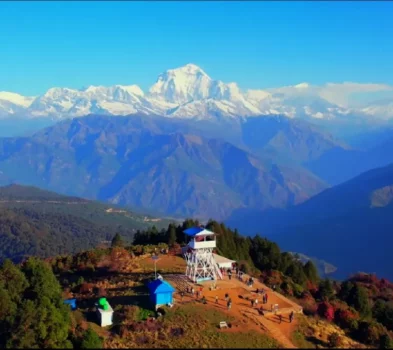
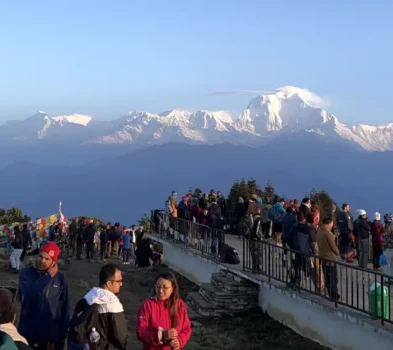
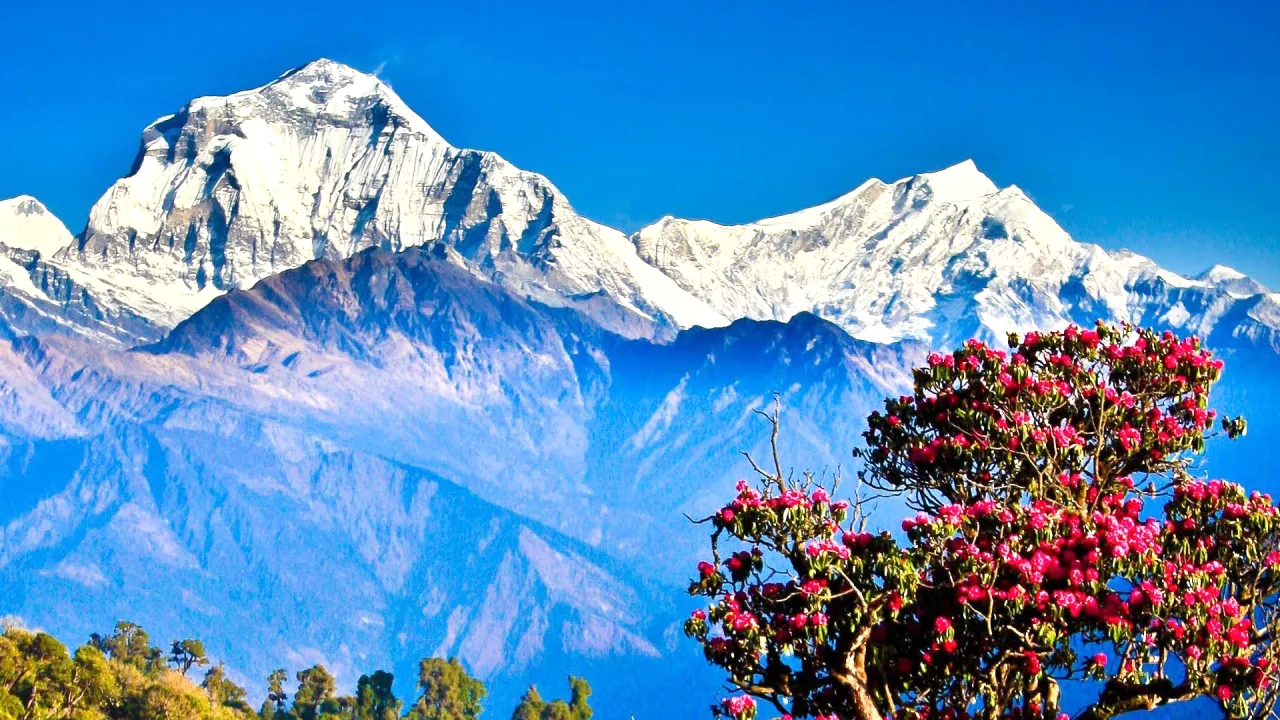
- Have an amazing sunrise from Poon Hill with the views of the Annapurna and Dhaulagiri ranges.
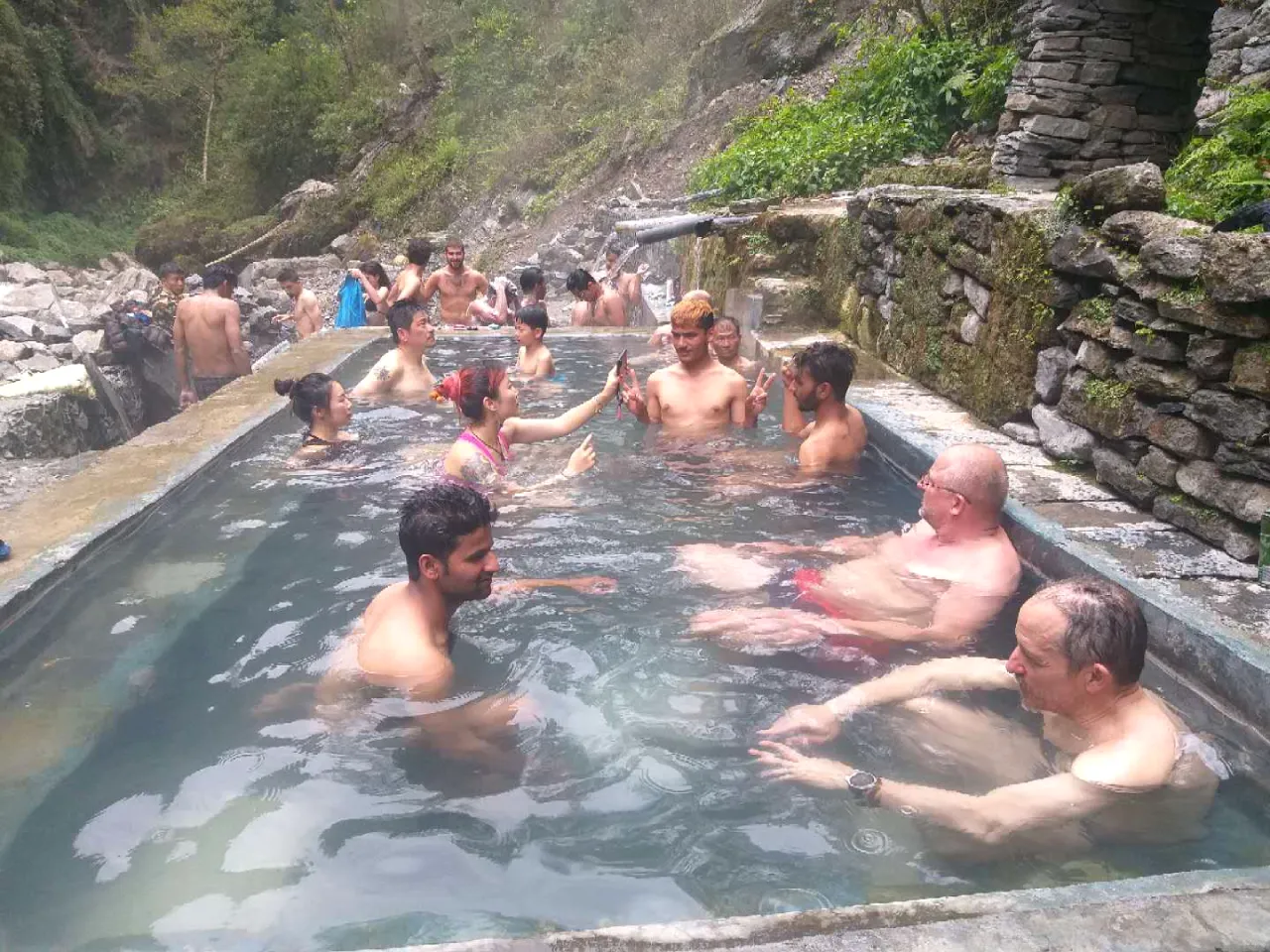
- Rest in the natural hot springs of Jhinu Danda, an ideal method of relaxing your body after trekking.
- Walk across gorgeous rhododendron trees that blossom in spring with bright flowers.
- Explore the friendly, welcoming attitude and culture of the Gurung villages such as Ghandruk and Chomrong.
- Hike on changing scenic paths overlooking rivers, waterfalls, and terraced farmlands.
- Stay in traditional teahouses and have simple meals that are freshly made.
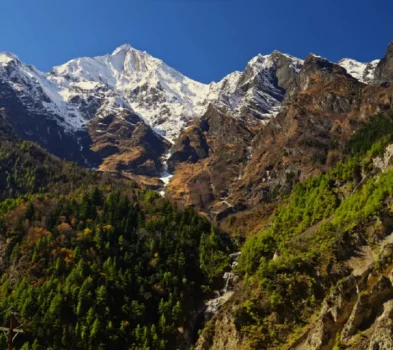
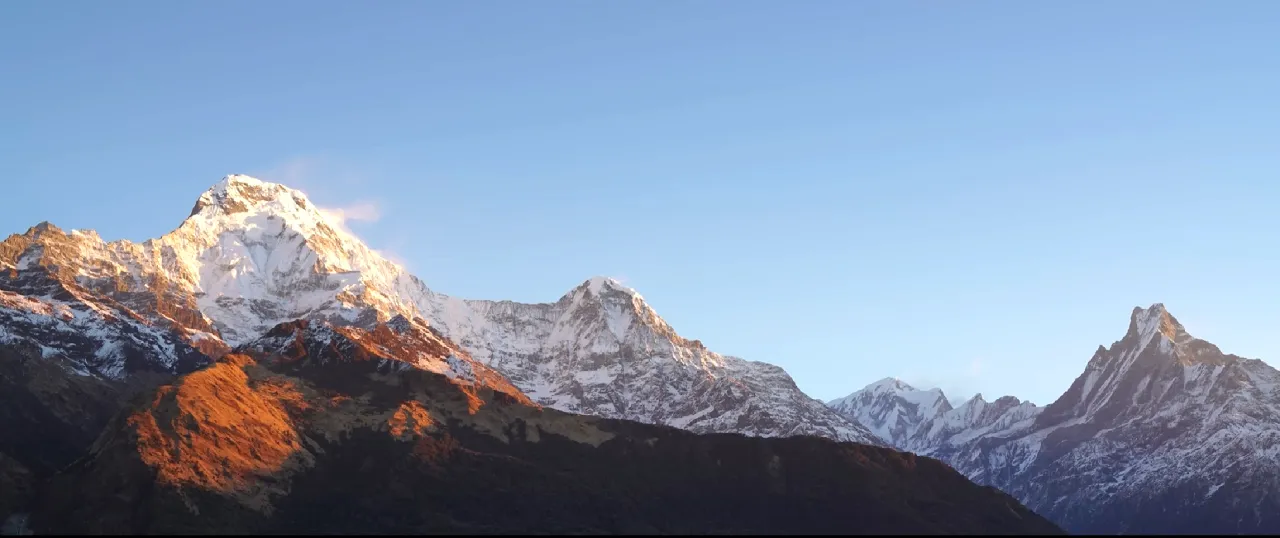
- Take beautiful photographs of Himalayan peaks such as Machhapuchhre (Fishtail), Annapurna South, and Hiunchuli.
- Experience a relaxing hiking experience that is not as congested as the longer trails in the area.
- Enjoy an ideal combination of natural and cultural experiences in a single amazing and short trip.
Trip Introduction
The Jhinu Hot Spring Trek is a beautiful and relaxing journey in the Annapurna region of Nepal. It is ideal for any traveler who wishes to feel nature, mountain sceneries, and localized culture without necessarily taking a very long and strenuous walk. The combination of walking paths, traditional villages, and the special adventure of natural hot springs makes this trek an excellent option regardless of whether it is for a beginner or even an experienced trekker.
The trek typically starts with a short drive between Pokhara and Nayapul or some other starting point. Beyond this, the path goes through the green hills, terraced fields, rivers, and forests with rhododendron and oak trees. During the trek, you will pass through lovely villages such as Ghandruk and Chomrong, where you will get to learn the culture and hospitality of the locals, the Gurung.
The trek also takes one to the famous Poon Hill (3,210 m / 10,531 ft), a tourist attraction site where one gets a beautiful view of the sunrise over the Annapurna and Dhaulagiri mountain ranges.
The natural hot springs at Jhinu Danda (1,750 m / 5,741 ft) are one of the key points of interest in the Jhinu Hot Spring Trek. After several days of walking, it is really refreshing to spend some time in these warm and mineral waters close to the river. It assists in relaxing the fatigued muscles and also gives a special feel to the adventure.
Jhinu Hot Spring Trek is rated as medium, and one walks approximately 4-6 hours a day. The trails are both uphill and downhill, and the speed can be set to your comfort level. Local teahouses offer easy food and comfortable lodging, which makes the walk easy and pleasant.
Therefore, the Jhinu Hot Spring Trek is an ideal combination of nature, culture, and rest. Himalayan Adventure Treks is the organizer of well-structured and trouble-free trekking experiences aimed at ensuring that people have an unforgettable journey.
Outline Itinerary of Jhinu Hot Spring Trek
Day 01: Drive from Pokhara to Nayapul and Trek to Ulleri.
Day 02: Trek from Ulleri to Ghorepani village.
Day 03: Morning Poonhill sunrise & trek to Tadapani.
Day 04: Trek from Tadapani to Ghandruk village.
Day 05: Trek from Ghandruk to Chomrong.
Day 06: Trek from Chomrong to Jhinu Danda (Hot spring).
Day 07: Trek from Jhinu Danda to Pothana.
Day 08: Trek from Pothana to Phedi via Dhampus and drive to Pokhara
Our guests sharing their experiences (Photo/Video Gallery)


Detail itinerary of Jhinu Hot Spring Trek
01
Day 01: Drive from Pokhara to Nayapul and Trek to Ulleri.
In the morning, we start with a drive of 1.5 to 2 hours covering 45 km (28 miles) between Pokhara and Nayapul. The highway is cut through green hills, terrace fields, and small villages, giving an insight into what daily life is like in rural Nepal. After getting to Nayapul (1,070 m / 3,510 ft), the journey begins with a relaxed walk down the Modi Khola River.
We cross Birethanti and have the permit inspected, then proceed on forest-lined trails, intersected by waterfalls, and through farmland. The road is slowly getting steeper and closer to Ulleri. The last part is the hardest climb, consisting of approximately 3,200 stone steps. This section is challenging, but it pays off in the form of the stunning scenery of Annapurna South and Hiunchuli.
On arrival at Ulleri (2,050 m / 6,725 ft), we get into a teahouse and rest as we see the serene mountain atmosphere.

Activity: Drive & Trek, 5-6 hours

Max. Altitude: 2,050m/6,726ft. Ulleri

Meal: Lunch & Dinner

Accommodation: Teahouse
02
Day 02: Trek from Ulleri to Ghorepani village.
We begin our hike from Ulleri (2,050 m / 6,725 ft) to Ghorepani (2,875 m / 9,432 ft) after breakfast. The trail is approximately 10 km (6.2 miles) in length and lasts 4-6 hours. It starts with a gradual walk uphill, through the deep woods of rhododendron and oak. These forests are blooming in spring and are colored with flowers.
We pass on the road through small villages such as Banthanti and Nangethanti. They are nice spots to rest, have tea, and admire the mountain scenery. If we are lucky, we will also encounter wildlife, which includes monkeys, birds, and grazing yaks.
As we approach Ghorepani, the scenes of Annapurna, Dhaulagari and Machhapuchhre are more visible, and they are more impressive. On arriving in the village, we check into the teahouse, where we get to enjoy the fresh mountain air.
Activity: Trek, 4-5 hours
Max. Altitude: 2,875m/9,432ft. Ghorepani
Meal: Breakfast, Lunch & Dinner
Accommodation: Teahouse
03
Day 03: Morning Poonhill sunrise & trek to Tadapani.
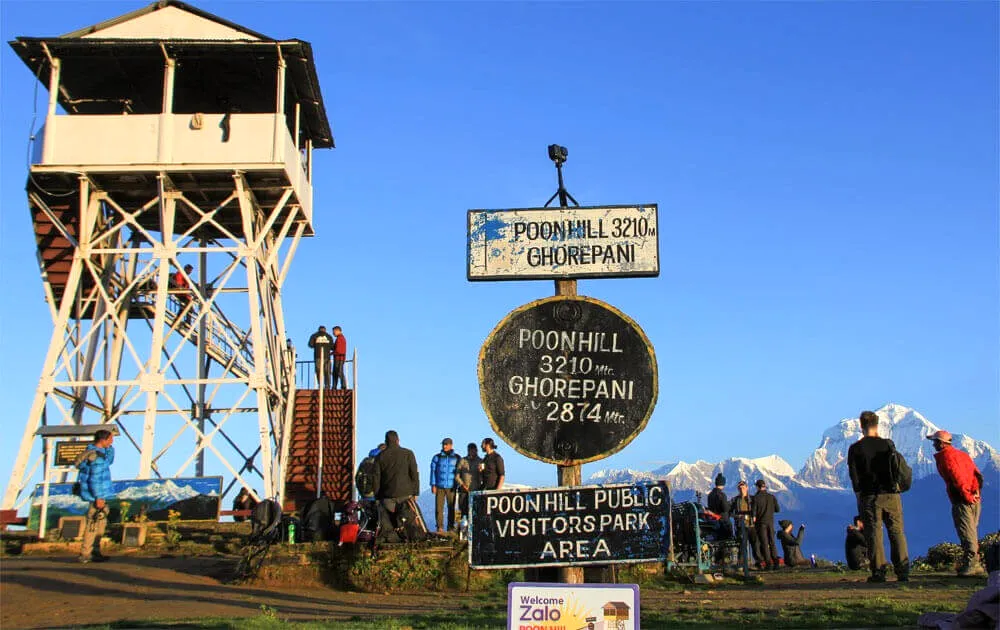
In the morning, we walk to Poon Hill (3,210 m / 10,531 ft), a 30-minute walk. This viewpoint provides one of the best sunrise scenes in the Annapurna region. The sun shines directly on the snow-white tops, such as Annapurna, Dhaulagiri, and Machhapuchre, forming a gorgeous golden sight as the sun makes its appearance.
After seeing the sunrise, we go back to Ghorepani and have breakfast. Then we keep on trekking to Tadapani (2,675 m / 8,776 ft). The path goes through the woods of rhododendron and oak trees. On the road, we can observe birds, animals, streams, and waterfalls.
There are also uphill climbs and downhill walks, which make the trail quite diverse and interesting. When we are nearing the Tadapani, the panoramas of Annapurna South and Machhapuchhre are breathtaking.
Our destination is Tadapani, where we spend the night in a teahouse with some relaxing forest and mountain scenery.
Activity: Trek, 6-7 hours
Max. Altitude: 2,675m/8,776ft. Tadapani
Meal: Breakfast, Lunch & Dinner
Accommodation: Teahouse
04
Day 04: Trek from Tadapani to Ghandruk village.
The day starts after breakfast with a short and easy walk between Tadapani (2,675 m / 8,776 ft) and Ghandruk (1,950 m / 6,398 ft). This is approximately an 8km (5 miles) trail taking 3-4 hours. The major part of the road is descending through thick rhododendron and oak woods.
It is a quiet walk, with the sounds of birds and running streams. In spring, the forest is colored with the blooming flowers. On our way down, we go through small villages and terraced farmland, which allows us to have a closer glimpse of the local life.
Ghandruk is a big and scenic village of the Gurung. This is the point where we have a clear view of the Annapurna South, Machhapuchhre, and Hiunchuli. Upon arrival, we get ourselves checked into a teahouse, and we have the time to visit the village.
We can also go to the Gurung Museum, where we can get to know about the local people and their culture and traditions. During the evening time we are able to walk through the village and have the mountain sunset.
Activity: Trek, 3-4 hours Trek
Max. Altitude: 1,950m/6,398ft. Ghandruk
Meal: Breakfast, Lunch & Dinner
Accommodation: Teahouse
05
Day 05: Trek from Ghandruk to Chomrong.
The trail on this day takes us through Ghandruk (1,950 m / 6,398 ft) to Chhomrong (2,170 m / 7,119 ft). The path is approximately 10 km (6.2 miles) and takes between 5 and 6 hours. We begin with a slow descent passing through fields and forests until we come to the Kimrong Khola. Across the river, we pass over a suspension bridge.
Beyond this, the road turns onto the steep side, whence we ascend the hill, through rhododendron and oak forests. On the route, we observe Machhapuchhre, Annapurna South, and Hiunchuli.
We go through small villages where we get to witness the traditional farming and life in the mountains. The path is becoming less difficult, and the valleys and mountains are in full sight as we approach Chomrong.
Chomrong is a significant village and the entry point of the Annapurna Base Camp. Upon arrival, we get into a teahouse and rest.
Activity: Trek, 5-6 hours
Max. Altitude: 2,170m/7,119ft. Chomrong
Meal: Breakfast, Lunch & Dinner
Accommodation: Teahouse
06
Day 06: Trek from Chomrong to Jhinu Danda (Hot spring).
We hike out of Chomrong (2,170 m / 7,119 ft) down to Jhinu Danda (1,750 m / 5,741 ft) after breakfast. It covers a distance of 6km (3.7 miles) and takes 2 to 3 hours. The path begins with a sharp drop in stone steps along a wooded path and farmland.
We pass the Chomrong Khola via a suspension bridge and then proceed with the trail that has short ascents and descents. It is a path that goes over little villages and forests.
Jhinu Danda is famous for its natural hot springs, which are one of the main highlights of the trek. Once in the village and having registered in our teahouse, we can make a brief walk to the hot springs close to the river.
Here, we can rest in warm water, which is one way of relaxing strained muscles after several days of trekking. It is the ideal location to relax since it is calm.
Activity: Trek, 1-2 hours
Max. Altitude: 1,750m/5,741ft. Jhinudanda
Meal: Breakfast, Lunch & Dinner
Accommodation: Teahouse
07
Day 07: Trek from Jhinu Danda to Pothana.
We start our walk on the morning of a relaxing day from Jhinu Danda (1,750 m / 5,741 ft) to Pothana (2,870 m / 9,416 ft). It is approximately 13 km (8 miles), and it takes approximately 6 to 7 hours.
The path begins with a slow ascension in the woods and agricultural land, which features the Modi Khola Valley. Our first stop is the picturesque village of Landruk with its mountainous scenery and traditional houses.
It goes on through forests of Tolka, and then to Deurali Pass (2,100 m / 6,889 ft). Here, one gets panoramic scenes of the Annapurna and Dhaulagiri ranges.
Having passed Deurali, the road runs down slightly and then reaches Pothana. This is a peaceful village that is encircled by green hills and forests. Upon arrival, we rest in a teahouse and have a scenic view of Machhapuchhre and the Annapurna range.
Activity: Trek, 4-5 hours
Max. Altitude: 2,870m/9,416ft. Pothana
Meal: Breakfast, Lunch & Dinner
Accommodation: Teahouse
08
Day 08: Trek from Pothana to Phedi via Dhampus and drive to Pokhara
We head off after breakfast on our last part of the trek from Pothana (2,870 m / 9,416 ft) to Phedi (1,130 m / 3,707 ft). The hike is approximately 8km (5 miles), and can last between 3 and 4 hours. The path is a downward one through woods and terraces.
On the road, we cross the attractive village of Dhampus (1,650 m / 5,413 ft), and the views of the mountain are excellent. From this point onward, the road gets steeper, and we head downwards to Phedi.
On arriving at Phedi, we make a 45-minute drive back to Pokhara (827 m / 2,713 ft). Upon arrival at Pokhara, we will be able to rest either in the hotel or around the lakeside.
You can take a walk along the Phewa Lake, or you can have a pleasant meal to celebrate the success of the trek. It is an ideal manner of ending the journey. Our guide will drop you hotel in Pokhara.
Activity: Trek & Drive, 4-5 hours
Max. Altitude: 850m/2,789ft. Pokhara
Meal: Breakfast & Lunch

Note:
If you have your own private group and want to make your trip private, we can run the custom trip all the day as per your requirements and group size.
Includes and Excludes
What are included with package?
- All the necessary trekking permits (ACAP and TIMS)
- Full board meal during the trek (Breakfast, Lunch, and Dinner)
- Accommodation in the teahouses or lodges during the trek.
- Private transportation(Pokhara to Nayapul and Phedi to Pokhara)
- Experienced trekking guide and porter (1 porter to every 2 trekkers)
- All the paperwork and trekking arrangements.
- A simple first aid kit that the guide carries.
- Assistance in the emergency support and rescue organization.
What are not included with package?
- Emergency evacuation (including travel insurance)
- Pokhara hotel accommodation.
- Personal cost (beverages, laundry, phone calls, hot showers, charging, and so on).
- Additional services (additional porter, bottled/boiled water, etc.)
- Anything extra, not in the inclusion list.
Pick Your Suitable Date
US$ 600
Book a Private Trip
Private & Group Discount Price
-
1 -
1 person
US$ 800
-
2 -
2 people
US$ 600
-
3 -
5 people
US$ 550
-
6 -
10 people
US$ 500
-
11 + people
9999
US$ 400
1 Travelers x US $ 2000
Total Cost:
US$ 800
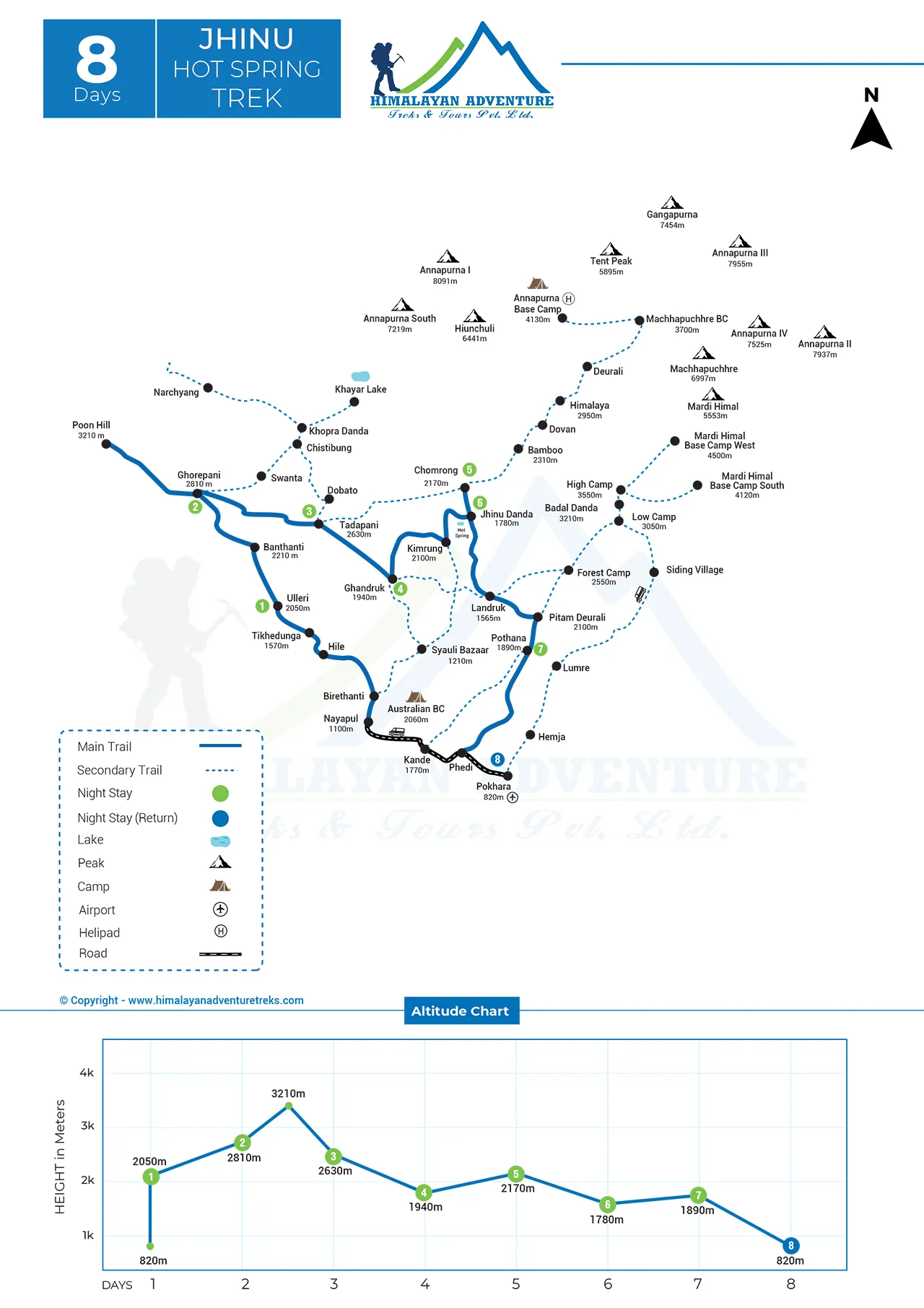
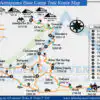
Route Map & Altitude Chart
Pokhara Hotel
Start/End point
Pokhara Hotel
Trip Information
How Difficult is the Trek?
The Jhinu Hot Spring Trek is regarded as an average trek, which can be enjoyed by a beginner who has a basic level of fitness and experienced trekkers. The paths have a combination of slow walks, walks through the forest, the use of stones, and a few steep uphill and downhill stages.
Climbing long stone steps, particularly in the area of Ulleri and Chomrong, is one of the more difficult sections. The level is, however, variable and there are numerous points of rest on the road.
The highest point of the trek is Poon Hill (3,210 m / 10,531 ft) and is accessible to the majority of visitors, provided one walks consistently. The normal daily walking hours are between 4 hours and 6 hours.
The Jhinu Hot Spring Trek is a fulfilling and pleasant trip with the right pace and frequent rest. It is very adventure-packed and comfortable without being very physically exhausting.
Weather and Best Season for Trek
Jhinu Hot Spring Trek may be carried out all year round, although the most favourable seasons are spring (March to May) and autumn (September to November). The weather is consistent in these months, and the mountain scenes are at their finest.
The forests are lush with blooming rhododendron flowers in the spring, and therefore, the trails turn colorful and vibrant. Autumn is cold with clear sight of mountains such as those in Poon Hill (3,210 m / 10,531 ft).
It is colder during the winter (December to February), and particularly at the higher altitudes, but with the right preparation, the trek can be done. Due to the monsoon (June to August), it rains, and the mountain trails are slippery, and the mountain views are limited.
On the whole, the Jhinu Hot Spring Trek is more comfortable and pleasant with regard to the season selection.
Food and Drink during the Trip
During the Jhinu Hot Spring Trek, you eat in local teahouses along the way. The meals are basic, nutritious, and meant to provide trekkers with sufficient power to walk on a daily basis. The most famous foods are rice, lentil soup (dal bhat), vegetables, noodles, pasta, and soups.
The type of breakfast common in the countryside is bread, pancakes, porridge, or eggs. Dinner and lunch provide a diverse range of local and simple international cuisine. Hot beverages like tea, coffee, and hot lemon are very common.
Food options can be reduced as you go above the ground, such as Poon Hill (3,210 m / 10,531 ft), yet the quality is still excellent. One should drink a lot of water and remain hydrated during the trek.
Jhinu Hot Spring Trek is an experience that will provide you with an opportunity to have hot meals with scenic views of the mountains.
Altitude Sickness and Suggestions
Altitude sickness is not common on the Jhinu Hot Spring Trek, but it is still important to be aware of it. The climb peaks at Poon Hill (3,210 m / 10,531 ft), which is not very dangerous to the majority of individuals.
Trekking at this elevation may cause slight complications such as a headache, fatigue, in cases where the trekkers have climbed too fast. In order to decrease the risk, one should walk slowly, consume sufficient water, and avoid alcohol.
It will help a lot with the right rest and giving your body time to adapt. In case of worsening, the best solution is to go down to a low altitude.
Jhinu Hot Spring Trek itinerary is made in such a way that the elevation increase is gradual and, therefore, it can mitigate potential risks. The journey will be safe and comfortable once the basic precautions are followed.
Preparation and Fitness
Proper preparation will enable you to enjoy the Jhinu Hot Spring Trek. The trek is not strenuous, and you need minimal fitness. Certain exercises, like jogging or cycling, can be used to train your body with regular walking or some light hiking.
Another useful training is walking up and down the hill because the trail has numerous steps and rough terrain. The highest point, Poon Hill (3, 210 m /10,531 ft), is quite challenging but can be attained by most individuals.
It is significant to pack the appropriate equipment. Comfortable hiking shoes, warm clothes, and a backpack will be required.
The Jhinu Hot Spring Trek would be considerably easier and more pleasant with adequate preparation. It can be successfully done even by beginners with a positive attitude and good timing.
Visa and Permits
In order to participate in the Jhinu Hot Spring Trek, travelers require a valid tourist visa and trekking permits in Nepal. The tourist visa can be obtained both on arrival at the Kathmandu airport and online.
To do the trek, one will require permits like the Annapurna Conservation Area Permit (ACAP) and the Trekkers Information Management System card (TIMS). These are the permits to get to the Annapurna region, including the places near Poon Hill (3,210 m / 10,531 ft).
Himalayan Adventure Treks arranges all permits, making the process easier and saving valuable time. With the right permits, the Jhinu Hot Spring Trek is a legal and smooth trekking experience.
Health and Safety
The Jhinu Hot Spring Trek is significant in regard to health and safety. The paths are not usually risky, yet trekkers are always advised to be cautious, particularly in steep or slippery parts.
One should take enough rest, eat well, and remain hydrated. It is suggested to carry a simple first aid kit. At greater altitudes, such as Poon Hill (3,210 m / 10,531 ft), the air is less dense, and thus walking slowly allows one to avoid any form of discomfort.
It is also advisable that travel insurance should be taken in case of any emergency. Hiring guides and porters provides an extra level of safety and support during the trek.
Jhinu Hot Spring Trek is said to be safe for the majority of travelers, provided they observe due precautions. As long as one is well-equipped, the journey will be smooth and enjoyable.
Transportation
The Jhinu Hot Spring Trek usually starts from Pokhara. The trip starts with a drive to Nayapul or any of the starting points, which is approximately 1.5 to 2 hours of driving. After the trek, the journey is completed with a drive from Phedi back to Pokhara.
The roads cut across picturesque hills, villages, and agricultural land, which provide a very good introduction to the region. The transport is organized mostly by car or shared jeep.
During the trek, everything is done on foot, such as access to places such as Poon Hill (3,210 m / 10,531 ft). Once you are done, you can rest and have fun in Pokhara.
With Himalayan Adventure Treks, the Jhinu Hot Spring Trek becomes effortless and comfortable throughout the journey.
Travel Insurance
Travel insurance is highly recommended for those planning the Jhinu Hot Spring Trek. Although the trek is moderate, there may arise, unforeseen circumstances like an injury, disease, or weather conditions. An effective insurance policy must be in place to include medical care, evacuation, and delay or cancellation of trips.
Even though the highest point of the Jhinu Hot Spring Trek is not very high, and its top is Poon Hill (3,210 m / 10,531 ft), altitude-related complications may happen to some trekkers. Being insured is a blessing, and you know that you have prepared against such eventualities.
Make sure your insurance policy covers trekking in remote areas of Nepal. Some plans involve helicopter evacuation that may be effective in case of an emergency requiring immediate medical attention. Travel insurance makes your journey more secure and safe.
Alternative Routes
Jhinu Hot Spring Trek is flexible, and the trekkers have several alternative paths they can follow on the basis of time and choice. Some paths are the ones that lead up to the Annapurna Base Camp, and the other ones are shorter scenic paths with villages and forest paths.
The addition of Ghandruk or Landruk villages, where one can experience the culture and see the beautiful mountain scenery, is one of the most popular ones. A different variation enables the trekkers to venture deep into the Annapurna region and experience higher altitudes in areas greater than Poon Hill (3,210 m / 10,531 ft).
The Jhinu Hot Spring Trek can be differentiated and customized with these options. You may choose a shorter route or choose the longer one; whatever you choose has an option that best suits your pace and fitness level.
You can take advice on the best route to use during your journey with the help of the experts from Himalayan Adventure Treks.
Your Extra Expenses
In the Jhinu Hot Spring Trek, not all costs are covered by the packages, and this is why it is rather important to calculate your budget. Some expenses can be snacks and beverages of personal use, hot showers, charging infrastructure, and Wi-Fi connectivity at teahouses.
Prices of food and services might go up as you climb higher in the trail, particularly in areas such as Poon Hill (3,210 m / 10,531 ft), as a result of transport difficulties. It is recommended to tip guides and porters, and that is a usual practice in Nepal.
You can also spend money on souvenirs, gifts, or visits to local sights. It is advisable to carry a bit of cash, since ATMs are not found on the trekking trail.
These additional expenses are necessary, and preparedness can make the Jhinu Hot Spring Trek a good and hassle-free experience.
Language & Communication
Communication in the Jhinu Hot Spring Trek is not normally a problem, particularly in the main trekking spots. The primary language of locals is Nepali, although most individuals employed in teahouses and the tourism industry have basic English.
Ordinary discussions on food, accommodation, and directions are not a big issue. Friendly locals will be found in villages along the trail and around vantage points such as the Poon Hill (3,210 m / 10,531 ft), which are accustomed to dealing with international trekkers.
One of the ways to improve your experience can be learning some basic Nepali words, including greetings, which will help you to bond with the locals.
In general, the language is not a significant obstacle during the Jhinu Hot Spring Trek, and the communication process is comfortable throughout the trip.
Internet, Charging Facilities, and Mobile Network
The Jhinu Hot Spring Trek has mobile network coverage in most areas, but the signal strength may differ depending on the area. Connection is generally good in the lower regions and weak or unreliable in the high regions, such as Poon Hill (3,210 m / 10,531 ft).
Wi-Fi services are provided at most teahouses at an additional fee, but the speed is slow. It also has charging facilities, but you might be required to pay a small fee to charge your devices.
It is also advisable to keep a power bank as a backup, particularly when there is a long trekking day. Local SIM cards can be helpful to have better network access.
Staying connected during the Jhinu Hot Spring Trek is possible, but you should expect limited and basic services.
Don’ts on this Trip
During the Jhinu Hot Spring Trek, one should try not to violate the local culture, nature, and safety rules. Never litter the trail, and proper waste disposal should be done to ensure the cleanliness of the environment.
Do not disturb animals or ransack plants, more particularly in reserves. The loudness or disrespectful behavior in villages and teahouses must be avoided. When in elevated areas, such as Poon Hill (3,210 m / 10,531 ft), be considerate of fellow trekkers and keep the atmosphere calm.
There is no need to hurry up with the trek because a speedy walk may cause exhaustion or pain. It is also advisable not to drink alcohol at elevated levels.
These few tips will help to make sure that the Jhinu Hot Spring Trek can be safe and respectful to everyone.
Photography & Drone Rules
The Jhinu Hot Spring Trek has numerous picturesque areas to take photographs in, with the greenery all the way to mountainous scenery at Poon Hill (3,210 m / 10,531 ft). It is not prohibited or discouraged to take photos; however, one should be respectful.
Never take pictures without permission on personal property or of individuals. Photography can also be limited in certain regions, particularly around cultural or religious places.
The usage of drones in Nepal is highly controlled. It requires special permission from authorities to operate a drone when flying within an area considered to be safe, such as the Annapurna region. If you fly drones without permission, you may get fined or have them confiscated.
By observing such rules, the Jhinu Hot Spring Trek is a smooth experience and captures memories.
Tips for First-Time Visitors
Among the first-time trekkers, the Jhinu Hotel Spring Trek is a good experience of trekking in Nepal. Begin with light packing, but not forgetting to bring important items and those that will carry you throughout the trip, such as comfortable shoes, warm clothing, and a reusable water bottle.
Walk and rest frequently, particularly on your way to such places as Poon Hill (3,210 m / 10,531 ft). Eating and being hydrated will keep you energetic.
Having a simple daily routine and paying attention to your body are useful. The experience might be easier and more enjoyable with the help of a guide, which is provided by Himalayan Adventure Treks.
Above all, have fun during the trip, appreciate the views, and enjoy the local culture. The Jhinu Hot Spring Trek is one experience where a destination is not the focus, but the journey to it is really appreciated.
Essential Packing Gear List for Jhinu Hot Spring Trek
If you have decided to go on the short trek, Jhinu Hot Spring Trek in Nepal, we assure you that you will have a fantastic time ahead. But what should you pack for your Adventure? What will be the right gear to make your trip more fabulous? To help you with this, we have compiled a packing list of essential items that you mustn’t forget to bring along.
- Passport ( min 6 months valid)
- Cash, credit card
- List of important addresses and contact details
- 2-3 passport photos (optional)
- Copies of all important travel documents (passport, visa, airline ticket, insurance policy, etc.)
- A sturdy 70 L trekking backpack which will be carried by your porter (please note that our assigned 1 porter will carry 2 clients’ luggage up to 20-25 kg.
Note: We will provide each participant with a spacious 70 to 75 L Company logo duffle bag to conveniently carry your trekking gear, which you have to return once the trek is complete. - A 30 L Daypack that has room for your essentials such as camera, mobile, Passport, important documents, water bottle, day-useable medicine, chocolate bars, raincoat, etc., which will be carried by you.
- Protective cover for a backpack or travel bag.
- Hiking Boots: Preferably ankle-high boots to prevent ankle sprain
- Regular Shoes: For small strolls and exploration around the city
- Second, a light pair of shoes and possibly sandals
- Micro Spikes or Ice Cleats for the winter trekking over snow and ice
- Gaiter for added protection in snow
- A rain and wind-resistant, lightweight down jacket for warmth, with a good helmet hood
- Summer-light, as well as winter warm clothing
- Quick-drying shirts made of synthetic fabrics
- Warm and cool vests or T-shirts
- Functional synthetic underwear
- Sports Bra for Female Trekker
- A waterproof pair of trousers
- Regular trousers of quick-drying fabric
- Hiking shorts
- Cargo Pants with multiple pockets to hold your small items, such as knives or chocolates
- Woolen or fleece pants
- Trekking socks, both thick and woolen fabric, and lighter wool socks
- Wool hat, gloves, and scarf
- A light cotton scarf or a bandanna for protection of your head, neck, ears, and mouth
- Sun hat, and sunglasses with 100% UV protection (for trekking trips, even with stray light and nose protection)
- Sunscreen cream or lotion with a high sun protection factor (at least 15, for trekking trip,s even at least 30)
- Sunscreen lipstick with a high SPF (at least 20, for trekking trips, even at least 30 or sunblock)
- Mosquito repellent (Optional)
- Comfortable light night clothes and shoes
- A drinking bottle that can be used as a hot water bottle on frosty nights
- Flip-flops or bathing shoes for using the showers
- Water purifiers: if you need to refill water from the tap or stream en route
- Headlamp: for a midnight or pre-dawn trip towards the viewpoint
- Quick-drying towel and sample-size toiletries for washing your feet and face
- Your Personal first-aid kit: with basic medical supplies such as bandages for sprains, antidiarrheal and antibiotics, iodine wipes for scrapes and cuts, plasters, aspirin, or ibuprofen, moleskine for preventing blisters, Diamox (acclimatizing medicine), and your Personal medication
- Sleeping bag appropriate for all-season treks (we can hire in Kathmandu)
- Waterproof money belt, chest bag, leg bag, or belt bag for storing important travel documents or valuables
- Toothpaste, Toothbrush, and soap
- Deodorants
- Moisturizer
- Nail clippers
- Feminine hygiene products (Sanitary Pads)
- Small mirror
- Wet wipes
- Hand sanitizer
- Comb
- Camera with sufficient memory cards and spare batteries, or a battery charger
- Small padlock for your travel bag
- Crampons ( during winter, Dec- Feb)
- Thermos flask
- Water bag
- Toilet paper (2-3 rolls without)
- Ear Plugs
- Matchbox, or lighter
- Compass or GPS
- Map
- Alarm clock
- Multi-tool kit
- Binoculars
- Books
- Whistle
Equipment Note:
- Please note that there is no need for you to bring all these heavy items, such as a Sleeping bag, a down Jacket, Trekking Poles, and items from your home. You can easily rent or purchase high-quality to standard-quality items in Kathmandu and Pokhara.
- Items are available from international brands such as The North Face, Sherpa Adventure, Marmot, Mountain Hardware, Black Yak, Karma Gear, and local brands like Goldstar and locally made products etc.
- Plus, we will also gift you a company logo T-shirt as a token of your experience in Nepal with us.
Renting Cost:
- Sleeping Bag & Down Jacket (-10-20 degree Celsius), Per Piece per day US$ 1.5
Frequently Asked Questions
What is the average time taken in the Jhinu Hot Spring Trek?
The Jhinu Hot Spring Trek usually takes 7 to 8-days, which depends upon the itinerary, pace, and option of routes.
Is previous trekking experience required for this trek?
There should have been no prior trekking experience, and basic fitness and readiness to walk a number of hours per day is a prerequisite towards comfort.
What kind of accommodation is provided during the trek?
You are largely accommodated in teahouses, which provide simple rooms, simple facilities, and a comfortable resting place.
Do we need guides and porters on this trek?
Guides and porters are optional, but they make the treksafer, effortless, and generally more enjoyable, especially when it is the first time.
What is the type of clothing should be brought on the trek?
Layered clothes such as warm jackets, trekking pants, gloves, and a hat are required because the temperatures fluctuate at different points of the trek.
Are there any age limitations for this trek?
No rigid age limits are set; however, one has to be physically fit and be able to walk several hours over the diverse terrain.
Is drinking water accessible on the route?
Teahouses offer drinking water, although purification pills or filters are good to have for clean drinking water.
Is it safe for a solotraveller?
Yes, individual travelers can finish the trek, but it is advisable to hire a guide so that they have more safety and local assistance.
What wildlife are visible on the trek?
In the forest regions, trekkers are likely to be surrounded by birds and monkeys, which enhances the natural beauty of the trip.
Does it have hot showers on the trek?
Most teahouses have hot showers for an additional charge, depending on the location and access to resources.
Is this trek crowded?
Jhinu Hot Spring trek is not as crowded as the major routes and is a quieter and more relaxed experience of a trek.
Do I need to tip guides and porters during the trek?
Tipping is not compulsory but it is welcomed to guides and porters to show their appreciation to the guides and porters.
What terrain do the trekkers have to expect?
The trek involves rock steps, woodland trails, suspension bridges, and rocky paths, and involves walking and moving slowly.
Does the route have any medical facilities?
In villages, simple medical assistance can be provided, but trekkers must have personal medicines and a first aid kit.
What is so special about the Jhinu Hot Spring Trek?
The Jhinu Hot Spring Trek is distinct in its ability to offer scenic trekking trails with a soothing hot spring in a serene Himalayan background.
Related Blogs & Articles


Reviews on Jhinu Hot Spring Trek

Related trips