

Duration
18 Days

Lower Dolpo Trek


Trip Grade
Challenging
Group Size
2-16 People
Max Altitude
5,190m. / 17,028ft.
Best Season
Feb- May/ Sept- Nov
Activity
Hiking & Trekking
Meals
Breakfast, Lunch & Dinner
Accommodation
Hotels & Teahouses
Transportation
Private Vehicle & Flight
Trip Customization
On request (click here)


Highlights of Lower Dolpo Trek
- Cross Numa La Pass at 5,190 meters with wind chill reaching -12°C during your summit stop.
- Witness Phoksundo Lake’s turquoise waters visible from 2 kilometers away.
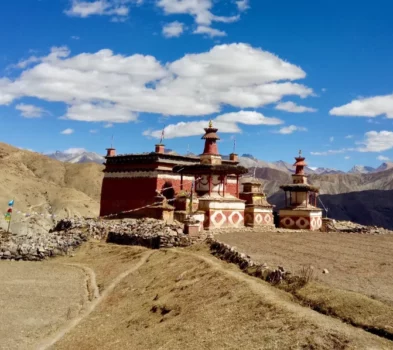
- Enter Shey Gompa’s 12th-century cave complex.
- Navigate the high pass trail all the way up to Baga La Pass.
- Trek through Shey Phoksundo National Park.
- Consume meals like buckwheat pancakes with wild honey, dal bhat, roasted barley, and buckwheat flat bread.
- Witness traditional net weaving using sheep wool in Ringmo village.
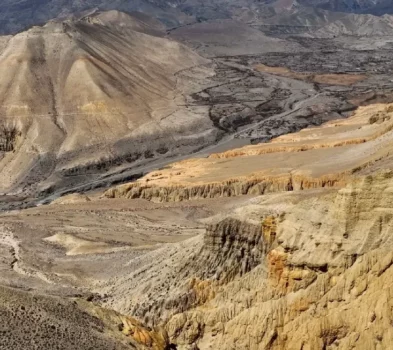
- Enjoy panoramic scenes of the valley with the high Himalayan ranges from the top of the high passes.
Trip Introduction
The Lower Dolpo Trek moves you through Nepal’s most isolated region beyond the Dhaulagiri Himalayas. This restricted area requires special permits through authorized agencies or the Tourism Board Office in Kathmandu.
Dolpa District spans 7,889 square kilometres at 2,100 to 5,500 meters elevation with only 5 persons per square kilometer according to Nepal’s 2021 data. You follow ancient routes used for hundreds of years by traders transporting goods and herders rearing their precious cattle.
Dolpo’s 42,000 residents speak a distinct Kham Tibetan dialect while practicing Bon religion alongside Tibetan Buddhism. Villages like Ringmo maintain sky burial traditions on designated charnel grounds as part of their spiritual practices.
Phoksundo Lake dominates the landscape as one of Nepal’s deepest bodies of water at 145 meters. The high content of minerals in the water gives the lake its distinctive turquoise color. Shey Phoksundo National Park protects over a hundred different bird species, including Himalayan snowcocks and snow leopards.
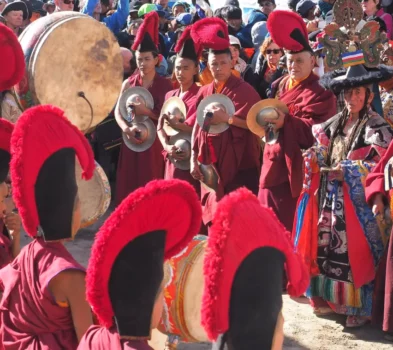
One of the main festivals in the region is the Shey Festival, which occurs every 12 years at Shey Gompa, where monks perform ritual dances wearing costumes representing deities. You experience Dolpo’s demographic uniqueness through its 85 percent farming population and pre-Buddhist Bon traditions.
This trek delivers direct access to one of Earth’s last culturally intact high-altitude ecosystems, where every step connects you to the stories of its history. Your journey begins where modern infrastructure ends and ancient pathways begin.
As your trekking partner, we will manage and arrange all the things that the Lower Dolpo Trek requires. This includes transportation, accommodation, permits, meal arrangements, daily itinerary, etc. Our team of guides and porters will help you throughout the journey.
While the porters are there to handle the heavy bags, our guides will lead the group, bridge the communication gap between you and the locals, and also share local insights as you make progress.
Outline Itinerary of Lower Dolpo Trek
Day 01: Arrive at Kathmandu Airport.
Day 02: Kathmandu valley Sightseeing & Preparation.
Day 03: Fly from Kathmandu to Nepalgunj (150m).
Day 04: Fly from Nepalgunj to Juphal (2475 m) and trek to Dunai (2850 m).
Day 05: Trek from Dunai to Tarakot (2545 m).
Day 06: Trek from Tarakot to Laini (3170 m).
Day 07: Trek from Laini to Nawarpani (3545 m).
Day 08: Trek from Nawarpani to Dho Tarap (4990 m).
Day 09: Acclimatization day at Dho Tarap (4990 m).
Day 10: Trek from Dho Tarap to Numa La Base Camp (4440 m).
Day 11: Cross Numa La Pass (5190 m) and Camp at Pelung Tang (4445 m).
Day 12: Cross Baga La Pass (5070 m) and Camp at Dajok Tang (4080 m).
Day 13: Trek from Dajok Tang to Ringmo (3600 m).
Day 14: Rest day at Ringmo and hike Phoksundo Lake (3612 m).
Day 15: Trek from Ringmo to Shyanta (2520 m).
Day 16: Trek from Shyanta to Juphal (2475 m).
Day 17: Fly back to Kathmandu via Nepalgunj.
Day 18: Departure from Kathmandu Airport.
Our guests sharing their experiences (Photo/Video Gallery)



Detail itinerary of Lower Dolpo Trek
01
Day 01: Arrive at Kathmandu Airport.
Day 1 of the Lower Dolpo Trek starts when your flight lands at Tribhuvan International Airport in Kathmandu. You move through immigration processing in about 60 minutes using Nepal’s visa-on-arrival procedure.
You require two passport photos and USD cash for visa fees. Pay $30 for a 15-day visa or $50 for 30 days, as the Nepal government rates confirm. Collect your luggage and find our rep waiting in the arrivals hall holding your name sign.
We drive you 5 kilometers to Thamel, Kathmandu’s trekking district. The transfer takes 20 minutes through busy city streets.
You see motorbikes weaving between street vendors and prayer flags fluttering above shops. Traffic flows slowly but predictably.
Your hotel check-in happens at approximately 1,400 meters elevation, matching the airport altitude. No elevation change occurs today.
Rest for the time being to recover from your flight. Most Thamel hotels provide reliable Wi-Fi and hot water, essential for preparation.
We guide you through essential gear checks in the afternoon. Water purification tablets cost $2 for a 50-tablet pack.
A durable daypack ranges from $25 to $40, depending on brand quality. Our guide conducts a mandatory 60-minute briefing covering safety and cultural practices.
You learn to greet Nepali people with “Namaste” and respect temple customs by avoiding pointing feet at shrines. We verify your passport validity, travel insurance coverage, and emergency contact details.
You eat dinner at a local restaurant featuring dal bhat, Nepal’s staple meal. This lentil soup and rice combination delivers 800 to 1,000 calories per serving.
Eat fully to restore energy after travel and sleep early tonight. Tomorrow morning at 8 a.m., we begin temple visits and final equipment inspections.

Activity: Airport Pickup, 30 min

Max. Altitude: 1,400m/4,593ft. Kathmandu

Accommodation: Hotel
02
Day 02: Kathmandu valley Sightseeing & Preparation.
Day 2 begins at 7:30 a.m. when you meet our team at your Thamel hotel entrance. We discuss today’s 8-kilometer walking route through UNESCO World Heritage Sites.
You wear sturdy shoes as Kathmandu’s stone paths demand light footing. You climb 365 steps to the Swayambhunath Stupa before 9 a.m. This fifth-century hilltop complex sits around 100 meters above the valley elevation.
You circle the white dome clockwise, touching prayer wheels. We explain the proper stupa circumambulation technique requiring three full rotations.
At Boudhanath Stupa by noon, you observe a 246-meter circumference circumambulation. Local Newari women sell marigold garlands at the eastern gate stalls.
You practice butter lamp offerings following our Lower Dolpo Trek guide’s demonstration. Each lamp costs $1 and burns for a solid hour or so, providing light for meditation.
Lunch features vegetable thukpa at a nearby local eatery. This noodle soup delivers 500 calories per bowl, but makes you feel full.
We verify your trekking permits during the meal. Check that your TIMS card matches passport details exactly.
Afternoon gear inspection happens at Kathmandu Guest House. We test your headlamp brightness using. Your sleeping bag must be rated to -5°C per Lower Dolpo Trek guidelines.
We recommend trekking poles rental shops if yours lack rubber tips. We emphasize layering: avoid cotton base layers as they retain moisture.
By 4 p.m., we will confirm your Nepalgunj flight seat. Dinner at Thamel includes momo dumplings. Eat fully to maintain energy reserves.
Activity: Sightseeing, 5-6 hours
Max. Altitude: 1,400m/4,593ft. Kathmandu

Meal: Breakfast
Accommodation: Hotel
03
Day 03: Fly from Kathmandu to Nepalgunj (150m).
Day 3 starts at 9:30 a.m. when you leave your Thamel hotel for Tribhuvan International Airport. You travel 5 kilometers in a pre-arranged vehicle included in the Lower Dolpo Trek package.
Domestic terminals open 90 minutes before departure per CAAN regulations. You present your ticket and passport at the check-in counter. Baggage allowance totals 20 kilograms, including 5 kilograms for carry-on.
Flight duration lasts 75 minutes with cruising altitude at around 15,000 feet. You descend through the Terai region, observing rice paddies and irrigation canals below. Nepalgunj Airport sits at 150 meters.
Baggage claim completes within 20 minutes of landing. Exit the terminal to find our waiting vehicle. Transfer to a pre-arranged accommodation takes 15 minutes, covering 3 kilometers.
Hotel elevation matches airport elevation at 150 meters. You receive a room with a cooler/heater and an attached bathroom. Lunch features tasty curry and rice at the hotel restaurant, included in the Lower Dolpo Trek.
Afternoon involves flight confirmation for Day 4 to Juphal. Show your booking reference to our guide. By 4:00 p.m., you rest in shaded courtyard areas.
Daytime temperatures reach 25 to 29 °C in November. Wear light clothing and apply SPF 50 sunscreen. Dinner consists of vegetable pulao.
Activity: Flight, 1 hour
Max. Altitude: 150m/492ft. Nepalgunj
Meal: Breakfast, Lunch & Dinner
Accommodation: Hotel
04
Day 04: Fly from Nepalgunj to Juphal (2475 m) and trek to Dunai (2850 m).
The 4th day of the Lower Dolpo Trek begins before dawn, with our team meeting you at your Nepalgunj hotel. Mountain flights operate only in early morning hours, so we move fast.
You feel the cool night air as we drive toward the airport. Our guide might share stories while en route. We have even rerouted clients through alternative trails after flight cancellations due to bad weather. Flexibility saves trips when the weather intervenes.
You learn this region demands respect for nature’s schedule, not ours. At the airport, we handle your permits and baggage efficiently. You board the Twin Otter plane feeling secure with experienced pilots.
The flight reveals Nepal’s dramatic transition from flat plains to rugged mountains. Below, you see patchwork fields give way to deep river gorges. You gain significant elevation quickly.
Our guide points out landmarks through the small window. This aerial perspective helps you understand tomorrow’s terrain. Landing at Juphal airstrip surprises first-time trekkers.
The short gravel runway sits perched on a mountainside. You step out directly onto the trail with your daypack. Lower Dolpo Trek porters carry the main luggage ahead. We start walking immediately to maximize daylight hours.
The trail follows the Thuli Bheri River through changing landscapes. You cross sturdy suspension bridges where prayer flags snap in the wind. River sounds accompany your footsteps. We teach you the local greeting “Julley” used when meeting villagers.
Each bridge crossing builds confidence for higher passes ahead. Lunch happens at a family-run teahouse. The owner serves dal bhat on metal plates.
You notice how she refills water bottles from a spring source. We check oxygen levels here as altitude increases. Our Lower Dolpo Trek guides watch for subtle signs of fatigue in every traveler.
Afternoon trekking involves steady climbing through juniper forests. Switchbacks reduce strain on your knees. We stop frequently to adjust layers as temperatures drop.
Trail markers guide your path when fog rolls in unexpectedly. You learn to trust the route even when visibility shrinks. You reach Dunai village before the afternoon light fades.
Our preferred guesthouse owner prepares hot water for washing. Dinner features buckwheat dishes grown locally.
Sleep comes easily after this demanding transition day. This flight-to-trek sequence remains our most requested itinerary segment. Clients remember the contrast between Nepalgunj’s heat and Dunai’s mountain air.
Activity: Flight & Trek, 3-4 hours
Max. Altitude: 2,850m/9,350ft. Dunai
Meal: Breakfast, Lunch & Dinner
Accommodation: Teahouse
05
Day 05: Trek from Dunai to Tarakot (2545 m).
The next day starts at 6:15 a.m. with hot ginger tea in your Dunai room. You pack your daypack while checking water levels.
We confirm your oxygen saturation reads 90 to 96 percent using our pulse oximeter. This measurement meets Himalayan Rescue Association safety thresholds for today’s descent. The trail leaves Dunai village heading east along the Thuli Bheri River.
You walk 15 kilometers today with 305 meters of net elevation loss. River width narrows to 10 meters here. Trail surfaces shift between packed earth and river-smoothed stones, requiring careful foot placement.
We navigate three river crossings before 9 a.m., each uses wooden footbridges secured with ropes and steel wire. Bridge decks measure around 40 centimeters wide. At 10:30 a.m., the path enters juniper forest sections. Tree density decreases with elevation rise.
You identify Rhododendron saplings at 2,700 meters elevation. Trail markers change to blue paint blazes. We practice the zigzag walking technique to conserve energy on steeper slopes.
Lunch occurs at Chharka village at around 12:45 p.m. You eat buckwheat pancakes with honey at a stone hut charging. Rest breaks last 10 minutes to prevent joint stiffness. The final 5 kilometers follow ancient routes.
You pass three mani walls built with slate stones. Villagers greet you with “Tashi delek” as you approach Tarakot. You arrive at a guesthouse by 3:20 p.m., and the elevation reads 2,545 meters.
Rooms feature wood-burning stoves for evening warmth. Dinner includes roasted barley soup; we review tomorrow’s 3170-meter elevation target.
Activity: Trek, 5-6 hours
Max. Altitude: 2,545m/8,350ft. Tarakot
Meal: Breakfast, Lunch & Dinner
Accommodation: Teahouse
06
Day 06: Trek from Tarakot to Laini (3170 m).
The following day of the Lower Dolpo Trek starts with a gear inspection at a guesthouse at 5:55 a.m. We adjust your backpack strap for optimal breathing during ascent. Oxygen intake increases a certain percent with proper torso alignment.
You ascend 625 meters over 14 kilometers through juniper forest corridors. Trail gradients average 14 percent on the initial 2.5-kilometer climb above Tarakot. Juniper trees measure 3 to 5 meters tall. You identify Rhododendron trees once again at 2,800 meters.
At 7:40 a.m., you navigate the first mani wall sequence. Each stone structure contains 180 to 220 carved slats. Trail markers shift to red prayer flags where forest cover obscures painted blazes.
You cross the Laini Khola tributary at 9:15 a.m. Lunch occurs at 12:05 p.m. near a teahouse in Sermathang. You consume roasted barley cakes with dried cheese.
The final approach follows dirt routes through open meadows. You pass three active yak grazing areas with herds. Trail width narrows to a couple of meters, requiring focused foot placement on exposed roots.
You reach Laini Guesthouse by 3:55 p.m. Rooms feature no heating, just a warm bed and blankets. That’s just how it goes in the remote hills.
Nighttime temperatures drop to -3°C; before that, dinner provides much-needed energy and warmth through potato stew with wild greens. This route reveals Dolpo’s forest ecosystems.
Your safe arrival depends entirely on maintaining precise hydration management throughout the ascent.
Activity: Trek, 5-6 hours
Max. Altitude: 3,170m/10,400ft. Laini
Meal: Breakfast, Lunch & Dinner
Accommodation: Teahouse
07
Day 07: Trek from Laini to Nawarpani (3545 m).
The 7th day of the Lower Dolpo Trek begins at 6:45 a.m. when you adjust your headlamp for the pre-dawn trail departure.
We need you to verify your hydration status with urine color charts, matching standards. Clear to pale yellow indicates proper fluid intake before ascending.
The trail climbs steadily from Laini’s stone houses through terraced barley fields. You cover 10 kilometers today, gaining 375 meters of elevation to reach Nawarpani. Rocky sections require precise foot placement on limestone fragments common in Dolpo’s arid landscape.
We practice energy-conserving pacing: 50 minutes walking followed by 5-minute rests. Your pulse stays below 100 beats per minute during these intervals.
You cross three dry riverbeds by 10:30 a.m. Each requires navigating boulder fields up to 1 meter in height. Carved stone cairns act as trail markers above 3200 meters in elevation.
Lunch occurs at 1:15 p.m. You eat filling and energising dal bhat at a teahouse en route.
The final ascent involves traversing a scree slope with loose gravel. You use trekking poles vertically for stability on the 25-degree incline.
Trail markers disappear temporarily, but our Lower Dolpo Trek guide will lead the pack. You arrive at Nawarpani Guesthouse by 4:10 p.m.
Elevation confirms 3,545 meters, and rooms feature stone walls providing natural insulation against nighttime temperatures. Dinner includes potato soup with barley dumplings.
Activity: Trek, 6-7 hours
Max. Altitude: 3,545m/11,631ft. Nawarpani
Meal: Breakfast, Lunch & Dinner
Accommodation: Teahouse
08
Day 08: Trek from Nawarpani to Dho Tarap (4990 m).
On the 8th day of the Lower Dolpo Trek, the trail demands immediate focus as you start the trek at 6:20 a.m. from Nawarpani. Your body processes oxygen at 80 percent efficiency compared to sea level at 3,545 meters elevation.
You traverse 13.2 kilometers across Dolpo’s high desert plateau today. Elevation gain totals 1,445 meters, reaching Dho Tarap’s 4,990-meter mark. Trail surfaces shift from packed earth to exposed bedrock, requiring ankle-stabilizing movements.
You cross the first high-altitude stream at 10:10 a.m. Water temperature registers 4°C based on our digital thermometer. We test each step using trekking poles before full weight transfer on makeshift bridges. Lunch occurs at 1:00 p.m. near the village of Tshowa.
You consume tsampa porridge with dried yak meat. Pulse oximeter checks happen every 45 minutes. The final approach involves 2.1 kilometers of continuous ascent over moraine terrain.
Loose boulders up to 50 centimeters in diameter demand careful route selection. Trail markers disappear completely above 4,800 meters, but you won’t need them anyway since our Lower Dolpo Trek guide will lead you on.
You enter Dho Tarap Guesthouse by 4:25 p.m. Nighttime temperatures drop to -5°C based on records. We calculate tomorrow’s 5,190-meter pass crossing using elevation gain comparison.
Activity: Trek, 7-8 hours
Max. Altitude: 4,990m/16,371ft. Dho Tarap
Meal: Breakfast, Lunch & Dinner
Accommodation: Teahouse
09
Day 09: Acclimatization day at Dho Tarap (4990 m).
Day 9 of the Lower Dolpo Trek requires complete rest at Dho Tarap’s 4,990-meter elevation. Your blood carries 35 percent less oxygen here than at sea level.
We measure your resting heart rate at 78 beats per minute during 7:00 a.m. checks. Rates above 85 necessitate additional rest.
You perform controlled movement exercises on flat ground near your guesthouse. Complete three sets of 10-minute walks at a 1.5 kilometers per hour pace.
This maintains circulation without stressing your cardiovascular system. Monitor your breathing depth using the talk test: you must speak full sentences without gasping.
At 9:30 a.m., we visit Dho Tarap Monastery’s 15th-century assembly hall. Wall paintings depict Vajrayana deities using natural minerals.
Each mural measures 2.5 meters by 1.8 meters. Monks demonstrate butter lamp preparation using butter in brass bowls. Lunch occurs at 12:20 p.m., featuring barley soup with dried vegetables.
Afternoon involves oxygen saturation monitoring every 2 to 3 hours. You observe traditional wool weaving techniques at around 3:00 p.m. Local women use backstrap looms.
Activity: Explore day, 4-5 hours
Max. Altitude: 4,990m/16,371ft. Dho Tarap
Meal: Breakfast, Lunch & Dinner
Accommodation: Teahouse
10
Day 10: Trek from Dho Tarap to Numa La Base Camp (4440 m).
Day 10 of the Lower Dolpo Trek requires precise trail navigation as you descend from Dho Tarap’s stone houses at 4:50 a.m.
Trail conditions demand immediate attention: loose scree covers 60 percent of today’s 12.3-kilometer route to Numa La Base Camp. You lose 550 meters of elevation descending into the Numa Valley.
Griddy rocks create unstable footing with pebbles shifting under each step. We move in a single file using trekking poles horizontally for balance.
You cross a couple of streams by 9:40 a.m. Water temperature averages 2°C based on our field thermometer. Stream beds contain sharp quartz fragments requiring careful step testing with poles. Lunch occurs at 12:50 p.m. near the village of Numa.
You consume vegetable thukpa with dried yak cheese. Pulse oximeter checks happen at every stop en route. The final approach follows a lateral trail across steep slopes.
You navigate 1.8 kilometers of exposed terrain with 40-degree inclines. Trail width narrows to 50 centimeters, requiring focused foot placement.
You reach your tented camp by 3:30 p.m. Nighttime temperatures drop to -10°C per records. Tents feature double-layer construction rated for 50 kilometers per hour winds. Dinner provides much-needed warmth and calories through hot soup and bread with honey.
Activity: Trek, 6-7 hours
Max. Altitude: 4,440m/14,567ft. Numa- La Base Camp
Meal: Breakfast, Lunch & Dinner
Accommodation: Teahouse
11
Day 11: Cross Numa La Pass (5190 m) and Camp at Pelung Tang (4445 m).
The following day of the Lower Dolpo Trek starts at 4:15 a.m. when we secure crampons to your boots for chilly trail sections. We distribute iodine tablets for immediate water treatment during the ascent.
You climb 750 meters vertically over 3.8 kilometers to Numa La Pass. Trail surfaces shift from packed dirt trails to loose rocks. Stream bridges span 1.2-meter-wide gaps. You reach Numa La Pass summit at 8:25 a.m.
Elevation confirms 5,190 meters as wind chill registers -12°C. You perform a mandatory 20-minute rest with high-calorie snacks. The descent begins immediately after summit photography. You lose 745 meters of elevation over 5.2 kilometers to Pelung Tang.
The trail features 22 switchbacks on the initial 1.5-kilometer drop with an average 25 percent gradient. Loose rock sections require the zigzag descent technique to prevent momentum buildup.
At 11:40 a.m., you cross the Pelung Glacier outflow stream. Water temperature measures 1°C with silt reducing visibility. Lunch occurs at 1:20 p.m. near Pelung Tang campsite.
You arrive at Pelung Tang Guesthouse by 3 p.m. Nighttime temperatures drop to -7°C. Dinner features hot yak butter soup with buckwheat noodles.
Activity: Trek, 6-7 hours
Max. Altitude: 5,190m/17,028ft. Pelung Tang
Meal: Breakfast, Lunch & Dinner
Accommodation: Teahouse
12
Day 12: Cross Baga La Pass (5070 m) and Camp at Dajok Tang (4080 m).
The 12th day of the Lower Dolpo Trek demands immediate snow assessment as pre-dawn light reveals trail conditions at 4:00 a.m.
You ascend 630 meters vertically over 4.1 kilometers to the Baga La Pass summit. Trail gradients peak at 37 percent on the final 800-meter approach above 4,900 meters.
At 6:40 a.m., you navigate steep trails on the pass’s north face. Summit arrival occurs at 8:10 a.m. at precisely 5,070 meters elevation.
Wind speed registers 28 kilometers per hour, creating a -14°C wind chill per our digital thermometer. Descent begins immediately toward Dajok Tang’s 4,080-meter camp.
You lose 990 meters of elevation over 6.3 kilometers through mixed terrain. The first 2 kilometers traverse rockfall-prone slopes requiring 3-meter spacing between trekkers.
At 11:20 a.m., you cross the Dajok Glacier meltwater channel. Lunch occurs at 1:00 p.m. near Dajok Tang.
Activity: Trek, 6-7 hours
Max. Altitude: 4,080m/13,386ft. Dajok Tang
Meal: Breakfast, Lunch & Dinner
Accommodation: Teahouse
13
Day 13: Trek from Dajok Tang to Ringmo (3600 m).
Day 13 of the Lower Dolpo Trek begins with a trail assessment at Dajok Tang’s stone courtyard at 5:50 a.m.
We check your knee braces for proper tension before the descent. Joint stress increases significantly during downhill walking.
You descend 480 meters over 12.5 kilometers to Ringmo’s lakeside settlement. Loose shale covers 70 percent of this section, requiring controlled heel braking with each step.
At 7:30 a.m., you navigate the first Thuli Bheri River ford. Lunch occurs at 12:00 p.m. near a village. You consume vegetable thukpa with dried fish.
The final approach follows Phoksundo Lake’s eastern shoreline. Trail width narrows to 60 centimeters with 200-meter drop-offs requiring focused foot placement. You arrive at Ringmo Guesthouse by 3:20 p.m.
Activity: Trek, 4-5 hours
Max. Altitude: 3,600m/11,811ft. Ringmo
Meal: Breakfast, Lunch & Dinner
Accommodation: Teahouse
14
Day 14: Rest day at Ringmo and hike Phoksundo Lake (3612 m).
Morning light reveals Phoksundo Lake’s turquoise waters at 3612 meters. Your boots touch the lakeshore by 7:00 a.m. to avoid afternoon winds. Glacial minerals create this distinctive color visible from 2 kilometers away.
We follow the eastern shoreline trail for 3.2 kilometers round-trip. Loose stones cover 40 percent of the path. At 8:45 a.m., you reach Bon Po Monastery’s ancient stone steps.
The 12th-century structure features 1.8-meter-thick walls built without mortar. Monks perform water offering rituals using copper vessels filled from the lake. Each offering requires three clockwise circumambulations as per Bon religious texts.
You observe lake wave patterns at 10:20 a.m. Lunch occurs at 12:30 p.m. near Ringmo village. You eat local pancakes, soup, and bread with wild honey.
Afternoon involves cultural observation at 2:00 p.m. Villagers demonstrate traditional net weaving using sheep wool fibers.
Each net requires 12 hours to weave 1 square meter, based on our timing. We purchase spare gloves for 350 NPR per pair to handle cold lake winds. You return to Ringmo Guesthouse by 4:00 p.m.
Activity: Hike, 4-5 hours
Max. Altitude: 3,612m/11,850ft. Phoksundo Lake
Meal: Breakfast, Lunch & Dinner
Accommodation: Teahouse
15
Day 15: Trek from Ringmo to Shyanta (2520 m).
The following day of the Lower Dolpo Trek requires knee brace adjustment at Ringmo Guesthouse before trail departure at 6:00 a.m.
You descend 1,080 meters over 14.3 kilometers through Phoksundo Valley. At 7:50 a.m., you navigate the first Thuli Bheri River tributary crossing. Water depth measures 35 centimeters. Lunch occurs at 12:40 p.m. near Lamjin village.
You consume dal bhat with dried pickles. The final approach follows terraced barley fields carved into valley walls.
You reach Shyanta Guesthouse by 3:50 p.m. Rooms feature mud-plastered walls providing natural temperature regulation. Dinner provides 650 calories through vegetable curry with rice.
We will verify tomorrow’s Juphal flight. Sleep starts by 8:20 p.m. to recover from sustained downhill walking.
Activity: Trek, 4-5 hours
Max. Altitude: 2,520m/8,268ft. Shyanta
Meal: Breakfast, Lunch & Dinner
Accommodation: Teahouse
16
Day 16: Trek from Shyanta to Juphal (2475 m).
Day 16 starts with a trail inspection at Shyanta Guesthouse at 5:45 a.m. You cover 13.8 kilometers descending 55 meters net elevation to Juphal. The Thuli Bheri River width expands to 80 meters.
At around 10 in the morning. You observe traditional fishing methods in the river. Villagers use bamboo traps measuring 1.5 meters long with 10-centimeter mesh openings.
Each trap catches 200 to 300 grams of fish daily. Lunch occurs at 12:20 p.m., and you eat vegetable thukpa with dried fish.
Arrival at Juphal Guesthouse happens by 3:40 p.m. Rooms feature solar-charged battery stations for device charging. This route reveals Dolpo’s river valley agriculture through active terraced fields and traditional fishing practices.
Activity: Trek, 5-6 hours
Max. Altitude: 2,475m/8,120ft. Juphal
Meal: Breakfast, Lunch & Dinner
Accommodation: Teahouse
17
Day 17: Fly back to Kathmandu via Nepalgunj.
Day 17 of the Lower Dolpo Trek requires permit verification at a nearby checkpoint. You transfer to Juphal Airport by 8:10 a.m. in a pre-arranged vehicle covering 1.2 kilometers.
Check-in completes by 9:40 a.m. Flight duration lasts 46 minutes, descending from 2,475 meters to Nepalgunj’s 150-meter elevation. You lose 2,325 meters of elevation during this segment, verified by flight logs.
Landing at Nepalgunj Airport happens at around 11 a.m. Baggage claim completes within minutes of arrival.
Our vehicle transfers you directly to Nepalgunj Airport’s domestic terminal for the 11:30 a.m. Buddha Air flight to Kathmandu.
After landing at Tribhuvan International Airport, you collect your luggage from the carousel. One of our reps meets you in the arrivals hall holding your name sign.
Transfer to Thamel takes 20 minutes. We will have you check into your hotel for the night.
Activity: Flight, 3-4 hours
Max. Altitude: 1,400m/4,593ft. Kathmandu
Meal: Breakfast & Dinner
Accommodation: Hotel
18
Day 18: Departure from Kathmandu Airport.
The ultimate day of the Lower Dolpo Trek begins with your final wake-up at the hotel at 6:30 a.m. You verify your flight confirmation number.
Departure gates close 45 minutes before scheduled takeoff per Tribhuvan International Airport regulations.
You complete hotel checkout by 7:00 a.m. Settle your bill using cash or credit. You can exchange your remaining Nepali currency at a 130 NPR per dollar exchange rate, which is subject to fluctuations.
Arrival at Tribhuvan International Airport occurs by 7:45 a.m. You proceed directly to the counter for international flights.
Present your passport showing 6 months’ validity beyond the departure date. Officers stamp your passport with departure verification.
Activity: Airport drop, 30 min
Max. Altitude: 1,400m/4,593ft. Kathmandu
Meal: Breakfast

Note:
If you have your own private group and want to make your trip private, we can run the custom trip all the day as per your requirements and group size.
Includes and Excludes
What are included with package?
- Pick up from Airport and Transfer to the hotel: Arrival transfer to your hotel in Kathmandu.
- Three Night’s 3-star hotel in Kathmandu with Breakfast: Accommodation with breakfast in a 3-star hotel.
- One Night’s 3-star hotel in Nepalgunj with Breakfast, Lunch & Dinner: Stay in a 3-star hotel with full board meals.
- Kathmandu/ Nepaljung/Jhupal/Kathmandu flight: Flights covering the route between Kathmandu, Nepalgunj, and Jhupal.
- Lunch, dinner & breakfast during trek: Meals provided throughout the trekking days.
- Kathmandu sightseeing by private vehicle with an experienced tour guide: Guided sightseeing tour in Kathmandu using private transportation.
- Trekking permit: Necessary trekking permits for the journey.
- All necessary paper works: Arrangements for permits and other required documentation.
- All accommodations in Camping/tea houses during the treks: Stay in tea houses or camping during the trek.
- Dolpo Special permit: Special permit required for trekking in the Dolpo region.
- ‘Trekkers’ Information Management System (TIMS) Permit: Permit for the Trekker’s Information Management System (TIMS).
- An experienced, helpful, Govt Licence holder and friendly Guide, porters (1 porter for 2 clients): Qualified guide and porters for the trek.
- Medical supplies (first aid kit will be available): Basic medical supplies in case of emergencies.
- All government taxes: Taxes covered under the package.
- Last Night’s farewell dinner at an authentic Nepalese restaurant with a cultural performance: Traditional Nepalese farewell dinner with cultural entertainment.
What are not included with package?
- Nepal Visa fee: You can easily obtain your visa upon arrival at Kathmandu airport.
- Entrance fee in Kathmandu: Fees for entry to various monuments and sites in Kathmandu are not included.
- International airfare to and from Kathmandu: Flights to and from Nepal are not included.
- Travel and rescue insurance: Insurance for travel and emergency rescue services is not included in the package.
- Personal expenses: Costs such as phone calls, laundry, bar bills, battery recharge, extra porters, bottle or boiled water, and showers are the responsibility of the traveler.
Pick Your Suitable Date
US$ 3800
Book a Private Trip
Private & Group Discount Price
-
2 -
2 people
US$ 4000
-
3 -
5 people
US$ 3800
-
6 -
10 people
US$ 3500
-
11 -
16 people
US$ 3200
-
17 + people
9999
US$ 3000
2 Travelers x US $ 2000
Total Cost:
US$
Route Map & Altitude Chart
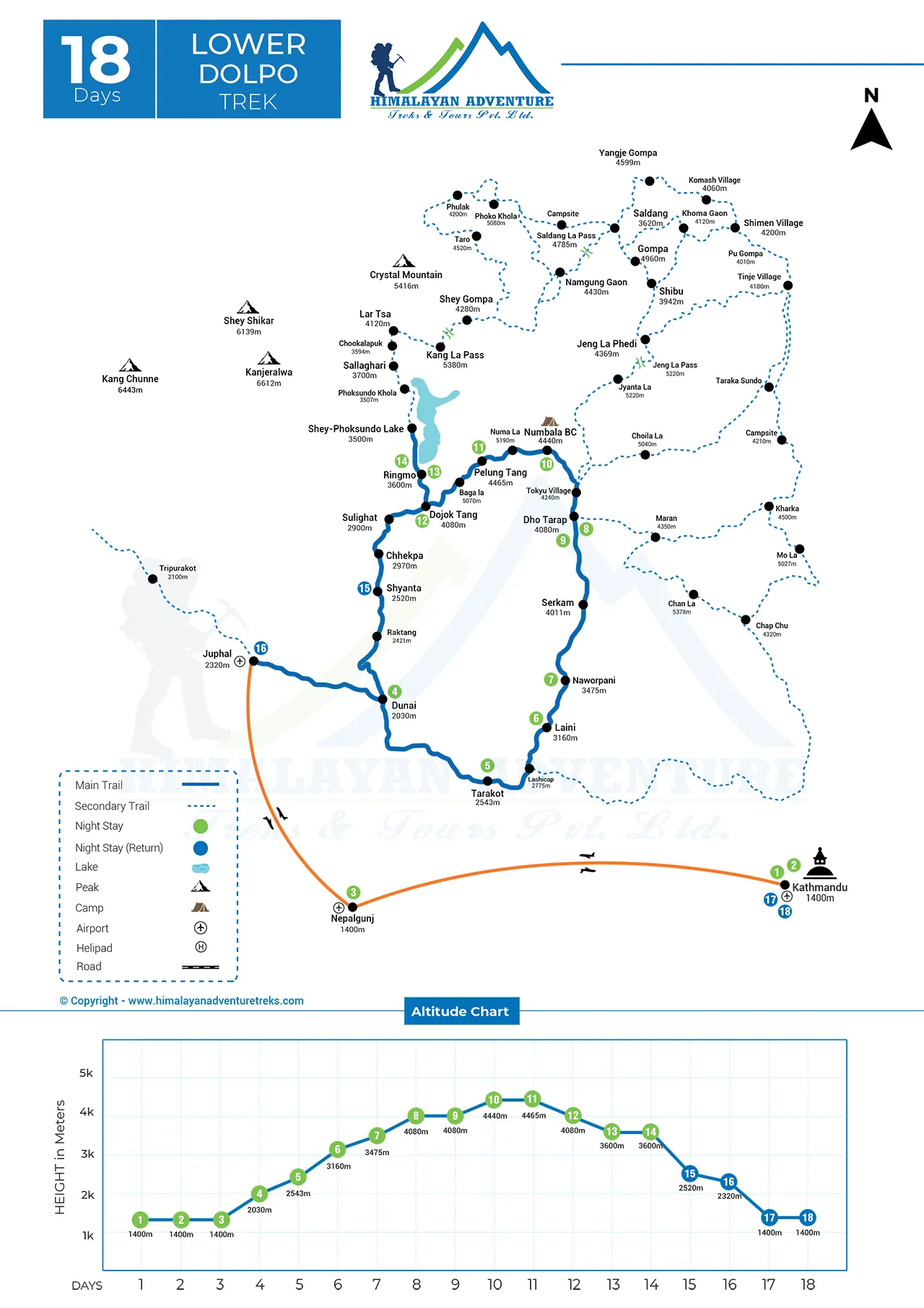
Kathmandu
Start/End point
Kathmandu
Trip Information
How does our trip start?
Your Lower Dolpo Trek journey begins at Tribhuvan International Airport in Kathmandu. You clear immigration in 45 to 60 minutes using Nepal’s easy visa system. We will meet you in the arrivals hall holding your name sign. Transfer to Thamel takes 20 minutes, covering 5 kilometers through narrow streets.
Day 2 includes UNESCO World Heritage site visits and gear preparation at rental stores if you have to rent some equipment. Day 3 requires departure for the Nepalgunj flight. Day 4 involves an early morning Tara Air flight to Juphal at 2,475 meters. Trekking starts 15 to 30 minutes after landing with a 12-kilometer walk to Dunai. This start ensures proper acclimatization before high-altitude sections begin.
Difficulty
The Lower Dolpo Trek ranks among Nepal’s most challenging routes. You face sustained daily walks of 12 to 15 kilometers with elevation gains up to 750 meters. Numa La Pass reaches 5,190 meters, where oxygen saturation drops significantly.
Trail surfaces include loose pebbles covering a huge chunk of high-altitude sections. Medical facilities remain hours away from most trail points. You need cardiovascular fitness supporting 50-minute walking intervals with a heart rate below 100 beats per minute.
Proper acclimatization prevents the majority of altitude sickness cases, which is why it will be one of our main focuses on this trek. On a difficulty scale of 10, we have rated it a 7.5.
Best Season
Autumn delivers optimal conditions from September to November. Daytime temperatures average 15°C with nighttime lows at -5°C based on local records. Clear skies provide 300-meter visibility for mountain views. November sees minimal precipitation at around 25 millimeters monthly.
Spring offers alternative timing from March to May. Daytime temperatures reach 18°C with blooming rhododendrons above 2,000 meters. Avoid the monsoon season, June through August, when rainfall exceeds 300 to 500 millimeters monthly, causing trail erosion.
Steer clear of winter, December through February, with temperatures dropping to -20°C and flight cancellation rates exceeding 40 percent. September and October represent the statistically safest window for successful completion.
Can a beginner join this trip?
The Lower Dolpo Trek demands previous high-altitude experience. The NMA classifies it as a difficult journey requiring proven cardiovascular fitness. You need documented experience above 4,500 meters before attempting Numa La Pass at 5,190 meters. Most beginners face higher injury rates on scree slope sections.
Himalayan Rescue Association mandates a minimum of 30 days of daily cardio training before arrival. We require written proof of prior 4,500-meter ascents during booking. First-time trekkers attempt this route at their own risk with a mandatory porter-to-trekker ratio of 1:2.
Altitude Sickness
Oxygen saturation drops significantly at Numa La Pass summit. Himalayan Rescue Association records show many trekkers develop symptoms above 4,500 meters without proper acclimatization. We enforce mandatory pulse oximeter checks every couple of hours above 4,400 meters.
Low values trigger immediate descent procedures per medical protocols. Acclimatization days like Day 9 at Dho Tarap prevent most cases through controlled elevation gain. Recognize early symptoms: headache lasting over 2 hours, nausea, or resting heart rate above 100 bpm. Carry prescribed meds as emergency treatment.
Accommodation, Food, and Drink
Teahouses operate under Nepal Tourism Board regulations with certified lodges along the route. Rooms feature stone walls and solar-charged LED lighting at elevations up to 4,990 meters. Shared bathrooms are standard, while attached ones are very rare.
Meals include dal bhat, buckwheat pancakes, roasted barley soup, thukpa, and many more options. Water undergoes mandatory 10 to 15-minute boiling cycles depending on elevation.
Avoid local alcohol above 3,500 meters, and preferably throughout the whole Lower Dolpo Trek, as it accelerates dehydration. Carry iodine tablets for emergency treatment. All lodgings provide hot lemon ginger tea for altitude management.
Transportation
You fly Nepal Airlines from Kathmandu to Nepalgunj on Day 3. This 75-minute flight crosses the Gangetic Plain at 15,000 feet. Day 4 requires a pre-dawn Tara Air departure to Juphal Airport. You board the Twin Otter aircraft for a 25-minute mountain flight. Juphal Airport sits at 2,475 meters on a small runway.
The Civil Aviation Authority restricts these flights to morning and afternoon hours only. We verify your physical permits before boarding all mountain flights. Ground transfers use pre-booked vehicles meeting safety standards. Return journeys follow the same flight sequence through Nepalgunj. All domestic flights operate under set regulations.
Permit
Lower Dolpo requires Restricted Area Permits from the Tourism Board Office. You cannot enter this protected cultural zone without these documents. Apply through authorized trekking agencies at least 10 days before departure. Submit passport copies and a detailed itinerary for processing.
All of this hassle will be handled by our Lower Dolpo Trek guide; you just have to provide the necessary documents. Nepal Tourism Board verifies all documents before issuing permits. Carry original permits during the entire trek for daily check posts.
Shey Phoksundo National Park needs separate conservation area permits. Obtain these in Kathmandu before your flight to Nepalgunj. Incorrect documentation causes most delays to mountain destinations. We inspect your permits every morning before trail departure.
Trip preparation and fitness
Begin cardiovascular training at least 30 days before departure with daily walking sessions. Build endurance to sustain almost an hour of walking intervals at high elevation. Practice stair climbing with a full backpack to simulate trail conditions. Our experienced guide recommends a minimum weekly distance of 40 km before arrival.
Consult physicians for altitude medication prescriptions like dexamethasone and Diamox. Complete gear checks using equipment standards. Test all clothing layers before departure. As your travel partner, we require documented proof of prior high-altitude experience.
Pack iodine tablets and compression sleeves as mandatory medical items. We conduct mandatory fitness assessments during Kathmandu briefings. Your preparation determines success on this demanding route.
Alternative routes
Some travelers extend to Upper Dolpo beyond Dho Tarap, requiring additional permits. This adds 5 days crossing Shey Gompa and Phoksundo Lake’s western shore. Nepal Tourism Board restricts this extension to groups with certified high altitude guides.
Others shorten the trek by flying directly to Kathmandu, skipping Ringmo days. This option suits travelers with time constraints but misses Phoksundo Lake immersion. No viable alternatives exist for Numa La or Baga La Pass crossings, as these form the route’s essential high passes. Most travelers complete the standard 18-day itinerary due to permit restrictions and trail logistics.
Cost Budget
Authorized agencies, such as ourselves, manage most payments, avoiding cash handling during the trek as much as possible. The budget covers mandatory guide porter teams meeting the set standards. Include costs for Tara Air mountain flights and domestic connections.
Meals and teahouse stays form predictable daily expenses under standard regulations. Unexpected costs typically involve emergency helicopter evacuations covered by comprehensive travel insurance. We provide detailed pre-departure budget guides showing all mandatory expenditures. Remember carrying cash as ATMs remain unavailable beyond Juphal.
Gadgets charging the Internet
Teahouses provide solar charging for modern devices at designated stations. Carry USB cables compatible with standard outlets, and a universal adapter, which can be very necessary. Full phone charges take 1 to 2 hours using the teahouse solar power systems, verified. Power banks prove essential above 4,000 meters, where solar efficiency drops.
Internet access remains spotty, with functional Wi Fi only in Nepalgunj and Kathmandu. Purchase local SIM cards in Kathmandu for limited connectivity through the Ncell or NTC network. Expect no signal during high pass crossings like Numa La.
Download offline maps and documents before leaving Kathmandu, as data connectivity ceases completely in Dolpo. We provide satellite communication devices for emergency use only.
Your Extra expenses
Insurance covers emergency helicopter evacuations but requires comprehensive policies. We verify your coverage includes high altitude rescue before departure. Some travelers pay extra for premium sleeping bags rated below -15°C. Teahouses charge additional fees for extended device charging beyond standard solar stations.
Personal gear replacements like trekking poles cost more in Nepalgunj stores. Tips for guide porter teams are at your own expense. Unexpected flight delays may require extra hotel nights in Nepalgunj. Specialty food requests in teahouses incur supplementary charges. Carry cash for these contingencies as ATMs remain inaccessible beyond Juphal.
What to expect
You hear prayer wheels spinning at Swayambhunath before dawn on Day 2. Stone paths demand secure footwear during Kathmandu Valley sightseeing. Nepalgunj’s Terai heat reaches 35°C, requiring light clothing and SPF 50. Juphal Airport’s short runway vibrates during Twin Otter landings. Teahouse meals feature dal bhat and buckwheat dishes.
Oxygen saturation drops noticeably above 4,000 meters, requiring deliberate breathing. Rigid trekking poles secure Baga La Pass’s steepest sections. Phoksundo Lake’s turquoise waters create mirror reflections visible from shoreline trails. Nighttime temperatures fall below freezing, requiring layered clothing systems.
We monitor your pulse oximeter readings bi-hourly during high pass crossings. You experience Bon monastery rituals at Shey Gompa with butter lamp ceremonies. Trail markers shift between prayer flags and stone cairns depending on the elevation zone. Sleep happens early each night to maximize recovery for the next day’s demands. Your journey follows ancient routes unchanged for centuries.
Essential Packing Gear List for Lower Dolpo Trek
If you have decided to go on the Tibetan and Bon Po culture trek, Lower Dolpo Trek in Nepal, we assure you that you will have a fantastic time ahead. But what should you pack for your Adventure? What will be the right gear to make your trip more fabulous? To help you with this, we have compiled a packing list of essential items that you mustn’t forget to bring along.
- Passport ( min 6 months valid)
- Cash, credit card
- List of important addresses and contact details
- 2-3 passport photos (optional)
- Copies of all important travel documents (passport, visa, airline ticket, insurance policy, etc.)
- A sturdy 70 L trekking backpack which will be carried by your porter (please note that our assigned 1 porter will carry 2 clients’ luggage up to 20-25 kg.
Note: We will provide each participant with a spacious 70 to 75 L Company logo duffle bag to conveniently carry your trekking gear, which you have to return once the trek is complete. - A 30 L Daypack that has room for your essentials such as camera, mobile, Passport, important documents, water bottle, day use medicine, chocolate bars, raincoat, etc., which will be carried by you.
- Protective cover for a backpack or travel bag.
- Hiking Boots: Preferably ankle-high boots to prevent ankle sprain
- Regular Shoes: For small strolls and exploration around the city
- Crampons: During the winter December- March
- Second, a light pair of shoes and possibly sandals
- Micro Spikes or Ice Cleats for the winter trekking over snow and ice
- Gaiter for added protection in snow
- A rain and wind-resistant, lightweight down jacket for warmth, with a good helmet hood
- Summer-light, as well as winter warm clothing
- Quick-drying shirts made of synthetic fabrics
- Warm and cool vests or T-shirts
- Functional synthetic underwear
- Sports Bra for Female Trekker
- A waterproof pair of trousers
- Regular trousers of quick-drying fabric
- Hiking shorts
- Cargo Pants with multiple pockets to hold your small items, such as knives or chocolates
- Woolen or fleece pants
- Trekking socks, both thick and woolen fabric, and lighter wool socks
- Wool hat, gloves, and scarf
- A light cotton scarf or a bandanna for protection of your head, neck, ears, and mouth
- Sun hat, and sunglasses with 100% UV protection (for trekking trips, even with stray light and nose protection)
- Sunscreen cream or lotion with a high sun protection factor (at least 15, for trekking trip,s even at least 30)
- Sunscreen lipstick with a high SPF (at least 20, for trekking trips, even at least 30 or sunblock)
- Mosquito repellent (Optional)
- Comfortable light night clothes and shoes
- A drinking bottle that can be used as a hot water bottle on frosty nights
- Flip-flops or bathing shoes for using the showers
- Water purifiers: if you need to refill water from the tap or stream en route
- Headlamp: for a midnight or pre-dawn trip towards the viewpoint
- Quick-drying towel and sample-size toiletries for washing your feet and face
- Your Personal first-aid kit: with basic medical supplies such as bandages for sprains, antidiarrheal and antibiotics, iodine wipes for scrapes and cuts, plasters, aspirin, or ibuprofen, moleskine for preventing blisters, Diamox (acclimatizing medicine), and your Personal medication
- Sleeping bag appropriate for all-season treks (we can hire in Kathmandu)
- Waterproof money belt, chest bag, leg bag, or belt bag for storing important travel documents or valuables
- Toothpaste, Toothbrush, and soap
- Deodorants
- Moisturizer
- Nail clippers
- Feminine hygiene products (Sanitary Pads)
- Small mirror
- Wet wipes
- Hand sanitizer
- Comb
- Camera with sufficient memory cards and spare batteries, or a battery charger
- Small padlock for your travel bag
- Crampons ( during winter, Dec- Feb)
- Thermos flask
- Water bag
- Toilet paper (2-3 rolls without)
- Ear Plugs
- Matchbox, or lighter
- Compass or GPS
- Map
- Alarm clock
- Multi-tool kit
- Binoculars
- Books
- Whistle
Equipment Note:
- Please note that there is no need for you to bring all these heavy items, such as a Sleeping bag, a down Jacket, Trekking Poles, and items from your home. You can easily rent or purchase high-quality to standard-quality items in the Kathmandu.
- Items are available from international brands such as The North Face, Sherpa Adventure, Marmot, Mountain Hardware, Black Yak, Karma Gear, and local brands like Goldstar and locally made products etc.
- Plus, we will also gift you a company logo T-shirt as a token of your experience in Nepal with us.
Renting Cost:
- Sleeping Bag & Down Jacket (-10-20 degree Celsius), Per Piece per day US$ 1.5
Frequently Asked Questions
Do I need special permits for the Lower Dolpo Trek?
Yes, the Lower Dolpo Trek requires several permits:
-
Restricted Area Permit (RAP) for Lower Dolpo
-
Shey Phoksundo National Park Permit
-
Trekkers’ Information Management System (TIMS) card
These are essential and are often searched with “Lower Dolpo Trek permit cost” or “Dolpo trekking permit requirement”
How do I reach the starting point of the Lower Dolpo Trek?
You first take a flight from Kathmandu to Nepalgunj, and then another short flight to Juphal, the actual trekking starting point. The full route is often searched using keywords like “Kathmandu to Juphal flight” and “how to reach Lower Dolpo”.
Is hiring a guide mandatory for the Lower Dolpo Trek?
Yes, since Lower Dolpo is a restricted area, it is mandatory to hire a registered guide and trek with a minimum of two trekkers. Solo trekking is not allowed here. It’s widely searched as “Do I need a guide for Dolpo trek?” and “Dolpo group trekking requirement”.
How do I get a visa to Nepal?
You can simply take advantage of the visa on arrival system that the Nepal government has been offering.
What is the best way to prepare for the Lower Dolpo Trek?
We recommend being physically and mentally ready. Do not slack during the training phase.
How many porters will be there?
Every two trekkers in the group will share a porter. Our porters are capable of carrying a total of 25 kg.
Can I demand the starting date of the trek?
In a group trek setting, you are not able to choose your own starting date. But if you go for a private trek, you will get to choose your own date with many other flexible options.
Related Blogs & Articles

Reviews on Lower Dolpo Trek

Related trips