notification

Great News, From June 2025 Mount Kailash is open for individuals holding Indian Passports

Cultural Tour in Nepal

Cultural Tour in Nepal explores the amazing architectural beauty and historical dexterity of the medieval towns and villages. These trips visit cultural monuments and historical heritages. Nepal has one of the densest concentrations of World Heritage Sites listed by UNESCO in the world housing seven such destinations. Moreover, Nepal is also the land where Lord Gautama Buddha- the founder of Buddhism, was born.

Nepal is filled with many remnants and temples from its ancient and medieval eras. These heritages reflect Nepal’s historical significance and riches in many forms. From religious temples like the Pashupatinath, the Boudhanath, and the Muktinath, to old Durbar Squares like that of the Kathmandu city, Patan and Bhaktapur, Nepal is quite opulent in terms of culture and the preservation of ethnic practices that span back centuries.

Not only that, but Nepal is also the hub of the unique Newa Architecture- an intricate form of building not found anywhere else on the planet. Nepalese art and architectural styles are laced with some of the most intricate handiwork. The beautiful carvings done on the roofs, pillars, doors and the windows of the temples and old buildings reflect a beautiful and unique presentation of art and culture.

The woodwork, stone masonry, and metalwork engrained in the heritage buildings and temples reflect the cultural semblance of the people’s lives. Tours in Nepal allow travelers to experience the cultural aspect of the country. These short journeys are insightful trips that explore the glorious heritage and cultural riches of the diverse ethnic groups in Nepal.

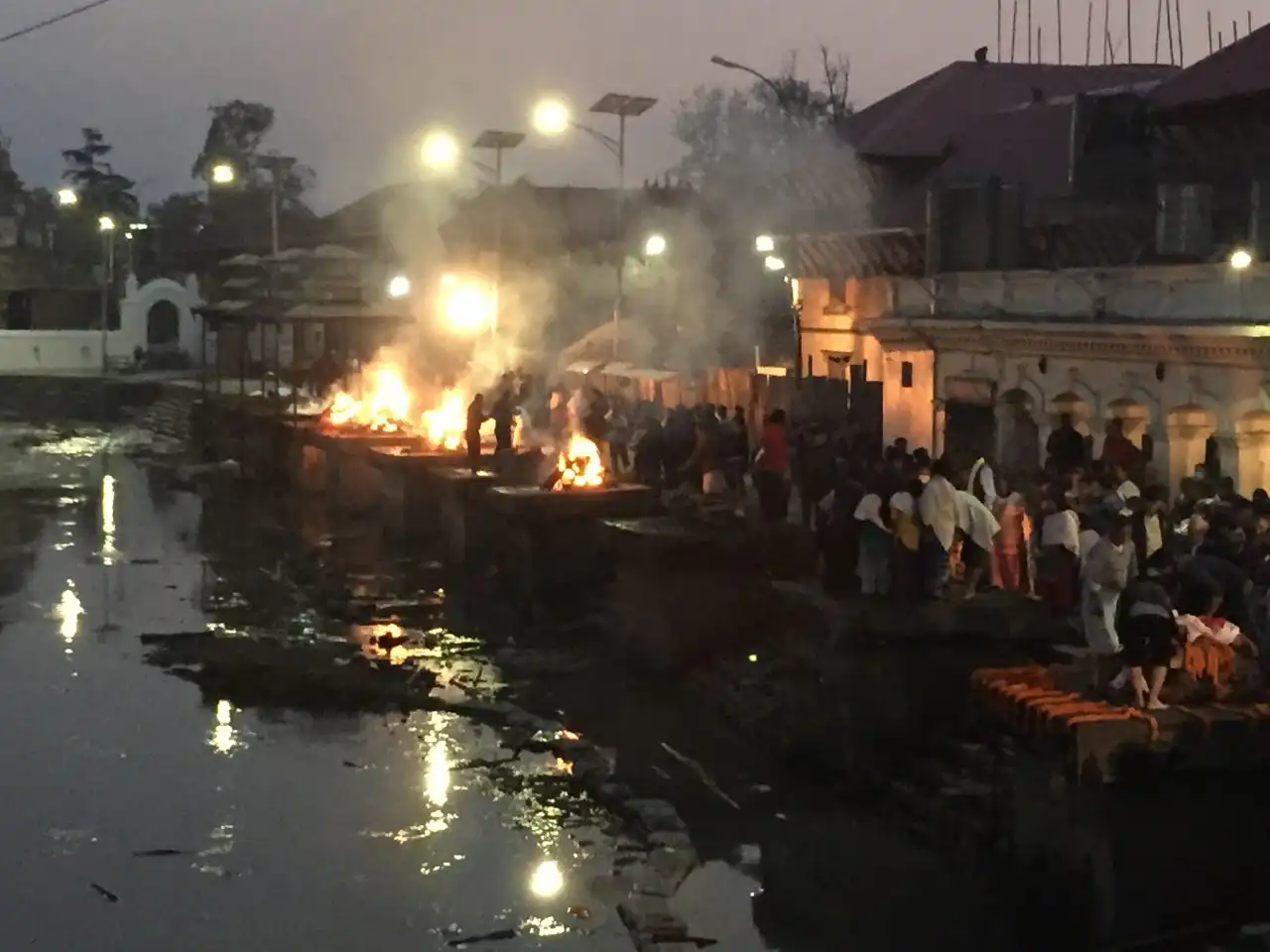
Pashupatinath Temple:

Pashupatinath temple is one of the four most important Hindu religious temples in Nepal & India for devotees of Lord Shiva. Temple was Built-in the 5th century and later renovated by Malla kings of Kathmandu valley, the site itself is said to have existed from the beginning of the millennium when a Shiva lingam was discovered on the bank of the Bagmati river. Lord Shiva, the national God, is worshipped in Nepal in the form of the Shiva Linga. It is said that there are 12 Jyotirlinga in India. It is said that twelve Jyotirlinga in India are the body and the Jyotirlinga at Pashupatinath in Kathmandu is the head.

The most worshipped and important Shiva Lingam (linga) to Hindus is situating at the bank of Bagmati River in the holy shrine of Pashupatinath to the east of Kathmandu. In front of Shiva temples, one usually sees a statue of Nandi, the diving bill. Another popular form of Shiva in Nepal is the Bhirav. Different aspects of Bhairavs play a major role in the Kathmandu valley’s festivals’. Basically, Bhairav is worshipped as the protector of the valley and the anger form of Shiva.

According to Gopalraj Vamsavali (Chronicle), Nepa, the herdsman, his brown cow- Buhibri, used to go to the bank of Bagmati River where she pours her milk every day in a hole. After finding the location when it was dogged the Jyotirlinga came to the presence.

This temple complex was enlisted on the UNESCO World Heritage site’s list in 1979. Pashupatinath temple is the oldest Hindu temple in Kathmandu. It is not known when the Pashupatinath temple was built. According to Nepal Mahatmaya and Himvatkhanda, Pashupatinath Temple’s existence dates back to 400B.C. The temple was erected in today’s form in the 15th century by Lichhavi King Shupuspa after the previous building was consumed by termites.

Muktinath Temple:

Muktinath is a popular Temple in Nepal.  According to the Hindu principle, it is believed that Lord Vishnu, will incarnate the earth ten times as a different incarnation or avatar. He has incarnated as Matsya (a fish) Kurma(a tortoise) Varaha (a wild boar) Narasimha, Vamana, Parashurama, Rama, Krishna, Buddha, and Kalki (will be incarnated at the end of Kali-yuga) His animal incarnations are fish, tortoise and a wild boar thus Hindus worship those animals as an incarnation of Lord Bishnu.

All the Hindus and the people who believe in rebirth, Pre-birth, and Mukti ( Nirvana) believed that all miseries/ sorrows are relieved once you visit the temple (Mukti means Nirvana and Nath means god). The famous temple Muktinath lies in the district of Mustang’s popular Annapurna circuit Trek trails, after passing the Throng-La pass from Manang and Annapurna region and is situated about 18 km from Jomsom Town and 13.5 km from the Kagbeni at an altitude of about 3,749 m. It is not only popular for Pilgrimage tours but popular for foreigners for trekking where you can see the amazing view of Annapurna, Dhaulagiri, Nilgiri, and Tukuche Peaks. It is also called the rain shadow district of Nepal only a few showers of rain during the monsoon season so all parts of the area are dry and sandy.

It is a pagoda-shaped (storied) temple dedicated to Lord Vishnu. There are 108 waterspouts, with holy water, people take bath. Jal Devi temple where you can see the fire lighting itself (Natural gas)on the water. Religious people believe that this flame is since the creation of this universe or from the Satya Yuga. There are different ways to get to Muktinath from Kathmandu. Either take a direct from Kathmandu via Pokhara to Jomsom and hike for 5-6 hours via Kagbeni or to trek all the way from Pokhara which talked 7-8 days or there is a direct bus service from Kathmandu to Muktinath.

It is believed that one should visit this temple after completing Pilgrimages of four Dham ( Badrika Nath Dham, Dwarka Dham, Jagganath Puri Dham, Rameswaram Dham) in India. It is said that Jagat Guru Shankaracharya had established this temple. It is the sacred temple for South Indians to pay priority to visit the temple.

This temple is the symbol of Hindu- Buddhist religious syncretism. The main priest of the temple is Hindu and the caretaker the Jhumas are the Buddhists. Hindus worship the God Muktinath as an incarnation of Vishnu whereas Buddhist worship it as Guru Rimpoche.

Changunarayan Temple:

Changunarayan temple is located on the high hilltop Changu or Dolagiri Parbat (hill). The temple was enlisted on the UNESCO World Heritage Site’s list. The temple is surrounded by a champak tree forest and a small town. Changunarayan Temple is about 12 km east of Kathmandu and a bit north of Bhaktapur. This is a temple of Lord Narayan, double roofed, and is considered to be one of the oldest temples of the Lichhavi periods. The temple is decorated with ten incarnations of the Narayan. Stone lions guard all four doors of the temple.

There is an inscription stone behind the statue of Manadeva of 464 A.D. The inscription provides important information of the Licahavvi dynasty, the then history of Kathmandu valley, and chronology of Lichhavi King before and after Man Deva. There are smaller statues of King Bhupatindra Malla and his queen. To the north of the temple is the statue of old Vishnu seated on a Garuda. The sculpture dates back to the 9th century. It dates back to 464 A.D. Another statue shows Vishnu as Vikrant/ Vamana, the six-armed dwarf who later transformed into a giant. To the side of these images is a small black slab showing a 10 headed and 10 armed Vishnu. The beautifully carved image is around 1500 years old.

There are many legends about the temple. In ancient times, a Gwala, or cow herder, had brought a cow from a Brahmin named Sudarshan. The cow was known for producing large quantities of milk. The Gwala used to take the cow to Changunarayan for grazing. At that time Changunarayan was a forest of Champak trees. While grazing, the cow always went to the shade of a particular tree. In the evening, when the Gwala took the cow home and started milking her, he got only a very small amount of milk. This continued for several days. He grew very sad, so he called on the Brahmin saying the cow was not giving enough milk. After observing this with his own eyes, Sudarshan agreed with the Gwala they should observe the cow’s daytime activity while she was grazing in the forest.

Brahmin and Gwala both hide behind the tree. To their surprise, a small black boy came out of the tree and started drinking cow milk. The two men were furious because they thought the boy must be the devil and the tree must be its home. So the Brahmin cut down the champak tree. When he was cutting it down, fresh human blood came out of the tree. Both Brahmin and Gwala got worried, believing they had committed a great crime, and began to cry. Lord Vishnu emerged from the tree and told the Brahmin and Cowherd it was not their fault. Vishnu told the story of how he killed Sudarshan’s father while hunting in the forest. After that, cursed for the crime, he wandered the earth on his mouth, as ‘Garuda’ eventually descending on the hill at Changunarayan.

There he lived in anonymity, surviving on milk stolen from a cow. When Brahmin cut down the tree, Vishnu was beheaded this freed Lord Vishnu from his sins. After hearing these words from Vishnu, Brahman and Gwala resolved to worship the place and established a small temple in the name of Lord Vishnu. Even today, we find Sudarshan’s descendant as a priest of the temple and the Gwala’s descendants as ghutiyars (conservators).
Nepal Reopens Issuing on Arrival Visas for Travelers

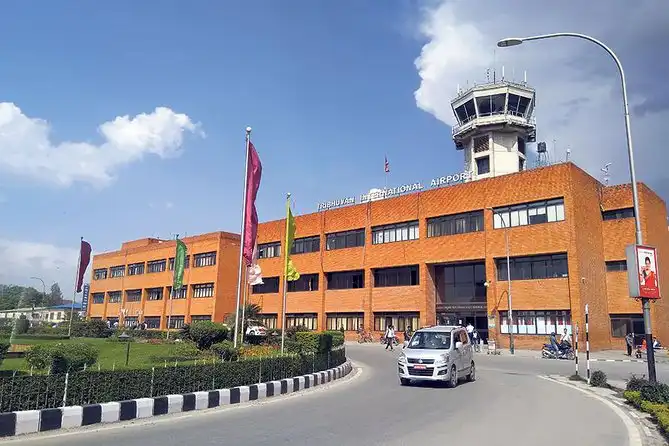
Nepal Reopens Issuing on Arrival Visas for Travelers, as throws away quarantine requirements and resumes on-arrival visas, in a move hailed by entrepreneurs as a much-needed respite for the virus-ravaged industry.

Nepal on Thursday threw away the seven-day quarantine requirement and resumed issuing on-arrival visas to all vaccinated foreign travelers in a bid to bring its virus-ravaged tourism industry back to life.

Visitors should have received their last dose of the Covid-19 vaccine at least 14 full days prior to entering Nepal. Those who are not vaccinated or partially vaccinated will not get on-arrival visas. They have to get their entry permits from Nepali diplomatic missions, and also spend 10 days in quarantine in government-listed hotels.

A negative RT-PCR or Gene Expert or True NAAT test is required for all to travel to Nepal, according to a new travel protocol issued on Thursday. All travelers need to undergo mandatory antigen or rapid antigen tests at immigration entry points .

The new protocol was issued under the Infectious Disease Act (1964), after the Covid-19 Crisis Management Ordinance (2020), along with around a dozen ordinances, introduced by the government, became ineffective from September 16 when they failed to get through Parliament within the constitutional deadline.

After the Covid-19 Crisis Management Ordinance failed to get parliamentary approval, all legal frameworks related to travel also became invalid.

On Monday (20.09.2021), the Cabinet approved the new travel protocol under the old Infectious Disease Act.

“We have approved the removal of the quarantine requirement for all vaccinated travelers arriving in Nepal from all international destinations and updated the travel procedures effective from Thursday, September 23,” Taranath Adhikari, spokesperson for the Tourism Ministry, told the Post. “The measures are expected to boost the country’s tourism industry.”

Before boarding a flight to Nepal, all vaccinated travelers will have to present a negative Covid-19 test result taken 72 hours prior to the departure, and fill up the international travelers’ online form at www.ccmc.gov.np and have a printed copy to apply for an on-arrival visa at the airport, according to the travel protocol published by the Tourism Ministry on Thursday.

If they test positive, they will be sent to an isolation center or hospital recommended by the Health Ministry. According to the new rules, if there is no antigen testing facility at the airport or immigration point, foreigners have to undergo the test at the hotel. They will be allowed to leave the hotel if the test comes back negative.

“Unvaccinated or partially vaccinated tourists have to mandatorily quarantine themselves at the hotel for 10 days at their own expense. On the 11th day, if they test negative, they are free to travel,” according to the new rule.

All expenses for testing for Covid-19, isolation, and insurance should be borne by the travelers themselves. Travel and trekking agencies are responsible for enforcing all conditions set by the new rule.

Hotels will be responsible for implementing quarantine and isolation.

If visitors don’t abide by the rules, the hotel should inform the police or other agencies concerned, according to the rules.

“Though a delayed decision, it is a huge boost for the country’s tourism industry,” said Khum Bahadur Subedi, president of the Trekking Agencies Association of Nepal (TAAN).“We expect a partial recovery in arrivals this autumn, the country’s peak tourism season. There are high hopes for a full spring season recovery if there are no threats of Covid-19 resurgence.”

Travel trade entrepreneurs say that inquiries from potential visitors to Nepal have been massive, and they were eagerly waiting for Nepal’s decision to ease quarantine requirements and visa issuance.

Travel and tourism businesses, which accounted for around 8 percent of the country’s gross domestic product and provided more than 1.05 million jobs directly and indirectly in pre-Covid-19 times, were the hardest hit after travel restrictions came into force in late March last year.

Last spring, the government reopened the country to foreign travelers in the hope of lifting the economy and employment by reviving tourism.

Subsequently, Nepal received a record-high number of foreigners aspiring to climb the world’s tallest peak, Mt Everest, as the Covid-19 pandemic appeared to peter out. But fresh Delta outbreaks and slow vaccine rollout again cast a pall on the country’s tourism.

After the second Covid-19 wave hit Nepal in April, the country slid into a devastating crisis with the authorities enforcing strict lockdown measures. About two months later, the restrictions were relaxed gradually, and since September 1, almost everything has been allowed to reopen.

Daily coronavirus infections have also fallen sharply from a high of 9,317 on May 11, 2021, to 1,239 on Thursday. Restrictions on businesses have been eased, and encouraging signs of an economic revival are emerging even as concerns persist about renewed outbreaks.

On Wednesday, the Asian Development Bank revised down its forecast for Nepal’s economic growth in the current fiscal year 2021-22 to 4.1 percent from the previous 5.1 percent, Largely due to high Covid-19 cases and risks, though reduced now, and slowed growth in tourism and services.

Tourism-dependent Nepal hosted 230,085 foreign tourists in 2020, a drop of more than 80 percent compared to 2019 and a figure similar to that of 1986. As of August, total international arrivals to Nepal had numbered just 66,966 individuals.

According to the new rule, on-arrival visas have been resumed for non-resident Nepalese or foreigners who are married to Nepali citizens too. If they are fully vaccinated, receiving the last dose at least 14 full days prior to the day they enter Nepal, they are allowed to proceed to their respective destinations.

If they are not fully vaccinated or have not had the last dose at least 14 full days prior to the day they enter Nepal, they will be allowed to continue to their respective destinations if their antigen test comes back negative.

According to the rules, people returning to Nepal for mourning rituals following the death of their loved ones will be allowed to go to their destinations if their antigen test comes back negative, based on the recommendation of the local government.

Similarly, persons suffering from having illnesses or disabilities and their careers, are allowed to go to their homes directly if their antigen test comes back negative, based on hospital documents and the recommendation of the local government.

People aged above 75, their careers, and children below five and their careers are allowed to go home following a negative antigen test at the airport, based on the recommendation of the local government.

Representatives of diplomatic agencies and their family members have to submit a negative Covid-19 test result taken within 72 hours of departure. The online form at www.ccmc.gov.np for their on-arrival visa is mandatory for them as well.

Those who have secured a visa at Nepal’s diplomatic missions abroad have to submit a negative Covid-19 report and fill-up the form and submit it at the immigration point. If they don’t have Covid-19 symptoms after their arrival in Nepal, they will be allowed to go to their destination.

Official representatives of diplomatic missions in Nepal, if they are not vaccinated, should quarantine themselves for 10 days at a place recommended by their agency.

The government has also opened land entry points for all tourists, including Indian travelers.

Travelers entering Nepal through surface routes have to fill up the arrival form and undergo antigen tests. A negative report will allow them to enter Nepal. Except for Indians who do not require visas, other visitors should obtain visas from the Nepali diplomatic mission in their respective countries.

According to the new rules, if the immigration points do not have facilities to conduct antigen tests, they need to do it at the hotel.

Similarly, fully vaccinated foreigners transiting to third countries through Kathmandu’s airport, after a short stay in Nepal, have to submit a negative test report 48 hours prior to their departure.

The rules say that children below five years of age do not require vaccines and tests. For children between five and 18 years of age, vaccination is not mandatory.

Passengers departing from Nepal have to submit a negative Covid-19 test report taken less than 48 hours before departure or as per the rules of the countries they are traveling to.

With cases declining and almost everything opening up, tourism entrepreneurs for quite a while had been mounting pressure on the government to lift the travel ban.

Deepak Raj Joshi, former chief executive officer of Nepal Tourism Board, said the new rules are better late than never.

“Delays in government approval have caused headaches for scores of prospective travelers, who made their plan to visit Nepal in autumn, but had to cancel due to quarantine requirements,” Joshi told the Post. “The government should have made this decision a month earlier. Nonetheless, the decision has been made and this will be a big boost to the tourism industry as it emerges from this pandemic.”

Source: Kathmandu Post

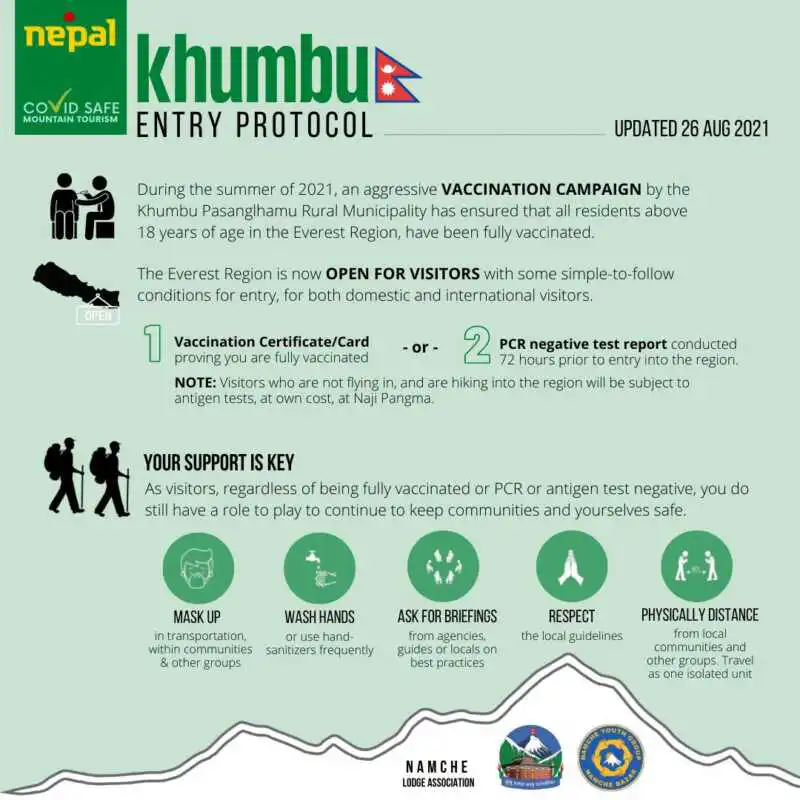
Khumbu Region Entry Protocol

Everest, the Khumbu region is one of the most popular trekking destinations in the world. Every year thousands of trekkers visit this region and the main aim is to reach Everest Base Camp and other popular routes like Gokyo lakeThree high PassesEverest Climbing, and popular peak climbing.

After the Pandemic COVID situation, almost Khumbu valley was in a sleeping situation now after the new Khumbu Region Entry Protocol from the Committee hopefully it will turn into a positive way.

An aggressive vaccination campaign conducted by the Khumbu Pasang Lhamu Rural Municipality has resulted in all residents over 18 being fully vaccinated. This was facilitated by the Verocell vaccine donated given by the Chinese government which had a condition that all Municipalities connected to Tibet get fully vaccinated. A smart move to protect the borders but useful for the bordering Palikas (village development committee.)

Accordingly, the Everest Region now is OPEN for visitors who are either fully vaccinated or have done a PCR test 72 hours prior to entering the region. Visitors who are entering on foot, and not flying in, will also be subject to antigen testing as they enter the region.

The visitors of course, still have a role to play to keep communities and themselves safe.

Great protection from the Namche Lodge Association and the Namche Youth Groupshowing the way. The Youth Group also aims to put flyers in each lodge, and signs along in each community in the region, reminding visitors and crews of the roles that they need to play. They are looking for funds to do that. If anyone wants to support this cause, can help connect you up.

Upper Mustang in Nepal

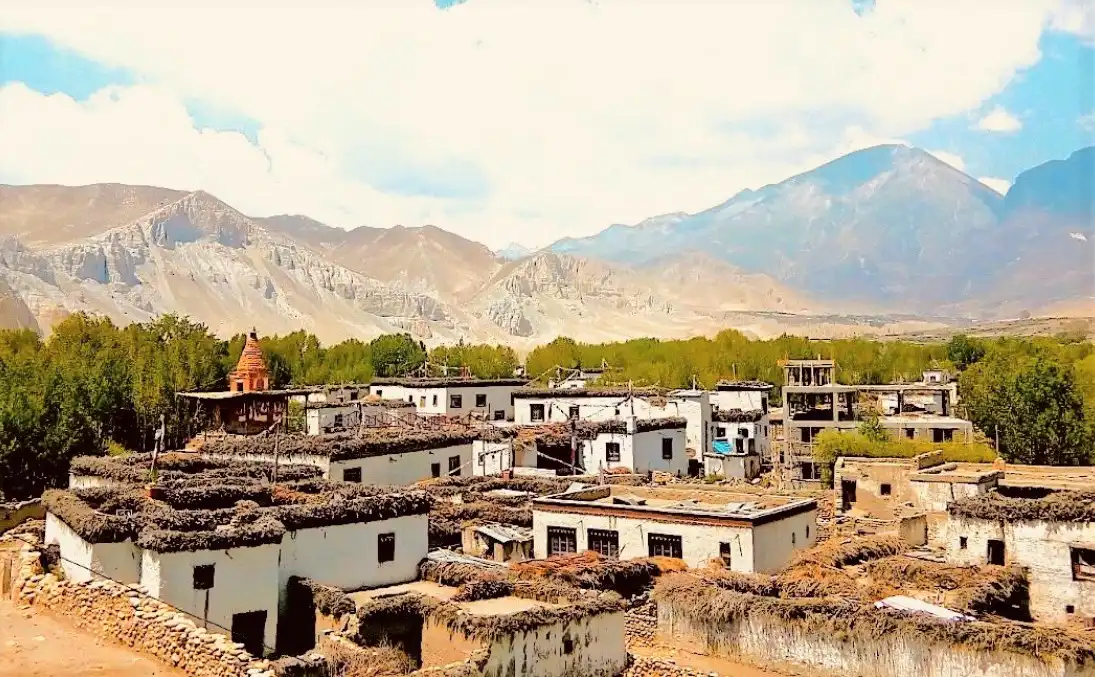
The Upper Mustang region is one of the most important parts for both geographical and cultural aspects in Nepal. Upper Mustang also called the Lo- Manthang Upper Mustang is determined by the rain-shadow zone of the Annapurna and the Dhaulagiri mountain ranges, trekking in the Mustang region could be achieved at any time without any worries about snow or rain. The Mustang region of Nepal is considered the forbidden Kingdom of Nepal. The region is inhabited by Tibetan origin people with their own culture and traditions. The place is often described as a place beyond mountains. The mesmerizing landscape and unique culture of this Himalayan village never fails to hypnotize the visitors.

Mustang Region can be divided into two areas, the upper and lower Mustang. It includes both green and dry vegetation a unique mix of the sandy and rocky landscape, starting up north from Kagbeni village next cross to Kali Gandaki River the area has an ample amount of Buddhist traces with stupas, gompas, Monastary and colourful prayer flags Buddhist lurking around along with stone-walled architecture. Lo- Manthang is the small kingdom of Upper Mustang that was once a gateway for trade, old folklore suggests the founder of Buddhism resided in the area to fight against evil. The area has a plethora of old rich Tibetan culture and religious sentiments.

The place beyond the Annapurna circuit trek route and requires a special permit to get admittance. The place is within the restricted region of Nepal. The government of Nepal has tried to protect the essence and the beauty of this place for the world. Therefore special permits and separate immigration visas should be required in order to enter the upper Mustang region of Nepal.

Jeep drive is an ideal idea for Upper Mustang specially and perfectly designed for visitors who wish to witness the ancient place without having to hike all the way up to the destination, either due to lack of time or if they have difficulties in walking and Royal Enfield Motorbike 350/ Honda CRF 250/ Royal Enfield Himalaya 411 Motorbike Tour is another perfect Adventurous ride for adventure lovers.

As for the lower region of the Mustang region, the world’s deepest gorge of Kali Gandaki river between the Annapurna (8,091m)and Dhaulagiri (8,167m) ranges. Lo- Manthnag area brushes you with dry air and pleases you with clear skies amongst the sandy looking plateaus. The journey to lower Mustang starts with Jomsom the capital of the region and ventures into the holy temple Muktinath and the beautiful walled city and the exploration in this part lets you immerse yourself in the stone-walled dunes, nature architect of striking landscapes, and get acquainted with the people and their unique lifestyle of sheep, Yak herding, simplistic living.

The place is famous for the Tiji festival, Apart from the traditional and cultural aspects, the monasteries of upper Mustang are awaiting Buddhist religious pilgrims. The famous trekking route of Mustang is as follows.

1. Upper  Mustang Trek.

2. Muktinath Lo-Manthang Trek

3. Manang Mustang Trek

4. Upper Mustang Tiji Festival Trek

5. Upper Mustang Overland Jeep Tour

Upper Mustang Tiji Festival:

The Lo- Manthang great Tiji festival is captivating and wonderful. Upper Mustang trek combines the traditional cultural and rare villages at Mustang, astonishing amazing mountain vistas, Buddhist shrines and temples, and the three days celebration of the Tiji festival, a Tibetan ritual. The people in the upper Mustang practice ancient their own religions. Trekking/ Jeep driving / Bike Tour up to Lo during the Tiji festival is a golden opportunity to explore the local Tibetan culture.

Tibetan culture and Tibetan Buddhist lifestyle influence the Upper Mustang region, being too close to the Tibet border. At the Lo- Manthang, you can see the old attractive monasteries and the remainings of ancient palaces and forts. Upper Mustang is also known as Lo lies towards the northwest of the Annapurna I (8,091m) and Dhaulagiri (8,167m)ranges. Tibetan plateau surrounds upper Mustang on the eastern, western, and northern parts and keeps intact with Nepal in the south part only.

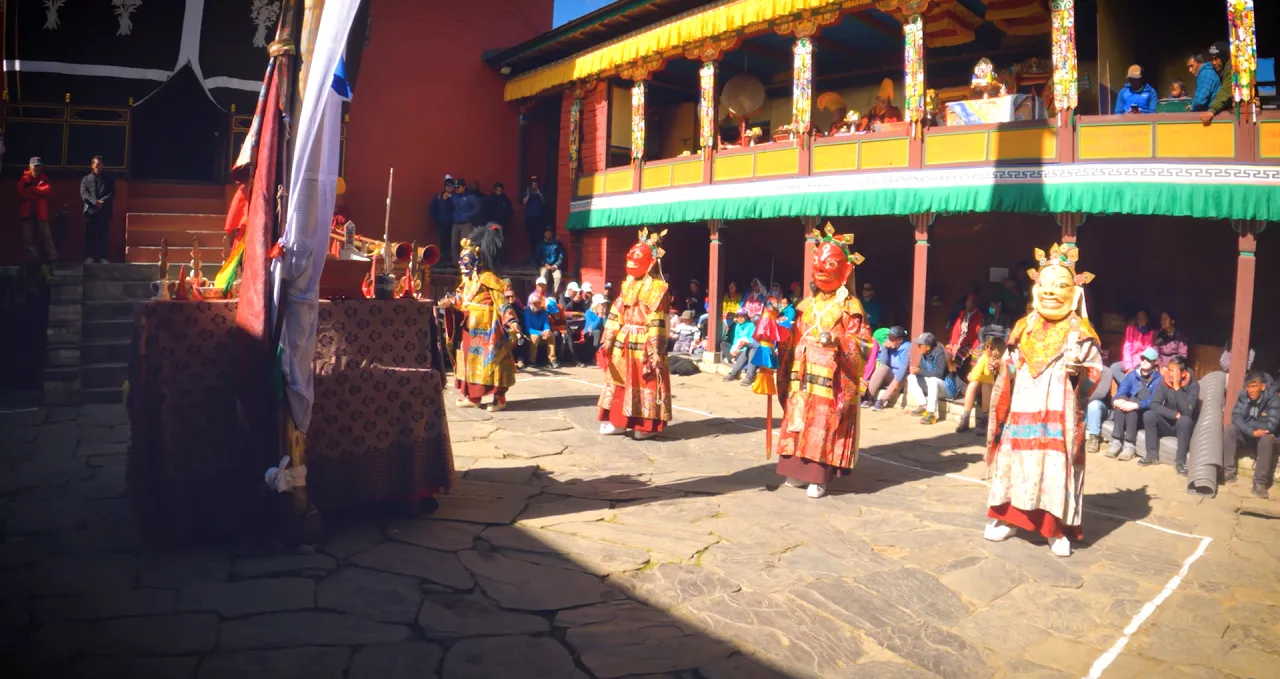
The Tiji Festival normally celebrates in the month of May or June depending on their own calendar. It takes you to the Forbidden Kingdom of Lo Manthang for the main three days celebration. During the festival, you’ll see the monks dance on the masked acting like demons. They perform several forms of dances slashing on the air with their traditional swords and colourful traditional Tibetan costumes and music.

The term Tiji comes from the words “ten che” which means the “hope of the dharma prevailing in the entire world”. This is a message that Guru Rinpoche spread all over the world through the Buddhism religion. It believes that Tiji is a spring renewal festival that happened in the Summer. The people in Lo- Manthang believe that the festival strengthens the hope, strength, and prosperity in their kingdom from the evils.

Lo Manthang people believe that the Tiji festival is the celebration of the victory of good over evil. The festival corresponds directly to a myth. According to the myth, Dorje Jono, a deity must save the kingdom of Lo from destructing by battling against his demon father. People believe that the deity took rebirth to defeat the evil forces that created suffering on earth. Tiji is a revered festival in the Mustang region. At the celebrations of the Tiji festival locals, the People of Lo Manthang wear their own traditional colourful costumes, mask, and perform unique dances in front of their local King’s palace.

It believes that the Tiji festival began in the 15th century. During the three-day masked dance, the beating of drums (Dhangro)and Buddhist chants fill the air. Also, during the festival, they display an ancient Thangka painting of Guru Rimpoche Padmasambhava. Overall this is an amazing experience to explore the Upper Mustang valley during the summer.

In 2021, the people of Lo- Manthang will celebrate the Tiji festival on 30th May, 31st May, and 01st June.

Adventure Activities in Nepal

Adventure Activities in Nepal “Unusual Experience” is one of the fastest-growing tourism industries in the World but the least understood forms of international tourism. Nepal is one of the best destinations in the world for adventure tourism activities which offers an excess of outdoor activities from River rafting, Paragliding near the mountains to waiting for the Royal  Bengal tiger in the dense forest of National parks. The history of adventure tourism in Nepal starts from the early attempts to ascend the world’s highest peak Mt. Everest some about five decades ago.

Nepal, rising from an elevation of 56 meters to 8848.86 meters above sea level, possesses all the climatic zones of the world from bitter tundra vegetation to the hot tropical forestation. Nepal’s biodiversity is a reflection of physiographic climatologically and altitudinal variations. The beauty of Nepal Himalayas ensures it is a destination well suited for international tourism.

The Himalayas have been an attraction to many people since 1950. Out of 14 Himalayas (above 8000 meters), Nepal has eight. Mount Everest (8848.86 meters) the world’s highest mountain is in Nepal.  Eight of the highest peak is in Nepal. George Mallory and Andrew Irvine attempted to summit o Everest in 1924 and went missing. France national Maurice Herzog became the first person to summit Annapurna. On 29th May 1053, Sir Edmund Hillary (New Zealand) and tensing Norgay Sherpa (Nepal) summated Mt. Everest (8848.86 meters) first time in history. Since then Nepal became an attraction for mountaineering for foreigners.

Adventure Activities in Nepal:

Trekking is still the most popular sport among most visitors. Treks in Nepal can be distinguished based on numerous factors from popularity and difficulty to trek destinations and the duration of the treks along with the mode of accommodations. Based on popularity, treks in regions like Everest, Annapurna, and Langtang are the most popular. Annapurna Base Camp Trek, Ghorepani Poonhill Trek, Everest Base Camp Trek, and Langtang Valley Trek are some of the most famous treks in Nepal. As such, most of these popular treks are also teahouse treks. Teahouse treks are the most popular trekking approach in Nepal where trekkers spend the nights at local teahouses. These teahouses offer basic food and accommodation services along with additional facilities which vary according to the trekking destination.

Jungle Safari in the Terai region of Nepal preferred to see Nepal’s rare varieties, endanger and rare animals and birds. A venture into the lush green Chitwan National park and Bardia National park on an Elephant’s back safari and jeep safari inside the National park in the Terai region crossing rivers and swamps will give an opportunity to explore flora and Fauna and typical ethnic group people culture of Nepal as well as encounter animals and birds. Be prepared for a royal treat of Royal Bengal tiger and one-horned rhino may surprise you by his majestic appearance.

Nepal Hot Air Ballooning in Pokhara is here to satisfy your adrenaline rush. A short yet scenic ride through the city will take you to Dhampus. It is where the true trip starts as it is a launch site for a hot-air balloon. When the weather is agreeable, the hot-air balloon will lift off. Following the ride, you will return to the lakeside to relax.
For Nepal Hot Air ballooning, we start our adventure from Lake city Pokhara. Unlike another quest, a hot-air balloon is unique in many aspects. First, you have the option to decide when to take a ride. If you are a morning person, then you could take the ride as soon as sunrise. This choice offers you the scenic beauty of the mountains. Getting close to the peaks and overseeing the lush forests through bird eye view will leave you in awe. The ride even lets you share the experience with your loved ones unlike paragliding, where you have to enjoy the experience all by yourself.

Since Nepal is rich in nature and has a diverse terrain, Mountain biking, Jungle walk, Hiking is other wonderful adventure sport. It offers an environmentally sound way to explore the magnificent landscape and vibrant culture as well as remarkable UNESCO world heritage sites. Walking on the hidden trails of the rarely visited rural villages, you will see smiling and warm greetings from the local faces living a simple lifestyle in peace and harmony and practising their own traditional & culture as well as speaking their own Languages.

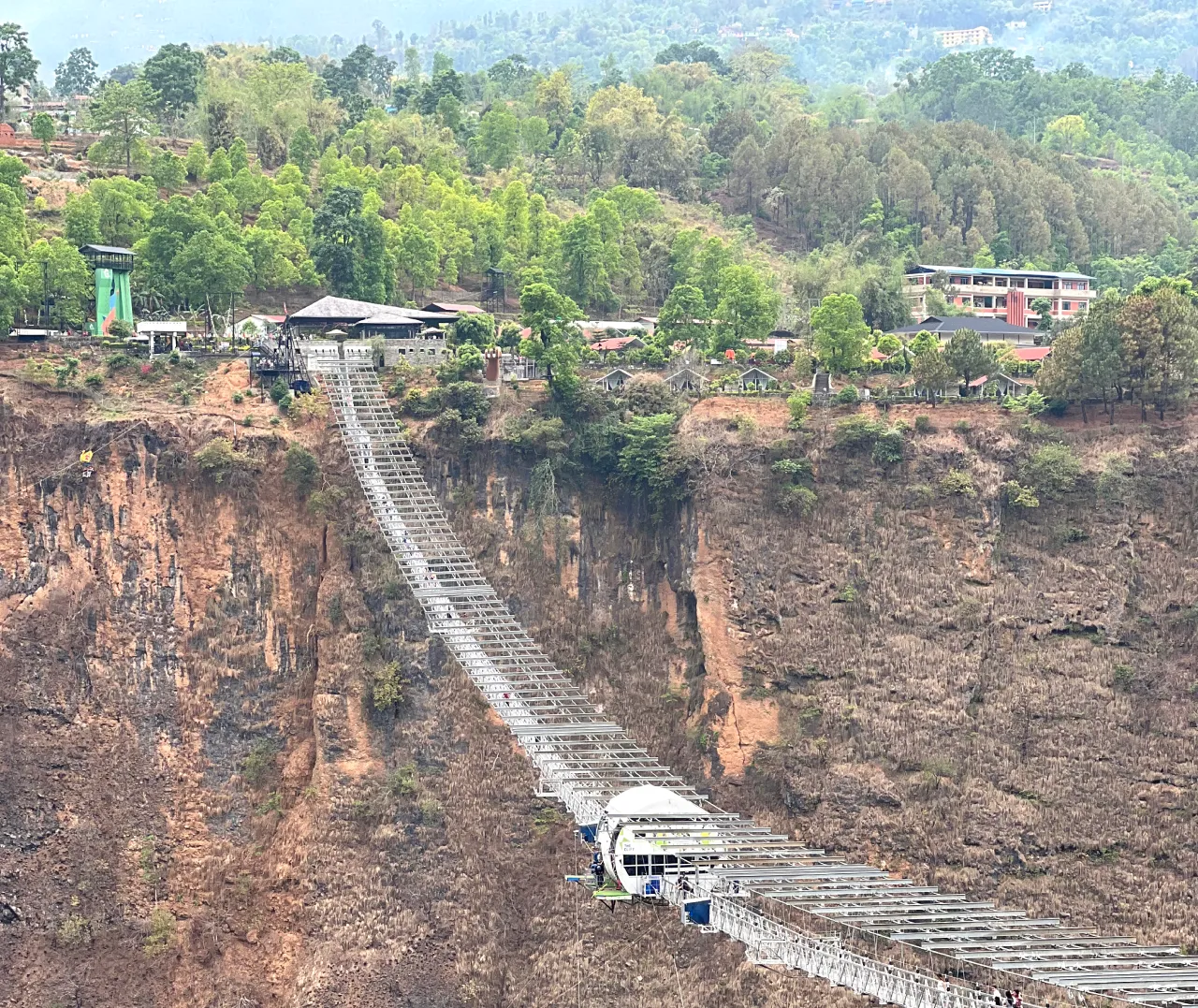
Same as, you can have another thrilling adventure experience of ultimate bungee jumping over the 160 m high bridge of Bhote Koshi River, one of the world’s wildest raging river rushes down from the Himalayas and naturally highest in South Asia. All together, Nepal offers other various adventure activities like Paragliding, Jeep Safari inside National Park, Bird watchingCannoning, Horseback Riding, Snowboarding, High Mountain Expedition, Rock ClimbingPeak ClimbingHelicopter Tour, Everest Mountain flightUltralight Flight, Zip LineFishingSky Diving, Honey Hunting and many more.

Ultralight aircraft take off from Pokhara and offer spectacular views of the lakes, mountains, and villages. This is an ideal way to see life from a new perspective. The choice of Pokhara Valley for ultralight aircraft is appropriate chiefly because of the proximity of the mountains and the scenic lakes. For those who wished they could fly birds when growing up this flight is a must.

It might be lonely at the top but the spectacular view from up high certainly makes it all worth it. Flights are from the Pokhara airport begins from September to June. The flights take place early in the morning to 11 am and from 3 pm to sunset every day during these months.

Paragliding in Nepal can be a truly wonderful and fulfilling experience for the adventure-seeking a trip will take some of the best scenery on earth, as share airspace with Himalayan griffins’ vultures, eagles, kites and float over villages, monasteries, temples, lakes, and jungle with a fantastic view of the majestic Himalayas. Pokhara is a famous destination for paragliding. Likewise, Lakuribhanjang of Kathmandu is also popular for paragliding.

Flying like a bird above the cloud on the Queen City Pokhara valley where you can see the Fewa Lake just under your feet. Paragliding is the adventure sport of jumping out of an aircraft with a special parachute. Paragliding in Pokhara can be a perfect alternative adventure sport in terms of climatically and geographically.

will take you through the fabulous scenery on the earth, as you share airspace with Himalayan Griffin vultures, kites, eagles, and float over villages, lakes, and jungle, temple, Monasteries with a fantastic view of the majestic Himalaya Vista. Pokhara is one of the most beautiful cities in Nepal. This is also the gateway to the popular trek Annapurna region. 

Prior experience is not required to do paragliding in Nepal because the paragliding flights are launch by a fully trained and experienced guide having full knowledge about the Himalayas and local weather conditions too. The month of November, December and January are considered the best flying season in the Himalaya country Nepal.

Rafting, Kayaking, Canoeing in Nepal is some of the best ways to explore the typical cross-section of natural as well as the ethnic-culture heritage of the country. There are numerous rivers in Nepal that offer excellent rafting or canoeing experience. Few rafting rivers in the world can the thundering course of the river of Nepal originating from the snow meltdown of the Himalayan terrain. The government has opened sections of 10 rivers for commercial rafting. Trishuli is one of the most popular rivers for rafting. The Kali Gandaki, Bhote Koshi, Sunkoshi, Marsyangdi, Karnali, and Seti Rivers are awaiting rafters.

The Bhote Koshi is 26 km. of continuous white water and Marshyanghi is four days of uninterrupted white water. The Karnali River provides some of the most challenging rapids in the world. The sun Koshi, 27 km., requiring 8-10 days to complete, is a big and challenging river. Adventurers are provided with world-class rafting. Cannoning gives the freedom to explore some of the most ruggedly beautiful, yet forbidden places in the world.

Zip Line in Nepal is a new adventure activity in Pokhara. Zip flyer Nepal is the world’s longest, steepest and fastest zip-line to give the ultimate adventure experience. Consisting of a trolley mounted on a steel cable 1.8 km. in length the ride drops 600 meters vertically from the top of the Sarankot hill, with resulting speeds of over 140 km. per hour concludes at the Tibetan refugee camp.

You can enjoy the magnificent mountain view and beautiful lake in Pokhara.

Himalayan Adventure Treks & Tours is a well known and reputable government licensed Travel holder Company that has been organizing rewarding adventure activities for travellers for many years. The topography of this Himalayan Mountains makes it the first choice for adventure tours in Nepal. Let us have the chance to look at the most thrilling, electrifying, and mind-blowing adventure places, sports, and activities that we offer from this Himalayan country Nepal. We always take pride in a large number of our satisfied and repeat customers that visit us every year. We look forward to extending to you the opportunity to share the adventure of a lifetime experience.

Accommodation in Annapurna Base Camp

A small country with diverse topography and a multitude of cultural treasures, Nepal is one of the best travel destinations in the world. It is home to the mighty Himalayan peaks, including Mount Everest– the tallest Mountain Peak on Earth. Nepal presents its visitors with a myriad of amazing features that spread from arid desert landscapes to thick woodlands and vast snowy lands that end in the Himalayas. In just a span of 800 kilometers from north to south, the country has an elevation that diversifies in terms of climate, geomorphic aspects, and the ethnic populace.

No wonder, considering all the facts, that Nepal is among the best trekking destinations among the global crowd. Similarly, Nepal also presents many different trekking destinations to choose from. It presents trekkers with various choices of treks that they can choose based on their experience, their preference, and other considerable factors like the duration and the difficulty level. As such, among the many different trekking journeys, the Annapurna Base camp Trek is perhaps one of the most famous.

Annapurna Base Camp Trek

Taking place in the Annapurna region of Nepal, the Annapurna Base Camp Trek takes trekkers through the gorgeous river valleys embedded with emerald acreages of Pine and Cedarwoods. The region is home to the Mount Annapurna and Dhaulagiri massifs and also harbors one of the most unique ecosystems in the country. Home to ethnic Rai, Magar, Limbu, and Gurung people, the region is a destination filled with breath-taking natural facets, including the renowned Annapurna Sanctuary, as well as prominent landmarks like Ghandruk and Poon Hill. The Himalayan tapestry of the Annapurna Peaks spectacularly decorates the horizon throughout the trip, giving trekkers an unforgettable experience.

Accommodations during the ABC Trek

There are plenty of accommodations along the trekking trail of the Annapurna Base Camp Trek. There are good choices as well among the many numbers. Most of the accommodations come in the form of guesthouses, lodges, and tea-houses. During peak trekking seasons, like spring and autumn, the accommodations tend to get filled with trekkers pretty fast, so booking ahead of time is a good idea.

You should carry your sleeping bag as there might be a short supply of blankets in the guesthouses. Likewise, regarding equipment, you should also always carry your toiletries, like paper towels and wet wipes.

Similarly, running hot water is not available in all villages, although some do offer the service of hot bucket showers. During the winter months, fires are commonplace, including fires for under your table on the coldest of nights. Some guesthouses situated near Pokhara city also offer wifi services.

Cost of accommodations per day and availability

The cost of accommodation during the Annapurna Base camp Trek varies from one lodge and guesthouse to the next. Generally, it starts from USD 3 to USD 15 per night. The cost, of course, depends upon the standard of the guesthouse. March to May and September to December are the major trekking months where lots of trekkers visit the region for various trekking trips. During these months, the accommodations tend to get over-booked and it can be difficult to find a vacancy. However, due to a large number of accommodations that have sprung up in the region located near the major trekking trails, finding a guesthouse at the end of the trek isn’t too arduous of a task. When one is trekking with a guide, usually the guide will make sure that you have a room in the guesthouse for the night.

  • Hot Water Cost

The cost of hot showers is not included in the accommodation prices. Thus, you will have to pay an extra USD 2 for a hot shower. There are chances of the price going down during the off-peak season, but it is not a definite idea. It gets easier to bargain a little bit for better prices during the off-trekking seasons. Likewise, the toilet facilities also vary from one location to the next. Remote destinations often have only one toilet that has to be shared by everyone. Otherwise, all guesthouses have toilets, some modeled as squat toilets while others present western-style toilets.

  • Extra Charges

Some accommodations charge an hourly fee of about USD 2 to the billing for using electricity on the electronic devices that you may carry. Some accommodations also have wifi services, but they also cost extra, ranging from USD 2 to USD 5. But the wifi services can be slow and often have broken connections. Moreover, for charging the devices, the guesthouses usually have three-pin Indian-style plug outlets.

  • Drinking-Water and Meals

Once again, there isn’t a definite price that is the same throughout the trekking trip. The cost of meals and drinking water can vary from one guesthouse to the next. It usually depends upon the location and other factors like the isolation and remoteness of the guesthouse. The farther into the trek you go, the higher the price range can become.

Nepali Dal Bhat is the staple food of the country and almost all the guesthouses have this option for meals. It usually starts at USD 2, and at remote locations, the price can go up to USD 9. Likewise, one liter of bottled water can cost, on average, about USD 2, with the price fluctuations depending upon the elevation and the altitude during trekking.

Similarly, both vegetarian and non-vegetarian meals are available during the trip. There are many choices when it comes to meals, like bakery items, fried food, and other cooked delicacies like soups, eggs, pasta, and others.

Regarding drinking water, it is better to bring water purification tablets. They are cost-effective and easier compared to buying bottled drinking water. Additionally, water purification tablets are also better for the environment. You can fill up your bottle with water from the many water bodies that you can find along the way and use the purification tablets for drinking.

Recent Accommodation Updates

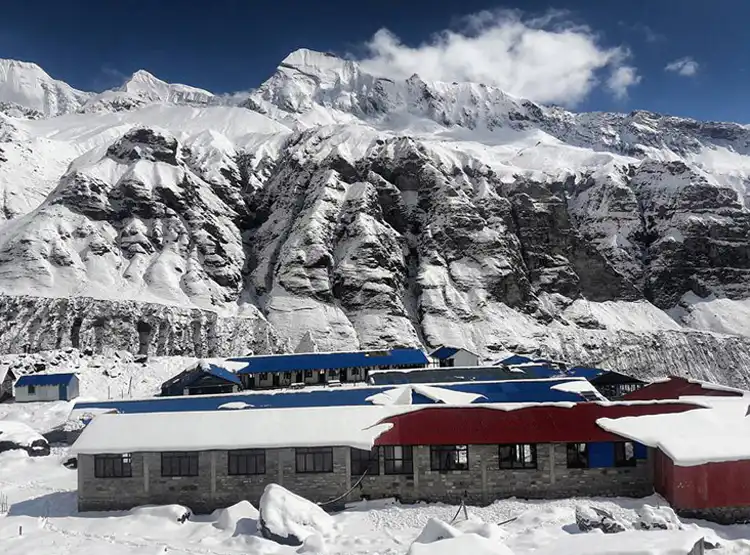
Due to heavy snowfall, the hotels along the Annapurna Base Camp Trek had halted their services since February 2019. The hotels and lodges along the trail were received damage due to the heavy snowfall and were unable to function. This had led to the eventual decline in the trekking activities in the region during winter. However, the hotels and guesthouses along the ABC Trek are set to resume service once again from August 18th, 2019.

The Annapurna Conservation Area Project (ACAP) announced that there would be a resumption of accommodation services in the region following the snow. The Trekking Agencies Association of Nepal (TAAN) has also informed all the trekking agencies of the recommencement of booking the Annapurna Treks.

The hotels and lodges situated at an altitude of 4,130 meters had suffered heavy damages due to heavy snowfall. The thick blankets of snow had also halted the roads and passageways. After five months, the owners of the guesthouses and the hotels in the region received information from ACAP that the hotels are reopening. Thus, trekking activities are beginning to gather momentum once again.

During the heavy snow days, trekkers used to stay overnight at the Machhapuchhre Base Camp and hike to the Annapurna Base Camp early in the morning instead, since the accommodations at the ABC area were completely closed. However, despite the difficulties in the accommodation, there were a few agencies that continued to take trekkers to the Annapurna Base Camp. The incident of accommodations being negatively harmed obstructed due to heavy snowfall is an incident that is the first of its kind.

Currently, the accommodations along the trekking trail have been reprimanded and reconstructed to suit the trekkers once again. After the heavy snowfall damaged the route and hotels, trekking on that route had been halted by ACAP for a few months. Later, an alternate route through the Machhapuchhre Base Camp had been brought into operation. It took around two hours to reach the Annapurna Base Camp from the base camp of Machhapuchhre. As such, the trekkers were first guided up to the MBC, and from there, trekkers would start the day trip to ABC and had to return before noon.

Conclusion

After the Everest Base Camp, the Annapurna Base Camp Trek is the most popular trekking destination in Nepal. The base camp of Mount Annapurna is located at an altitude of 4,130 meters and trekking starts from villages like Phedi of Kande or Nayapul of Kaski. Around 20,000 tourists from all over the world trek the route every year, which makes the Annapurna region one of the most-visited trekking destinations of Nepal. It presents amazing views of the Annapurna peaks and also presents trekkers with a chance to experience the lifestyle of the local ethnic people of the region. It has also been growing steadily in popularity, even more so than before, and pulls in more people every year.

Buddhist Religious Sites in Nepal

Buddhism is another major religion after Hinduism in Nepal. According to the census 2011, Buddhists are 9.04% of the total population.  The World Heritage site Lumbini, which is the birthplace of Gautam Buddha, is an important pilgrimage site for Buddhists. Other prominent Buddhist sites are Swayambhunath (Monkey Temple), Kapan Monastery, and Boudhanath in Kathmandu, Namobuddha of Kavre, Bajrayogini of Sankhu are also the famous Buddhist pilgrimage destination.

Buddhism practices in various ways in Nepal. Local Newaras especially the Maharjans, Dangol, and the people called Jyapu community practice Theravada Vajrayana Buddhism whereas Tamang, Sherpas practices Mahayana as well a Tibetan Buddhism. They also have Shakyapa, Nigmapa, Kahyupa, and Geluk sects within Tibetan Buddhism. Acharya Padmasambhava or Guru Rimpoche (in Tibetan) is considering the founder of Tibetan Buddhism.

Siddhartha Gautama, who was born in Lumbini in the southern Terai in about 534 B.C. Until the age of 29, led a sheltered life in the palace, completely unaware of the problems and suffering of the outside world. One day Siddhartha convinced his charioteer to take him outside the palace, where he was shocked to see the outside world at the sight of an old man, a sick man, a corpse, and an ascetic. The realization of the true misery of the world persuaded the prince to abandon his luxurious life and goes into the Jungle to seek enlightenment to end human suffering. For many years, Gautam practiced asceticism without success. One night beneath a Pipal tree in the forest of Bodh Gaya he became enlightened.  Henceforth known as Lord Gautam Buddha, The “enlightened one” he traveled around northern India and Southern Nepal preaching the Middle path to enlightenment. At the age of eighty, he passed into the final enlightenment, the Par Nirvana.

Top Five Buddhist Pilgrims’ Site of Nepal:

  1. Kopan Monastery:

Kopan is a famous Tibetan Buddhist monastery situated on the north side of Kathmandu valley, the hill behind the Bouddhanath Stupa. Established in 1969 by the Tibetan guru Thubten Yeshe, Thubten Zopa Rinpoche. Kapan monastery is home to over 300 Tibetan Buddhist monks under the leadership of Thubten Zopa Rinpoche. Dominated by a magnificent Bodhi tree, Affiliation to teach Tibetan Buddhism. It is a member of the Foundation for the Preservation of the Mahayana Tradition, an international network of Gelugpa dharma centers as a headquarter. Every year a large number of foreigners arrive here to study Buddhism and meditation for a long number of days. The Kopan Monastery also offers a panoramic view of the town of Boudha below and the spectacular Himalayan mountain range in the northern part.

2. Swayambhunath (Monkey Temple):

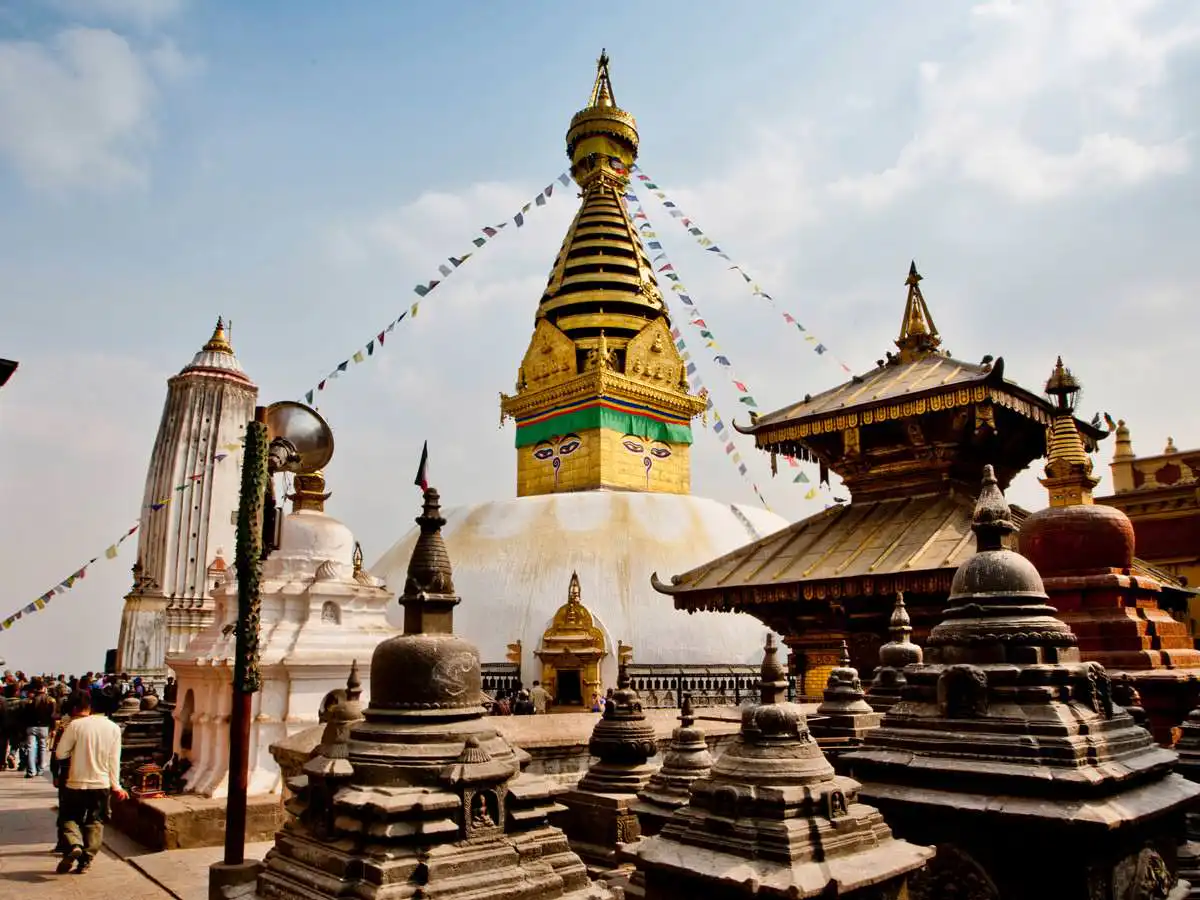
Swayambhunath stupa complex sits atop a high hill overlooking Kathmandu and the entire Kathmandu Valley with Mountain ranges on the Southern side. Monkey temple is an ancient religious architecture on the top of the hill in the Kathmandu Valley. Swayambhunath is probably the most sacred Buddhist pilgrimage site in Nepal. It is another famous tourist destination and the holiest Buddhist and Hindu pilgrims. Most of Swayambhunath’s iconography comes from the Vajrayana tradition of Newar Buddhism. This temple also called the Monkey temple due to the lots of monkeys and they have their swimming pool. This is a wonderful place to catch your breath and observe the sunset, start to understand the deep importance of Buddhist belief to the people. It consists of a very large white stupa with all-seeing eyes, it believes in the love and peace of Lord Buddha and many small stupas and beautifully carved stone shrines. If you feel more energetic then you might also like to try some or all of the 350 steps or more that lead all the way from the eastern part of the temple called Bhagwan pau (God Feet)up to your Swayambhunath stupa vantage point. The complex consists of a stupa art and art structure, a variety of shrines, and temples, some dating back to the time of the Licchavi dynasty.

3. Namobuddha Monastery:

Namo Buddha pilgrimage site is about forty kilometers from the Boudhanath Stupa. Monastery Located on slightly elevated hillside land, it is a pleasant and out-of-the-way place. In this wide panorama, mountain ranges, Mahalangur Himal glisten white like a conch shell or a crystal. Amazing view of Morning sunrise and the evening you can see a wonderful sunset.

It is a small village next to the Newari town Panauti that houses a very old Thrangu Tashi Yangtse Monastery which is one of the most important Buddhist pilgrimages and holiest in the world. Guru Thrangu Rinpoche designed the Namo buddha as a representation of the Three Yanas. Vajrayana Buddhism divides the journey to enlightenment into three major stages. These are called Yanas. It is usually translated as “vehicles” that carry you along the path to enlightenment. All the three yana lays the spiritual ground for the next, they are not necessarily taught or practiced in sequence.

The story of Namo Buddha was the previous life as a prince who was here that the Buddha gave up his body out of compassion for a starving tigress and her cubs. It has an amazing story concerned with the Buddha which is commemorated by an ancient stone slab and a Stupa with the all-seeing eyes of Lord Buddha. Namo Buddha is a very suitable and perfect place for meditation and practice. Namo Buddha is a highly esteemed Pilgrimage place by people from all over the world, East and West.

4. Boudhanath Stupa:

It is the most popular religious Buddhist religious complex with a long history back over 500 years and more. The stupa is located in the northern part of Kathmandu. Boudhanath is always a great pilgrimage site for Buddhist followers to circle its massive holy stupa and spin its many prayer wheels. Boudhanath is one of the largest stupas in the world and also the UNESCO World Heritage Site in Nepal. For the Tibetan people, Boudhanath is a pilgrimage destination because the influx of large populations of refugees from Tibet has seen the construction of over 50 gompas (Tibetan convent) and monasteries around Boudhanath areas during the 1950s.

The main attraction of Boudhanath is its huge hemispherical white stupa with a central golden tower and the all-seeing eyes of the Lord Buddha. It also believes that eyes represent love and peace for all creatures in the world. Visitors always circle the stupa in a clockwise direction and spin prayer wheels for good fortune and get Nirvana. Boudhanath area surrounding a kind of school for foreign visitors who are interested in painting (Thanka) to see highly skilled artists at work on religious mandala paintings.

5. Lumbini- Gautam Buddha Born Place:

Lumbini is holy and the birthplace of Lord Buddha which is one of the most popular pilgrimage places in the world. Lumbini is one of the main magnets for pilgrimage that sprang up in places pivotal to Lord Buddha Life. Lumbini is also a UNESCO World Heritage Site. Lumbini is one of the four major Buddhist holy places commemorating the most significant events in Buddha’s life. One of the most attractive parts of Lumbini is the Maya Devi temple and the Puskarini, or Holy Pond, where the Buddha’s mother (Maya Devi) took the ritual dip prior to his birth and where Buddha had his first bath on the Puskarini pond. Bodh Gaya is the place where Gautama Buddha is said to have attained Enlightenment.

The main attraction of Lumbini remains the Sacred Maya Devi temple, the Ashoka Pillar, World peace pagoda, Myanmar Golden Temple the sacred pond, Maya Devi Temple, Lumbini Crane Sanctuary, China Temple, and many more. In Lumbini different countries build the shrines and monasteries at different times to reflect the architectural traditions of the respective countries and thus giving Lumbini an international feel with a message of world peace.

Mani Rimdu Festival

Mani Rimdu Festival in the Khumbu (Everest) Region of Nepal

Overview: Festival on the Lap of Mount Everest

The Mani Rimdu Festival is a vibrant and deeply spiritual celebration that takes place in the Khumbu region of Nepal, specifically at Tengboche Monastery, which lies on the route to Everest Base Camp. This sacred festival is celebrated by the Sherpa community, followers of the Mahayana-Nyingma-pa sect of Tibetan Buddhism. It honors Guru Rinpoche (Padmasambhava)—the revered Buddhist master who introduced Buddhism to Tibet in the 8th century and is credited with establishing Buddhism in the Himalayan regions.

Celebrated since 1930 A.D. in Tengboche Monastery, the Mani Rimdu festival is a mix of spiritual practice, ritual dance, and communal celebration.

Timing: Based on the Tibetan Lunar Calendar

The festival usually takes place in November, aligned with the full moon of the tenth Tibetan month. However, the exact dates vary each year according to the Tibetan lunar calendar. This timing is significant as it coincides with the end of the harvest season, allowing the local Sherpa people from villages across the Khumbu region to gather and celebrate after completing their agricultural duties.

Spiritual and Cultural Significance

Mani Rimdu is more than just a festival—it’s a ritualistic reenactment of the founding of Buddhism in Tibet. The festival symbolizes the triumph of Buddhism over Bon, the indigenous shamanistic religion of Tibet and the Himalayas.

Monks prepare for weeks leading up to the event through prayers, meditation, and rituals. The central features of the festival include:

1. Ritual Ceremonies and Mandala Creation

  • Monks build a large mandala (symbolic diagram) using colored sand and soil gathered from sacred points across the hills.

  • The creation of the mandala is an act of devotion and meditation, and it may take up to four full days to complete.

  • It represents the spiritual universe and is eventually destroyed at the end of the ceremony to symbolize the impermanence of life.

 2. Masked Dance Performances

  • The monks perform 16 traditional masked dances known as “Cham” dances.

  • Each dance is symbolic and tells a story—often the battle between good and evil or the suppression of demonic forces by Buddhist deities.

  • The dancers wear elaborate costumes and ferocious masks representing deities and demons.

  • The atmosphere is filled with the sounds of chanting, horns, drums, and cymbals, creating a deeply spiritual and theatrical experience.

3. Public Blessings and Social Gatherings

  • The head Lama of Tengboche Monastery bestows blessings upon the attendees, both locals and trekkers.

  • Locals, dressed in their finest traditional attire, join the monks in prayers, singing, and merrymaking.

  • The festival brings together faith and festivity, strengthening community bonds and sharing cultural values with visitors.

Trekking Itinerary with Mani Rimdu Festival

Mani Rimdu is often included in Everest trekking itineraries. Here’s a typical route for travelers planning to witness the festival:

Day 1–2: Arrival in Kathmandu

  • Sightseeing in the cultural hub of Nepal.

  • Visit UNESCO World Heritage Sites like Swayambhunath, Boudhanath, and Pashupatinath.

Day 3: Flight to Lukla (2,860m / 9,383 ft)

  • Scenic 45-minute flight to one of the world’s most adventurous airports.

  • Start a 3-hour trek to Phakding (2,610m / 8,562 ft).

Day 4: Trek to Namche Bazaar (3,440m / 11,286 ft)

  • The main commercial hub of the Khumbu region.

  • A melting pot of Sherpas, trekkers, and traders, with a lively atmosphere and stunning mountain views.

Day 5: Trek to Tengboche (3,867m / 12,687 ft)

  • 4–5 hours of trekking through rhododendron forests and mountain trails.

  • Arrival at Tengboche Monastery, the spiritual center of the Khumbu region.

Day 6–8: Mani Rimdu Festival Observance

  • Attend rituals, dances, and blessings over three days.

  • Experience Sherpa culture and spiritual traditions up close.

Day 9: Trek to Monjo (2,835m / 9,301 ft)

  • Begin the descent. A 5–6 hour trek leads back to the quieter village of Monjo.

Day 10: Trek to Lukla and Return to Kathmandu

  • Hike back to Lukla and prepare for your flight to Kathmandu.

  • Be mindful: flights can be delayed due to unpredictable Himalayan weather.

Why Mani Rimdu is a Unique Experience

  • Spiritual Journey: Offers insights into Tibetan Buddhism and Sherpa customs.

  • Visual Spectacle: The dances, mandalas, and masks create an unforgettable visual and auditory experience.

  • Cultural Immersion: Meet local families, monks, and villagers who have kept these traditions alive for centuries.

  • Off-the-Beaten-Path: Unlike mainstream festivals in Kathmandu or Pokhara, Mani Rimdu happens in a remote Himalayan setting.

  • Perfect Timing: Held during autumn, when the skies are clear, the landscapes vibrant, and trekking conditions ideal.

Travel Tips for Mani Rimdu Festival Trek

  • Book early: Since the festival attracts many trekkers, flights and lodges fill up quickly.

  • Check festival dates: Confirm with local tour operators since dates vary each year.

  • Acclimatize properly: Altitude sickness is a risk—take rest days in Namche.

  • Bring warm clothing: November nights in Tengboche are cold (often below freezing).

  • Respect local customs: Ask permission before photographing monks or rituals.

Final Thoughts

The Mani Rimdu Festival is a spectacular celebration of faith, heritage, and Himalayan culture. It not only reflects the spiritual life of the Sherpa people but also enriches your trekking journey with a profound cultural and emotional connection to the Everest region. More than just a hike to see mountains, this experience allows travelers to witness living traditions at the highest monastery in the world.

Plan your trip in October or early November, and combine the natural grandeur of Everest with one of the most colorful and meaningful Buddhist festivals in the Himalayas.

Canyoning in Nepal

Canyoning in Nepal

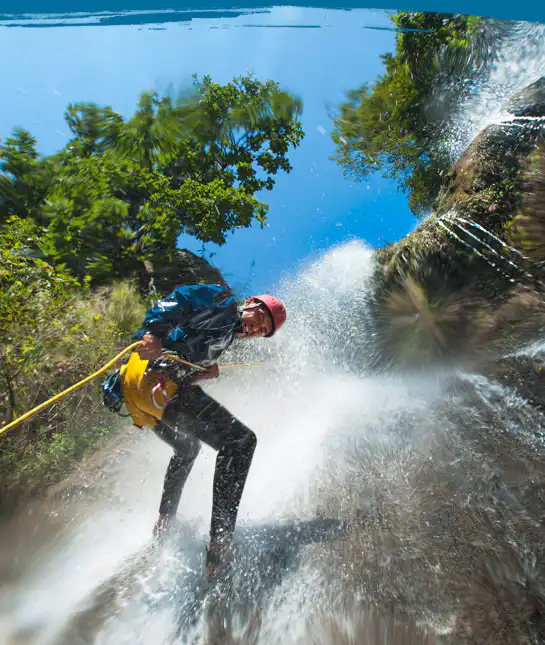
Canyoning is the foundation of adventure sports in Nepal. The activity of canyoning consists of travel in and around canyons by hikingtrekking, jumping, climbing, swimming, and rowing. Canyoning remains one of the most rigorous adventure sports of Nepal, an absolute favorite of adrenaline junkies.

Canyoning is often performed in remote and rugged areas, including navigational, route-finding, and other wilderness skills. Nepal, therefore, has the perfect set of geographical make-up to facilitate some exciting canyoning adventures. The mix of natural beauty surrounding an already naturally set up trail gives the biggest advantage to adventurers looking for a scenic getaway.

Key Features of Canyoning in Nepal

Geographically, Nepal sits between two massive nations. Gigantic Himalayan ranges act as a natural barrier line in the Northern region of Nepal. The southern part of Nepal showcases an extremely diverse bio-diversity, housing forests, hills, farmlands, terraces, and rivers flowing from the northern peaks. This wonderful mixture gave birth to canyons cut of bedrock stones with narrow gorgers with high drops, magnificently sculpted walls, and breathtaking waterfalls. Any adventurer will quickly notice that these are the ideal canyons for canyoning.

Hence, Nepal houses hundreds of wonderful canyons for travelers looking for a once-in-a-lifetime experience with marvelous adventure sports in Nepal.

Canyoning Sites in Nepal

The massive success of canyoning among the youths of Nepal led to the opening of many canyoning destinations in Nepal. Many youngsters start at a young age right around their own homes. One of the top-rated canyoning destinations for tourists is the Jalbire canyon. The canyons are located in Chitwan. The tributary goes down to the massive Trishuli River. The river earned its fame for white river rafting but also emerged as a champion for canyoning a few years ago. The endpoint for the Jalbire canyon lies somewhere between Prithvi Highway and Simital village.

The other canyoning sites in Nepal are Sunkoshi Canyoning, Kakani Canyoning, and Bhotekoshi Canyoning. The best time to attempt canyoning is during the autumn season (September to November).  The weather is clear, and the temperature moderate.

How to Experience Canyoning in Nepal

Most tour operators arrange the full experience of canyoning without any hassle. They take care of the travel, gear, and even guides by contacting the canyoning agency. Tourists also contact canyoning agencies directly if they can arrange travel on their own. Canyoning agencies have fully trained professionals to conduct canyoning. They train and help beginners to adjust to the scenario. Canyoning agencies also provide thorough safety talks and instructions.

However, if the traveler is already experienced, they will hand them the steering wheel without any fuss! Depending upon the experience level of the adventurer, canyoning can take anywhere from 4 to 5 hours to complete. The travel from the capital Kathmandu to Chitwan takes about 3 to 4 hours by private jeep, bus, or micro-bus.

Canyoning pairing with other adventure sports

Canyoning stands good by itself, but it becomes majestic when paired with other adventure activities like white river rafting or kayaking. Adventurers get to play with both elements of land and water. Notwithstanding, canyoning surpasses expectations even when paired with trekking, hiking, or camping adventures around the canyon area. It all depends upon the traveler on what experiences not to miss.

All in all, canyoning requires a fairly fit physique to attempt it. However, anyone remotely fit completed canyoning in Nepal. They say if you have the zeal, you can achieve anything!

Gosaikunda Lake

Gosaikunda Lake

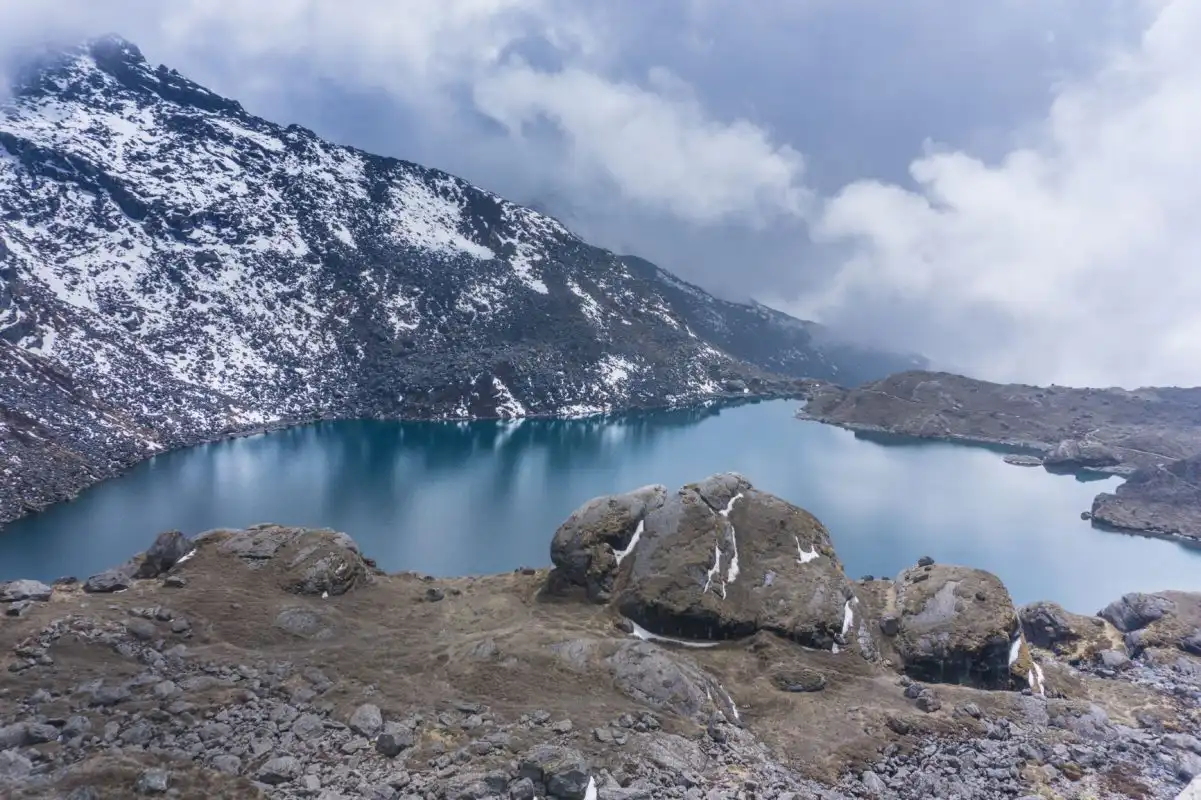
Legends said a long time ago; a large trident plunged at a mountain. Crystal clear water trickled from the same point. Lord Shiva, the mightiest Hindu deity, took just three sips when his throat was irritated with poison felt utter bliss. Gosainkunda Lake formed right after, the water flowing down to create a large pool of cerulean water.

Today, Gosaikunda is an alpine freshwater lake, located within the vicinity of Langtang National Park in Nepal. The lake sits at an impressive altitude of 4380m in the Rasuwa District (almost 50km away from Kathmandu). The magnificent lake spreads at an impressive 34 acres, with at least 108 smaller lakes around it.

Key Attractions of Gosaikunda Lake

Gosaikunda Lake gains fame not only for its exquisite physical appearance but its immensely high religious significance. The lake attracts thousands of Hindus around August every year for Janai Purnima (a widely celebrated Hindu festival).

Popular as a pilgrimage, even the lake’s origin appears in Hindu scriptures of Bhagavata Purana, Vishnu Purana, and the epics Ramayana and Mahabharata. Additionally, Hindu mythology specifies Gosainkunda as the abode of the same mighty Shiva and goddess Parvati.

How to Reach There

The placement of the lake makes it ideal as a tourist destination. Gosainkunda Lake remains a part of many treks around the area, including Gosaikunda Lake Trek, Langtang Trek, and Dhunche-Helambu Trek. Out of the three, the Dhunche-Helambu trek stands as the best comprehensive trek to embrace everything around the Langtang region. Usually, the trek to Gosainkunda begins with a drive from Kathmandu to Dhunche Bazaar (1970m). The trail goes up to Shin Gumba, an old Tibeto-Buddhist monastery at 3335m. The Dhunche-Helambu trek also features picturesque views of the Langtang range, the highest being Langtang Lirung at 7234m.

Best Season to Visit Gosainkunda Lake

The best season to approach Gosainkunda is from April to June or September to December. Flora and fauna are livelier during these months, and the weather is moderately cold enough to walk 4-5 hours every day.

Langtang preserves mystical endangered species such as Himalayan Thar, Assam macaque, and red pandas. Some famous folklore also cites the sighting of Yeti in the pine and rhododendron forests. The Lantang region is home to ethnic groups such as Tamang, Magar, and Gurung and houses Tibeto-Buddhists near the monasteries.

Trekking to Gosaikunda Lake

The treks surrounding Gosainkunda Lake are of moderate grading. Gosaikunda Lake Trek lasts explicitly only about eight days, while others may extend up to 18 days. These treks tend to get difficult in terms of acclimatization. Only gradual acclimatization assures trekkers do not experience altitude sickness. The graveled trails are suited for trekkers with at least a few trekking experiences. Trekkers must be fairly fit in attempts to complete 5 hours of average walking.

The popular method of trekking in the region is Teahouse Trekking. These teahouses have food and lodging services. Additionally, they may also have access to warm water for baths. Trekkers are advised at least to seek knowledge about the area before heading out. In terms of grouping, due to it being in a fairly isolated area, a group of more than two people is suggested.

Free Travel Guide
Your Perfect, Personalized Journey Awaits
profile
Bhagwat Simkhada Seasoned Travel Expert with Years of Experience