


The Upper Mustang Motorbike Tour Map is one of the best ways to understand the dramatic route from Kathmandu to the remote Himalayan kingdom of Lo Manthang. This spectacular Upper Mustang motorcycle tour in Nepal combines long-distance riding, high-altitude off-road trails, ancient Tibetan Buddhist culture, dramatic Himalayan scenery, traditional villages, monasteries, caves and the unique landscapes of the Mustang region. According to the current Himalayan Adventure Treks & Tours itinerary, the 12-day journey begins and ends in Kathmandu and travels through Pokhara, Kalopani, Samar, Lo Manthang, Muktinath and Tatopani.
The Upper Mustang Motorbike Tour Map shows how the route gradually changes from Nepal’s busy central highways to the remote dirt tracks of the Kali Gandaki Valley and the high-altitude desert of Upper Mustang. Riders first travel from Kathmandu to Pokhara before following the Kali Gandaki corridor north through Beni, Tatopani, Kalopani, Jomsom and Kagbeni. From Kagbeni, the journey enters the restricted Upper Mustang area and continues through Chele, Samar, Syangboche, Ghami, Dhakmar, Charang and finally Lo Manthang. The return route passes through Muktinath, Jomsom, Marpha, Tatopani and Pokhara before reaching Kathmandu again.
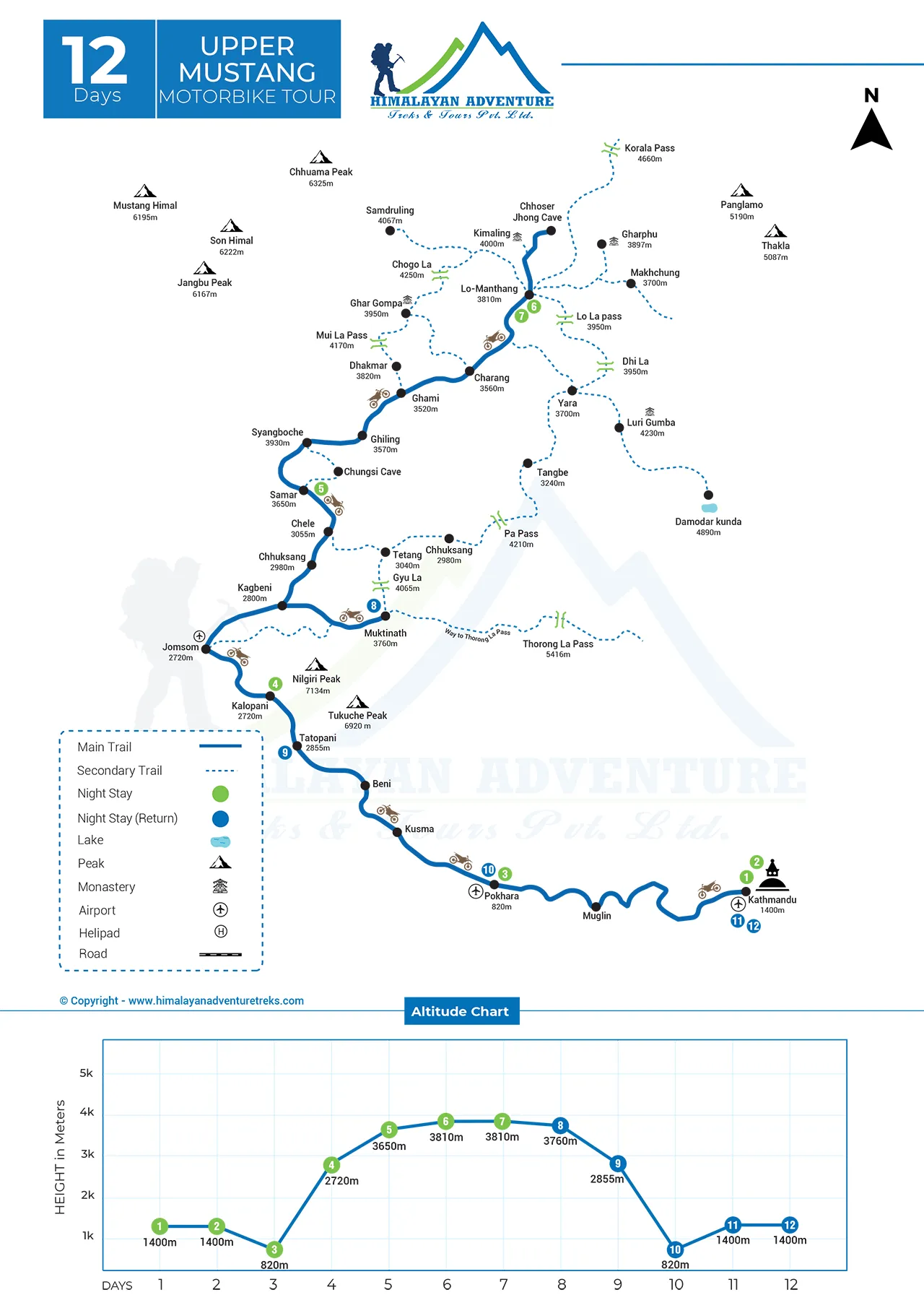
Official Upper Mustang Motorbike Tour Map
The official Himalayan Adventure Treks map is especially useful because it shows the main trail, secondary trails, overnight locations, monasteries, airports, major mountain peaks and the altitude profile of the journey. The map identifies Kathmandu at approximately 1,400 meters, Pokhara at around 820 meters, Jomsom at approximately 2,720 meters, Muktinath at 3,760 meters and Lo Manthang at about 3,810 meters. It also illustrates important high points such as Syangboche, Mui La, Dhi La, Lo La and the route toward Korala Pass.
Official HATT route map: View the official Upper Mustang Motorbike Tour Map PDF
Understanding the Upper Mustang Motorbike Tour Route
The Upper Mustang Motorbike Tour route is not simply a motorcycle journey between two destinations. It is a complete Himalayan adventure that crosses several geographic and cultural zones.
The first part of the journey travels through the Kathmandu Valley and central Nepal. Kathmandu is the cultural and historical gateway to the tour. Riders then head west toward Pokhara along one of Nepal’s major highways. From Pokhara, the route follows the Kali Gandaki corridor toward Beni and the Mustang region.
Once riders leave Beni, the character of the road changes dramatically. The paved highway gradually gives way to gravel, stones, mud, river crossings and rough mountain tracks. This is where the Upper Mustang off-road motorcycle tour becomes a true adventure.
The route continues through the lower Mustang settlements of Tatopani, Ghasa, Kalopani, Marpha and Jomsom. Kagbeni marks an important gateway to Upper Mustang. Beyond Kagbeni, riders enter the restricted region and encounter a completely different landscape dominated by barren cliffs, high plateaus, ancient villages, monasteries and Tibetan Buddhist culture.
The final approach to Lo Manthang crosses several high mountain passes and traditional villages. The ancient walled settlement of Lo Manthang is the cultural heart of the tour.
On the return journey, riders descend through Muktinath and the Kali Gandaki Valley before reaching Tatopani and Pokhara.
This makes the Upper Mustang motorcycle route from Kathmandu to Lo Manthang a fascinating combination of road riding, off-road riding, cultural exploration and high-altitude adventure.
Upper Mustang Motorbike Tour Route at a Glance
Kathmandu → Pokhara → Kalopani → Samar → Lo Manthang → Muktinath → Tatopani → Pokhara → Kathmandu
More specifically, the route includes:
Kathmandu → Mugling → Pokhara → Kushma → Beni → Tatopani → Ghasa → Kalopani → Tukuche → Marpha → Jomsom → Kagbeni → Tangbe → Chhusang → Chele → Samar → Syangboche → Ghami → Dhakmar → Charang → Lo Manthang → Muktinath → Jomsom → Marpha → Tatopani → Beni → Pokhara → Kathmandu.
Day 1: Kathmandu Arrival – Gateway to the Upper Mustang Motorcycle Adventure
The Upper Mustang Motorbike Tour begins in Kathmandu, the capital city of Nepal and the starting point for many of the country’s greatest Himalayan adventures.
Upon arrival at Tribhuvan International Airport, travelers are welcomed by the Himalayan Adventure Treks & Tours team and transferred to their hotel. Kathmandu is situated at approximately 1,400 meters above sea level, providing a comfortable starting altitude before the journey gradually climbs into the mountains.
The first day is deliberately relaxed. Travelers can recover from their international flight, explore nearby areas and experience the atmosphere of Kathmandu.
For people searching for an adventure motorcycle tour in Nepal, Kathmandu provides an exciting introduction because the city combines ancient temples, Buddhist stupas, traditional architecture, busy markets and modern tourist facilities.
The evening can be used to prepare riding equipment, check documents and discuss the following day’s program with the guide.
This initial preparation is particularly important for an Upper Mustang off-road bike tour, because the route ahead includes rough roads and high-altitude terrain.
Day 2: Kathmandu Sightseeing and Motorbike Test Ride
The second day combines cultural sightseeing with motorcycle preparation.
According to the HATT itinerary, travelers visit important Kathmandu attractions including Pashupatinath, Boudhanath and Swayambhunath. Later, riders inspect their Royal Enfield Himalayan 411 motorcycles and take a test ride before beginning the long journey toward Pokhara.
This day is useful for riders who are unfamiliar with Nepal’s road conditions.
A test ride gives participants an opportunity to become comfortable with the motorcycle’s clutch, brakes, throttle, gears and riding position. It is also a good opportunity to check luggage, protective equipment and communication arrangements.
For anyone searching for a Royal Enfield Himalayan tour in Nepal, this preparation is an important part of the experience.
Day 3: Kathmandu to Pokhara – 210 km
The first major riding day takes travelers from Kathmandu to Pokhara, covering approximately 210 kilometers.
The route leaves Kathmandu through Kalanki and Thankot and continues along the Prithvi Highway toward Mugling. From there, riders continue toward Pokhara.
This section is primarily highway riding rather than technical off-road riding, making it an excellent opportunity to become accustomed to the motorcycle before entering Mustang’s more difficult terrain.
The route provides views of Nepal’s central Himalayan ranges, and depending on weather conditions riders may see peaks associated with the Annapurna, Manaslu, Ganesh and other Himalayan ranges. HATT describes the riding day as approximately seven to eight hours.
Pokhara is one of Nepal’s most famous adventure destinations. Located beside Phewa Lake and surrounded by mountain scenery, it is an ideal overnight stop before the motorcycle tour enters the Kali Gandaki Valley.
Day 4: Pokhara to Kalopani – 125 km
The route becomes considerably more adventurous after leaving Pokhara.
The journey begins toward Baglung and Kushma before continuing toward Beni. HATT describes Kushma as a scenic stop where travelers can see its famous suspension bridge and surrounding mountain landscape. After Beni, the smooth asphalt road gradually gives way to rougher terrain.
The route follows the Kali Gandaki River, one of the most important geographical features of the Mustang region.
The road passes through Tatopani and continues toward Ghasa before reaching Kalopani. The landscape changes from lush green valleys to increasingly dry mountain terrain.
Tatopani is famous for its natural hot springs, while Ghasa and the surrounding settlements introduce travelers to traditional Thakali culture.
The Kali Gandaki corridor is one of the highlights of the Mustang motorbike adventure because the road continuously changes in character. Riders experience mountain bends, rocky surfaces, waterfalls, cliffs and river valleys.
The destination for the day is Kalopani at approximately 2,530 meters. HATT describes the ride as approximately 125 kilometers and five to six hours.
Day 5: Kalopani to Samar – 65 km
Day five marks the real beginning of the Upper Mustang off-road experience.
The journey passes through Marpha, Jomsom and Kagbeni before entering the restricted Upper Mustang region.
Marpha is famous for its whitewashed traditional houses, narrow streets and apple products. Jomsom is the administrative center of Mustang and an important transportation hub.
From Jomsom, the route follows the Kali Gandaki Valley toward Kagbeni.
Kagbeni is one of the most historically important villages in the region. It sits at the gateway to Upper Mustang and has a distinctive medieval atmosphere.
After Kagbeni, the landscape becomes dramatically drier. The road continues through Tangbe, Chhusang and Chele before climbing toward Samar.
For travelers researching Kagbeni to Lo Manthang by motorbike, this section is particularly important because it represents the transition from lower Mustang into the restricted Upper Mustang landscape.
Day 6: Samar to Lo Manthang – 63 km
Day six is arguably the highlight of the entire Upper Mustang Motorbike Tour.
The route from Samar to Lo Manthang crosses some of the most spectacular landscapes in Mustang.
The trail climbs toward Syangboche La at approximately 3,850 meters before descending toward Ghami. From there, the route continues through dramatic red and gray cliffs and across high passes.
One of the major points on the route is Mui La Pass, shown on the official HATT map at approximately 4,170 meters. The journey then continues toward Dhakmar and the Lo-Ghekar/Ghar Gompa area before reaching Charang.
Charang is an important cultural settlement with traditional architecture, monasteries and the famous Charang Dzong.
From Charang, the road continues north toward Tsarang Chu and then across Lo La before reaching Lo Manthang.
The official map identifies Lo Manthang at approximately 3,810 meters, while the HATT itinerary gives the day’s maximum altitude as approximately 3,860 meters.
This is why Lo Manthang motorcycle tour is such a popular search term among adventure travelers. The ride combines challenging terrain with some of the most unusual landscapes in the Himalayas.
Day 7: Explore Lo Manthang and Chhoser Cave
Lo Manthang is the cultural heart of Upper Mustang.
The ancient walled city is surrounded by a high-altitude desert landscape that is dramatically different from the green valleys of southern Nepal.
The HATT itinerary includes a full exploration day in Lo Manthang and a visit to Chhoser Cave and monastery areas. Travelers can explore ancient monasteries, traditional settlements, and the distinctive Tibetan Buddhist culture of the former Kingdom of Lo.
The Chhoser area is particularly fascinating because of its ancient cave complexes carved into the cliffs.
The caves have attracted archaeologists, researchers and travelers interested in the history of the Himalayan region. The route to Chhoser is approximately 16 kilometers from Lo Manthang, according to the HATT itinerary.
For people searching for things to do in Lo Manthang, Lo Manthang caves, Upper Mustang cultural tour, or Chhoser Cave Mustang, this exploration day provides one of the strongest cultural highlights of the trip.
The rest day is also valuable from a riding perspective because it provides additional time for acclimatization before the return journey.
Day 8: Lo Manthang to Muktinath – 105 km
The return journey begins with a long and scenic ride from Lo Manthang toward Muktinath.
The route retraces sections through Charang, Ghami and Kagbeni before continuing toward Muktinath.
The HATT itinerary lists the distance at approximately 105 kilometers and the destination altitude at approximately 3,710 meters.
Muktinath is one of the most important pilgrimage destinations in Nepal and is sacred to both Hindus and Buddhists.
The temple area is associated with natural springs and eternal flames, making it a unique spiritual destination within the Mustang region.
Day 9: Muktinath to Tatopani – 70 km
Day nine takes riders from the high-altitude environment of Muktinath back toward the warmer Kali Gandaki Valley.
The route passes through Jomsom and Marpha before continuing south toward Tatopani.
The altitude decreases significantly, creating an obvious change in climate and vegetation.
Tatopani is famous for its natural hot springs, making it a perfect location to relax after several demanding days of off-road riding.
The HATT itinerary lists approximately 70 kilometers for this riding day.
This part of the route is especially enjoyable because riders can feel the temperature gradually becoming warmer as they descend from Mustang’s high desert.
A stop at the hot spring provides an excellent opportunity to relax muscles after several days of motorcycle riding.
Day 10: Tatopani to Pokhara – 105 km
The journey continues south from Tatopani toward Pokhara.
The road follows the Kali Gandaki corridor toward Beni before continuing toward Pokhara. The landscape becomes greener and more humid as riders leave the dry Mustang environment.
HATT lists approximately 105 kilometers for this riding day and a destination altitude of around 900 meters in Pokhara.
After several days of riding through remote mountain terrain, arriving in Pokhara provides an opportunity to relax, enjoy Phewa Lake and experience the city’s restaurants and cafés.
Day 11: Pokhara to Kathmandu – 210 km
The final major riding day takes the group from Pokhara back to Kathmandu.
The route follows the highway through the central hills and eventually reaches Kathmandu Valley.
The final evening provides an opportunity to celebrate the completion of the 12-day Upper Mustang Motorbike Tour with the group.
The journey has covered a remarkable variety of landscapes—from Kathmandu’s urban environment and Pokhara’s lakeside setting to the Kali Gandaki Gorge, Mustang’s high-altitude desert and the ancient walled city of Lo Manthang.
Day 12: Departure from Kathmandu
The final day is reserved for departure.
Depending on the international flight schedule, travelers may have free time for shopping or relaxing in Kathmandu before transferring to Tribhuvan International Airport.
For international travelers, it is recommended to allow sufficient time between the scheduled airport transfer and the international flight.
What Makes the Upper Mustang Motorbike Tour Map Special?
The map is more than a simple line connecting destinations.
It demonstrates the dramatic changes in altitude and landscape throughout the journey.
At the beginning, Kathmandu is approximately 1,400 meters above sea level. Pokhara is lower at around 820 meters. From Pokhara, the route climbs through the Kali Gandaki Valley toward Mustang.
Jomsom is approximately 2,720 meters, while Lo Manthang is around 3,810 meters. The official map also shows high passes and secondary routes, including Mui La at approximately 4,170 meters and other elevated sections.
This variation is one reason the Upper Mustang motorcycle adventure is physically and technically demanding.
The rider must be prepared for changing road surfaces, changing weather, strong wind, dust, steep climbs, descents and altitude.
Upper Mustang Motorbike Tour Map and Major Destinations
Kathmandu
Kathmandu is the start and finish point of the tour. It is Nepal’s political, cultural and historical center and contains several major heritage sites.
Pokhara
Pokhara is the adventure capital of Nepal and provides spectacular views of the Annapurna and Fishtail ranges. It is also the main gateway to the Mustang region for many road travelers.
Kalopani
Kalopani lies along the Kali Gandaki corridor and provides the first major overnight stop after entering the mountain road system from Pokhara.
Jomsom
Jomsom is an important town in Mustang and a major gateway for travelers heading toward Muktinath and Upper Mustang.
Kagbeni
Kagbeni is the traditional gateway to Upper Mustang and one of the most atmospheric settlements on the route.
Samar
Samar is a high-altitude settlement surrounded by dramatic cliffs and dry mountain landscapes.
Ghami
Ghami is one of the important traditional villages of Upper Mustang and is associated with long Mani walls and Tibetan Buddhist culture.
Charang
Charang is known for its traditional settlement, monastery and dzong.
Lo Manthang
Lo Manthang is the principal destination of the journey and the cultural center of Upper Mustang.
Muktinath
Muktinath is a major Hindu and Buddhist pilgrimage site located in the Mustang region.
Tatopani
Tatopani is famous for its natural hot springs and provides a relaxing stop during the return journey.
High Passes Shown on the Upper Mustang Motorbike Tour
One of the most important reasons adventure riders choose this route is the number of high mountain passes.
- Syangboche – approximately 3,930 m on the map
- Mui La Pass – approximately 4,170 m
- Dhi La – approximately 3,950 m
- Lo La Pass – approximately 3,950 m
- Chogo La – approximately 4,250 m
- Pa Pass – approximately 4,210 m
- Korala Pass – approximately 4,660 m on the official map
Not every mapped pass necessarily represents the primary overnight route of the 12-day itinerary, so riders should distinguish between the complete regional map and the exact scheduled daily riding route.
Road Conditions on the Upper Mustang Motorbike Route
The road conditions are one of the defining features of this adventure.
From Kathmandu to Pokhara, riders mainly use paved highways.
From Pokhara toward Beni, the route is increasingly mountainous.
Beyond Beni, the road becomes considerably rougher. Travelers should expect gravel, stones, mud, dust, uneven surfaces and sections requiring careful motorcycle control.
HATT describes the road after Beni as becoming a serious test of riding ability, with rocky and muddy surfaces as the journey follows the Kali Gandaki River.
For this reason, the Upper Mustang off-road motorcycle tour is more appropriate for riders who already have some experience riding motorcycles on uneven mountain roads.
Riders should not approach this trip as an ordinary paved-road motorcycle holiday.
Motorcycle for the Upper Mustang Tour
The HATT package provides a Royal Enfield Himalayan 411, which is well suited to long-distance mountain riding and mixed road conditions. The company also describes possible motorcycle alternatives depending on specific terrain and tour requirements.
The Himalayan 411 is popular among adventure riders because of its relatively comfortable riding position, simple mechanical design and suitability for long mountain journeys.
HATT also lists an optional Himalayan 450, Himalayan 440, and Honda CRF 250 upgrade, explaining that its lighter frame and suspension can be useful on rough off-road terrain.
When choosing a motorcycle for an Upper Mustang bike tour, riders should consider:
- Off-road experience
- Motorcycle weight
- Seat height
- Suspension
- Riding position
- Ability to control the bike on loose gravel
- Experience with steep descents
- Comfort with river crossings
- Ability to ride for several hours per day
Difficulty of the Upper Mustang Motorbike Tour
The Upper Mustang Motorbike Tour difficulty level is best described as moderate to challenging for experienced motorcyclists.
The difficulty does not come only from the distance. It comes from the combination of altitude, rough terrain, wind, dust, steep sections, and long riding days.
Specifically, after Beni, the road becomes much more challenging, and riders who are inexperienced with off-road motorcycle riding may find the journey difficult.
A rider should be comfortable with:
- Gravel roads
- Rocky tracks
- Mud
- Steep climbs
- Steep descents
- Narrow mountain roads
- Loose stones
- High-altitude riding
- Long riding days
Previous experience with Himalayan motorcycle tours or off-road riding is highly beneficial.
Altitude on the Upper Mustang Motorbike Route
Altitude is an important consideration.
Although the itinerary’s highest overnight point is Lo Manthang at approximately 3,860 meters, some route sections climb above 4,000 meters. The official map shows several high passes above 4,000 meters.
Emphasizes that altitude sickness can affect motorcycle riders as well as trekkers. The company recommends gradual acclimatization, hydration and immediate communication with the guide if symptoms develop.
Common altitude-related symptoms can include headache, nausea, dizziness, fatigue and difficulty sleeping.
Anyone experiencing significant symptoms should inform the guide immediately and follow professional medical advice.
Best Time for Upper Mustang Motorbike Tour
The best time for an Upper Mustang Motorbike Tour is generally spring and autumn.
Spring, particularly March to May, provides generally favorable mountain conditions and can bring some greenery to the lower Mustang landscape.
Autumn, particularly September to November, is another excellent period because the weather is generally dry and mountain visibility is often good.
HATT identifies September through November as a prime period and March through May as another favorable season. The company notes that monsoon rainfall can affect lower approaches during July and August, while winter can bring snow and harsh winds.
Therefore, travelers searching for the best time to visit Upper Mustang by motorbike will generally find spring and autumn to be the most practical seasons.
Upper Mustang Motorbike Tour Permit
Upper Mustang is a restricted region, so special permits are required.
Upper Mustang Motorbike tour requires both the Restricted Area Permit (RAP) and the Annapurna Conservation Area Project (ACAP) permit. The company states that the special permit for Upper Mustang and ACAP permit arrangements are handled as part of the package.
The permit requirement is one reason travelers generally book the Upper Mustang restricted area motorbike tour through a registered local trekking or tour company.
Travelers should carry their passport and required travel documents throughout the journey.
Travel Insurance for Upper Mustang Motorcycle Tour
Travel insurance is particularly important for a high-altitude motorcycle adventure.
Travel insurance is essential, and the company recommends a policy that covers biking activities and emergency rescue at elevations reaching approximately 4,000 meters. The company also states that travel insurance and bike insurance are not included in the package and should be arranged separately.
Before traveling, riders should carefully check that their policy covers:
- Motorcycle riding
- Off-road riding
- High-altitude activities
- Emergency medical treatment
- Helicopter or air rescue where applicable
- Evacuation
- Personal accident
- Third-party liability where appropriate
- Motorcycle-related exclusions
This is especially important for an Upper Mustang adventure motorcycle tour because remote locations can make emergency assistance more complicated.
Accommodation on the Upper Mustang Motorcycle Route
Accommodation changes as the journey moves from cities into remote mountain areas.
In Kathmandu and Pokhara, HATT provides three-star hotel accommodation under the standard package. In Upper Mustang, accommodation is generally in local lodges and teahouses.
The local lodges are simpler than city hotels but provide the essential facilities needed by motorcycle travelers.
Rooms generally have beds, mattresses, pillows and blankets. Bathrooms may be shared, and hot showers can sometimes cost extra.
For travelers searching for Upper Mustang teahouse accommodation, it is important to understand that the remote region should not be compared with conventional city hotels.
The simplicity of the accommodation is part of the adventure and provides an opportunity to experience local Himalayan hospitality.
Food During the Upper Mustang Motorbike Tour
Food is another important part of the journey.
In Kathmandu and Pokhara, travelers can choose from a wide range of restaurants and international cuisines.
In the mountain villages, meals are simpler but generally filling.
Common dishes include:
- Dal Bhat
- Thakali food
- Momo
- Chowmein
- Tibetan-style dishes
- Pasta
- Noodles
- Soups
- Rice and vegetables
- Local bread
The HATT travel information highlights traditional Nepali and Thakali foods as well as other commonly available dishes along the route.
Trying local Thakali and Tibetan-influenced food can be one of the memorable cultural experiences of the Mustang motorcycle adventure.
What to Pack for an Upper Mustang Motorbike Tour
Packing correctly is essential.
The official HATT equipment recommendations include a full-face helmet, protective motorcycle jacket, gloves, protective trousers, long motorcycle boots, rain gear, sunglasses, waterproof bags and other motorcycle accessories.
Important riding equipment includes:
- Full-face helmet
- Motorcycle jacket with protection
- Motorcycle gloves
- Protective riding trousers
- Motorcycle boots
- Thermal layers
- Waterproof jacket
- Warm fleece
- Down jacket
- Warm socks
- Sunglasses
- Sunscreen
- Dust mask
- Rain gear
- Waterproof backpack
The dry environment can produce significant dust, so eye protection and face protection are useful.
A GPS, phone holder, USB charger, power bank and basic personal electronics can also be helpful.
Upper Mustang Motorbike Tour for Adventure Photographers
The route is also ideal for photography.
The landscape changes continuously from green valleys to barren high-altitude desert.
Photographers can capture:
- Annapurna range
- Dhaulagiri
- Nilgiri
- Tukuche Peak
- Kali Gandaki Gorge
- Kagbeni
- Traditional Mustang villages
- Mani walls
- Buddhist monasteries
- Red cliffs
- High-altitude plateaus
- Lo Manthang
- Chhoser caves
- Muktinath
- Marpha
- Himalayan roads
The unusual combination of Tibetan-style villages, dramatic cliffs and snow-covered peaks makes Mustang Nepal photography particularly attractive.
Early morning and late afternoon generally provide excellent opportunities for landscape photography because the changing sunlight emphasizes the textures of the cliffs and mountains.
Culture of Upper Mustang
Upper Mustang is culturally distinct from many other areas of Nepal.
The communities of the region have strong Tibetan cultural and Buddhist traditions.
The landscape is dotted with monasteries, prayer flags, Mani walls, chortens and traditional houses.
Lo Manthang is particularly important because it preserves the cultural heritage of the former Kingdom of Lo.
An Upper Mustang cultural motorbike tour therefore offers much more than scenery.
Travelers have opportunities to observe traditional architecture, Buddhist practices, local food, festivals, monasteries and village life.
Respect for local culture is extremely important. Visitors should ask permission before photographing people, religious ceremonies or private areas.
Upper Mustang and the Former Kingdom of Lo
Lo Manthang was historically the center of the Kingdom of Lo.
Its traditional architecture and fortified settlement provide an extraordinary connection with Mustang’s past.
The walled city, monasteries and surrounding villages demonstrate the influence of Tibetan culture on the region.
This is one reason why the Lo Manthang motorcycle tour is often described as a journey into the “hidden kingdom” of Nepal.
The remoteness of the region helped preserve its unique cultural identity for generations.
Today, motorcycles make access easier, but the region remains significantly different from the major tourist centers of Nepal.
Upper Mustang Motorbike Tour and the Kali Gandaki Valley
The Kali Gandaki Valley is one of the central geographical features of this journey.
The river cuts through the Himalayan landscape between massive mountain systems and provides the natural corridor used by the road.
The route from Pokhara through Beni, Tatopani, Kalopani, Jomsom and Kagbeni follows this broader geographical corridor.
For riders, the Kali Gandaki Valley provides constantly changing scenery.
Waterfalls, cliffs, villages, suspension bridges, river crossings and high mountains all appear along the route.
The Kali Gandaki motorcycle tour experience is therefore an important part of the wider Upper Mustang adventure.
Upper Mustang Motorbike Tour Map: Simple Route Diagram
For website readers, the following simplified route diagram can be placed underneath the official map:
Kathmandu (1,400 m)
↓
Mugling
↓
Pokhara (820–900 m)
↓
Kushma
↓
Beni
↓
Tatopani
↓
Ghasa
↓
Kalopani
↓
Marpha
↓
Jomsom (2,720 m)
↓
Kagbeni
↓
Tangbe
↓
Chhusang
↓
Chele
↓
Samar (3,650 m)
↓
Syangboche
↓
Ghami
↓
Dhakmar / Ghar Gompa
↓
Charang
↓
Lo Manthang (approx. 3,810–3,860 m)
↓
Chhoser Cave Exploration
↓
Charang
↓
Ghami
↓
Kagbeni
↓
Muktinath (approx. 3,710–3,760 m)
↓
Jomsom
↓
Marpha
↓
Tatopani
↓
Beni
↓
Pokhara
↓
Kathmandu
This route representation works well alongside the official Upper Mustang Motorbike Tour Map because readers can quickly understand the direction of travel before examining the detailed map.
Upper Mustang Motorbike Tour Map: Altitude Overview
| Location | Approx. Elevation |
|---|---|
| Kathmandu | 1,400 m |
| Pokhara | 820–900 m |
| Tatopani | 1,200 m |
| Kalopani | 2,530–2,720 m |
| Jomsom | 2,720 m |
| Kagbeni | 2,800 m |
| Chhusang | 2,980 m |
| Chele | 3,055 m |
| Samar | 3,650 m |
| Ghami | 3,520 m |
| Charang | 3,560 m |
| Lo Manthang | 3,810–3,860 m |
| Muktinath | 3,710–3,760 m |
| Mui La Pass | approx. 4,170 m |
| Korala Pass | approx. 4,660 m |
The exact elevation can vary slightly between sources and map references, so travelers should use the itinerary and official route map as the principal reference for this particular tour.
Who Should Choose the Upper Mustang Motorbike Tour?
The tour is ideal for travelers who want:
- A genuine Himalayan motorcycle adventure
- Off-road riding
- Remote mountain landscapes
- Tibetan Buddhist culture
- Ancient monasteries
- Traditional villages
- High-altitude riding
- Long-distance motorcycle travel
- Photography
- Cultural exploration
- An alternative to conventional trekking
Experienced motorcycle riders will particularly appreciate the technical sections of the route.
People who have never ridden on gravel, rocks or mountain roads should consider gaining off-road experience before attempting the tour.
Is Upper Mustang Suitable for Beginner Riders?
The answer depends on the rider’s experience.
A person may be physically fit but still struggle with technical off-road riding.
The Upper Mustang route requires balance, clutch control, braking technique and confidence on uneven surfaces.
HATT specifically describes the terrain after Beni as challenging and recommends appropriate motorcycle skills.
Therefore, the Upper Mustang bike tour is best suited to riders who already have motorcycle experience and preferably some off-road riding experience.
Support Vehicle and Mechanical Support
A support system can make a major difference on a remote motorcycle expedition.
HATT highlights support arrangements and includes basic tools and spare parts with the motorcycle package. The company also notes that a skilled mechanic may accompany groups depending on group size and tour requirements.
This is particularly useful because mechanical problems in remote areas can be more difficult to resolve than in cities.
The guide and support team can also help with navigation, permits, local communication and emergency arrangements.
Upper Mustang Motorbike Tour: Safety Considerations
Safety should always come before speed.
The most important safety principles include:
Ride within your ability.
Do not attempt to match another rider’s speed.
Control your motorcycle on loose surfaces.
Loose gravel can cause the front wheel to move unexpectedly.
Use protective equipment.
A helmet, gloves, protective jacket, trousers and boots are strongly recommended.
Stay hydrated.
Dry mountain air can increase fluid loss.
Protect yourself from the sun.
The high-altitude environment can produce strong UV exposure.
Respect altitude.
Headache, nausea, dizziness or unusual fatigue should be reported to the guide.
Follow the guide.
Mountain weather and road conditions can change rapidly.
Avoid unnecessary night riding.
Mountain roads are difficult to navigate after dark.
Why Choose Himalayan Adventure Treks for Upper Mustang?
Himalayan Adventure Treks & Tours presents this as a structured 12-day motorcycle journey with a professional guide, motorcycle, fuel, basic tools and spares, permits, accommodation and travel/rescue arrangements included according to the package details.
The company also provides a dedicated official route map and altitude chart, making it easier for travelers to understand the route before departure.
For a traveler searching for a Nepal motorcycle tour company, Upper Mustang motorcycle operator, or Royal Enfield Himalayan tour Nepal, the combination of route planning, local guides, permits and logistical support is an important consideration.
FAQ:
1. Where does the Upper Mustang Motorbike Tour start?
The tour starts and ends in Kathmandu, Nepal. The route then travels through Pokhara before entering the Mustang region.
2. What is the main destination of the Upper Mustang motorcycle tour?
The principal destination is Lo Manthang, the historic walled city and cultural center of Upper Mustang.
3. How many days is the Upper Mustang Motorbike Tour?
The HATT itinerary is designed as a 12-day Upper Mustang Motorbike Tour.
4. How far is Kathmandu from Pokhara by motorcycle?
The itinerary lists approximately 210 kilometers between Kathmandu and Pokhara.
5. What motorcycle is used on the tour?
The standard motorcycle provided by HATT is the Royal Enfield Himalayan 411. An optional Honda CRF 250 upgrade is also described on the tour page.
6. Is the Upper Mustang Motorbike Tour an off-road adventure?
Yes. The route includes rough gravel, rocky and uneven mountain roads, particularly after Beni and inside Upper Mustang.
7. What is the highest overnight point?
Lo Manthang is the highest overnight destination on the main itinerary, at approximately 3,810–3,860 meters.
8. What permits are required?
The tour requires the Restricted Area Permit for Upper Mustang and the Annapurna Conservation Area Project permit. HATT states that these arrangements are handled as part of its package.
9. What is the best season for the Upper Mustang motorcycle tour?
Spring and autumn are generally the preferred seasons. HATT particularly identifies September to November and March to May as favorable periods.
10. Is travel insurance required?
Travel insurance is strongly recommended for this adventure, and HATT recommends coverage for motorcycle activities and emergency rescue at high altitude.
11. Can beginners join the Upper Mustang bike tour?
Riders should have solid motorcycle control and preferably previous off-road or mountain-riding experience because the route becomes challenging after Beni.
12. Does the tour include accommodation?
Yes. The package includes three-star hotel accommodation in Kathmandu and two nights in Pokhara, while mountain sections use local lodges and teahouses on a twin-sharing basis.
13. Can I bring my own motorcycle?
HATT states that travelers can bring their own motorcycle, but recommends sharing the motorcycle specifications in advance so appropriate technical assistance can be considered.
14. Why is the Upper Mustang route so popular?
The route combines Himalayan motorcycle riding with Tibetan Buddhist culture, ancient monasteries, high-altitude desert landscapes, traditional villages, caves, and the historic city of Lo Manthang.
15. Where can I see the official Upper Mustang Motorbike Tour map?
The official HATT map is available as a PDF showing the route, elevations, major passes, villages, monasteries, peaks, and overnight locations. Open the official Upper Mustang Motorbike Tour Map
Conclusion: The Ultimate Upper Mustang Motorbike Route
The Upper Mustang Motorbike Tour Map tells the story of one of Nepal’s most extraordinary motorcycle journeys.
Starting from Kathmandu, the route travels through Pokhara and follows the Kali Gandaki Valley toward the remote Mustang region. Riders pass through Beni, Tatopani, Kalopani, Marpha, Jomsom and Kagbeni before entering the restricted Upper Mustang area.
From there, the landscape becomes increasingly dramatic.
The road climbs through Chele and Samar, crosses high passes near Syangboche and Mui La, passes through Ghami, Dhakmar and Charang, and finally reaches the ancient walled city of Lo Manthang.
The exploration day in Lo Manthang and Chhoser adds an important cultural dimension to the adventure. The return journey through Muktinath, Jomsom, Marpha, Tatopani and Pokhara completes the loop before riders return to Kathmandu.
For anyone searching for an Upper Mustang Motorbike Tour, Upper Mustang motorcycle tour Nepal, Lo Manthang motorcycle adventure, Royal Enfield Mustang tour, Upper Mustang off-road tour, Mustang Nepal road trip, or Nepal Himalayan motorcycle tour, this route offers an exceptional combination of adventure, culture, history and scenery.
The most important thing to remember is that Upper Mustang is not simply a destination reached by motorcycle. The road itself is the adventure.
Every kilometer introduces a new landscape, village, monastery, mountain pass or cultural experience. The journey moves from the green hills of central Nepal into the dry Himalayan desert of Mustang, creating one of the most visually and culturally distinctive motorcycle experiences in the Himalayas.
Official tour page: Upper Mustang Motorbike Tour – Himalayan Adventure Treks & Tours
Official route map: Upper Mustang Motorbike Tour 12-Day Map PDF


