The Luxury Everest Base Camp Trek is one of the most exclusive trekking experiences in the world. It combines the adventure of trekking in the Himalayas with the comfort of luxury accommodation, helicopter transportation, and professional guiding services. This premium trekking experience allows travelers to explore the legendary Everest region while enjoying high-end hospitality and safety.
The trek begins in Kathmandu, the vibrant capital city of Nepal. Travelers stay in luxury five-star hotels that provide international standards of comfort, including spacious rooms, excellent dining, spa services, and relaxing environments before beginning the Himalayan journey.
The main highlight of the trek is reaching the base of the world’s highest mountain, Mount Everest. For many travelers, standing in the shadow of Everest is a dream adventure. The luxury trek makes this dream possible without sacrificing comfort.
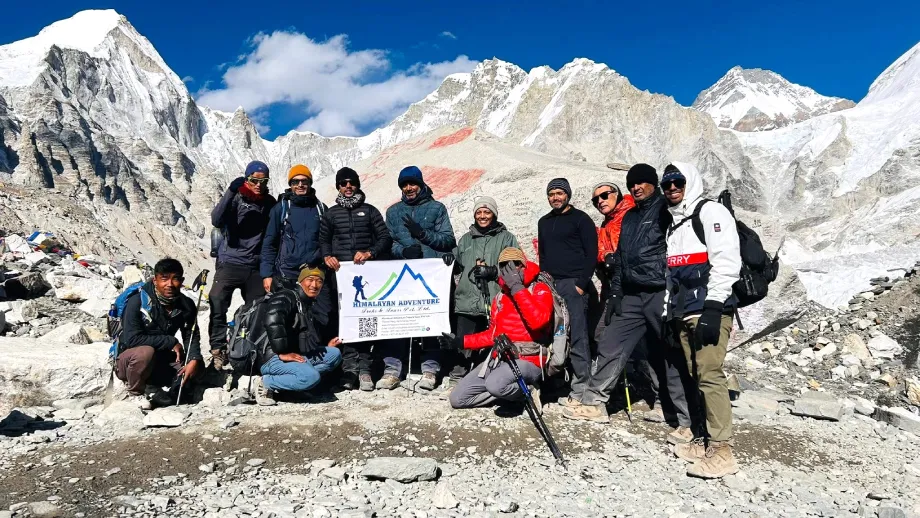
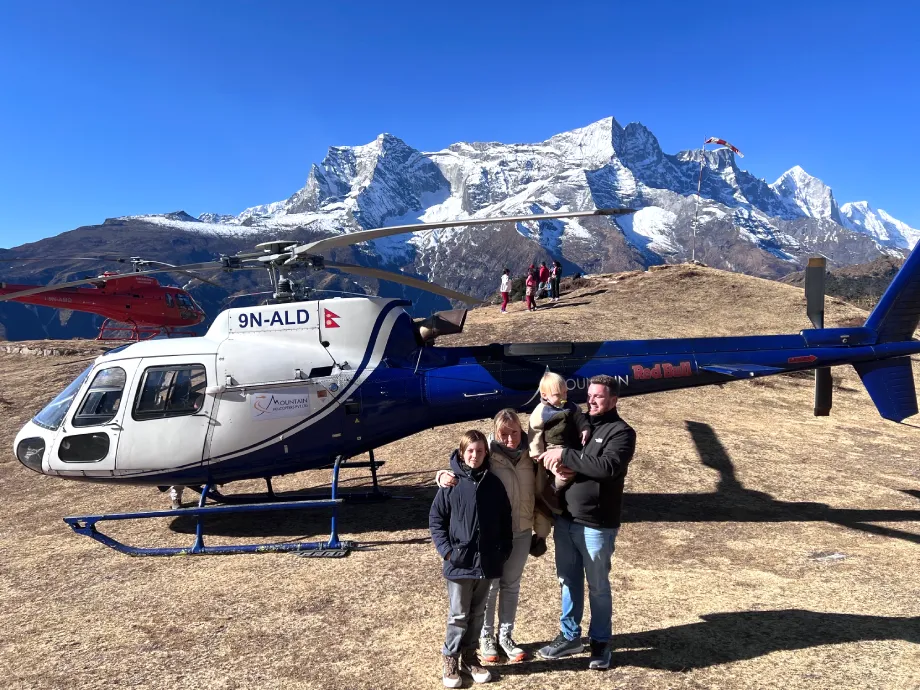
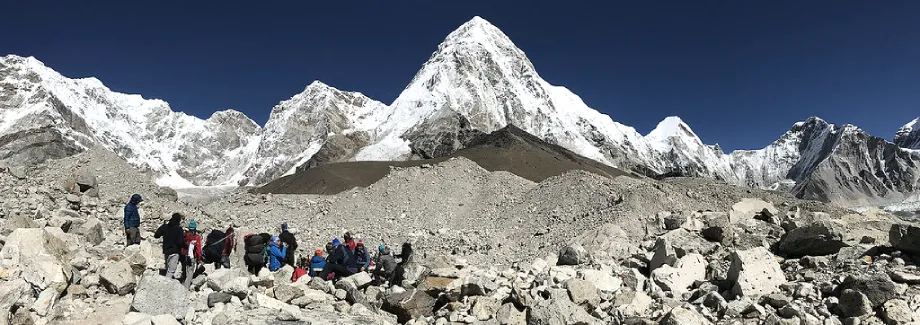
Group Photo at Everest Base Camp
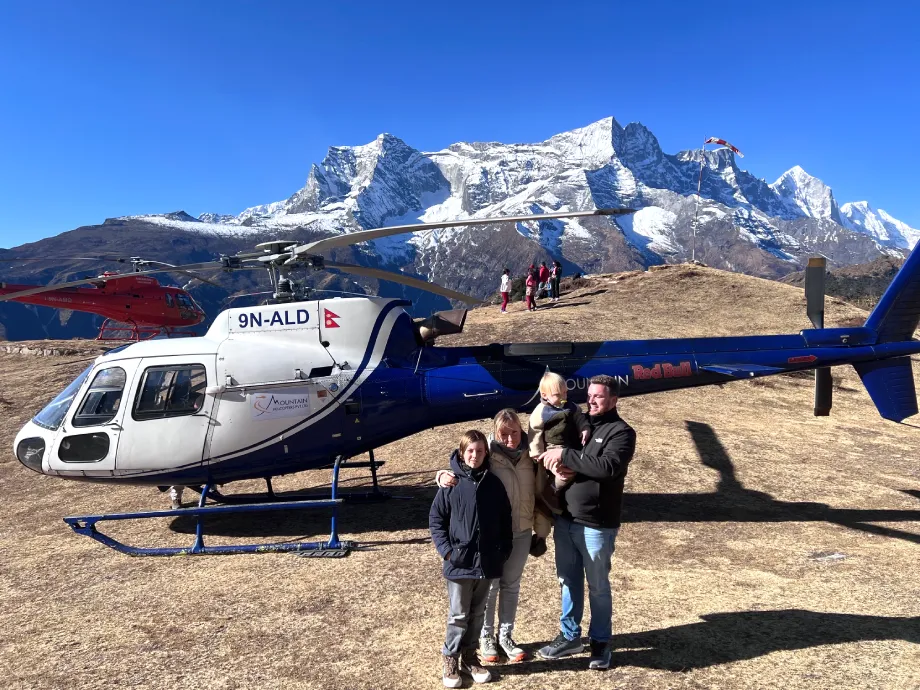
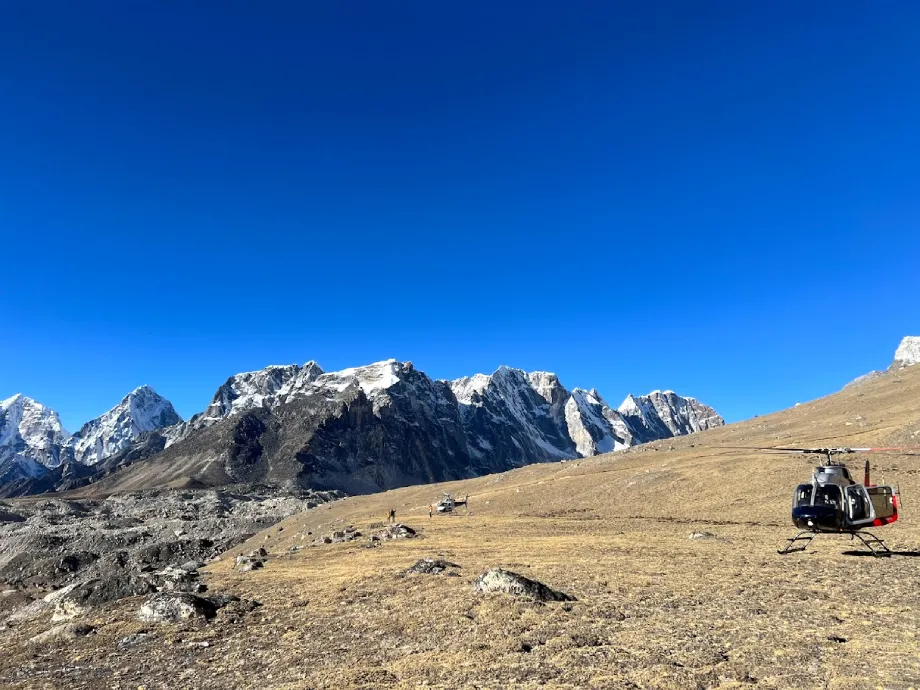
Scenic Helicopter Flight to Lukla
The adventure usually begins with a spectacular helicopter flight from Kathmandu to Lukla. This short but exciting flight offers breathtaking aerial views of the Himalayas.
Flying by helicopter provides several advantages compared to standard domestic flights. Helicopters offer more flexibility with weather conditions and reduce travel delays. The scenic flight itself becomes one of the highlights of the entire journey.
During the flight, travelers can see snow-capped mountains, deep river valleys, terraced hillsides, and remote Himalayan villages.
Trekking Through the Beautiful Khumbu Region
After arriving in Lukla, trekkers begin their journey into the Khumbu region, following the famous Everest Base Camp trekking route.
The first stop is the village of Phakding, located along the beautiful Dudh Koshi River. From here the trail gradually ascends through forests of pine and rhododendron.
The next major destination is Namche Bazaar, the main trading center of the Everest region. Namche Bazaar is a vibrant Sherpa town filled with bakeries, cafes, gear shops, and stunning viewpoints.
Luxury trekkers stay in premium lodges such as Yeti Mountain Home, which offer exceptional comfort compared to traditional teahouses.
These lodges provide heated dining rooms, comfortable beds, attached bathrooms in some locations, and high-quality meals.
Cultural Highlights Along the Trek
The Everest region is not only famous for its mountains but also for its rich Sherpa culture and Buddhist traditions.
One of the most important cultural sites on the trek is Tengboche Monastery. This beautiful monastery is the spiritual center of the Khumbu region and sits in a spectacular location surrounded by Himalayan peaks.
Nearby, luxury trekkers stay at Himalayan Luxury Lodge, which offers breathtaking views of Mount Everest and other iconic mountains.
Visitors can experience Buddhist ceremonies, prayer chants, and the peaceful atmosphere of this sacred site.
Higher Himalayan Adventure
As trekkers ascend higher into the Khumbu Valley, the landscape becomes increasingly dramatic. Forests gradually disappear, replaced by rugged alpine terrain and glaciers.
Trekkers pass through villages such as Dingboche, where they spend time acclimatizing to the altitude.
The journey continues through the remote settlements of Lobuche and Gorak Shep.
At these high altitudes, temperatures can drop below freezing. Luxury trekking packages ensure the best possible accommodation available, including spacious rooms and electric blankets to keep trekkers warm.
Everest Base Camp and Kala Patthar
Reaching Everest Base Camp is one of the greatest achievements for any trekking enthusiast.
Trekkers also climb to Kala Patthar, which offers the best panoramic view of Mount Everest. Sunrise from Kala Patthar is considered one of the most spectacular mountain views in the world.
After this unforgettable experience, trekkers return to Kathmandu by helicopter, enjoying a breathtaking flight over glaciers, valleys, and towering peaks.
The adventure begins with a scenic helicopter flight to Lukla, the gateway to the Everest region. The helicopter journey provides spectacular aerial views of deep valleys, rivers, forests, and snow-covered peaks.
From Lukla, trekkers begin walking through traditional Sherpa villages and beautiful landscapes. The trail follows the Dudh Koshi River and passes through charming settlements such as Phakding and Namche Bazaar.
Namche Bazaar is the heart of the Khumbu region. It is a bustling mountain town surrounded by spectacular Himalayan scenery. Many trekkers spend an acclimatization day here to adapt to the altitude while enjoying cafes, bakeries, and panoramic viewpoints.
Luxury trekkers stay in premium lodges such as Yeti Mountain Home. These lodges provide warm hospitality, heated dining rooms, comfortable beds, and high-quality meals.
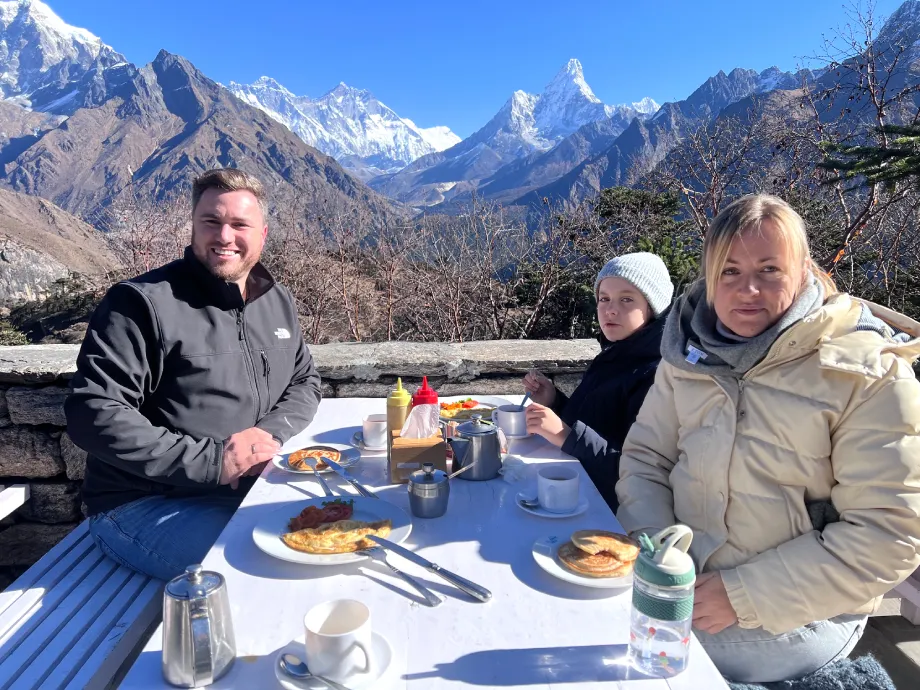
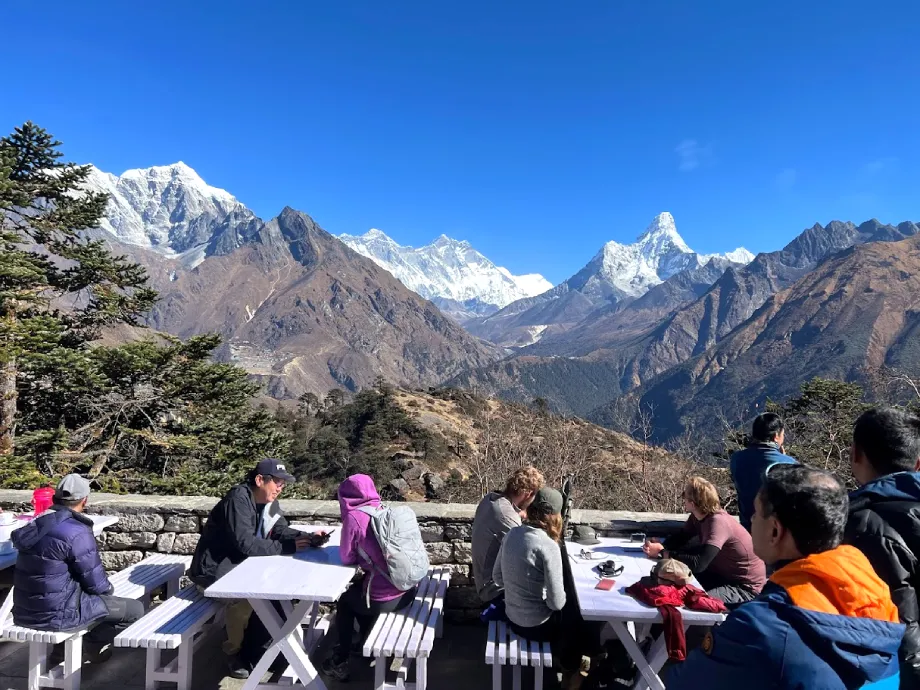
Breakfast at Hotel Everest View
Why Choose Luxury Everest Base Camp Trek?
Luxury trekking offers many advantages:
• Comfortable lodges with high-quality services • Helicopter flights to reduce travel time • Professional guides and Sherpa support • Smaller groups and personalized attention • Safe and well-organized logistics
This type of trekking is ideal for travelers who want both adventure and comfort.
Luxury Everest Base Camp Trek Itinerary
Day 1 – Arrival in Kathmandu Day 2 – Helicopter flight to Lukla and trek to Phakding Day 3 – Trek to Namche Bazaar Day 4 – Acclimatization day in Namche Day 5 – Trek to Tengboche Day 6 – Trek to Dingboche Day 7 – Acclimatization day Day 8 – Trek to Lobuche Day 9 – Trek to Gorakshep and visit Everest Base Camp Day 10 – Sunrise hike to Kala Patthar and helicopter return to Kathmandu Day 11 – Departure
• Luxury hotels in Kathmandu • Helicopter flights • Premium mountain lodges • Professional guide and Sherpa staff • All meals during trekking • Trekking permits • Airport transfers • Porter services
Major Cost Factors
Helicopter flights – $1200 to $2000 Luxury accommodation – $150 to $400 per night Guides and porters – $30 to $80 per day Permits and park fees – $100 to $200
Luxury vs Standard Everest Base Camp Trek
Feature
Luxury Trek
Standard Trek
Accommodation
Luxury lodges
Basic teahouses
Transportation
Helicopter options
Domestic flights
Comfort
High
Basic
Return Journey
Helicopter
Trek back
Cost
$4500 – $7000
$1300 – $2500
Luxury trekking offers a more comfortable and efficient experience.
Luxury vs Everest Base Camp Helicopter Tour
Many travelers also compare the luxury trek with a helicopter tour.
Feature
Luxury Trek
Helicopter Tour
Duration
10–12 days
1 day
Experience
Trekking adventure
Scenic flight
Altitude experience
Gradual
Short visit
Physical effort
Moderate
Very easy
Price
$4500 – $7000
$1200 – $1700
Helicopter tours are great for travelers with limited time, while luxury trekking offers a deeper Himalayan experience.
Group ready for Helicopter Tour
Luxury Everest Base Camp Trek – FAQ
1. Is the Luxury Everest Base Camp Trek difficult? It is moderately challenging but manageable with proper preparation.
2. What is the highest altitude? About 5,545 meters at Kala Patthar.
3. Do I need previous trekking experience? Not necessarily, but good fitness is helpful.
4. When is the best time? Spring and autumn.
5. Are luxury lodges available everywhere? They are available in major villages.
6. Is WiFi available? Yes, in most villages.
7. Are hot showers available? Yes, in most luxury lodges.
8. Is altitude sickness a concern? Yes, proper acclimatization is necessary.
9. What type of food is available? International and local dishes.
10. How cold does it get? Temperatures can drop below freezing at night.
11. Are electric blankets available? Yes, in some luxury lodges.
12. Do I need travel insurance? Yes, helicopter evacuation coverage is recommended.
13. Are guides required? Yes, for safety and navigation.
14. How long is the trek? About 10–12 days.
15. Can beginners do this trek? Yes, with good physical preparation.
16. Is drinking water safe? Filtered or boiled water is recommended.
17. Are charging facilities available? Yes, but sometimes for an extra fee.
18. What permits are required? Everest National Park permit and local permits.
19. What is the best view point? Kala Patthar.
20. Why choose a luxury Everest Base camp trek? For comfort, safety, and premium service.
Final Thoughts
The Luxury Everest Base Camp Trek offers an extraordinary opportunity to explore the Himalayas in comfort and style. Travelers can experience breathtaking mountain scenery, rich Sherpa culture, and the legendary Everest region while enjoying premium accommodation and professional service.
For adventurers who seek the ultimate Himalayan journey with comfort, safety, and unforgettable memories, the Luxury Everest Base Camp Trek is truly a once-in-a-lifetime experience.
The Mani Rimdu Festival is the most important and spectacular event in the calendar of the Sherpa people, a profound and vibrant celebration of Tibetan Buddhism held in the majestic setting of the Everest (Khumbu) region. For those planning to witness this sacred occasion, the TangbocheMani Rimdu Festival date in 2026 is confirmed to take place on October 26, 27, 28, and 29, which are the main public festival days at the famous Tengboche Monastery. This detailed explanation will explore every facet of the festival, from its ancient history and deep spiritual significance to the intricate rituals and practical information for visitors, weaving in the most searched keywords to provide a complete understanding of this “Mani Rimdu Trek” and cultural experience.
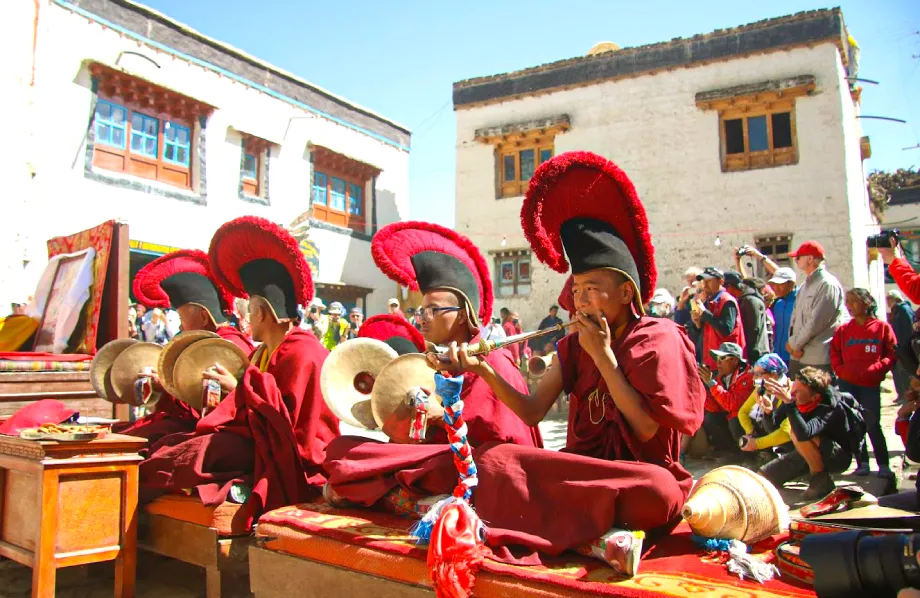
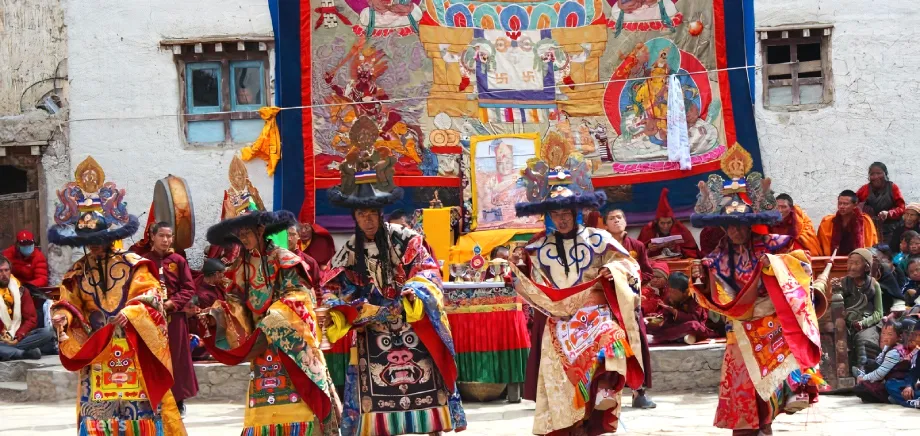
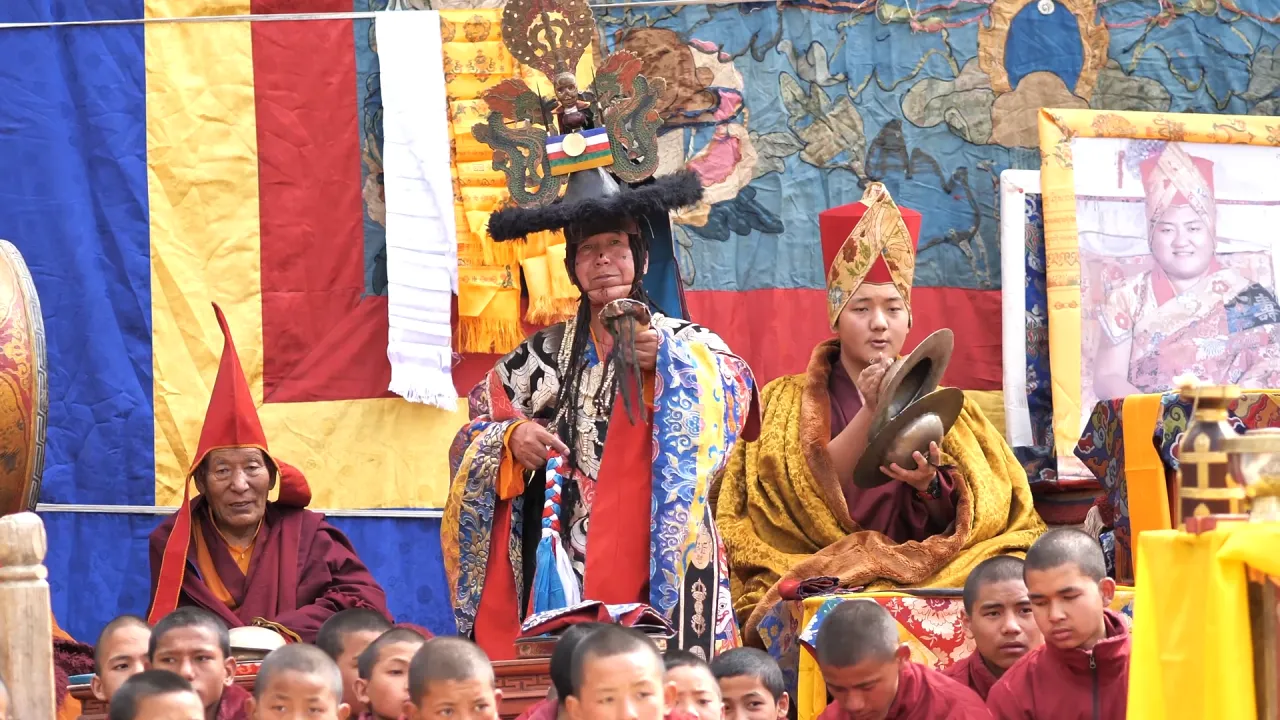
Monks at Tangboche Monastery
An Introduction to the Mani Rimdu Festival 2026
The Mani Rimdu Festival is an elaborate, nineteen-day religious event observed by the Buddhist communities, particularly the Sherpa people, in the Solu-Khumbu district of northeastern Nepal. While the entire festival spans over two weeks with closed-door monastic rituals, it culminates in a three-day public celebration filled with color, music, and profound spiritual meaning. The festival is celebrated at several monasteries in the region, including Thame and Chiwong, but the most famous and grandiose celebration occurs at the Tengboche Monastery, perched dramatically on a ridge with breathtaking views of the Himalayas, including the iconic peak of Ama Dablam and gateway to the Everest Base Camp Trek.
The very name Mani Rimdu unlocks the festival’s core purpose. “Mani” refers to the mantra of Chenrezig, the Buddha of Compassion, which is “Om Mani Padme Hum”. This mantra is chanted millions of times during the festival’s rituals. “Rimdu” (or Rilwu) translates to “sacred pills”—small, red pills that are blessed throughout the ceremonies and distributed to attendees, symbolizing the reception of blessings and spiritual accomplishment. Thus, Mani Rimdu is, at its heart, a festival of blessing, compassion, and the reaffirmation of Buddhist faith. It is a time when Lamas and Sherpas gather at the monastery not just for social celebration, but for the profound purpose of accumulating merits and praying for the welfare of the world.
The Rich History and Origin of Mani Rimdu
The history of Mani Rimdu is a fascinating journey of how a sacred ritual traveled across the Himalayas, adapting to new homes while preserving its core spiritual essence.
Origins in Tibet
The roots of the Mani Rimdu festival can be traced back to the early 20th century in Tibet. It was first established at the Rongbuk Monastery in Tibet, which sits at the base of Mount Everest’s north side. The festival was initiated by a renowned Tibetan Buddhist practitioner, Lama Ngawang Tenzin Norbu, who had studied at the prestigious Mindroling Monastery in Central Tibet, a great monastery of the Nyingma (or “Red Hat”) school of Tibetan Buddhism. The rituals and texts that form the foundation of Mani Rimdu are derived from this ancient lineage. The festival was created as a way to mark the founding of Buddhism in Tibet by the great 8th-century tantric master Guru Rinpoche Padmasambhava, who is credited with subduing local spirits and establishing the Buddhist doctrine.
Transmission to Nepal
The festival found its way to Nepal in the mid-20th century. In the 1940s, due to the changing political landscape in Tibet, the tradition was brought south to the Solukhumbu region of Nepal, home to a large Sherpa population. It was first established at the Chiwong Monastery and later, in 1940, the Tengboche Monastery, which had been founded in 1916 by Lama Gulu, became its new and most famous home. Since then, Mani Rimdu has become an integral part of the cultural and spiritual identity of the Sherpa community, preserving the Nyingma Buddhist traditions passed down through generations.
The Spiritual and Cultural Importance
The importance of the Mani Rimdu Festival is multi-layered, serving religious, social, and cultural functions for the Sherpa community and offering a profound experience for visitors.
Religious Significance
At its core, Mani Rimdu is a powerful religious ceremony with several key objectives:
Victory of Good over Evil: The festival reenacts and celebrates the triumph of Buddhism over the dark forces and negative energies that oppose enlightenment. This theme is most vividly portrayed in the famous masked dances (Chham), which depict the defeat of demons and the protection of the Buddhist faith.
Spiritual Empowerment: The entire 19-day ritual cycle is designed to generate immense spiritual energy. This energy is channeled into the sacred Mani Rilwu pills, which are then distributed to the public during the Wong (Empowerment Ceremony). Receiving these pills is believed to confer blessings, protection from harm, promote long life, and provide spiritual fortification for the year ahead.
Purification and World Peace: A key aim of the festival is to purify the environment and the minds of all beings. The intricate rituals, including the creation and subsequent destruction of the sand mandala and the final Fire Puja (Jinsak), are performed to dispel negative karma, remove obstacles, and bring peace, good fortune, and cosmic balance to the world.
Cultural Significance
For the Sherpa people, Mani Rimdu is the biggest event of the year. It is a time when scattered communities come together, strengthening social bonds and reinforcing their unique cultural identity. The festival is a living transmission of their heritage, passing down ancient stories, artistic skills (like mask-making and dance), and oral traditions to the younger generation. For the outside world, and especially for the thousands of trekkers who undertake the Everest Base Camp Trek during this period, the festival offers an unparalleled, authentic window into the spiritual soul of the Himalayas.
The 19-Day Festival: From Secret Ritual to Public Spectacle
While visitors flock to Tengboche for the final three days, the full Mani Rimdu festival is a much longer, more complex affair. The first 16 days are known as the Drupchen (or “Great Accomplishment”), a period of intense, closed-door rituals and meditation performed by the monks.
The Creation of the Sand Mandala
One of the first and most important acts is the construction of the sacred sand mandala. Monks spend several days meticulously creating this intricate, multi-colored diagram out of colored sand. The sand, often sourced from a specific high point in the Himalayas, is carefully laid to form a symbolic cosmic palace of the deity. The mandala serves as the visual and spiritual focal point for all the meditations and prayers performed during the Drupchen. This entire preparatory phase is dedicated to invoking the deities and generating the blessings that will later be shared with the public.
The Three Main Public Days of Mani Rimdu Festival in 2026
The long period of internal practice concludes with three days of public ceremony, a vibrant and deeply moving experience that is the highlight of the Mani Rimdu Festival Trek. The dates you have specified, October 26-29, 2026, mark these main festival days at Tengboche. The schedule typically unfolds as follows:
Day 1: The Empowerment Ceremony (Wong)
The first public day is the Wong, or Empowerment Ceremony. This is a solemn and sacred ritual where the spiritual energy accumulated over the preceding weeks is shared with the community.
The Ritual: The head lama of Tengboche, the Tengboche Rinpoche, presides over the ceremony. Pilgrims and visitors gather inside or in the courtyard of the monastery to receive blessings. The Rinpoche, assisted by senior monks, performs tantric chantings and consecrates the Mani Rilwu (sacred long-life pills) and Tshereel (pills for long life).
Receiving Blessings: Attendees file past the Rinpoche to receive these blessed pills, which are believed to be imbued with protective and healing powers. It is a moment of profound personal connection and spiritual significance for devotees. This day marks the spiritual opening of the festival, drawing immense positive energy into the region.
Day 2: The Sacred Mask Dances (Chham)
The second day is the most visually stunning and famous part of the Mani Rimdu festival. This is the day of the Chham, or sacred masked dances.
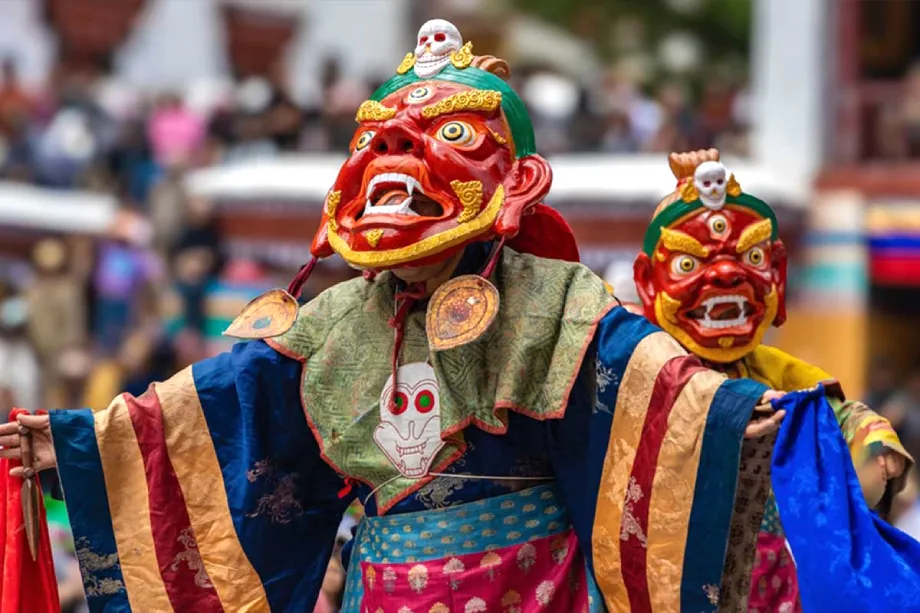
The Performance: Monks, who have spent days in deep meditation to embody the deities, emerge from the monastery in elaborate, colorful costumes and large, expressive papier-mâché masks. The dances are performed in the monastery courtyard, with the towering peaks of the Himalayas, including Everest and Ama Dablam, serving as a breathtaking backdrop.
The Stories and Symbolism: Each dance tells a story, primarily enacting the victory of good over evil and the protection of the Buddhist faith. The dances are not mere entertainment; they are a form of meditation and a symbolic representation of complex Buddhist teachings. Viewers witness the subjugation of demons, who represent ignorance and ego, by fierce but compassionate deities.
Key Dances: Some of the most important dances include the Shanak (Dance of the Black Hat Sorcerers), which ritually cleanses the space of negative spirits; the dances of the Dharma Protectors like Mahakala; and the captivating Dur-Dahk (Dance of the Skeletons), which serves as a powerful reminder of the impermanence of life. The dances are often interspersed with brief, comedic interludes that provide levity and sometimes offer social commentary. The atmosphere is made even more spectacular by the traditional Buddhist folk music played on instruments like drums, horns, and cymbals.
Day 3: The Fire Puja and Conclusion (Jinsak)
The final public day culminates with the Fire Puja, known as Jinsak.
The Ritual: This ceremony is performed in a sacred enclosure outside the main monastery. A large fire is consecrated, and the monks chant mantras while making offerings into the flames. These offerings include tormas (small ritual cakes made of barley flour and butter), grains, and other blessed substances.
Significance: The fire, often identified with Agni, the god of fire, acts as a purifying agent. The ritual symbolizes the burning away of all negative karma, evil spirits, and mental defilements that were gathered and transformed during the festival. The smoke carries these purified offerings to the spiritual world and dispels any remaining harm.
The Mandala’s Dissolution: After the Fire Puja, a final, poignant act takes place inside the monastery. The monks ritually dismantle the intricate sand mandala, sweeping the colored sand into a pile. This act is the ultimate lesson in Buddhist philosophy: a powerful, tangible reminder of the impermanence of all things. The sand is then ceremonially carried to a river and poured into the water, dispersing the festival’s blessings into the world for the benefit of all sentient beings.
Tengboche Monastery: The Heart of the Celebration
The Tengboche Monastery (also spelled Thyangboche) is not just the venue; it is an integral part of the Mani Rimdu experience. Situated at an altitude of 3,867 meters (12,687 feet), it is the largest gompa (monastery) in the Khumbu region. Founded in 1916, the monastery has a dramatic history, having been destroyed by an earthquake in 1934 and a devastating fire in 1989 before being rebuilt with international assistance. Its location, at the confluence of the Dudh Koshi and Imja Khola rivers and on the main trail to Everest Base Camp, makes it a spiritual and geographical crossroads. During Mani Rimdu, the monastery becomes a vibrant hub, its ornate interiors and the faith of the monks providing the sacred space for the rituals, while its courtyard becomes a stage for the timeless drama of the mask dances, watched by hundreds of local villagers and international visitors.
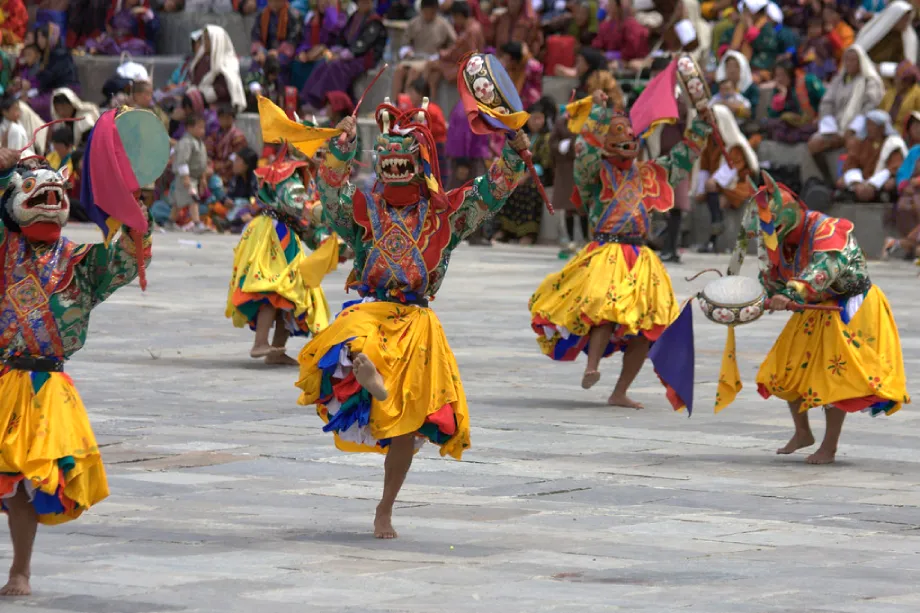
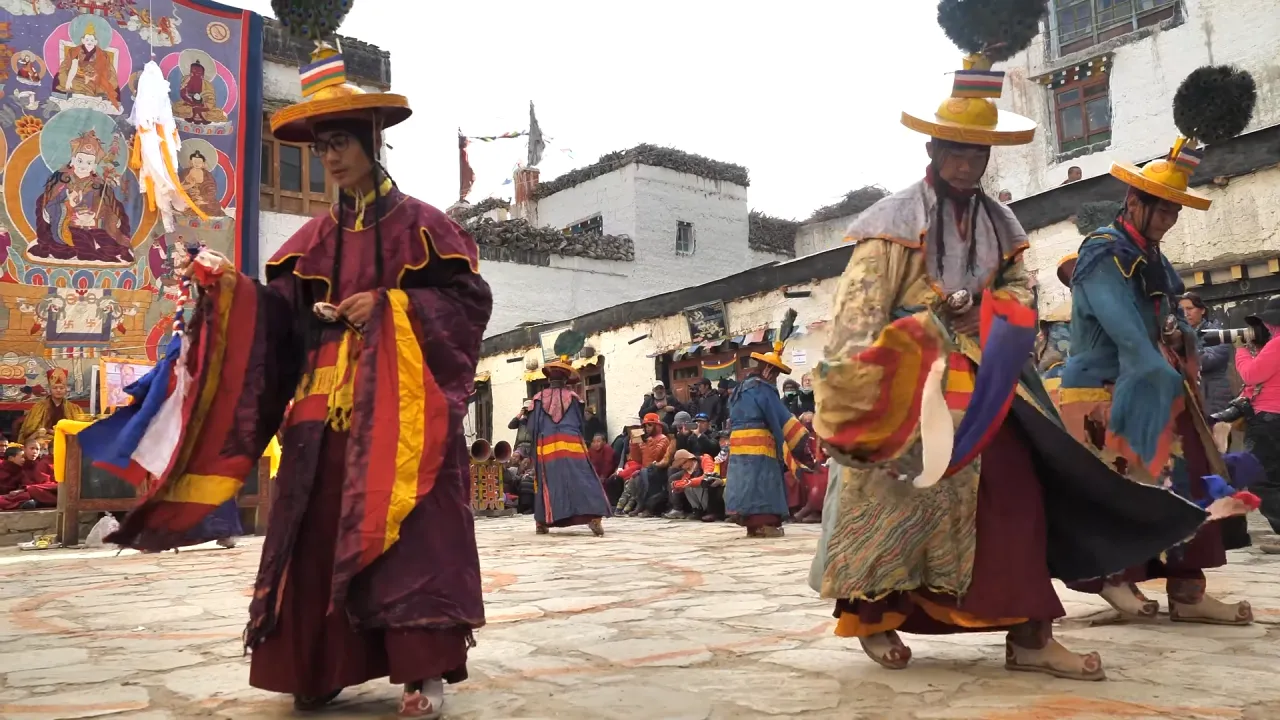
Mani Rimdu Festival Dance Performance
Planning Your Mani Rimdu 2026 Experience
Attending the Mani Rimdu Festival is a highlight of any Nepal tour, but it requires careful planning. The festival coincides with the peak autumn trekking season (October-November), offering stable weather and clear mountain views. This makes a Mani Rimdu Festival Trek an ideal combination of cultural immersion and Himalayan adventure.
Itinerary and Logistics
To be in Tengboche for the main festival days of October 26-29, 2026, you must plan your trek carefully. Reaching Tengboche involves a scenic flight from Kathmandu to Lukla, followed by a multi-day trek. It is crucial to build in extra days for acclimatization, especially in Namche Bazaar, to prevent altitude sickness. A typical itinerary would look like this:
Before Oct 26: Fly Kathmandu to Lukla, trek to Phakding, then to Namche Bazaar (allow an acclimatization day here), and finally trek to Tengboche.
Oct 26-29: Full days at Tengboche to witness the Wong, Chham, and Fire Puja ceremonies.
After Oct 29: Begin the trek back to Lukla for the flight to Kathmandu.
Tips for Visitors
Respectful Conduct: Remember that you are a guest at a sacred religious event. Dress modestly, always ask permission before taking photographs (photography is often restricted in certain areas during ceremonies), and maintain a respectful silence during rituals.
Accommodation: Teahouses (lodges) in Tengboche and Namche Bazaar fill up very quickly during the festival. It is highly recommended to book your Mani Rimdu festival trek package with a reputable trekking agency well in advance to secure your spot.
Preparation: This is a high-altitude trek. Ensure you are physically prepared and have the proper gear. Listen to your guide and prioritize acclimatization to fully enjoy this once-in-a-lifetime cultural experience.
(FAQ) Mani Rimdu Festival 2026
1. What are the exact dates for the Mani Rimdu Festival at Tengboche in 2026?
The main public days of the Tengboche Mani Rimdu Festival will take place from October 26 to October 29, 2026.
2. What is the main significance of the Mani Rimdu festival?
Mani Rimdu is a sacred Tibetan Buddhist festival celebrating the victory of good over evil. It is a time for blessing, spiritual empowerment, and reaffirming the faith of the Sherpa community.
3. What happens on the first public day (October 26)?
The first day is the Wong (Empowerment Ceremony). The head lama consecrates sacred “Mani Rilwu” (blessed pills) and distributes them to the attendees for protection and good fortune.
4. What are the famous Masked Dances, and when do they occur?
The Masked Dances (Chham) occur on the second day (October 27). Monks dressed in colorful costumes and masks perform dances that depict the triumph of Buddhism over negative forces.
5. What is the Fire Puja, and when does it take place?
The Fire Puja (Jinsak) takes place on the final day (October 29). Offerings are burned in a consecrated fire to purify negative karma and dispel evil spirits, concluding the festival.
6. Do I need to trek to attend the festival?
Yes. Tengboche Monastery is located in the Everest (Khumbu) region. Visitors must take a flight to Lukla and then trek for several days to reach Tengboche.
7. Is the Mani Rimdu festival only a tourist show, or is it religious?
It is a deeply religious event for the Sherpa people. While it is spectacular for visitors, it is first and foremost a 19-day monastic ritual dedicated to praying for world peace and the welfare of all beings.
8. What should I wear or avoid wearing at the monastery?
You should dress modestly out of respect for the sacred occasion. It is also important to maintain silence during rituals and always ask for permission before taking photographs.
9. Is it easy to find accommodation in Tengboche during the festival?
No. Teahouses and lodges in Tengboche and nearby Namche Bazaar fill up very quickly. It is highly recommended to book a trek package with an agency well in advance.
10. What does “Mani Rimdu” actually mean?
“Mani” refers to the mantra “Om Mani Padme Hum” (the mantra of compassion), and “Rimdu” (or Rilwu) means “sacred pills”—the blessed pills distributed during the ceremony.
In conclusion, the Tangboche Mani Rimdu Festival is far more than a tourist attraction; it is the living, breathing heart of Sherpa Buddhist culture. For those fortunate enough to trek to Tengboche in late October 2026, the festival offers a profound glimpse into a world where ancient rituals, unwavering faith, and the majestic Himalayas converge, creating an experience that is both spiritually moving and visually unforgettable.
Introduction of Bhutan Tshechu Festival – 2026-2027
The Tshechu is a vibrant, sacred Buddhist religious Bhutan Tshechu festival held annually in each district to honor Guru Rinpoche, the 8th-century saint who introduced Tantric Buddhism to Bhutan. The significance of the Tshechu festival is deeply multifaceted, serving as a cornerstone of Bhutanese spiritual and cultural life. Primarily, it is a commemoration of Guru Rinpoche’s miraculous deeds, with each mask dance, or Cham dance, re-enacting events from his life and the revelations of great Buddhist masters.
Attending a Bhutan Tshechu Festival is believed to confer profound spiritual merits and blessings upon participants, cleansing them of past sins and accumulating good karma for future lives. The viewing of the sacred Thongdrel, a giant appliqué tapestry unveiled at dawn on the final day, is considered so powerful that it can liberate the beholder from the cycle of rebirth. Furthermore, Tshechus function as vital community gathering events in Bhutan, where people from remote villages don their finest traditional attire, or kira and gho, to socialize, reaffirm communal bonds, and receive blessings from monks.
The festivals are also a living museum of Bhutanese cultural heritage, transmitting Buddhist philosophy, history, and traditional values through dramatic performances to younger generations, ensuring the preservation of a unique national identity in the face of modernization. For the tourist, the Bhutanese Tshechu festival offers an unparalleled immersion into the kingdom’s living culture, with its mesmerizing mask dances, rhythmic monastic music, and deeply pious atmosphere.
When and Where It Is Held
The Bhutan Tshechu festival dates 2026-2027 vary by district and are determined by the traditional Bhutanese lunar calendar, often corresponding to specific days of a lunar month. The most famous and largest Tshechu is the Thimphu Tshechu, typically held in the capital city of Thimphu for three days beginning on the 10th day of the 8th lunar month, which usually falls in September or October.
The Paro Tshechu is another major festival held in the picturesque Paro Valley at the stunning Rinpung Dzong, usually in spring (March or April). Other significant district Tshechus include the Punakha Drubchen and Tshechu in late winter (February/March), the Wangdue Phodrang Tshechu, and the Bumthang Jambay Lhakhang Drup in the central Bumthang valley, known for its unique Mewang fire ceremony and Tercham naked dance. Essentially, every district or Dzongkhag in Bhutan has its own Tshechu held at the local Dzong fortress monastery, which serves as the administrative and religious heart of the district, making the festival both a spiritual and civic occasion.
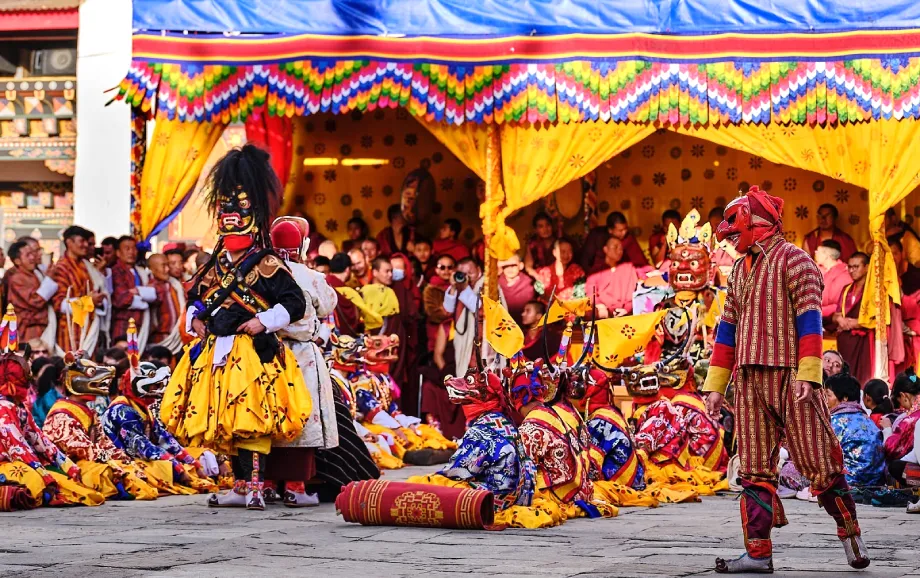
Festival Celebration in Bhutan
Best Month to Attend
Determining the best time to visit Bhutan for Tshechu depends on traveler preferences and festival logistics. For those seeking the grandest scale and vibrant atmosphere, the Thimphu Tshechu in September or October is a top choice, offering clear autumn skies and excellent photography conditions.
The Paro Tshechu in spring (March/April) coincides with beautiful blooming rhododendrons and pleasant hiking weather, ideal for combining the festival with a trek to the Tiger’s Nest Monastery or Paro Taktsang. However, these are also the peak Bhutan tourism seasons, requiring early booking for flights and hotels.
For a more intimate and less crowded experience, consider the Bumthang festivals in October-November or the Punakha Tshechu in February, which also offers milder winter weather in that valley. Ultimately, the best month for Bhutan Tshechu festival aligns with your desired balance between major event spectacle, regional exploration, and seasonal weather, with autumn (September to November) widely regarded as the overall optimal period for travel in Bhutan.
Reason to Celebrate
The core reason to celebrate Bhutan Tshechu festival is to honor Guru Rinpoche, also known as Padmasambhava, whose historical significance in Bhutan cannot be overstated. According to Buddhist texts, Guru Rinpoche visited Bhutan multiple times in the 8th century, subduing malevolent spirits and regional deities, binding them as protectors of the Dharma, and concealing sacred terma or treasure teachings for future discoverers.
The Bhutan Tshechu festival celebrates his birth, his manifold manifestations, and his enlightened activities that established Buddhism in the Himalayas. Each Cham dance’s meaning is didactic; for instance, the Dance of the Eight Manifestations of Guru Rinpoche (Guru Tshengye) depicts his eight forms used to tame different beings, while the Dance of the Black Hats (Shana) symbolizes the triumph over evil and the ritual destruction of the ego. The Dance of the Stags and Hounds (Shawo Shachi) depicts the conversion of a hunter by a celestial being and conveys messages of compassion and non-violence.
The climax, the unveiling of the Thongdrel, typically depicts Guru Rinpoche surrounded by lineage holders, and its mere sight is an act of spiritual purification. Therefore, the celebration is not merely a cultural show but a dynamic Buddhist teaching through performance, a means to inspire faith, remind people of moral teachings, and provide a direct conduit for blessings, reinforcing the religious and social harmony in Bhutanese society.
When is the Bhutan Tshechu Festival 2026-2027?
2026 Bhutan Tshechu Festival Projected Dates:
Paro Tshechu: March 30 – April 3, 2026.
(The main mask dances typically start on the 10th day of the 2nd lunar month, with the unfurling of the Guru Thongdrel sacred tapestry on the final morning, April 3).
Thimphu Tshechu: September 27 – 29, 2026.
(Main dances from the 10th to 12th days of the 8th lunar month, with the Thongdrel on the 29th).
Punakha Tshechu & Drubchen: February 18 – 22, 2026.
*(Note: Punakha Drubchen is unique, preceding the Tshechu. It’s one of the oldest festivals, re-enacting a 17th-century battle).*
Wangdue Phodrang Tshechu: September 22 – 24, 2026.
Jambay Lhakhang Drup (Bumthang): November 8 – 12, 2026.
(Famous for the Mewang (Fire Ceremony) and the Tercham (Naked Dance) performed around midnight).
2027 Bhutan Tshechu Festival Projected Dates:
Paro Tshechu: March 19 – 23, 2027.
Thimphu Tshechu: October 16 – 18, 2027.
Punakha Tshechu & Drubchen: February 8 – 12, 2027.
Wangdue Phodrang Tshechu: October 11 – 13, 2027.
Jambay Lhakhang Drup (Bumthang): October 28 – November 1, 2027.
Festival in Bhutan
FAQs About Bhutan’s Tshechu Festival
1. What is a Bhutan Tshechu Festival, and why is it celebrated? Answer: A Tshechu is a vibrant, annual religious festival held in each district (Dzongkhag) of Bhutan. It honors Guru Rinpoche (Padmasambhava), the 8th-century saint who introduced Tantric Buddhism to Bhutan. The festival is celebrated to commemorate his deeds, receive spiritual blessings, cleanse negative karma, and foster community unity. The sacred mask dances (Cham) are not mere performances but meditative acts believed to confer merit and bring enlightenment to both performers and viewers.
2. What are the main Tshechus and their projected dates for 2026 and 2027? Answer: The two largest and most accessible festivals are the Paro and Thimphu Tshechus. Their projected dates are:
Paro Tshechu 2026: March 30 – April 3, 2026 (Final day with the Thongdrel unveiling is April 3).
Thimphu Tshechu 2026: September 27 – 29, 2026.
Paro Tshechu 2027: March 19 – 23, 2027.
Thimphu Tshechu 2027: October 16 – 18, 2027.
*Note: Dates are lunar-based projections; confirm with your tour operator 6-9 months prior.*
3. Are these dates for 2026 and 2027 confirmed? Answer: No, these are highly reliable projections based on the Bhutanese lunar calendar. The official dates are finalized and announced by the Central Monastic Body of Bhutan, typically 6-12 months in advance. Licensed Bhutanese tour operators are the best source for the confirmed calendar. It is safe to plan your travel around these projected windows.
4. Which Tshechu is best for first-time visitors? Answer: Thimphu Tshechu is often recommended for first-timers. It is large, well-organized, held in the capital’s massive Tashichho Dzong, and offers good visitor facilities. Paro Tshechu, set in the stunning Rinpung Dzong, is equally magnificent and coincides with beautiful spring weather. For a more intimate and unique experience, consider the Punakha Drubchen & Tshechu (Feb 2026/2027) or the Jambay Lhakhang Drup in Bumthang (Nov 2026, Oct 2027).
5. What is the most important moment of a Bhutan Tshechu festival? Answer: The climactic moment is the pre-dawn unfurling of the Thongdrel, a gigantic sacred tapestry, on the final day. Viewing this Thongdrel (which depicts Guru Rinpoche and his mandala) is believed to liberate one from sins and grant blessings. In Thimphu and Paro, this happens on the final morning (e.g., April 3, 2026, in Paro). Be prepared to join locals at the Dzong very early (around 4-5 AM).
6. How far in advance should I book my trip for a Tshechu? Answer: Book as early as possible, ideally 6 to 9 months in advance. Flights into Paro International Airport and hotels in Thimphu and Paro during these major festivals sell out extremely quickly. Working with a licensed Bhutan tour operator early ensures you secure the mandatory Bhutan visa, flights, accommodations, and festival viewing arrangements.
7. What should I wear to a Bhutan Tshechu Festival? Answer: While there is no strict dress code for tourists, modest and respectful clothing is required. Given the sacred nature and the fact that you will be sitting on the ground for hours, comfortable, layered clothing is best. You are welcome to wear formal Bhutanese attire (Gho for men, Kira for women), which can often be rented or purchased in Thimphu. It is highly appreciated and enhances your experience.
8. What are the practical tips for attending a Bhutan Tshechu festival? Answer:
Arrive Early: Securing a good viewing spot is crucial, especially on the final day.
Be Prepared to Sit: Bring a small cushion or mat for comfort on the stone courtyards.
Respect Photography Rules: Always ask before photographing people, especially monks. Never use flash during dances or inside temples. Video recording may require a special permit.
Stay Hydrated and Protected: Bring water, sunblock, and a hat for the daytime.
Follow Local Guidance: Your guide will know the best times to view specific dances and manage crowds.
9. Can I attend a Tshechu independently, or do I need a tour? Answer: All tourists (except those from India, Bangladesh, and the Maldives) must travel to Bhutan through a licensed Bhutanese tour operator. This policy includes obtaining a visa and paying the mandatory Sustainable Development Fee (SDF). Therefore, you will be on a pre-arranged tour, and your guide will be essential for navigating the festival logistics, explaining the dances, and ensuring a respectful and smooth experience.
10. Besides the mask dances, what else happens at a Bhutan Tshechu festival? Answer: Beyond the mesmerizing Cham dances, Tshechus are vibrant social gatherings. You’ll see families in their finest clothes enjoying picnics, children playing, and locals receiving blessings from monks. Atsaras (clown-like figures in masks) roam the crowds, providing comic relief while also performing spiritual guardianship. The atmosphere is a unique blend of deep reverence, community joy, and cultural pride, making it a holistic cultural immersion.
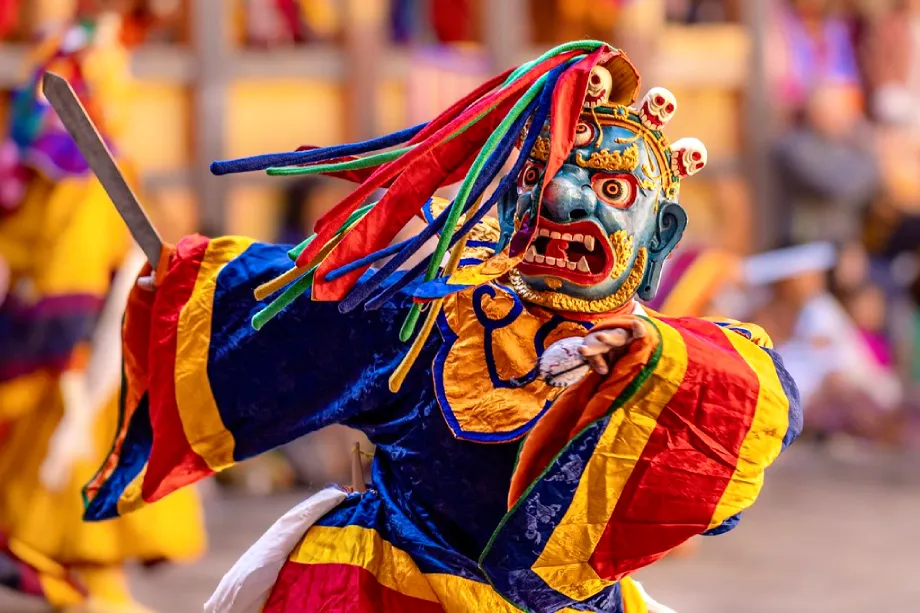
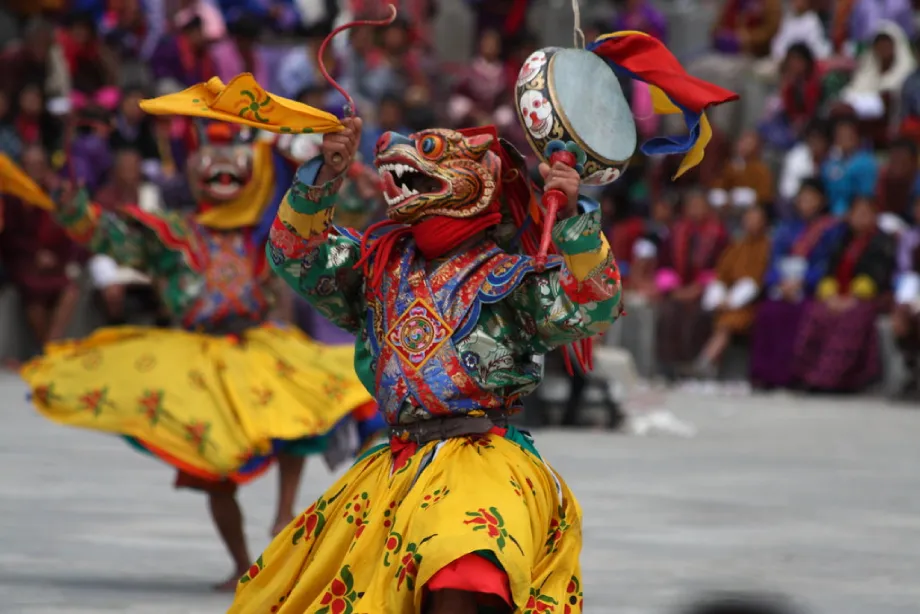
Performance Tshechu Festival Dance
Conclusion
In essence, the Bhutan Tshechu festival is far more than a tourist attraction; it is the pulsating heart of Bhutanese traditions and customs, a profound spiritual gathering, and a vibrant social event rolled into one. From the solemn, sacred masked dance rituals performed by monks to the joyous, colorful picnics of families, it encapsulates the essence of Gross National Happiness philosophy by nurturing spiritual well-being and cultural continuity.
Planning a trip requires consulting the official Bhutan festival calendar 2026 – 2027 from the Tourism Council of Bhutan, securing travel through a licensed Bhutan tour operator, and preparing for an experience that engages all senses. Whether witnessing the Atsara clown performers providing comic relief and spiritual commentary or losing oneself in the hypnotic drumbeats of the Drametse Ngacham (a UNESCO Intangible Cultural Heritage dance), attending a Tshechu offers a deep, unforgettable window into the soul of the Dragon Kingdom, making it a quintessential experience for any visitor seeking to understand this Himalayan jewel.
The Nepalese Himalayas, home to eight of the world’s fourteen 8,000-meter peaks, represent the ultimate pilgrimage for mountain enthusiasts. Two iconic treks dominate this landscape: Everest Base Camp (EBC) Trekand Annapurna Base Camp (ABC) Trek. Each offers a profoundly distinct experience, catering to different aspirations, fitness levels, and cultural appetites. Choosing between them is not merely selecting a route; it’s choosing a narrative—one of high-altitude grandeur and Sherpa culture, or one of breathtaking diversity and accessible beauty.
This analysis will dissect every facet of these legendary journeys, from geography and culture to logistics and personal challenge, culminating in a clear guide to help you decide which path is yours to walk.
Everest Base Camp
The Everest Base Camp (EBC) Trek – A Journey to the Roof of the World
Overview and Core Appeal
The EBC trek is more than a hike; it’s an iconic expedition to the foot of the world’s highest mountain, Sagarmatha (Mt. Everest – 8,848.86m). Starting with a thrilling flight into the Tenzing-Hillary Airport at Lukla, the trek traverses the heart of the Sagarmatha National Park (a UNESCO World Heritage Site), culminating at Base Camp (5,364m). The primary allure is monumental: standing in the shadow of Everest, surrounded by the giants of the Khumbu region—Lhotse, Nuptse, and Ama Dablam. It’s a test of endurance and acclimatization, steeped in the history of Himalayan climbing.
Detailed Route and Key Highlights
Standard Duration: 12-14 days (Lukla to Lukla).
Starting Point:Lukla (2,860m), reached by a dramatic 35-minute flight from Kathmandu or Ramechhap.
Key Stages & Highlights:
Phakding to Namche Bazaar (3,440m): The gateway to the high Khumbu, a bustling Sherpa hub with markets, museums, and the first breathtaking views of Everest.
Acclimatization at Namche: Essential rest day with hikes to the Everest View Hotel or the Sherpa Cultural Museum.
Tengboche (3,867m): Spiritual heart of the region, home to its most important monastery with a stunning backdrop of Ama Dablam.
Dingboche (4,410m) or Pheriche (4,371m): Second acclimatization stop, with hikes to Nangkartshang Peak for panoramic views.
Lobuche (4,940m) to Gorak Shep (5,164m): The final settlement, a stark, high-altitude landscape.
Everest Base Camp (5,364m): The goal—a surreal, rocky, glacial moraine beside the towering Khumbu Icefall (accessible only in pre-/post-monsoon seasons; not during climbing season for non-expedition members).
Kala Patthar (5,644m): The undisputed viewpoint highlight. A pre-dawn climb rewards the trekker with sunrise over Everest’s summit, illuminating the entire Himalayan panorama.
Return via Namche: Often includes a variation through the beautiful village of Khumjung.
Terrain, Altitude, and Difficulty
Terrain: A well-defined, often busy trail. It involves long, steady ascents and descents along river valleys, crossing numerous suspension bridges (including the famous Hillary Bridge). The final section to EBC is rocky and glacial.
Altitude: This is the defining challenge. The trek rapidly gains altitude, with sleeping above 5,000m at Gorak Shep. Proper acclimatization is non-negotiable. Acute Mountain Sickness (AMS) is a serious risk.
Difficulty:Strenuous. The combination of sustained altitude, long walking days (4-7 hours), and basic tea-house conditions demands excellent physical fitness, mental fortitude, and preparation.
Cultural and Scenic Immersion
Culture: Deep immersion into Sherpa culture. Pass countless Buddhist stupas, mani walls, and prayer wheels. Visit ancient monasteries like Tengboche and observe the profound influence of Tibetan Buddhism. Interact with the resilient Sherpa people, whose lives are intrinsically linked to the mountains.
Scenery: The scenery is epic and vertical. It’s a world of glacial valleys, colossal icefalls (like the Khumbu), and soaring peaks. The tree line is left behind early, leading to a majestic, alpine, and arctic landscape dominated by rock and ice.
Logistical Considerations
Access: The flight to/from Lukla is a crucial and weather-dependent element. Delays are common, requiring buffer days in Kathmandu.
Accommodation & Food: Basic tea houses with shared bathrooms (especially at higher altitudes). Menus are extensive but repetitive (dal bhat, noodles, soups, simple Western food). Prices increase exponentially with altitude.
Best Seasons:Pre-Monsoon (March to early June) and Post-Monsoon (late September to November). Winter (Dec-Feb) is possible but extremely cold. Monsoon (June-Sept) is not recommended.
Permits: Sagarmatha National Park Permit and Khumbu Pasang Lhamu Rural Municipality Entrance Permit (replacing the former TIMS).
The Annapurna Base Camp (ABC) Trek – A Symphony of Diversity
Overview and Core Appeal
The ABC trek, often called the Annapurna Sanctuary Trek, is a journey into the sacred amphitheater surrounded by a horseshoe of towering peaks. Its appeal lies in its incredible diversity—from lowland villages and rice terraces to dense rhododendron forests, and finally, a dramatic glacial basin beneath the icy flanks of Annapurna I (8,091m). It’s more accessible than EBC, offering a rich blend of nature and culture without the extreme altitude.
Detailed Route and Key Highlights
Standard Duration: 7-10 days (Pokhara to Pokhara).
Starting Points: Typically Nayapul (1-2 hour drive from Pokhara) or Phedi/Kande. The Ghorepani-Poon Hill route is a popular alternative start.
Key Stages & Highlights:
Tikhedhunga to Ghorepani (2,874m): A steep climb through beautiful forests to a major trail junction.
Poon Hill (3,210m): An optional but highly recommended pre-dawn detour for a 360-degree sunrise vista over the Dhaulagiri and Annapurna ranges.
The Modi Khola Valley: The trek’s core, leading from lush forests (Chhomrong) into the increasingly narrow and dramatic gorge.
Machhapuchhre Base Camp (MBC – 3,700m): The stunning vantage point directly beneath the iconic “Fishtail” mountain (Machhapuchhre, 6,993m), sacred and unclimbed.
Annapurna Base Camp (4,130m): The destination—a spectacular, open glacial basin surrounded by the near-vertical south face of Annapurna I, Annapurna South, Hiunchuli, and Machhapuchhre. The sense of enclosure by giants is profound.
Return via Jhinu Danda: Often includes a stop at the natural hot springs, a perfect post-trek reward.
Terrain, Altitude, and Difficulty
Terrain: Extremely varied. The trail involves countless stone steps (especially around Chhomrong), forest paths, riverbed walks, and a final ascent through a moraine valley. It feels more like a “mountain trek” in the traditional sense.
Altitude: The maximum altitude of 4,130m at ABC is significantly lower than EBC. While AMS is still a risk, it is less severe and more manageable with a sensible ascent profile.
Difficulty:Moderate to Strenuous. The challenge comes from the relentless ascents and descents (thousands of stone steps) rather than extreme altitude. It is physically demanding but achievable for well-prepared beginners.
Cultural and Scenic Immersion
Culture: A fascinating cultural mosaic. The trail passes through villages of the Gurung and Magar ethnic groups, known for their hospitality and distinct traditions (many Gurkha soldiers hail from these communities). The lower regions feature Hindu influences. The Sanctuary itself is considered a sacred place to the local people.
Scenery: The scenery is constantly evolving and lush from subtropical forests and cascading waterfalls to bamboo groves and blooming rhododendrons (spectacular in April), culminating in the stark, high-mountain grandeur of the Sanctuary. The variety is its greatest scenic asset.
Logistical Considerations
Access: The trek starts and ends near Pokhara, Nepal’s second city and a lakeside paradise of relaxation. Access is via a 25-minute flight or a 6-7 hour scenic drive/bus ride from Kathmandu, offering more flexibility than the Lukla flight.
Accommodation & Food: Tea houses are generally better developed and offer more comfort than on EBC, with a greater likelihood of attached bathrooms at lower altitudes. Food is similar but often perceived as slightly better and more varied.
Best Seasons: Same as EBC: Pre-Monsoon and Post-Monsoon. The rhododendron bloom in spring is a major attraction. The trek is also possible in winter, though the Sanctuary will be very cold.
Permits: Annapurna Conservation Area Permit (ACAP) and Trekkers’ Information Management System (TIMS) card.
Head-to-Head Comparison of EBC & ABC Trekking
Aspect
Everest Base Camp (EBC)
Annapurna Base Camp (ABC)
Core Appeal
Iconic high-altitude challenge; standing before Everest; mountaineering history.
Incredible ecological & cultural diversity; intimate peak immersion; accessibility.
Max Altitude
Kala Patthar (5,644m), Sleep at ~5,000m.
ABC (4,130m), Sleep at ~4,100m.
Primary Difficulty
Extreme Altitude. Risk of AMS is high and paramount.
Sustained Ascents/Descents. Thousands of stone steps; physically taxing.
Fitness Required
Very High. Excellent cardio, endurance, and mental resilience needed.
Moderate to High. Good general fitness and leg strength sufficient.
Typical Duration
12-14 days (excluding int’l travel & buffers).
7-10 days (excluding int’l travel).
Scenery
Epic, vertical, alpine/arctic. Grand vistas of the world’s highest peaks.
Diverse, intimate, lush. Forests, villages, waterfalls, culminating in an amphitheater of peaks.
Critical Considerations for Your Choice of EBC VS ABC Trekking
Altitude Tolerance
This is the single most important factor.
Choose EBC if: You are confident in your body’s ability to acclimatize, understand AMS protocols, and are prepared for the physical and mental demands of high altitude. Do not choose EBC simply for bragging rights; respect the altitude.
Choose ABC if: You are uncertain about altitude, have had issues before, or prefer a trek where the primary challenge is physical exertion rather than hypoxia.
Time and Budget
EBC requires a minimum of 16-18 days total (including international flights, buffers, Kathmandu). It is more expensive.
ABC can be done in 10-14 days total. It is more budget-friendly and time-efficient.
Desired Experience
Seek the Ultimate High-Altitude Test & Iconic Goal:EBC.
Seek Variety, Cultural Richness, & a “Classic” Trekking Feel:ABC.
Physical Fitness vs. Acclimatization Capacity
A very fit person prone to altitude sickness might still struggle on EBC.
A person with good stamina and strong legs who acclimatizes well might find ABC physically tougher on the joints but easier to breathe.
The “X” Factors
Solitude: Neither trek offers true solitude, but ABC’s alternative routes (like starting from Landruk or via Mardi Himal) offer more chances for quieter trails than the classic EBC route.
Flexibility: ABC’s road access offers more itinerary flexibility and less anxiety about flight cancellations.
The Gateway Cities: Kathmandu (chaotic, historic, vibrant) vs. Pokhara (tranquil, scenic, relaxed). Your start/end point influences the overall trip vibe.
Beyond the Classic – Variations and Add-ons
EBC Variations: The Three Passes Trek (Kongma La, Cho La, Renjo La) is a far more challenging and remote circuit for experienced trekkers. The Gokyo Lakes trek offers an alternative with stunning turquoise lakes and a viewpoint (Gokyo Ri) rivaling Kala Patthar.
ABC Variations: Starting with the Ghorepani-Poon Hill loop is classic. The Mardi Himal Trek is a fantastic, less-crowded ridge-walk with phenomenal Machhapuchhre views that can be linked or done separately. The longer Annapurna Circuit (though now road-affected) is a totally different, epic journey around the massif.
EBC vs ABC Trekking (FAQs)
1. Which trek is easier: EBC or ABC?
The Annapurna Base Camp trek difficulty is generally considered easier than the Everest Base Camp trek difficulty due to its lower maximum altitude (4,130m vs 5,645m), making ABC better for beginners who are concerned about altitude sickness but still want a challenging and rewarding Himalayan experience.
2. Which trek is more expensive: EBC or ABC?
The EBC trek cost is typically higher than the ABC trek cost due to the expensive Lukla flight, longer overall duration (12-14 days vs 7-10 days), and pricier tea houses in the Khumbu region, making ABC the more budget-friendly trek in Nepal for most travelers.
3. Which has better scenery: Annapurna or Everest?
Both offer spectacular but different scenery: EBC trek views feature dramatic, high-altitude glacial landscapes with iconic peaks like Everest and Lhotse, while ABC trek scenery provides incredible diversity from rice terraces and rhododendron forests to the intimate amphitheater of the Annapurna Sanctuary.
4. How cold does it get at Everest Base Camp vs Annapurna Base Camp?
Temperature at EBC can drop to -10°C to -15°C (14°F to 5°F) at night during peak seasons, while ABC temperature is generally milder at -5°C to 5°C (23°F to 41°F) due to the lower altitude, making packing for EBC require warmer trekking gear for high altitude.
5. Which trek has better tea house accommodation?
ABC tea houses generally offer better facilities with more options for attached bathrooms at lower elevations, while EBC accommodation becomes increasingly basic at higher altitudes with shared facilities standard above Namche Bazaar, though both provide the essential tea house experience in Nepal.
6. Is altitude sickness worse on EBC or ABC?
Altitude sickness risk is significantly higher on the EBC trek due to sleeping above 5,000m at Gorak Shep versus ABC’s maximum sleeping altitude of 4,130m, making proper acclimatization for Everest Base Camp absolutely critical for all trekkers attempting this route.
7. Can I do EBC or ABC as a solo trekker?
Yes, both EBC solo trekking and ABC solo trekking are possible and common, with well-marked trails and frequent tea houses, though hiring a guide is now mandatory in some regions and provides valuable support for navigation, accommodation, and emergency situations.
8. What is the best time to trek to EBC vs ABC?
The best time for EBC trek and best season for ABC trek are identical: pre-monsoon (March to May) for warmer weather and rhododendron blooms, and post-monsoon (September to November) for stable conditions and clear skies, with both avoiding the monsoon months of June through August.
9. Which trek is less crowded: Annapurna or Everest region?
While both are popular, the Everest region trekking crowds tend to be more concentrated on the single main trail to base camp, whereas Annapurna region trails offer more route variations (like starting from Poon Hill or Landruk) that can provide quieter alternatives during peak seasons.
10. Do I need training for EBC or ABC trekking?
Yes, training for EBC should focus on high-altitude cardio endurance with significant elevation gain practice, while preparation for ABC requires strong legs for thousands of stone steps, making both treks demanding but achievable with proper physical preparation for Himalayan trekking.
Conclusion: Which Trek is Your Mountain Calling?
The choice between EBC and ABC is not about which is “better,” but which is better for you.
Choose the Everest Base Camp Trek if:
You are drawn by the legend of Everest. You are physically and mentally prepared to confront and respect extreme altitude. You wish to immerse yourself in the iconic Sherpa culture and follow in the footsteps of mountaineering history. You have the time, budget, and resilience for a demanding high-altitude expedition where the reward is standing in the planet’s most famous mountain shadow.
Choose the Annapurna Base Camp Trek if:
You seek a rich and varied introduction to Himalayan trekking. You want to experience a spectacular cross-section of Nepal’s landscapes and cultures within a shorter timeframe. You prefer a trek where the challenge stems more from muscle power than thin air. You desire the awe of being surrounded by towering peaks but from a more accessible and forgiving altitude.
Both treks are life-changing journeys that offer profound rewards. EBC delivers a powerful, awe-inspiring punch at the top of the world. ABC weaves a beautiful, intricate tapestry of all that makes Nepal magical. One is a summit of ambition; the other is a journey of discovery.
Listen to what you seek: the call of the highest peak, or the song of the hidden sanctuary. Your answer will guide your first, but likely not your last, steps into the heart of the Himalayas.
Nestled in the heart of the Nepal Himalayas, the Annapurna Conservation Area is the most popular trekking destination in the country, attracting over 60% of Nepal’s trekkers. While epic journeys like the Annapurna Circuit Trek (18-21 days) capture much of the glory, the region is equally renowned for its accessible, shorter treks. These “Short Treks” offer a concentrated dose of Himalayan majesty, rich cultural encounters, and diverse landscapes, all within a timeframe of 3 to 10 days. They are perfect for those with limited time, families, first-time trekkers, or anyone seeking a less strenuous but equally rewarding Himalayan experience.
This overview will dissect the most popular and iconic short treks in the Annapurna region, detailing their routes, highlights, logistical requirements, and the unique experiences they offer.
Introduction to the Annapurna Region & Trekking Fundamentals
Geography and Environment:
The Annapurna massif is a colossal mountain range containing one peak over 8,000 meters (Annapurna I at 8,091m), thirteen peaks over 7,000m, and sixteen over 6,000m. The conservation area spans 7,629 sq. km., encompassing a breathtaking variety of ecosystems: from tropical lowland forests and bamboo groves to alpine meadows and the arid, high-altitude desert reminiscent of Tibet. The Kali Gandaki Gorge, which runs through the region, is considered the deepest gorge in the world.
Cultural Tapestry:
The trails wind through a mosaic of ethnic communities. In the lower hills, you’ll find the Gurung and Magar villages, with their distinctive stone houses, terraced farms, and rich traditions of hospitality. As you ascend, Thakali communities dominate, renowned for their entrepreneurship and cuisine. Tibetan Buddhism influences the region strongly, manifested in prayer walls, spinning prayer wheels, and ancient monasteries like Braga and Muktinath. Hinduism is also prevalent, especially at the sacred site of Muktinath, a pilgrimage destination for both Hindus and Buddhists.
Trip not found.
Best Seasons for Trekking:
Autumn (Mid-September to Late November): The premier season. Stable weather, clear skies, moderate temperatures, and excellent mountain views.
Spring (March to May): Second-best season. Warmer weather, blooming rhododendron forests (especially spectacular in April), and lush landscapes. It can be hazier than autumn.
Winter (December to February): Cold, especially at night and higher elevations, but days can be clear and sunny. Some high passes may be closed.
Monsoon (June to Early September): Persistent rain, leeches, cloudy skies obstructing views, and landslides make trekking challenging and less recommended.
Permits:
All trekkers in the Annapurna region require two permits:
Trekker’s Information Management System (TIMS) Card: A registration card for safety and data management.
These are arranged by trekking agencies for guided treks or can be obtained independently in Kathmandu or Pokhara.
Access Hub – Pokhara:
All short treks originate from the lakeside city of Pokhara (820m). A 25-minute flight or a 6-7 hour scenic drive from Kathmandu, Pokhara serves as the perfect staging ground with its abundance of hotels, gear shops, restaurants, and stunning views of the Annapurna range across Phewa Lake.
Detailed Route Breakdowns of Major Short Treks
The Ghorepani Poon Hill Trek (4-5 Days)
The Classic Introduction
Overview: The most popular short trek in Nepal, often called the “gateway to the Himalayas.” It combines manageable daily hikes with one of the most famous viewpoints in the world—Poon Hill.
Standard 4-Day Itinerary:
Pokhara to Tikhedhunga (1,540m) via Nayapul: A 1.5-hour drive from Pokhara to Nayapul, the trailhead. The trek begins with a gentle walk along the Modi Khola, passing through Birethanti (checkpoint for permits) and ascending through villages and terraced farms to Tikhedhunga. (Drive: 1.5 hrs; Trek: 3-4 hrs).
Tikhedhunga to Ghorepani (2,860m): The most challenging day features a steep ascent of over 3,300 stone steps to Ulleri village, offering the first major mountain glimpses. The trail then climbs more gradually through magnificent rhododendron and oak forests (spectacular in spring) to the large village of Ghorepani. (Trek: 5-6 hrs).
Ghorepani to Poon Hill (3,210m) to Tadapani (2,630m): Pre-dawn start for the 45-60 minute climb to Poon Hill. The 360-degree panoramic sunrise view is the trek’s crown jewel, encompassing the entire Annapurna and Dhaulagiri massifs—Dhaulagiri I (8,167m), Annapurna I (8,091m), Annapurna South, Himchuli, Machhapuchhre (Fishtail), and more. Return to Ghorepani for breakfast, then trek through forests to Tadapani. (Trek: 6-7 hrs).
Tadapani to Ghandruk (1,940m) to Pokhara: A descent to the beautiful Gurung village of Ghandruk, a model village with slate-roofed houses, a fascinating Gurung museum, and close-up views of Annapurna South and Machhapuchhre. Explore the village before descending to Kimche or Syauli Bazaar for a drive back to Pokhara. (Trek: 3-4 hrs; Drive: 3-4 hrs).
Key Highlights:
Poon Hill Sunrise: Unparalleled panoramic vista.
Rhododendron Forests: A sea of red, pink, and white in spring.
Cultural Immersion: Gurung villages of Ulleri and Ghandruk.
Accessibility: Suitable for most fitness levels.
Variations:
Extended Loop (5-6 days): Continue from Ghandruk to Landruk, descend to the Modi Khola, and trek up to Jhinu Danda for its famous natural hot springs, then exit via Nayapul.
The Mardi Himal Trek (5-7 Days)
The Hidden Gem & Off-the-Beaten-Path Adventure
Overview: A relatively new and rapidly growing trek that offers a more intimate, less crowded experience with stunning alpine scenery. It ventures close to the iconic Machhapuchhre (Fishtail) and the towering south face of Mardi Himal.
Standard 5-Day Itinerary:
Pokhara to Kande (1,770m) to Forest Camp (2,520m): Drive to Kande (1 hr). The trail climbs through forests to Australian Camp (2,060m) for excellent views, then continues through villages like Pothana and Deurali before entering deep forest to Forest Camp (also called Kokar). (Drive: 1 hr; Trek: 5-6 hrs).
Forest Camp to Low Camp (2,990m): A steady climb through enchanting, moss-covered forests of oak, maple, and rhododendron. The tree line begins to thin, offering occasional glimpses of Machhapuchhre. Low Camp is a small settlement with basic teahouses. (Trek: 4-5 hrs).
Low Camp to High Camp (3,580m): A spectacular day. The trail emerges above the tree line into alpine meadows with jaw-dropping, unobstructed views of Machhapuchhre, Mardi Himal, and the Annapurna giants. The path is steep and rocky at times. High Camp is a dramatic location perched on a ridge. (Trek: 4-5 hrs).
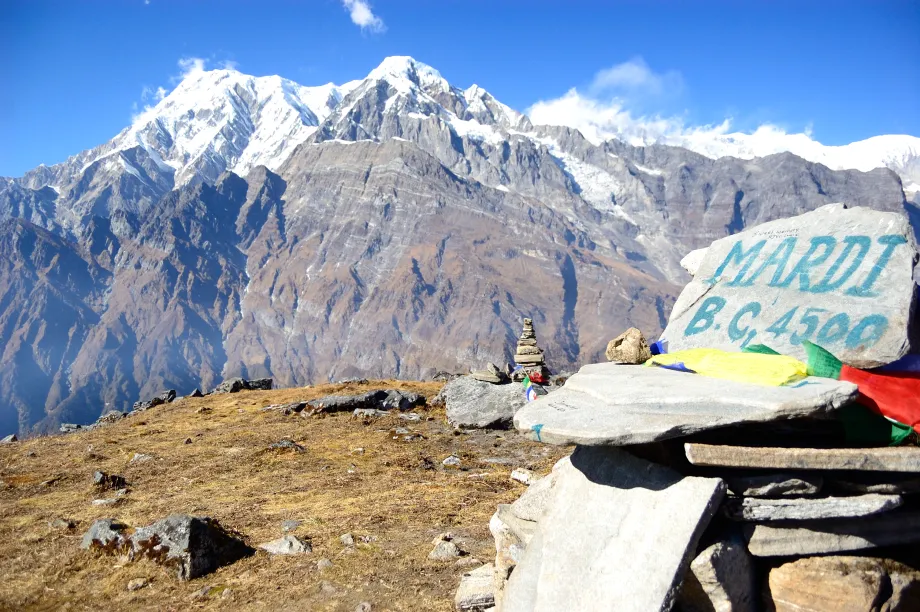
High Camp to Mardi Himal Base Camp (4,500m) and back to High Camp/Low Camp: An early, challenging ascent to the Mardi Himal Base Camp. The final stretch is a steep, often snowy climb along a narrow ridge, culminating in one of the most breathtaking viewpoints in Nepal—right at the foot of Machhapuchhre and Mardi Himal. Return to High Camp or descend further to Low Camp. (Trek: 6-8 hrs round trip).
High Camp/Low Camp to Siding Village (1,750m) to Pokhara: A long descent through forests and terraced farms to the ethnic village of Siding (or Lumre). From there, a drive back to Pokhara. (Trek: 5-6 hrs; Drive: 2-3 hrs).
Key Highlights:
Proximity to Machhapuchhre: Arguably the closest and most dramatic views of the sacred Fishtail mountain.
Alpine Experience: Feels more remote and rugged than Poon Hill.
Less Crowded: For those seeking solitude.
Dramatic Landscape Transition: From dense forest to high alpine ridge walking.
Variations:
Combine with the Australian Camp start for easier initial days and great initial views.
Side Trip: From Low Camp, a detour can be made to the beautiful Badal Danda (“Cloud Hill”).
The Annapurna Base Camp (ABC) Short Approach (7-10 Days)
A Direct Ascent to the Sanctuary
Overview: While the full ABC trek often takes 10-12 days, a direct and shorter route allows fit trekkers to reach the heart of the Annapurna Sanctuary—a breathtaking amphitheater surrounded by a ring of colossal peaks—in a compressed timeframe.
Standard 7-Day Itinerary:
Pokhara to Ghandruk (1,940m) by drive/trek: Drive to Nayapul or Kimche and make the short ascent to Ghandruk. Acclimatize here with magnificent views. (Drive: 2-3 hrs; Trek: 1-2 hrs).
Ghandruk to Chhomrong (2,170m): Descend to the Kimrong Khola, cross a suspension bridge, and make a steep ascent to the large, terraced village of Chhomrong, the gateway to the Sanctuary. (Trek: 4-5 hrs).
Chhomrong to Bamboo (2,310m): A steep descent on stone steps to the Chhomrong Khola, cross a bridge, then an ascent through forest to Sinuwa. A further descent and walk through bamboo and rhododendron forests leads to Bamboo. (Trek: 4-5 hrs).
Bamboo to Deurali (3,230m): The trail climbs steadily through lush, damp forest (prime habitat for wildlife) to Himalaya Hotel and Dobhan, following the Modi Khola gorge. The vegetation starts to thin as you approach Deurali. (Trek: 4-5 hrs).
Deurali to Annapurna Base Camp (ABC) (4,130m) via Machhapuchhre Base Camp (MBC) (3,700m): A dramatic day. The valley opens up into the Sanctuary. Pass the “Baggage” area (avalanche risk zone, best crossed early) to MBC for incredible views. The final climb to ABC reveals the staggering 360-degree panorama: the south face of Annapurna I, Annapurna South, Himchuli, Machhapuchhre, Gandharvachuli, and more. (Trek: 5-6 hrs).
ABC to Bamboo or Sinuwa: An early morning for sunrise on the peaks, then a long descent back through MBC and Deurali to lower elevations. (Trek: 6-7 hrs).
Bamboo/Sinuwa to Jhinu Danda (1,780m) to Nayapul/Pokhara: Descend to Chhomrong, then take a side trail down to Jhinu Danda for a rewarding soak in its natural hot springs by the river. A final descent to Nayapul and a drive to Pokhara. (Trek: 5-6 hrs; Drive: 2 hrs).
Key Highlights:
The Sanctuary Itself: The awe-inspiring, immersive experience of being surrounded by Himalayan giants.
Cultural Start: The vibrant Gurung culture of Ghandruk and Chhomrong.
Diverse Landscapes: From subtropical forests to glacial moraine.
Natural Hot Springs: Perfect for soothing muscles after the descent.
Key Consideration: This is a more strenuous trek due to rapid altitude gain. Acclimatization days (e.g., in Chhomrong or Deurali) are highly recommended, extending the trek to 8-9 days.
Overview: Also known as the Khopra Ridge Trek, this is a community-based tourism initiative that offers Poon Hill-style views with a fraction of the crowds. It uses a combination of teahouses and community-managed lodges.
Standard 6-Day Itinerary:
Pokhara to Ghandruk (1,940m): As per ABC/other treks.
Ghandruk to Tadapani (2,630m): A beautiful forest walk, joining the Poon Hill route.
Tadapani to Dobato (3,420m) via Bayeli Kharka: Diverging from the main trail, the path climbs through forests to the open grazing area of Bayeli Kharka and on to Dobato, with stunning sunrise/sunset views from nearby Muldai viewpoint.
Dobato to Chistibung (3,020m) to Khopra Danda (3,660m): Traverse to Chistibung and then make the final climb to the main goal: Khopra Danda (Ridge). The vista is phenomenal, encompassing Dhaulagiri, the Annapurnas, and the deep Kali Gandaki Gorge.
Khopra Danda to Swanta Village (2,270m): A descent through forests to the charming, traditional village of Swanta.
Swanta to Ulleri (2,080m) or Ghorepani, then descend to Tikhedhunga/Nayapul and drive to Pokhara. Can optionally include Poon Hill.
Community Focus: Supports local village cooperatives.
Optional Side Trek: A demanding day trip from Khopra to the sacred Khayer Lake (4,600m) near Annapurna South Base Camp.
Cultural Authenticity: Visits less-commercialized villages like Swanta.
The Mohare Danda Trek (5-6 Days)
The Eco-Trek with Stunning Dhaulagiri Views
Overview: Another excellent community-based trek, south of the main Annapurna range, focusing on sustainability and offering breathtaking views of Dhaulagiri and the Annapurnas from a different angle.
Route: Starts from Galeshwor (drive from Pokhara), ascends through villages to Mohare Danda (3,300m), the main viewpoint, often compared to Poon Hill for its panorama but without the crowds. Continues to another viewpoint at Khopra Danda (different from the one on the Khopra Ridge Trek) before descending to Tikot and driving back to Pokhara. Known for its eco-lodges and strong community management.
Glacial amphitheater, 360-degree high mountain walls
Broad ridge panoramas, Kali Gandaki Gorge views
Cultural Focus
Strong (Gurung villages)
Moderate
Strong (Gurung villages at start)
Strong (Community-based, authentic villages)
Best For
First-timers, families, photographers, limited time
Those seeking a quieter, more alpine feel, good fitness
Dedicated trekkers wanting a classic high-mountain goal
Trekkers wanting views & culture without crowds, community tourism supporters
Choosing Your Trek:
For First-Timers & Families:Ghorepani Poon Hill is the undisputed champion. It’s well-serviced, manageable, and delivers incredible rewards.
For an Alpine Adventure with Fewer People:Mardi Himal is the current favorite for those looking beyond Poon Hill. It feels more rugged and remote.
For the Ultimate Mountain Immersion: If you have the time (7+ days) and fitness, the direct Annapurna Base Camp route is a life-changing experience.
For a Culturally-Immersive, Community-Focused Journey:Khopra Danda or Mohare Danda offer incredible value, stunning views, and the satisfaction of supporting local initiatives.
Practical Considerations & Responsible Trekking
Guided vs. Independent: All these treks can be done independently (FIT) by experienced trekkers, as the trails are clear and teahouses are abundant. However, for first-timers, a guided trek through a reputable agency is highly recommended. Guides handle logistics, provide cultural interpretation, ensure safety, and help with acclimatization. Porter services are also available to carry your main bag, making the trek significantly more enjoyable.
Teahouse Trekking: This is the standard style. You stay in family-run lodges (teahouses) that offer basic private rooms (twin beds, sometimes with attached bathroom) and serve meals (dal bhat, noodles, pancakes, etc.) in a communal dining hall.
Packing Essentials: Layered clothing (moisture-wicking base, insulating mid-layer, down jacket, waterproof shell), sturdy broken-in trekking boots, sleeping bag (4-season recommended), trekking poles, water purification (tablets/filter), sun protection (hat, sunglasses, high SPF sunscreen), basic first-aid kit, headlamp, and a good daypack.
Health & Safety:
Acclimatization: Ascend slowly, especially on ABC and Mardi Himal. The rule of thumb is not to sleep more than 300-500m higher than the previous night, once above 3,000m. Listen to your body.
Water: Stay hydrated. Use purified water only. Avoid single-use plastic bottles; carry a reusable bottle and purification means.
Insurance:Mandatory. Must cover emergency helicopter evacuation and medical treatment at high altitude.
Leave No Trace & Responsible Trekking:
Support Local: Buy local food, use local guides/porters, and shop in village stores.
Minimize Waste: Carry out all non-biodegradable waste. Use refillable water bottles. Many teahouses now offer boiled/filtered water for a small fee.
Respect Culture: Ask permission before photographing people. Dress modestly. Respect religious sites (circumambulate chortens and mani walls clockwise).
Environmental Care: Stick to established trails. Do not disturb wildlife or pick plants.
FAQs about Annapurna Short Treks
1. What is the best short trek in Annapurna for first-timers?
The Ghorepani Poon Hill Trek (4-5 days) is the best for first-timers, offering manageable hikes, teahouse comforts, and a spectacular Himalayan sunrise view.
2. What permits do I need?
For Annapurna Short Treks, you need two permits: the Annapurna Conservation Area Permit (ACAP) and the Trekker’s Information Management System (TIMS) card.
3. When is the best time for Short Annapurna Treks?
The best seasons are Autumn (Sept-Nov) for clear skies and Spring (Mar-May) for blooming rhododendron forests and warmer weather.
4. Do I need a guide for a short trek?
While the popular routes like Poon Hill can be done independently, a local guide is highly recommended for safety, cultural insight, and logistical support.
5. How difficult are Annapurna short treks?
They range from Easy-Moderate (Poon Hill) to Moderate-Challenging (Mardi Himal, ABC), depending on the route, your fitness, and the pace you choose.
6. What is the accommodation like?
You stay in teahouses—basic, family-run lodges offering private rooms (twin beds) and shared dining halls serving meals like dal bhat, noodles, and pancakes.
7. What is the maximum altitude on these treks?
For the most popular short treks: Poon Hill (3,210m), Mardi Himal Base Camp (4,500m), and Annapurna Base Camp (4,130m).
8. Can I trek if I have limited time (e.g., 3 days)?
Yes. A 3-day version of the Poon Hill trek is possible by driving further to/from the trailhead, or you can opt for an even shorter trek to Australian Camp.
9. How do I get to the trek starting point?
All treks start from Pokhara. You take a short drive (1-3 hours) from Pokhara to trailheads like Nayapul, Kande, or Phedi.
10. What should I pack?
Essentials include sturdy trekking boots, layered clothing (including a down jacket), a daypack, water purification, sun protection, a headlamp, and a sleeping bag.
Conclusion
The short treks of the Annapurna region are a testament to the incredible accessibility and diversity of the Nepal Himalayas. They prove that one does not need to embark on a multi-week expedition to experience the soul-stirring majesty of the world’s highest mountains, the warmth of its indigenous cultures, and the profound sense of accomplishment that comes from journeying on foot through such legendary landscapes.
Whether you choose the classic panorama of Poon Hill, the intimate ridge walks of Mardi Himal, the awe-inspiring sanctuary of ABC, or the community-focused paths of Khopra and Mohare, you are guaranteed an unforgettable adventure. Each step on these ancient trails is a step into a world where nature’s scale is overwhelming, human resilience is inspiring, and the memories forged will last a lifetime. With careful planning, respect for the environment and culture, and a spirit of adventure, your Annapurna short trek will be far more than just a hike—it will be a transformative journey into the heart of the Himalayas.
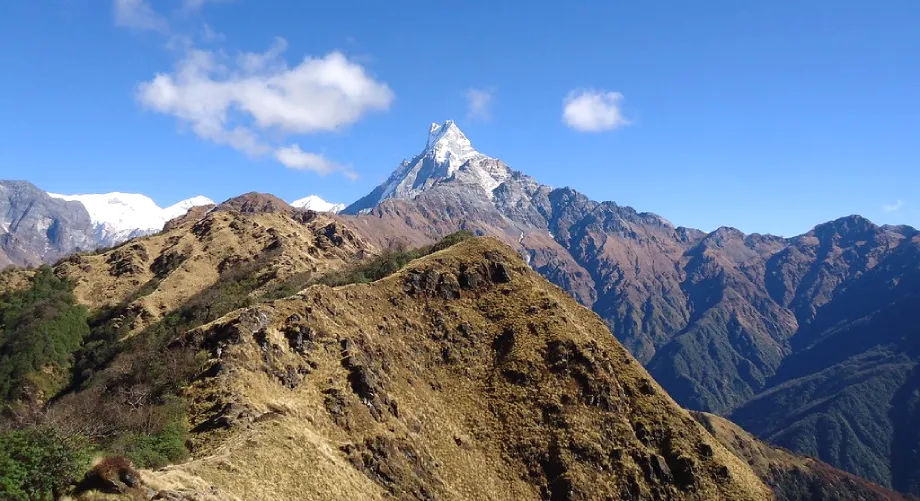
Mardi Himal Trek is an emerging and exceptional short-to-moderate trekking route situated just east of the iconic Annapurna Base Camp trail in the heart of Nepal’s Himalayas. Often celebrated as the “Hidden Gem of the Annapurna Region“, this journey offers a pristine and crowd-free alternative for trekkers seeking an authentic Himalayan experience without the prolonged duration or dense traffic of its more famous counterparts.
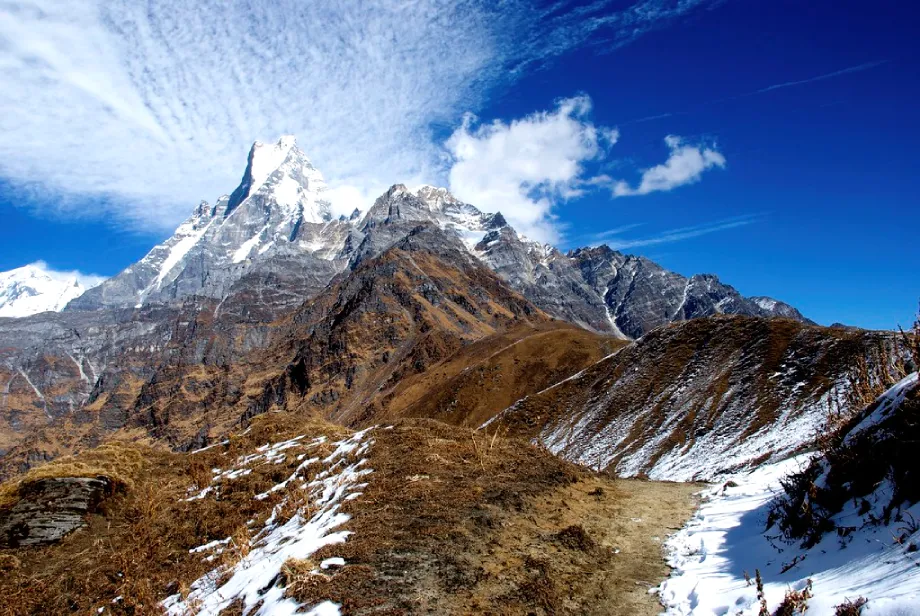
The trek’s unique appeal lies in its spectacular and intimate vantage points. It unfolds on a ridge line that runs directly towards the formidable Machhapuchhre (Fishtail Mountain), providing trekkers with unobstructed, face-to-face views of its razor-sharp summit. The panorama expands to include the entire Annapurna South wall, the elegant Hiunchuli, and the trek’s namesake, the majestic Mardi Himal (5,587m), from whose base camp (4,500m) the trek derives its climax.
Geographically and culturally, the trail is a journey through dramatically shifting ecosystems. It begins in the subtropical foothills near Pokhara, ascends through enchanting old-growth rhododendron and oak forests (vibrant with color in spring), and emerges into serene high alpine pastures known locally as “kharka.“ The final push traverses a rugged, moon-like landscape to the foot of the glacier below Mardi Himal. Along the way, trekkers pass through traditional Gurung and Magar villages like Siding and Lwang, offering glimpses into a rural mountain lifestyle that remains closely tied to the land.
What sets Mardi Himal apart is its sense of solitude and discovery. The teahouse infrastructure, while established and comfortable at lower camps, is less developed than on major routes, which preserves a sense of adventure. The trek is highly achievable for fit beginners yet deeply rewarding for seasoned hikers, perfectly balancing physical challenge, breathtaking scenery, and cultural immersion in a compact 5 to 7-day itinerary. It stands as a testament to the fact that some of Nepal’s most profound mountain experiences are found not on the most trodden paths, but on the quiet trails that run alongside them.
Often called the “hidden gem” due to its quieter trails and raw, unspoiled beauty, this trek is perfect for those seeking a shorter, moderately challenging Himalayan experience without the crowds.
Highlights
Breathtaking Mountain Views: Unobstructed, close-up views of Annapurna South, Hiunchuli, Machhapuchhre (Fishtail), and Mardi Himal.
Less Crowded Trails: Experience solitude and tranquility compared to busier routes like ABC or Everest.
Diverse Landscapes: From lush rhododendron and oak forests to alpine meadows and rugged high-altitude terrain.
Rich Culture: Interact with Gurung and Magar communities in traditional villages.
Mardi Himal Base Camp (4,500m): Stand at the foot of the majestic Mardi Himal with panoramic Himalayan vistas.
High Camp Sunrise: Spectacular sunrise over the Annapurna range from High Camp (3,580m).
Wildlife Spotting: Possible sightings of langur monkeys, deer, and various bird species.
Relatively Short Duration: Typically completed in 5–7 days, ideal for those with limited time.
Mardi Himal Base Camp
Classic Itinerary (6–7 Days)
Day 1: Drive from Pokhara to Kande (1.5 hours) → Trek to Forest Camp (Deurali) via Australian Camp (2,600m) – 5–6 hours. Day 2: Trek from Forest Camp to Low Camp (3,150m) – 4–5 hours. Day 3: Trek from Low Camp to High Camp (3,580m) – 3–4 hours. Day 4: Early morning hike to Mardi Himal Base Camp (4,500m) → Return to High Camp → Descend to Low Camp or Siding Village – 7–8 hours. Day 5: Trek from Low Camp/Siding to Lwang Village or Lumre – 4–5 hours → Drive back to Pokhara (1.5 hours).
Variations: Some itineraries include a night at Badal Danda (Cloud Hill) for sunset/sunrise views or extend via Landruk for a loop route.
Cost Breakdown (2026-2027 Estimates)
Costs vary based on style (independent vs. guided), season, and comfort level.
Independent Trekker (without guide): $400–$550 per person
Includes: Food, accommodation, permits, transport. Excludes gear rental, insurance, and extras.
Guided Group Trek: $700–$900 per person
Includes: Guide, porter, meals, accommodation, permits, transport, and insurance.
Private Guided Trek: $800–$1,200+ per person
Includes: Personalized service, flexibility in itinerary, and better accommodation.
Permits Required:
Annapurna Conservation Area Permit (ACAP): NPR 3,000 (≈ $25)
Trekker’s Information Management System (TIMS): NPR 2,000 (≈ $17) for independent; NPR 1,000 (≈ $8) if with a guide.
Best Time to Trek
Spring (March–May): Rhododendron blooms, clear skies, mild temperatures.
Autumn (October–November): Best visibility, stable weather, popular season.
Winter (December–February): Cold at higher camps, possible snow, very quiet.
Monsoon (June–September): Rainy, leeches, cloudy skies – not recommended.
Difficulty & Preparation
Difficulty: Moderate. No technical climbing, but steep sections and altitude (max 4,500m) require acclimatization.
Fitness: Good cardiovascular fitness recommended. Prior trekking experience is helpful but not mandatory.
Training: Cardio exercises (hiking, running, cycling) and strength training (squats, lunges) 4–6 weeks prior.
Accommodation & Food
Teahouses/Lodges: Basic but comfortable rooms with shared toilets. Hot showers available (extra cost).
Food: Dal Bhat (lentil rice), noodles, soups, pancakes, pasta. Vegetarian options are widely available.
High Camp facilities: More basic; recommend carrying snacks and water purification tablets.
Packing Essentials
Clothing: Layering system (base, insulation, waterproof shell), warm hat, gloves.
Footwear: Broken-in hiking boots, spare socks.
Gear: 30–40L daypack, trekking poles, sleeping bag (optional but recommended), headlamp.
Other: Water bottle/purifier, sunscreen, sunglasses, basic first-aid kit, portable charger.
Responsible Trekking Tips
Leave No Trace: Carry out all trash (including biodegradable).
Support Local: Buy meals at teahouses, hire local guides/porters.
Water: Use purification tablets/filters to reduce plastic bottle use.
Cultural Respect: Dress modestly, ask before photographing people.
Why Choose Mardi Himal Over ABC?
Less crowded: More intimate experience.
Shorter duration: Ideal for time-bound trekkers.
Unique perspective: Different, arguably more dramatic, angle of the Annapurna range.
Affordable: Generally cheaper due to shorter itinerary.
Getting There
International: Fly to Kathmandu.
To Pokhara: 25-minute flight or 6–7 hour scenic drive/tourist bus from Kathmandu.
Trailhead: 1.5-hour drive from Pokhara to Kande or Phedi.
Final Thoughts
The Mardi Himal Trek is a perfect blend of accessibility, natural beauty, and cultural immersion without the overwhelming crowds. Its “hidden gem” status is well-earned, offering a raw and rewarding Himalayan adventure suitable for both novice and experienced trekkers. With proper preparation and respect for the mountains, this trek promises memories to last a lifetime.
Mardi Himal View
Mardi Himal Trek: FAQ
1. What is the best season for the Mardi Himal trek?
The best season for the Mardi Himal Trek is during the autumn months (October to November) when the weather is stable, and the mountain views are crystal clear, and the spring months (March to May) when the rhododendron forests are in full, colorful bloom.
2. Is a guide mandatory for the Mardi Himal trek?
While a guide is not legally mandatory, it is highly recommended for navigation, cultural interpretation, and safety, especially as this is a less crowded trail; however, you must obtain a TIMS card independently if trekking without one.
3. What permits are required, and where do I get them?
Two permits are essential: the Annapurna Conservation Area Permit (ACAP) and the Trekkers’ Information Management System (TIMS) card, both of which can be obtained in Kathmandu or at the Pokhara Tourism Office before starting your trek.
4. How difficult is the trek to Mardi Himal Base Camp?
The trek is rated as moderate difficulty, featuring some steep ascents and reaching a high altitude of 4,500m at the base camp, so good physical fitness and proper acclimatization are important to prevent altitude sickness.
5. What is the typical cost for a 5-7 day trek?
The typical cost ranges from $300 for independent trekkers covering teahouse accommodation, food, and permits, to $600-$900 for an all-inclusive package tour with a guide, porter, and transport.
6. What kind of accommodation is available on the trail?
Accommodation consists of basic teahouses or lodges offering twin-share rooms with simple beds; facilities become more basic at High Camp, and hot showers are usually available for an extra fee at lower elevations.
7. Is altitude sickness a risk on this trek?
Yes, altitude sickness is a genuine risk as the trail ascends to Mardi Himal Base Camp (4,500m); key prevention strategies include a slow ascent, staying hydrated, and incorporating a rest day for acclimatization if needed.
8. What should I pack for the Mardi Himal trek?
Essential packing items include layered clothing for variable weather, broken-in hiking boots, a sleeping bag, trekking poles, a headlamp, a water purification method, and a comprehensive first-aid kit.
9. Can I do the trek independently, and how is the trail marked?
You can trek independently, as the trail is generally clear and marked with red-and-white painted signs; however, carrying a detailed map or a GPS device is advisable, especially in foggy conditions near the upper sections.
10. How does the Mardi Himal trek compare to Annapurna Base Camp (ABC)?
Compared to the Annapurna Base Camp (ABC) trek, the Mardi Himal Trek is shorter in duration, sees fewer crowds, offers a more intimate experience, and provides a unique, close-up vantage point of Machhapuchhre (Fishtail Mountain).
The Upper Mustang Trekis not merely a walk in the Himalayas; it is a profound voyage into a lost world, a living museum of Tibetan culture preserved behind the rain-shadow of the Annapurna and Dhaulagiri massifs. Often called “Lo,” the “Forbidden Kingdom,” this remote region in north-central Nepal was closed to outsiders until 1992, and even today, access is tightly controlled by a special permit system, preserving its delicate cultural and environmental fabric.
Geographical & Historical Context:
Upper Mustang is a high-altitude desert, an extension of the Tibetan Plateau, characterized by dramatic, wind-sculpted cliffs, deep canyons in shades of ochre, red, and brown, and surreal rock formations. It lies in the Mustang District of Gandaki Province, with the ancient walled city of Lo Manthang as its historic capital. For centuries, it was a vital salt-trading route between Tibet and the Indian subcontinent. The region was an independent kingdom with close ties to Lhasa, and while formally integrated into Nepal in the 18th century, the King of Lo retained his title and cultural authority until Nepal became a republic in 2008. The last king, Jigme Dorje Palbar Bista, passed away in 2016, but the royal lineage remains deeply respected.
The “Forbidden” Aspect & Modern Access:
The “forbidden” tag stems from its historical isolation and the Nepalese government’s policy of restricting tourism to protect its unique Tibetan Buddhist culture from outside influence and to maintain control over a sensitive border area with China (Tibet). This very restriction is what makes the trek so special. Unlike the lush, populated trails of the Everest or Annapurna regions, Upper Mustang offers stark, silent, and expansive landscapes that feel untouched by time. The culture here is purer, less commercialized, with ancient monasteries (gompa), sky caves, and fortresses (dzong) dotting the landscape.
Cultural and Spiritual Significance:
This is a stronghold of the Sakyapa sect of Tibetan Buddhism. The Tiji Festival, a three-day ritual held in Lo Manthang every spring (usually May), is a major draw, symbolizing the victory of good over evil with elaborate masked dances. The people are predominantly of Tibetan origin (Loba), speaking dialects of Tibetan and maintaining traditions of polyandry (now rare) and intricate Tibetan art.
Prayer Wheels
Trek Snapshot for Upper Mustang Trek:
Duration: Typically 10-17 days (including travel from Kathmandu).
Max. Altitude: 4,200m (13,780 ft) at the Dhakmar Pass or viewpoints above Lo Manthang. Note: The trek itself stays at a consistently high altitude, often above 3,500m.
Trek Style: Tea-house based, but more basic than popular routes. Camping is an option for larger groups. Kathmandu and Pokhara high-standard hotels are also available.
Best Seasons for Upper Mustang Trek:Late March to Early November. Prime months are May to October. The monsoon (June-August) has little effect here due to the rain-shadow, making it an ideal summer trek. Winters are extremely cold, and many passes are closed.
DETAILED ITINERARY (14 to 17 Day Standard Trek)
A classic Upper Mustang trek begins with a flight into the Himalayas.
Day 01: Fly from Pokhara to Jomsom (2,720m), Trek to Kagbeni (2,810m)
Upper Mustang Trek starts with a thrilling 20-minute flight between Annapurna and Dhaulagiri lands you in windy Jomsom. After a brief check-in at the ACAP checkpoint, you trek north along the Kali Gandaki River, the world’s deepest gorge, to Kagbeni. This medieval village with narrow alleyways is the gateway to Upper Mustang and your first taste of its arid landscape. Visit the 15th-century Kag Chode Thupten Samphel Ling Monastery.
Day 02: Kagbeni to Chele (3,050m)
Cross the official checkpoint into the restricted zone. The trail climbs steadily, leaving the Kali Gandaki and entering a stark, beautiful side canyon. Pass the distinctive Tangbe village with its whitewashed houses and apple orchards, then Chhusang village, before a steep climb to Chele.
Day 03: Chele to Syanbochen (3,475m)
A challenging day with two major passes. Climb to Taklam La Pass (3,624m) and Dajori La Pass (3,735m). The landscape is spectacularly barren. Descend to Saman, an important village for horse caravans, then climb again to Syanbochen.
Day 04: Syanbochen to Ghaymi (3,520m)
Cross the Yamda La (3,850m) and several smaller passes. Pass ancient chortens (stupas), mane walls, and caves. The trail offers views of Nilgiri and Tilicho peaks. Ghaymi is a large, walled village set below a massive red cliff.
Day 05: Ghaymi to Charang (3,500m)
A relatively easier day. Cross the Nyi La Pass (4,010m), the highest point so far. Descend to Charang (Tsarang), a large settlement with a spectacular five-story White Dzong (fortress) and a red gompa containing an excellent collection of thangkas and statues.
Day 06: Charang to Lo Manthang (3,810m)
A dramatic descent into the Charang River canyon, then a long climb up to the Lo La Pass (3,950m). Your first view of the walled city of Lo Manthang from the pass is unforgettable. Descend to the capital and enter through its main gate.
Day 07: Exploration Day in Lo Manthang
A full day to immerse in the capital. Key sites include:
The King’s Palace (Now Museum): A towering 4-story structure.
Thugchen Gompa: A 15th-century monastery with a huge assembly hall and exquisite murals.
Jampa Lhakhang (Champa Temple): The oldest monastery in the city, dating to the early 15th century.
Amitabha Buddha Monastery (New Gompa): Known for its detailed, modern wall paintings.
Optional day trip to the Chhoser Cave Complex, a labyrinth of ancient cave dwellings and monasteries carved into a cliff face.
Day 08: Lo Manthang to Drakmar (3,810m) via Ghar Gompa
Take an alternative southern route. Visit Ghar Gompa, one of the oldest and most sacred monasteries in Mustang, believed to have been founded by the great saint Padmasambhava (Guru Rinpoche). The trail then passes through stunning red and ochre cliffs to the small village of Drakmar.
Day 09: Drakmar to Ghiling (3,806m)
Climb from Drakmar, enjoying spectacular views of the unique red hoodoo formations, to the Dhakmar La Pass (4,200m). A long descent brings you back to the main trail at Ghiling.
Day 10: Ghiling to Chhusang (2,980m)
Retrace part of the inbound route, descending through the dramatic landscape back to the Kali Gandaki valley at Chhusang.
Day 11: Chhusang to Jomsom (2,720m)
The final trekking day follows the riverbed south, past Tangbe and Kagbeni, back to Jomsom. Celebrate the completion of your journey.
Day 12: Fly from Jomsom to Pokhara
Morning flight back to Pokhara. The remainder of the day is for relaxation.
*Note: Variations include shorter 10-day treks (using jeeps on the new road for parts) or longer 16-day treks starting from Pokhara or even including the Nar Phu Valley Trek.*
This is the most critical administrative aspect of the Upper Mustang trek.
1. Restricted Area Permit (RAP) for Upper Mustang Trek:
Cost:USD $500 per person for the first 10 days. Then, USD $50 per person per day for additional days. This is a government-mandated fee, non-negotiable, and must be arranged through a registered Nepali trekking agency. Independent & solo trekking is NOT allowed in the Upper Mustang Trek.
Process: Your chosen agency will require a copy of your passport and will obtain the permit for you in Kathmandu. You must travel with a licensed guide.
2. Annapurna Conservation Area Permit (ACAP):
Cost: NPR 3,000 (approx. USD $23) for foreign nationals.
This permit is checked at the entry point in Jomsom or Tatopani.
3. Trekkers’ Information Management System (TIMS) Card:
While officially not required for restricted areas, many agencies still obtain it as a safety measure, or you may need it for the approach trek. Cost is around USD $20.
Total Trek Cost for Upper Mustang Trek (Approximate, 2026):
Package Cost (excluding international flights): $2,000 – $3,500+ per person.
This includes: Permits, Kathmandu-Pokhara-Jomsom flights, all meals and accommodation during the trek, guide/porter services, and agency support.
Excludes: Personal gear, travel insurance, tips, drinks, and extra hotel nights.
The “Road” Factor: A rough dirt road now connects Jomsom to Lo Manthang (Upper Mustang), used by local jeeps and motorcycles. While some purists bemoan it, the trekking trail largely remains separate and scenic. The road also offers options for jeep-supported treks or even an Upper Mustang motorbike tour, which are becoming popular search topics.
EQUIPMENT & PACKING LIST
Packing for Upper Mustang trek requires consideration for a high-altitude desert climate: intense sun during the day, freezing temperatures at night, and constant, often strong, winds.
Clothing (Layering System is Key):
Base Layers: Moisture-wicking thermal tops and bottoms (merino wool or synthetic).
Mid Layers: Fleece jacket or pullover, lightweight down or synthetic insulated vest/jacket.
Outer Layer: Hard-shell, windproof, and waterproof jacket and pants. A windproof layer is arguably more critical than rain gear here.
Trekking Pants: Convertible or lightweight pants.
Headwear: Warm beanie, sun hat with wide brim, buff/neck gaiter.
Handwear: Lightweight liner gloves and insulated trekking gloves.
Backpack: A 40-50 liter pack for personal items if you have a porter.
Sleeping Bag: Rated to at least -10°C (14°F). Teahouse blankets are basic.
Trekking Poles: Highly recommended for steep, slippery descents.
Headlamp with extra batteries.
Water Purification: Bottled water is expensive and creates plastic waste. Use iodine/chlorine tablets, a SteriPEN, or a quality filter (note: filters can clog with silt in the Kali Gandaki).
Sunglasses: High UV protection is vital. Consider glacier glasses for increased protection.
Sun Protection: High SPF (50+) sunscreen and lip balm with SPF. The sun at altitude is brutal.
Dust Protection: A bandana or mask for windy, dusty sections.
Other Essentials:
Personal first-aid kit (blister care, painkillers, diarrhea medication).
Quick-dry towel.
Power bank/battery charger (charging costs extra in teahouses).
Toiletries, wet wipes (water is scarce).
A good book, a journal, and cards.
Cash (Nepali Rupees): There are NO ATMs beyond Jomsom. Carry enough for bottled drinks, snacks, hot showers, Wi-Fi, monastery donations, and tips.
DIFFICULTY & PHYSICAL PREPARATION
Difficulty Rating: Moderate to Strenuous.
Not Technically Difficult: No climbing or scrambling is involved.
High Altitude Challenge: While the maximum altitude (4,200m) is lower than Everest Base Camp (5,364m), the trek spends almost its entire duration above 3,000m, with constant ascents and descents over passes. Proper acclimatization is crucial.
Physical Demand: Long walking days (5-7 hours on average) with significant cumulative elevation gain/loss (often 500-800m per day). The terrain is rough and exposed.
Environmental Factors: The wind, dust, and intense sun can be taxing. The arid, cold air can dehydrate you quickly.
Remote & Basic Facilities: While not a camping trek, the teahouses are more rustic than on major routes. Mental preparedness for basic amenities is needed.
Preparation:
Cardiovascular Fitness: 8-12 weeks of training: focus on hiking, stair climbing, running, cycling. Aim for the ability to walk 5-7 hours with a daypack on consecutive days.
Strength Training: Legs (squats, lunges), core, and back.
Practice Hikes: Do full-day hikes in hilly terrain with your boots and loaded pack.
Altitude Acclimatization: The itinerary should be designed for gradual ascent. Listen to your body and communicate with your guide about any AMS symptoms (headache, nausea, dizziness, fatigue).
Teahouses (Lodges): Simple but adequate. Rooms are usually twin-share with basic beds and thin mattresses. Shared toilets are the norm, becoming more basic as you go north.
Food: The menu is a subset of classic trekking fare: Dal Bhat (lentil soup with rice), noodles, pasta, potatoes, momos (dumplings), and Tibetan bread. Fresh produce is scarce and expensive. Apple products (pie, brandy, juice) from local orchards are a treat.
Communication & Connectivity:
Mobile Network: Nepal Telecom (NTC) has sporadic coverage in villages. Ncell coverage is very limited.
Wi-Fi/Internet: Available in most teahouses for a fee (NPR 300-500 per hour), but it is very slow and unreliable. Satellite internet is sometimes available.
Recommendation: Inform the family of limited contact. Consider purchasing a local NTC SIM in Kathmandu for the best chance of connection.
Health and Safety:
Acute Mountain Sickness (AMS): The single biggest health risk. A good itinerary includes acclimatization days. Carry Diamox (Acetazolamide) after consulting your doctor.
Water & Food Hygiene: Use purified water, even for brushing teeth. Eat well-cooked, hot food. Peel fruits.
Travel Insurance:This is non-negotiable. Your policy must cover emergency helicopter evacuation from high altitude (up to 5,000m) and trekking in remote regions above 3,000m. Also, ensure it covers trip cancellation.
Guides and Porters: Hiring through a reputable agency ensures qualified, insured staff. Tipping is customary (guide: $10-15/day, porter: $8-12/day, per group).
Cultural Etiquette:
Circumambulation: Always walk clockwise around chortens, mani walls, and monasteries.
Respect in Religious Sites: Remove shoes and hats before entering. Ask before taking photographs inside monasteries (a donation is often expected). Do not point your feet at altars or monks.
Left Hand Taboo: Use your right hand for giving/receiving items and eating.
Dress modestly, especially in villages and monasteries.
Environmental Responsibility:
Leave No Trace: Carry all trash out (including biodegradable). Use toilets where provided.
Water: Use purification methods to minimize plastic bottle use.
Support Local: Use local lodges, hire local staff, buy local crafts.
The Future of Upper Mustang Trek:
The construction of the road is a double-edged sword. It brings development, easier access to goods, and connectivity for locals. For trekkers, it means more jeep traffic and a changing landscape. However, the unique culture, the requirement for a guide and expensive permit, and the sheer grandeur of the landscape will ensure that Upper Mustang remains a premier destination for discerning adventurers seeking a true wilderness and cultural experience.
In conclusion, the Upper Mustang Trek is a significant investment of time, money, and physical effort. But it rewards the intrepid traveler with an experience unlike any other on Earth: a starkly beautiful, ancient, and spiritually resonant journey into the heart of a once-forbidden kingdom, where Tibetan culture thrives in its most authentic form, guarded by the mighty Himalayas. It is a trek that changes perspectives and leaves an indelible mark on the soul.
Chortens at Upper Mustang
FAQ
1. What is the cost of the Upper Mustang Trek in 2026?
The total cost for a standard 14-day guided trek typically ranges from $2,000 to $3,500+ per person. This includes the $500 restricted area permit, Annapurna Conservation Area Permit (ACAP), flights (Kathmandu-Pokhara-Jomsom), all meals, teahouse accommodation, guide/porter services, and agency support. It excludes international flights, travel insurance, personal gear, and tips.
2. What permits are needed for the Upper Mustang Trek in 2026?
You need two main permits:
Upper Mustang Restricted Area Permit (RAP): $500 per person for the first 10 days, then $50 per day thereafter. It must be arranged by a registered Nepali trekking agency.
Annapurna Conservation Area Permit (ACAP): Approximately NPR 3,000 (around $23).
3. When are the Tiji Festival dates for 2026?
The Tiji Festival is held in Lo Manthang based on the Tibetan lunar calendar. The 2026 dates are tentatively projected for May 14-16, 2026. Dates are usually confirmed closer to the year, so check with trekking agencies in early 2025 for final confirmation.
4. How does the Upper Mustang Trek compare to the Annapurna Circuit?
Upper Mustang: A high-altitude desert trek in a culturally Tibetan, restricted area. Focus is on ancient culture, stark landscapes, and isolation. Requires a special permit and guide. Consistently high altitude (3,000m+). Best in spring/autumn.
Annapurna Circuit: A classic Himalayan trek with diverse landscapes—lush foothills, high passes (Thorong La, 5,416m), and villages. More physically demanding due to the higher altitude, but culturally a Hindu/Buddhist mix. No restricted permit needed for most parts. Best in spring/autumn.
5. Is the Upper Mustang Trek difficult?
It is rated Moderate to Strenuous. While not technically difficult, the challenge comes from long walking days (5-7 hours), constant ascents/descents over high passes (max 4,200m), and the effects of consistently high altitude, wind, and cold. Good fitness and acclimatization are essential.
6. Can you do a motorcycle tour in Upper Mustang?
Yes, motorcycle tours are an increasingly popular and thrilling way to explore Upper Mustang. They require the same Restricted Area Permit ($500) and must be arranged through a licensed tour operator who provides the bikes, support vehicle, and guide. The rough road from Jomsom to Lo Manthang makes it an adventurous off-road experience.
7. What is the weather like in Lo Manthang in October?
October offers excellent trekking conditions. Days are generally clear, sunny, and pleasant (10-15°C / 50-59°F). Nights are cold, dropping below freezing (0 to -5°C / 32-23°F). There is minimal precipitation, and visibility for mountain views is superb. It’s one of the busiest months.
8. What is the Upper Mustang restricted area permit?
It is a mandatory permit issued by the Nepali government to control tourism and protect the unique Tibetan culture and the sensitive border area of Upper Mustang. The high fee ($500/10 days) limits visitor numbers. Independent & Solo trekking is prohibited; you must travel with a registered agency and guide.
9. What is the best time for the Upper Mustang trek?
The best times are from late March to early November. The prime windows are:
Spring (March-May): Stable weather, blooming wildflowers, and the Tiji Festival (May).
Autumn (September-November): Clear skies, stable weather, and excellent mountain views.
Monsoon (June-August): A great summer option as the region lies in a rain-shadow, receiving little rain.
10. How does the flight to Jomsom for Upper Mustang work?
The trek starts with a scenic 20-minute flight from Pokhara to Jomsom. These small twin-engine aircraft (e.g., Yeti Airlines, Tara Air) are highly weather-dependent, especially in the morning due to wind. Flights are often scheduled for early morning, and delays/cancellations are common. The alternative is a long jeep/bus ride from Pokhara.
11. Where can I find a map for the Upper Mustang trek?
Detailed trekking maps are published by Himalayan Map House and Nepa Maps. Look for their “Mustang Trekking Maps.” These can be purchased in Thamel, Kathmandu, or from international retailers online. Digital maps are also available on apps like Maps.me (download the Nepal region offline).
12. What are the teahouse facilities like in Upper Mustang?
Facilities are basic and become more rustic as you go north. Expect simple twin-share rooms with wooden beds and thin mattresses. Shared squat or Western toilets are standard. Heating is only in the common dining room (usually by a stove). Charging electronics and Wi-Fi are available for an extra fee, but are slow and unreliable. Hot showers (bucket-style) are available for a cost.
13. Is Upper Mustang Trek suitable for trekking with kids?
It is generally not recommended for young children due to the high altitude, remote nature, long walking days, and basic facilities. It could be considered for experienced, resilient teenagers who are accustomed to trekking and camping, but careful planning, a longer itinerary for acclimatization, and consultation with a doctor are mandatory.
14. What makes the Upper Mustang a cultural trek?
It is a journey into a preserved Tibetan Buddhist kingdom. Highlights include visiting centuries-old monasteries (gompas) like Thugchen and Luri Gompa, exploring the medieval walled city of Lo Manthang, seeing ancient sky caves, witnessing traditional lifestyles of the Loba people, and potentially attending the vibrant Tiji Festival. The culture is less commercialized than in other trekking regions.
15. What is the impact of the new road in Upper Mustang?
The dirt road from Jomsom to Lo Manthang has a mixed impact:
Positive: Easier access to goods and healthcare for locals, provides jeep support options for trekkers, and enables motorcycle tours.
Negative: Some trail sections share the road, leading to dust and occasional traffic. Purists feel it diminishes the wilderness experience. However, the main trekking trails often run parallel and remain scenic, and the road does not lessen the region’s profound cultural value.
Soaring with the Gods: A Comprehensive Guide to Himalayan Helicopter Tours
Nepal, a nation cradled in the heart of the Himalayas, has long been a siren call for adventurers, trekkers, and spiritual seekers. Its landscape is a dramatic tapestry of terraced hills, deep river gorges, and the planet’s most formidable mountain peaks, including the legendary Mount Everest. For decades, the primary means to experience this grandeur was on foot, through arduous and time-consuming treks. However, a new paradigm of exploration has emerged, offering a perspective once reserved for mountaineers and birds: the helicopter tour.
A Himalayanhelicopter touris not merely a flight; it is a profound, visceral, and transformative experience. It is a door to the inaccessible, a solution for the time-pressed, and a lifeline for those who dream of witnessing the roof of the world but are constrained by physical limitations or schedule. This 5000-word guide delves into every facet of this extraordinary adventure, from the thunderous roar of the rotors to the silent awe of hovering before Everest.
The Genesis and Allure – Why Choose a Himalayan Helicopter Tour?
The inception of helicopter tourism in Nepal is intertwined with the growth of its aviation sector and the increasing global demand for unique, luxury, and accessible travel experiences. The challenging topography that makes Nepal so enchanting also makes it difficult to traverse. Helicopters became a logical tool for connectivity, rescue, and eventually, tourism.
The allure of a helicopter tour is multi-faceted:
Time Efficiency: The most significant advantage. A classic Everest Base Camp Trek requires a minimum of 12-14 days. A helicopter tour to the base camp or a scenic flight around the peak can be accomplished in a single morning from Kathmandu. This makes the Himalayas accessible to business travelers, families with young children, or anyone with a tight itinerary.
Accessibility and Inclusivity: Trekking is a physically demanding activity that requires a certain level of fitness and acclimatization to high altitude. Helicopter tours democratize the Himalayan experience. They are a boon for senior citizens, individuals with mobility issues, or those who simply do not have the time or inclination for a long trek. It ensures that the majesty of the mountains is not an exclusive privilege of the able-bodied and the endurance athlete.
The Ultimate Perspective: While trekking offers an intimate, ground-level connection with the land, a helicopter provides a god’s-eye view. You witness the scale, the geology, and the interconnectedness of the Himalayan range in a way that is impossible from a trail. The sight of serpentine rivers, sprawling glaciers, and peaks stretching to the horizon is a humbling and awe-inspiring spectacle.
Access to the Inaccessible: Certain areas, like the sacred lakes of Gosaikunda or the remote peaks of the Dolpo region, are extremely difficult and time-consuming to reach on foot. Helicopters can land in these high-altitude, secluded spots, offering a glimpse into a world few ever see.
Adventure and Luxury Combined: The experience of flying in a helicopter itself is an adventure. Coupled with a champagne breakfast at a high-altitude hotel or a landing at the base of the world’s highest peak, it transforms into the epitome of adventure luxury.
Heli Landed at Kalapatthar
A Palette of Journeys – Types of Himalayan Helicopter Tours
Nepal’s diverse geography offers a variety of helicopter tour experiences, each with its own unique character and highlights.
The Everest Experience (The Crown Jewel)
This is the most sought-after helicopter tour, delivering the quintessential Himalayan dream.
Everest Base Camp (EBC) Landing Tour: The most comprehensive option. The flight from Kathmandu heads east, tracing the Himalayan range. You fly over the lush foothills of the Solu-Khumbu region, passing traditional Sherpa villages like Namche Bazaar. The aircraft then navigates the deep gorge of the Dudh Koshi River before emerging into the amphitheater of the high Himalayas. The pilot typically circles iconic peaks like Ama Dablam, Lhotse, and Nuptse before the main event: a close-up view of the mighty Mount Everest (Sagarmatha). The climax is a landing at either Kalapatthar (5,545m) or the Everest Base Camp (5,364m) itself (season and weather permitting). Here, you get to step out for 10-15 minutes into the thin, frigid air, surrounded by a 360-degree panorama of the world’s highest peaks—an unforgettable, albeit brief, moment of alpine nirvana.
Everest Panorama Flight (without landing): A shorter and more economical option. This flight takes you on a spectacular scenic circuit around the Everest region, offering breathtaking views of the entire Khumbu range, including Everest, but without a landing at Base Camp. It often includes a landing at Syangboche or Lukla for breakfast, providing a taste of the Khumbu atmosphere.
The Everest View Hotel Landing: This tour combines a scenic flight with a luxury experience. The helicopter lands at the iconic Everest View Hotel in Syangboche (3,880m), the highest-placed hotel in the world. Guests can enjoy a cup of tea or coffee while gazing at the unobstructed view of Everest, Lhotse, and Ama Dablam.
The Annapurna massif in central Nepal offers a completely different, yet equally stunning, Himalayan experience.
Annapurna Base Camp (ABC) Landing Tour: Flying from Pokhara, the helicopter journeys into the heart of the Annapurna Sanctuary. The flight offers dramatic views of the fishtail peak of Machhapuchhre (Mt. Fishtail), which is considered sacred and unclimbed. The landing at Annapurna Base Camp (4,130m) places you in a natural amphitheater surrounded by a ring of towering peaks, including Annapurna I (8,091m), Annapurna South, Hiunchuli, and Gangapurna.
Muktinath Pilgrimage Tour: Muktinath is one of the most sacred pilgrimage sites for both Hindus and Buddhists, located in the Mustang district at an altitude of 3,800 meters. The overland journey is long and arduous. A helicopter tour makes this pilgrimage possible in a day from either Pokhara or Kathmandu. Pilgrims can perform their rituals at the temple complex and return by afternoon, a journey that would otherwise take several days.
The Langtang Valley
Closest to Kathmandu, the Langtang region is known as the “Valley of Glaciers.” A helicopter tour here is a journey into a rugged and less-crowded wilderness.
Langtang Valley and Gosainkunda Lake: This flight soars over the lush hills of Helambu and into the high valley of Langtang, with views of Langtang Lirung (7,234m) and other snow-capped peaks. A highlight is often a flyover or landing near the sacred Gosainkunda Lake, a site of great religious significance, especially during the Janai Purnima festival.
The Remote Wilds: Upper Mustang and Dolpo
For the true connoisseur of the remote and forbidden, helicopter tours offer a glimpse into the ancient Tibetan kingdoms preserved within Nepal’s borders.
Upper Mustang: Once a forbidden kingdom, Upper Mustang is a high-altitude desert with a landscape reminiscent of Tibet. The flight over the Kali Gandaki gorge, the world’s deepest, is spectacular. A tour can land in Lo Manthang, the walled capital, allowing visitors to explore its ancient monasteries and unique culture. This requires a special restricted area permit, which the tour operator arranges.
Dolpo: Immortalized in Peter Matthiessen’s “The Snow Leopard,” Dolpo is one of the most remote and isolated regions in Nepal. A helicopter tour is one of the few practical ways for a casual traveler to witness the breathtaking beauty of Phoksundo Lake with its turquoise waters and the unique Bon-Po culture.
The Himalayan Pilgrimage Combo
Nepal is also the land of important religious sites. Helicopter tours combine these spiritual destinations with scenic beauty.
Muktinath & Manakamana: Manakamana is a famous temple in the hills of Gorkha, believed to grant wishes. A combined tour can take pilgrims to both Manakamana and the high-altitude Muktinath temple in a single, efficient day.
The Machinery and the Masters for Himalayan Helicopter Tour – Operational Realities
The Helicopters: The backbone of Nepal’s helicopter tourism industry is a fleet of robust, high-performance machines designed for high-altitude operations. The most common workhorses are:
Eurocopter/Airbus AS350 B3e (Ecureuil/AStar): Known for its powerful engine and excellent high-altitude performance, the “B3” is the most widely used helicopter for mountain tours. It can typically carry 1 pilot and 4-5 passengers.
Eurocopter/Airbus AS350 B2: Slightly less powerful than the B3 but still highly capable for most tours.
Mil Mi-17: A larger Russian-built helicopter used for group charters, logistics, and expeditions. It’s not typically used for standard tourist flights but can be chartered for larger parties.
Bell 206 & 407: Also used, though less common than the AS350, for the highest altitude missions.
The Pilots: The pilots operating these tours are among the most skilled in the world. They possess intimate knowledge of the complex mountain weather, wind patterns, and treacherous topography. Their experience, often honed through years of mountain rescue and logistics operations, is the single most critical safety factor. They make real-time decisions about routes, altitudes, and the feasibility of landings, prioritizing passenger safety above all else.
Weather: The Unpredictable Dictator
The Himalayas create their own weather systems, which can change in an instant. Weather is the most significant variable and cause of delays and cancellations. Flights are almost exclusively conducted in the early morning (6 AM to 10 AM) when the air is generally calmer, and the skies are clearer. Afternoon flights are rare due to the high likelihood of cloud cover, turbulence, and wind. Tour operators and pilots maintain constant communication with meteorological services, and passenger safety is non-negotiable.
The Practicalities – Cost, Booking, and Preparation
The Cost Factor: Helicopter tours are a premium experience, and their cost reflects the high operational expenses, including fuel, maintenance, insurance, and pilot expertise.
Everest Base Camp Landing: Can range from $2,000 to $3,000 per person for a seat on a shared basis.
Annapurna Base Camp Landing: Typically costs between $600 and $800 per person.
Muktinath Pilgrimage: Around $700-$900 per person.
Private Charter: Costs significantly more but offers flexibility in itinerary and timing. A private charter for an Everest tour (Kalapatthar Landing) can cost $5,500 – $7,000 for the entire helicopter.
What’s Included: The price usually includes airport transfers, all permits (National Park, TIMS, and local fees), and the flight itself. Some luxury tours may include a meal at a mountain hotel.
Booking Your Tour:
It is imperative to book with a reputable and government-licensed operator. Research companies with a proven safety record and positive customer reviews. Ensure they are registered with the Nepal Tourism Board and the Civil Aviation Authority of Nepal. A reliable operator will be transparent about costs, safety procedures, and cancellation policies.
Himalayan Helicopter Tour
Essential Preparation:
Acclimatization: Even on a short tour, you will be taken to very high altitudes quickly. While the time spent on the ground is brief, Altitude Sickness (AMS) can still occur. It is advisable to spend at least 2-3 days in Kathmandu or Pokhara acclimatizing before the flight. Consult your doctor about medication like Acetazolamide (Diamox).
What to Wear and Bring: Dress in warm, layered clothing. Even on a sunny day, the temperature at high altitude is below freezing.
Thermal innerwear, a fleece jacket, and a down or Gore-Tex outer shell.
Warm hat, gloves, and sunglasses (high-altitude UV protection is crucial).
Sunscreen with a high SPF.
Camera with extra batteries (they drain faster in the cold).
Passport and a small amount of cash.
Health Considerations: These tours are not recommended for individuals with serious heart conditions, severe respiratory problems, or pregnant women. A basic level of mobility is required to get in and out of the helicopter.
The Ethical and Environmental Dimension
The rise of helicopter tourism is not without its controversies, and it’s important for the conscious traveler to be aware of them.
Environmental Impact: Helicopters are fossil-fuel-powered machines that emit greenhouse gases and noise pollution. The sound of a helicopter can disrupt the serene mountain ambiance for trekkers and the local wildlife. The industry is aware of this and follows strict flight paths where possible, but the impact remains a point of discussion.
Impact on Trekking Tourism: There is a concern that the convenience of helicopter tours could detract from the traditional trekking industry, which supports a vast network of teahouses, guides, and porters. However, many argue that they cater to a different demographic and can actually be complementary.
Safety Record: While Nepal’s mountain aviation has a challenging safety record, helicopter operators have invested heavily in safety, training, and maintenance. The safety standards for private charters and tours are generally very high. It is crucial to choose an operator with a modern fleet and an impeccable safety culture.
Being a Responsible Traveler:
Choose operators who demonstrate a commitment to environmental and social responsibility.
Respect the local culture and environment at landing sites.
Understand that you are a guest in a fragile and powerful landscape.
Conclusion: More Than a Flight, A Pilgrimage of the Senses
A Himalayan helicopter tour in Nepal is an investment not just in money, but in a memory that will be etched into your soul forever. It is the gasp as Everest first comes into view, a monolithic pyramid of rock and ice against an impossibly blue sky. It is the profound silence that envelops you at Base Camp, broken only by the wind and the beating of your own heart. It is the perspective that shrinks human concerns to their proper scale against the timeless march of geological epochs.
It is a privilege to witness the Himalayas from this vantage point. It is a journey that transcends tourism and becomes a pilgrimage—a swift, majestic flight into the realm of the gods, returning the traveler forever changed, humbled, and awestruck by the raw, untamed beauty of our planet.
In a decision poised to reshape the landscape of high-altitude tourism, the Government of Nepal has announced a fundamental change to the fee structure for foreign trekkers visiting the iconic, restricted region of Upper Mustang. This move, ratified during a Cabinet meeting and communicated by government spokesperson Jagadish Kharel, signifies more than just a fiscal adjustment; it represents a strategic pivot in Nepal’s approach to managing its most fragile and coveted trekking destinations. The shift from a rigid flat fee of $500 per person for a 10-day period to a more flexible $50 per person per day model marks the culmination of decades of advocacy from the trekking industry and a bold experiment in sustainable tourism economics.
This report will delve into the multifaceted dimensions of this policy change. We will explore the historical context that led to the creation of “restricted areas,” conduct a granular economic analysis of the new fee structure, examine the ecological and cultural imperatives of the Mustang region, and situate this decision within the broader global trends of post-pandemic travel recovery and the growing demand for exclusive experiential tourism. Furthermore, we will analyze the persistent regulatory hurdles, the potential for digital transformation in permit issuance, and the future trajectory of tourism liberalization in other restricted zones like Upper Dolpa and Humla. This comprehensive review aims to provide stakeholders—from policymakers and trekking agencies to potential tourists and local communities—with a clear understanding of the opportunities and challenges that lie ahead in the new era of Nepalese trekking.
The Historical Tapestry – From “Forbidden Kingdom” to Restricted Area
To appreciate the significance of this policy change, one must first understand the unique history of Upper Mustang and the geopolitical rationale behind Nepal’s restricted areas.
The Ancient Kingdom of Lo
Upper Mustang, traditionally known as the Kingdom of Lo, is a high-altitude desert region nestled in the rain shadow of the Annapurna and Dhaulagiri massifs. Its history is deeply intertwined with Tibet, evident in its language, religion, and culture. For centuries, it was a crucial conduit for trade caravans transporting salt, grain, and wool between Tibet and the lower Himalayan kingdoms. This isolation preserved a pristine form of Tibetan Buddhism, with ancient monasteries, cave dwellings, and a unique royal lineage that endured until Nepal’s transition to a republic in 2008. This very isolation earned it the moniker “the Forbidden Kingdom,” a branding that now forms the cornerstone of its tourism appeal.
Upper Mustang
The Geopolitical Genesis of Restricted Areas (1970s)
The formal “restriction” on Upper Mustang and other northern districts was not born from tourism strategy but from Cold War-era geopolitical strife. In the 1960s and 1970s, the presence of Tibetan Khampa rebels, who opposed Chinese rule and used the porous Nepal-Tibet border as a sanctuary and staging ground for raids, became a major diplomatic crisis for Nepal. Caught between two giants, India and China, the Nepali government acted to assert its sovereignty and maintain regional stability.
In 1974, the Nepali Army successfully disarmed the Khampa rebels. However, the travel restrictions imposed on a swath of border districts—including Mustang, Manang, Dolpa, Humla, and Mugu—remained in place. The initial security concern gradually evolved into a mechanism for controlled access, ostensibly to:
Protect Fragile Ecosystems: These are among the most vulnerable and arid regions in Nepal, with limited capacity to handle large-scale waste and resource consumption.
Preserve Indigenous Cultures: The government argued that uncontrolled foreign influence could erode unique Tibetan Buddhist cultures and traditions.
Monitor and Control Movement: Maintaining a record of all foreigners in sensitive border areas remained a priority for national security.
The Official Dawn of Trekking Tourism
The history of modern trekking in Nepal is often traced to 1949, when the country ended its centuries-long period of isolation. British diplomat and mountaineer Lieutenant Colonel James Owen Merion Roberts is credited with organizing the first commercial trek in 1950, laying the foundation for an industry that would become a pillar of the national economy. As trekking grew in popularity through the latter half of the 20th century, the “restricted areas” remained tantalizingly off-limits, their mystique only growing over time. The government began issuing special permits through a tightly controlled system, creating a niche, high-value segment within the broader tourism market.
Deconstructing the Policy Shift – Economic and Strategic Rationale
The Cabinet’s decision is a calculated response to a complex set of economic pressures and strategic opportunities. It is a move that aligns with global travel trends 2024 and search behaviors like “sustainable luxury trekking” and “exclusive Himalayan journeys.”
Granular Economic Analysis: Old Model vs. New Model
The previous $500 flat fee was a significant barrier to entry. Its economic implications were clear:
Inequity for Short-Duration Trekkers: A trekker interested in a 5-day flying trek to Lo Manthang, the capital of Upper Mustang, had to pay the same $500 as someone on a full 15-day expedition. This resulted in an effective cost of $100 per day for the short-term trekker versus $33 per day for the long-term one. This discouraged shorter, potentially more frequent visits.
Disincentive for Diversification: The high upfront cost made it difficult for trekking agencies to market Upper Mustang as part of a broader “Nepal highlights” tour that included, for instance, Pokhara and Chitwan. Tourists were forced to choose.
The new $50 per day model introduces dynamic pricing and flexibility:
Cost-Benefit for Different Trekker Profiles:
Short-Trip Trekker (5-7 days): The biggest winners. A 7-day permit now costs $350, a saving of $150, making the trip instantly more attractive and competitive.
Standard Trekker (10 days): Cost-neutral at $500. No financial disadvantage.
Long-Haul Trekker (15+ days): Now faces a higher cost. A 15-day permit jumps from $750 ($500 for the first 10 days + $250 for the next 5) under the old system to $750 under the new. Any trip longer than 15 days becomes more expensive, potentially discouraging overly long stays and their associated environmental impact.
Revenue Maximization Theory: The government is betting that the increased volume of trekkers, particularly those opting for shorter trips, will compensate for and potentially exceed the revenue lost from the reduced per-trip fee from shorter journeys. This is a classic volume-over-margin strategy, common in industries trying to stimulate demand.
The “revenge travel” and “transformative travel” trends that emerged post-COVID-19 have reshaped tourist preferences. Today’s travelers, especially the high-net-worth individuals that Upper Mustang attracts, seek:
Flexibility and Shorter Itineraries: Uncertainty has made long-term planning difficult. The ability to book a shorter, high-impact trip is a major advantage.
Exclusivity and Safety: The “restricted” tag, coupled with the mandatory guide, inherently promises an uncrowded and managed experience, which aligns perfectly with post-pandemic safety and exclusivity concerns.
Meaningful Experiences: Travelers are increasingly seeking culturally immersive and environmentally conscious trips. The new pricing can be framed as part of a more thoughtful, accessible, and less extractive model.
Strategic Industry Stimulus
The Trekking Agencies Association of Nepal (TAAN) has been a vocal proponent of this change. For them, it’s a lifeline. By lowering the financial barrier for a flagship product like Upper Mustang, the government is directly injecting vitality into a sector that supports thousands of jobs—from guides and porters to hotel owners and suppliers in Kathmandu and Pokhara. This decision acts as a stimulus package for the entire trekking ecosystem, encouraging agencies to innovate new itineraries and marketing campaigns centered on the new affordability of a “premium” destination.
The Mustang Microcosm – Ecology, Culture, and Carrying Capacity
The liberalization of fees cannot be discussed in a vacuum. Upper Mustang is an incredibly fragile environment, and the fear of “overtourism” is a legitimate concern, as rightly pointed out by TAAN President Sagar Pandey.
The Fragile Ecosystem of the Trans-Himalayan Desert
Upper Mustang receives minimal annual rainfall. Its ecosystem is slow to regenerate. Key concerns include:
Water Scarcity: The entire region depends on glacial melt and a limited number of springs. An influx of tourists places immense pressure on local water resources for drinking, bathing, and cooking.
Waste Management: The arid climate means waste decomposes very slowly. The challenge of managing plastic bottles, packaging, and human waste is monumental. Unlike the Everest region, there are no reliable mechanisms for hauling trash out by helicopter or yak.
Soil Erosion: The sparse vegetation is easily damaged by off-trail hiking and the establishment of new campsites, leading to irreversible soil erosion.
The Preservation of a Living Culture
The culture of Upper Mustang is a primary attraction. The ancient walled city of Lo Manthang, with its medieval mud-brick structures and monasteries like Thubchen and Luri Gompa are priceless heritage site.
Cultural Commodification: An increase in tourist numbers risks turning sacred cultural practices and sites into mere photo opportunities, diluting their spiritual significance.
Socio-Economic Disparity: While tourism brings money, it can also inflate local prices for basic goods, creating a divide between those who benefit from the industry and those who do not.
Architectural Integrity: The traditional Tibetan architecture is vulnerable. Increased demand for lodging could lead to the construction of modern, incongruous buildings that破坏 the visual and cultural landscape.
The Concept of Carrying Capacity
The new policy makes the calculation of Upper Mustang’s “carrying capacity” more critical than ever. Carrying capacity is not just a number of tourists, but a complex measure of:
Physical Capacity: The number of available hotel beds and campsites.
Ecological Capacity: The point at which environmental degradation begins.
Social Capacity: The level of tourist influx beyond which the host community’s quality of life and cultural integrity are negatively impacted.
The government, in partnership with local communities and experts, must urgently define and enforce these limits. Tools like “digital permits with daily caps” linked to a real-time monitoring system could be a technological solution to prevent overcrowding.
Tiji Festival
The Unfinished Agenda – Remaining Regulatory Hurdles and Industry Demands
While the fee change is a monumental step, TAAN has been quick to highlight that the job is not finished. The current regulatory framework still contains archaic provisions that hinder market growth.
The Archaic “Minimum Two Trekkers” Rule
This is arguably the next big frontier for reform. The rule that requires a foreign trekker to be part of a group of at least two people to obtain a restricted area permit is a significant obstacle.
TAAN’s Argument: As President Pandey stated, “Why isn’t a single foreign trekker allowed…? There is no logic.” His argument is potent: since every trekker in a restricted area must be accompanied by a government-licensed guide, the security and monitoring rationale for the “two-person” rule is negated. The guide ensures the trekker does not wander off or engage in prohibited activities.
The “Solo Trekker” Market: This rule effectively shuts out the growing market of solo travelers, a demographic that is a major driver of tourism in destinations worldwide. These travelers often have higher disposable income and seek flexible, personalized experiences. Allowing solo trekkers (with a mandatory guide) would instantly double the potential market for Upper Mustang and other restricted areas without increasing the physical number of people on the trail proportionally.
Economic Inefficiency: It forces trekking agencies to turn away business or engage in complex “matchmaking” to pair solo travelers, an inefficient and often unsuccessful process.
The Call for Broader Liberalization
Upper Mustang is being used as a test case. TAAN has explicitly called for a similar review of fees and rules in other restricted areas, with Upper Dolpa being the prime candidate.
Upper Dolpa: Currently shares the old Mustang fee structure ($500/10 days). Dolpa, home to the stunning Phoksundo Lake and the ancient Shey Gompa, is even more remote and expensive to access. A per-day fee model could make shorter Dolpa circuits a viable product.
Humla (The Simikot to Kailash Route): While the permit for Humla itself is cheaper ($50/week), the journey is often the first step for pilgrims heading to Mount Kailash in Tibet. Easing restrictions and promoting Humla as a standalone destination could capture a segment of the spiritual tourism market.
Regional Development: Liberalizing fees in these remote western regions can directly combat poverty and spur infrastructure development in some of Nepal’s most marginalized districts, aligning with national goals for equitable growth.
The Digital Future and Competitive Positioning
To fully capitalize on this policy shift, Nepal must modernize its administrative processes and sharpen its global marketing message.
Digital Transformation of the Permit Process
The current process of obtaining a restricted area permit is bureaucratic, often requiring in-person visits to the Department of Immigration in Kathmandu. The future lies in a “digital permit platform for Nepal trekking.”
A Seamless Online System: A dedicated portal where certified trekking agencies can apply, pay for, and receive permits for their clients online, complete with QR codes for verification.
Integrated Carrying Capacity Management: This system could be hardcoded with daily trekker caps for each region. Once the cap is reached, no further permits are issued for that date, automatically preventing overtourism.
Data Analytics for Policy: Such a platform would generate invaluable data on tourist origins, trekker density, and seasonality, allowing for data-driven policy adjustments and targeted global marketing campaigns.
Positioning Nepal in the Global Adventure Market
Nepal’s main competitors in the high-altitude trekking space are Peru (Inca Trail), Tanzania (Kilimanjaro), and Bhutan. Bhutan’s high-value, low-volume model is particularly instructive.
Differentiating from Bhutan: While Bhutan imposes a high daily tariff, Nepal is now positioning itself with a more accessible, mid-range premium model. The message is: “Experience a ‘restricted’ Himalayan kingdom with unparalleled Tibetan Buddhist heritage, but with greater flexibility and affordability than our neighbors.”
Marketing Keywords: Nepal’s tourism board and private agencies should now aggressively target keywords and phrases like:
“Upper Mustang trek cost 2024/2025”
“How to get a Mustang permit”
“Solo trekking in Nepal restricted areas” (if the rule changes)
“Sustainable trekking Nepal”
“Lo Manthang tour”
“Compare Mustang vs Dolpa trekking”
Storytelling: The narrative must shift from just “adventure” to “conservation and community-based tourism.” Tourists should be made to feel that their fee is a direct contribution to preserving a unique part of the world’s heritage.
Trip not found.
The Road Ahead – A Blueprint for Sustainable Liberalization
The decision on Upper Mustang is a beginning, not an end. Its success will determine the future of restricted area tourism in Nepal. Here is a potential blueprint for the road ahead:
Phased Implementation and Monitoring: Use Upper Mustang as a 2-year pilot. Closely monitor key metrics: total trekker numbers, average trip duration, total permit revenue, and—crucially—reports from local communities and environmental officers on ecological and social impacts.
Urgently Review the “Two-Person” Rule: A task force should be established to formally assess this rule. The logic for its continuation appears weak, and its removal would be a low-cost, high-impact reform.
Reinvest Revenue Locally: A transparent mechanism must be created to ensure a significant portion of the permit fees is directly returned to the Mustang region for concrete projects: waste management plants, solar energy installations, heritage conservation, and local health and education initiatives.
Develop a Holistic Management Plan for Each Restricted Area: A one-size-fits-all approach is flawed. Upper Dolpa’s challenges are different from Manaslu’s. Each region needs a specific Tourism Management Plan that defines its unique carrying capacity, sets infrastructure standards, and outlines community benefit agreements.
Promote Off-Season Trekking: The new daily fee model makes off-season travel more logically priced. Marketing campaigns should promote the unique beauty of Mustang in the spring (blooming desert flowers) and late autumn (clear skies), dispersing visitors and extending the economic benefits throughout the year.
Conclusion
The Government of Nepal’s decision to amend the Upper Mustang trekking fee is a bold and commendable step into a new era of tourism management. It demonstrates a willingness to adapt archaic policies to modern market realities. By replacing a prohibitive flat fee with a flexible daily rate, Nepal is not merely changing a price tag; it is strategically repositioning one of its crown jewels to attract a broader, more dynamic range of global travelers in the post-pandemic world.
However, this liberalization comes with a profound responsibility. The specter of overtourism looms large, and the fragile, otherworldly landscape of Mustang that draws people in is precisely what is most at risk. The success of this policy will not be measured in revenue alone, but in its ability to balance economic growth with ecological preservation and cultural integrity. The fee change is the key that has unlocked the door; it is now up to the government, the trekking industry, and the local communities to walk through it together, building a future where the “Forbidden Kingdom” remains a beacon of sustainable and transformative travel for generations to come. The eyes of the global adventure community are now on Upper Mustang, watching a fascinating experiment in 21st-century tourism unfold on the roof of the world.
Overview: The Last Forbidden Kingdom Awaits Your Two Wheels
The Upper Mustang motorbike tour is not just a ride; it is a pilgrimage for serious adventure motorcyclists. Nestled in the Himalayan rain shadow of the Dhaulagiri and Annapurna massifs, Upper Mustang, often called “Lo,” was a restricted kingdom until 1992, preserving a unique Tibetan culture in near-isolation. A motorbike expedition to Upper Mustang is a journey back in time, traversing a dramatic, arid landscape that more closely resembles the Tibetan Plateau than the green foothills of Nepal. This is a challenging, high-altitude adventure on what is often dubbed the “Nepal motorbike tour of a lifetime,” requiring preparation, resilience, and a valid Upper Mustang Restricted Area Permit.
The terrain is a mix of rough, rocky trails, river crossings, and vast, high-altitude deserts. The best bikes for Upper Mustang are robust, preferably 250cc or above, with good ground clearance and suspension, such as the Royal Enfield Himalayan or similar dual-sport motorcycles. This is not a ride for the faint-hearted or the inexperienced. It’s a test of man and machine against some of the most rugged and breathtakingly beautiful landscapes on Earth. The Upper Mustang road condition is notoriously variable, ranging from smooth-ish dirt to technical, rocky sections that demand constant attention. For those seeking an adventure biking in Nepal that is both culturally immersive and physically demanding, the Mustang trail offers an unparalleled experience.
Trip Highlights: Why This Ride is Unforgettable
The Upper Mustang motorcycle highlights are numerous and profound, creating a tapestry of experiences that will stay with you long after the dust has settled.
Riding the Kali Gandaki Gorge: Traverse the world’s deepest gorge, a massive cleft between the Dhaulagiri (8,167m) and Annapurna (8,091m) mountain ranges. The sheer scale of the geography is humbling.
The Wall of Damodar Kund: Conquer the challenging, steep climb from Chele to the pass, a formidable obstacle that offers a true sense of accomplishment and stunning panoramic views.
Exploring the Walled City of Lo Manthang: The capital of the former kingdom is a mesmerizing, medieval walled city. Riding up to its gates feels like entering a different era. Inside, discover ancient monasteries, the King’s Palace, and a deeply traditional way of life.
Surreal Landscapes of the “Arid Desert”: Experience the mesmerizing, wind-sculpted canyons, towering cliffs of red, ocher, and gray, and vast expanses that look more like Arizona or Tibet than the common perception of Nepal. The Mustang Nepal landscape photography opportunities are endless.
Tiji Festival in Lo Manthang (Seasonal): If your timing is right, witnessing this three-day “prayer for world peace” festival is a cultural spectacle. It’s a vibrant, colorful event featuring elaborate costumes, masks, and dances performed by monks. Planning a Tiji festival motorbike trip requires careful advance booking.
Ancient Cave Dwellings of Chhoser: A short ride from Lo Manthang leads to the ancient, human-made caves precariously perched on a cliff face, a testament to the region’s mysterious history.
Muktinath Temple Darshan: A sacred site for both Hindus and Buddhists, the temple complex at Muktinath is a major pilgrimage destination. The ride to and from this holy site is a highlight in itself.
Unforgettable Himalayan Vistas: Constant, breathtaking views of Nilgiri, Dhaulagiri, Annapurna I, and other snow-capped giants form a dramatic backdrop to your entire journey.
Timing is critical for a successful and enjoyable Upper Mustang bike adventure.
Ideal Season (Peak): March to Early June & September to November
This is the undisputed best time to visit Upper Mustang. The weather is generally stable, with clear skies, minimal rainfall, and moderate temperatures. The days are pleasant for riding, though nights can be cold. The visibility is at its peak, offering unobstructed views of the Himalayas. This is the period when the trails are at their driest and most manageable.
Shoulder Seasons: Late February & Late November
These periods can be viable but are significantly colder, especially at night. There is a higher risk of snow closing the high passes like Thorong La if you are connecting from the Annapurna Circuit. However, you will encounter far fewer tourists.
Winter (December – January):
This is challenging for a Mustang motorbike expedition. Many guesthouses close, and temperatures plummet well below freezing. The risk of snow-blocked passes is very high, making the journey potentially impossible and dangerous.
Is Monsoon Season Suitable for an Upper Mustang Motorbike Trip?
This is a common query with a nuanced answer. The Upper Mustang monsoon season ride is a unique proposition.
The Short Answer: Yes, it is possible and can be surprisingly rewarding, but it comes with significant caveats.
The Science: Upper Mustang lies in a rain shadow. While the rest of Nepal is drenched by the monsoon, Mustang receives very little precipitation. This makes a monsoon motorbike tour Nepal to Mustang a popular alternative to the wet and leech-infested trails elsewhere.
Advantages of a Monsoon Ride (July – August):
Lush Valleys: The lower Mustang region (Kagbeni to Jomsom) is surprisingly green and vibrant with blooming wildflowers.
Fewer Crowds: You will have the trails and teahouses largely to yourself.
Unique Photography: The contrast between the green lower valleys and the stark, arid landscapes of upper Mustang is dramatic.
Disadvantages and Serious Risks:
Not Completely Dry: While it doesn’t get the heavy rain, sporadic showers and thunderstorms do occur. When it rains, the clay-rich soil turns incredibly slick and greasy, making riding extremely treacherous.
Flash Floods: The dry riverbeds (nullahs) can quickly fill with raging water from rainfall higher in the mountains. This is a serious and potentially fatal hazard.
Leeches: While less prevalent than in eastern Nepal, they can be found in the vegetated areas south of Kagbeni.
Heat and Dust: It can be hot and very dusty.
Verdict: A monsoon motorcycle adventure in Upper Mustang is suitable only for highly experienced riders with advanced off-road skills who are prepared for rapidly changing and challenging trail conditions. It is not recommended for novice or intermediate riders.
Permit Costs and Logistics for Upper Mustang
Access to Upper Mustang is strictly controlled. You cannot simply ride in; you must obtain the necessary permits.
Restricted Area Permit (RAP): This is the crucial document. The Upper Mustang Restricted Area Permit cost is:
USD $500 per person for the first 10 days.
USD $50 per day for each additional day beyond the initial 10.
Annapurna Conservation Area Project (ACAP) Permit: This is also mandatory as you travel through the Annapurna Sanctuary to reach the restricted area. The ACAP permit cost for Upper Mustang is:
NPR 3,000 (approximately USD $23) for SAARC nationals.
NPR 3,000 (approximately USD $23) for other foreigners. (Note: Prices can change; always check the latest).
Upper Mustang During Winter
How to Obtain Permits:
You cannot get the RAP independently. You must be part of an organized group of at least two people, booked through a licensed Nepali trekking or tour operator. The company will handle the permit process, for which they will require your passport details, visa copies, and passport-sized photographs. The Nepal motorcycle tour company recommendation is essential here; choose a reputable, experienced operator.
Essential Gears and Bike Requirements
Packing correctly is non-negotiable for this trip. Your safety and comfort depend on it.
Motorcycle Gear (Non-Negotiable):
Helmet: A full-face, DOT/ECE certified helmet is mandatory. A dual-sport or adventure helmet is ideal.
Jacket and Pants: A high-quality, armored motorcycle jacket and pants with removable thermal and waterproof liners. Abrasion-resistant material like Cordura or leather is best.
Gloves: At least two pairs: a sturdy pair for cold mornings and a lighter, ventilated pair for warmer afternoons.
Boots: Sturdy, above-the-ankle motorcycle boots with good grip and ankle protection.
Eye Protection: A clear visor for the helmet is essential, along with sunglasses for dust and glare.
Hydration Pack: Staying hydrated at high altitude is critical. A 2-3 liter hydration bladder in your backpack is a game-changer.
Personal Gear and Clothing:
Layering System: Base layers (synthetic or merino wool), mid-layers (fleece or down jacket), and a waterproof/windproof outer shell.
Headwear: Balaclava, beanie, and a bandana or buff for dust.
Footwear: Camp shoes or sandals for the evenings.
High-Altitude Essentials: Strong sunscreen (SPF 50+), lip balm with SPF, and high-quality polarized sunglasses.
Personal First-Aid Kit: Include blister plasters, painkillers, Diamox (for altitude sickness), anti-diarrheal medication, and any personal prescriptions.
Bike Requirements and Spares:
The Royal Enfield Himalayan for Upper Mustang is an excellent choice due to its simplicity, torque, and suspension. Whatever bike you choose, ensure it is well-serviced before the trip.
Essential Spares: Multiple inner tubes, tire repair kit, clutch and throttle cables, spark plugs, fuses, chain link, and engine oil.
Tools: A comprehensive tool kit, tire levers, a portable air pump, and a pressure gauge.
Accessories: Robust panniers or soft luggage, a tank bag, and a sturdy center stand for repairs.
This Upper Mustang motorbike itinerary is a classic and well-structured route that balances challenging riding, cultural immersion, and acclimatization. Let’s delve into the specifics of each day to give you a clear picture of what to expect on this adventure biking in Nepal experience.
Day 01: Arrival at Kathmandu Airport (1400 m)
Your Nepal motorbike tour begins as you land at Tribhuvan International Airport. After clearing customs and immigration, you will be greeted by a representative from your tour company who will assist you with the transfer to your hotel. The initial Kathmandu arrival for bike trip process is about settling in and overcoming any jet lag. The vibrant, chaotic energy of Kathmandu is your first taste of the adventure to come. Use the evening to take a stroll around the Thamel area, but ensure you get a good night’s rest. This day is crucial for the Mustang motorbike tour preparation phase.
Day 02: Kathmandu Sightseeing and Test Ride
This day serves two vital purposes. The morning is dedicated to Kathmandu UNESCO world heritage sites like Swayambhunath (Monkey Temple) or Patan Durbar Square, offering a profound cultural introduction before heading into the remote Himalayan landscape. The afternoon is for the all-important test ride motorcycle before Mustang trip. You will be introduced to your steed for the next 10 days—typically a robust Royal Enfield Himalayan for Upper Mustang or a similar dual-sport bike. This shake-down ride around the Kathmandu valley outskirts allows you to get comfortable with the bike’s handling, check the gear, and ensure everything is in perfect working order, a critical step for safe adventure motorcycling.
Day 03: Ride from Kathmandu to Pokhara (900 m) – 210 km
The journey truly begins. This is a long but spectacular day of riding. You’ll leave the capital behind and traverse the Prithvi Highway, a winding road that follows the Trisuli and Marsyangdi rivers. The scenic ride from Kathmandu to Pokhara offers a constantly changing panorama of terraced hillsides, traditional villages, and, on a clear day, distant snow-capped peaks. While the road is paved, it demands constant attention due to traffic, buses, and unpredictable obstacles. Arriving in the lakeside city of Pokhara, the relaxed atmosphere is a welcome contrast. This stop is a key part of planning a Tiji festival motorbike trip if you wish to discuss final details with your guide.
Day 04: Ride from Pokhara to Kalopani (2530 m) – 125 km
Today, you enter the Annapurna Conservation Area. The ride is breathtaking, with smooth tarmac initially giving way to more adventurous stretches. You’ll pass through bustling towns like Beni, the gateway to the Mustang region. The landscape begins to transform as you climb alongside the Kali Gandaki River, witnessing some of the best Himalayan views from motorbike, including glimpses of Dhaulagiri and Annapurna South. The Kali Gandaki Gorge motorbike experience begins in earnest here. Kalopani is a small village offering stunning mountain vistas, and staying here is an effective strategy for acclimatization for Mustang bike trip.
Day 05: Ride from Kalopani to Samar (3650 m) – 65 km
This is where the Upper Mustang road condition becomes truly challenging and the adventure intensifies. You’ll ride to Jomsom for a crucial checkpoint where your Upper Mustang Restricted Area Permit will be verified. Continuing north, you cross the official gateway at Kagbeni, a medieval-looking village with its own ancient monastery. The landscape dramatically shifts to an arid, desert-like terrain. The climb from Chele to Samar involves navigating the first high passes, testing your off-road skills. This day provides a raw, unfiltered taste of the Mustang Nepal landscape photography opportunities, with wind-sculpted cliffs and stark, beautiful vistas. The shorter distance is deliberate to aid acclimatization.
Day 06: Ride from Samar to Lo Manthang (3860 m) – 63 km
Arguably, the most spectacular riding day of the entire Upper Mustang motorbike tour. You will conquer a series of high passes, including the Taklam La Pass (3,624m) and Dajong La Pass (3,735m). The riding challenges in Upper Mustang are on full display here—steep, rocky ascents and descents. The feeling of seeing the walled city of Lo Manthang appear in the vast, flat plain below is indescribable and is the pinnacle of the Lo Manthang bike tour arrival experience. This ancient capital of the former Kingdom of Lo feels like entering a living museum, a true reward for the arduous journey.
Day 07: Explore Lo Manthang – Visit Chhoser Cave and Monastery
A vital rest day for the rider, but a feast for the soul. Exploring the walled city of Lo Manthang on foot is essential. You will visit the 15th-century Thubchen Gompa and the taller Jhampa Lhakhang, absorbing centuries of history. The highlight is often the trip to the ancient Chhoser cave dwellings, a complex of human-made caves precariously perched high on a cliff face, showcasing the region’s mysterious past. This cultural immersion is a core part of the Upper Mustang motorcycle highlights, offering a deeper understanding of the unique Tibetan culture preserved here.
Day 08: Ride from Lo Manthang to Muktinath (3,710 m) – 105 km
You begin your return journey, but via a different and equally stunning route. The ride to Muktinath is long and involves crossing the high Ghami La Pass. The landscape continues to astonish with its variety. Muktinath Temple is one of the most sacred Hindu and Buddhist pilgrimage sites in Mustang, revered by both faiths. The temple complex, with its 108 water spouts and eternal flame, is a deeply spiritual place. The Muktinath to Lo Manthang bike route is a popular alternative path for many tours, and experiencing it in reverse offers new perspectives.
Day 09: Ride from Muktinath to Tatopani (1,200 m) – 70 km
This day is a dramatic descent from the high, arid desert back into the lusher, greener landscapes of lower Mustang. You’ll retrace your path down the Kali Gandaki Gorge, passing through Jomsom and Marpha, famous for its apple orchards and brandy. The ride from Muktinath to Tatopani is a rewarding one, as you lose significant altitude. The destination, Tatopani, means “hot water,” and its natural hot springs are legendary among trekkers and bikers. Soaking your tired muscles in the warm waters is a perfect way to celebrate the completion of the most challenging off-road sections—a quintessential post-ride relaxation in Nepal.
Day 10: Ride from Tatopani to Pokhara (900 m) – 105 km
The return to civilization continues. The ride from Tatopani to Pokhara is mostly on paved but winding mountain roads. You’ll leave the Annapurna Conservation Area, and the air will become thicker and warmer. Arriving back in Pokhara feels like a homecoming. The evening is perfect for a celebratory dinner by Phewa Lake, sharing stories and reflecting on the incredible journey through the Last Forbidden Kingdom. This is a key moment to debrief with your guide and mechanic about the final leg of the journey.
Day 11: Ride from Pokhara to Kathmandu (1400m) – 210 km
The final leg of your riding adventure. The return ride from Pokhara to Kathmandu on the Prithvi Highway is your last chance to enjoy the sensation of the open road in Nepal. The journey allows you to process the entire experience, from the chaotic streets of Kathmandu to the high deserts of Mustang and back again. Upon arrival in Kathmandu, you’ll hand over your trusted motorcycle, marking the symbolic end of the riding portion of your Nepal motorcycle expedition.
Day 12: Departure to Kathmandu Airport
Your Upper Mustang motorbike adventure concludes. Depending on your flight time, you may have a final opportunity for some last-minute souvenir shopping in Thamel. You will be transferred to the airport for your departure, carrying with you not just souvenirs, but a lifetime of memories, stunning photographs, and the profound satisfaction of having conquered one of the world’s great motorcycle journeys. The Mustang bike trip conclusion is often bittersweet, leaving riders with a deep desire to return to the Himalayas.
Upper Mustang Off Road
More About the Trip: Crucial Details for a Successful Expedition
Physical Fitness and Altitude Sickness:
This is a demanding trip. You need a good level of physical fitness and, crucially, experience in off-road motorcycle riding. Altitude is a significant factor, with most of the ride above 3,500m. Acclimatize properly, stay hydrated, and be aware of the symptoms of Acute Mountain Sickness (AMS). The itinerary should include acclimatization days.
Cultural Sensitivity:
Upper Mustang is a deeply conservative Buddhist region with strong Tibetan influences.
Always circumambulate chortens, mani walls, and prayer wheels in a clockwise direction.
Ask for permission before photographing people, especially monks and inside monasteries.
Dress modestly.
Respect local customs and traditions. Your guide will provide specific advice.
Accommodation and Food:
Accommodation is in basic teahouses and lodges. Rooms are typically twin-sharing with a common toilet. Hot showers may be available for an extra cost. The food is simple but nourishing, with a staple of dal bhat (lentil soup and rice), noodles, potatoes, and Tibetan bread. As you go further into Upper Mustang, the variety and quality decrease, and prices increase significantly.
Budgeting and Costs:
Beyond the tour package cost (which can range from $2,500 to $4,000+, depending on services), budget for:
International flights.
Nepali visa fees.
Personal expenses (snacks, drinks, souvenirs).
Tips for guides and support staff.
Additional activities in Kathmandu and Pokhara.
Choosing a Tour Operator:
This is the most critical decision. Look for a company with:
A proven track record in operating Upper Mustang bike tours.
Positive reviews and testimonials from past clients.
Well-maintained, reliable motorcycles.
Experienced, English-speaking guides and skilled mechanics.
Clear communication about what is and isn’t included in the price.
Proper insurance and licensing.
Conclusion
The Upper Mustang motorbike adventure is the pinnacle of two-wheeled exploration in the Himalayas. It’s a journey that challenges your riding skills, tests your physical endurance, and rewards you with a profound cultural and spiritual experience. The stark beauty of the landscape, the ancient and preserved culture, and the sheer sense of accomplishment in conquering one of the world’s most legendary adventure biking routes make it a truly transformative expedition. With meticulous preparation, the right support, and a spirit of adventure, riding a motorcycle through the Last Forbidden Kingdom will be an story you will tell for the rest of your life.
✖
Free Travel Guide
Your Perfect, Personalized Journey Awaits
Bhagwat SimkhadaSeasoned Travel Expert with Years of Experience