notification

Great News, From June 2025 Mount Kailash is open for individuals holding Indian Passports

Nepal’s Big Trekking Rule Change 2026 : Solo Travelers Can Now Access Restricted Areas

Nepal has long been a dream destination for trekkers from around the world. Its high Himalayan ranges, rugged roads, and ancient culture cannot be found elsewhere. Over the decades, explorers have arrived in Nepal to traverse isolated valleys, traverse high mountain areas, and explore local cultures in a different way.

Not every trekking path in Nepal has been so accessible, however. There are special areas, called restricted areas, which have always needed special permits and have had a lot of stricter rules. These are near or along the international boundaries, culturally sensitive or fragile environments.

Nepal has recently implemented a significant change in trekking rules to attract the attention of the world’s travel destinations. Solo travelers are now able to use closed zones, which were not previously possible. The update has provided new opportunities to independent trekkers and has not compromised safety or regulation.

The change is particularly significant to individual travelers who want to learn at their own pace without relying on a group. The Nepal trekking rule change 2026 allows remote adventures to be more accessible without compromising the safety of the trekkers since the trekkers will be under guidance.
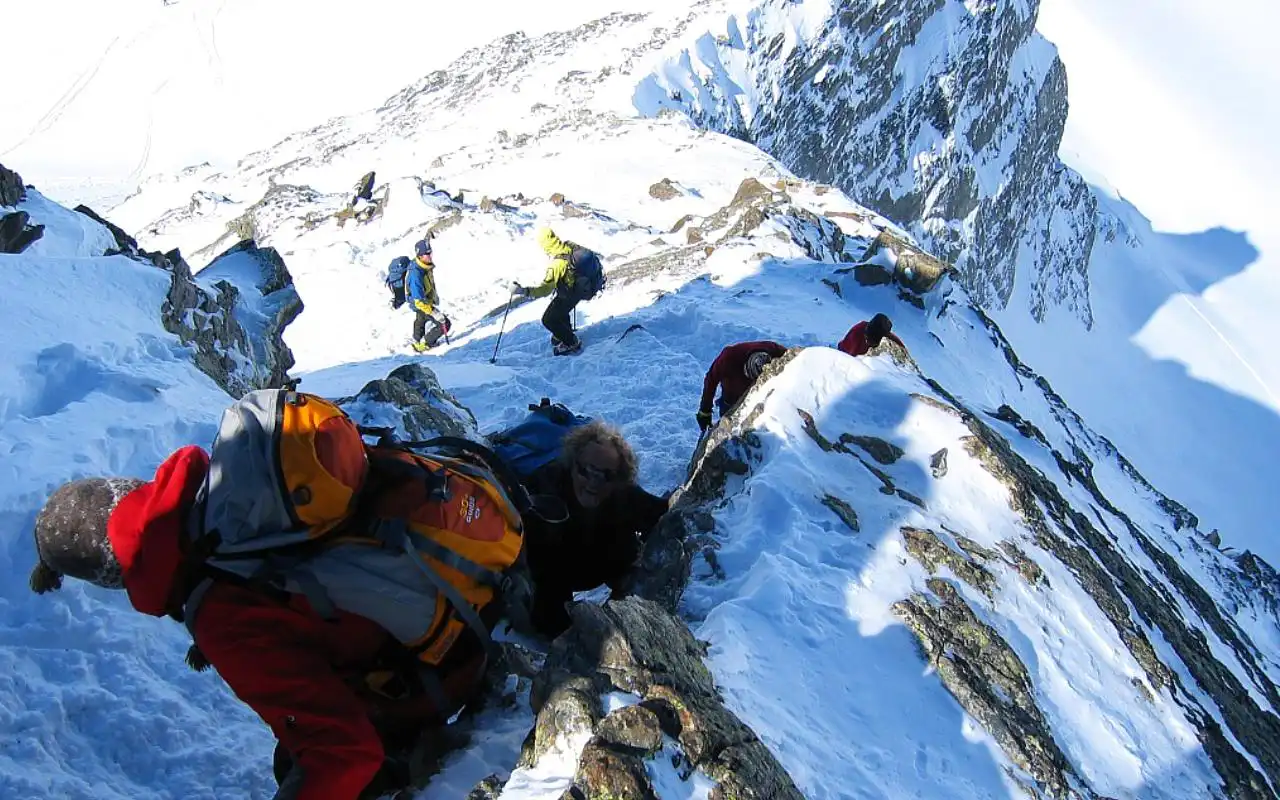
Access Restricted Areas

Understanding Restricted Areas in Nepal

Special areas in Nepal are restricted trekking areas whose access is managed by the government. These are not open areas like popular trekking trails like the Everest Base Camp or the Annapurna Circuit. Rather, trekkers have to acquire special permits and adhere to special regulations.

There are a number of reasons why these restrictions are in place. Border security is one of the primary reasons. There are a large number of restricted zones on the borders of Tibet (China) and the movement in these areas is closely controlled by the government.

The other important reason is cultural preservation. Certain of these areas possess distinct traditions, languages and ways of life that have not changed in centuries. Nepal is aiding the protection of these cultures by controlling tourism so that the cultures are not disturbed.

It is also largely due to environmental protection. The ecosystems around these regions are usually delicate and are easily destroyed by uncontrolled tourism. Through restricting access, one can preserve the natural beauty and biodiversity of these areas.

Some of the popular restricted trekking areas in Nepal are the Upper Mustang, Upper Dolpo, Manaslu Region, Tsum Valley and Kanchenjunga. All these places are special in their own way, starting with desert-like scenery, to isolated villages in the Himalayas.

Previous Trekking Rules (Before 2026)

Before the change of the Nepal trekking rule 2026, there were strict conditions that accompanied trekking in restricted areas. The minimum group requirement was one of the most vital regulations. In order to get a permit, trekkers had to be in a group of at least two individuals.

Besides this, it was also obligatory to book the trek with a registered trekking agency. Independent planning was not permitted, and all permits needed to be dealt with by an authorized agency.

All the restricted area treks needed to have a licensed guide. This regulation was safe and helped control tourism in the isolated areas.

These regulations posed a number of problems to individual trekkers. The travelers could not easily get an equivalent to share trekking with, particularly when they were alone. Some were forced to be randomized into groups in order to satisfy the requirement, which diminished their flexibility and personal experience.

Planning was complicated. Solo travelers were less in charge of time and sometimes had to change plans depending on the availability of the group.

What Changed in 2026?

The trekking rule change of 2026 in Nepal introduced a huge change in the accessibility of restricted areas. The biggest change is the elimination of the minimum two-person requirement.

Individuals are now able to seek restricted area permits without necessarily having to become members of another trekker. With this change, people can now make their own arrangements to travel.

But not all has changed. Not all the rules have been abolished. The trekkers will need to reserve their tours with an authorized trekking agency. They also need to employ an authorized guide throughout the walk.

This is a policy that was implemented by the government in order to create a balance between liberty and security. Although individual travelers are now able to explore on their own, having a guide around guarantees that they are safe and that the local rules are observed.
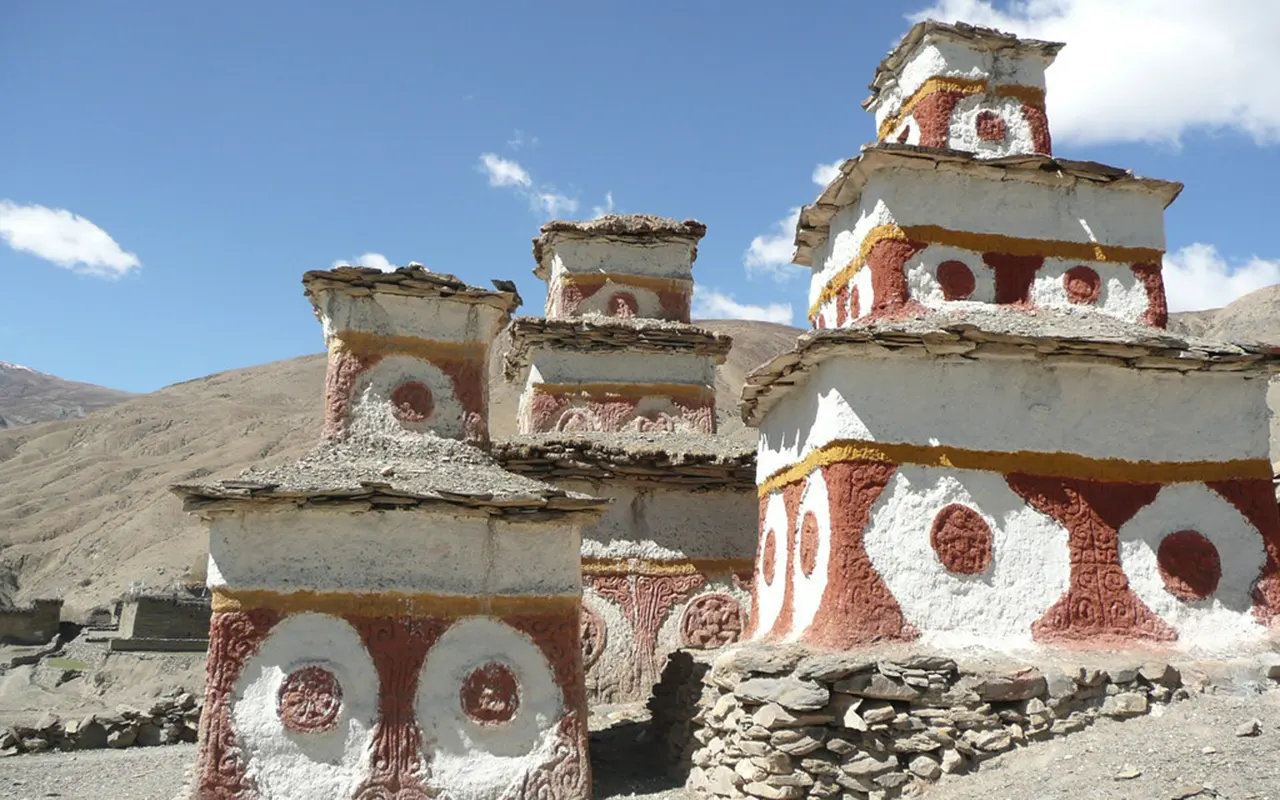
Solo Travelers

Why Nepal Introduced This Rule Change

The reason behind the change of Nepal trekking rule 2026 is due to several reasons. Among the key reasons is the increase in solo travel around the world. An increasing number of people now choose not to travel with others, in search of self-development and exotic experiences.

Nepal has been aware of this trend and changed its policies to suit the evolving demands of travelers. The country will be able to serve more people by letting in individual trekkers.

The other reason is to increase tourism revenues. Restricted areas will have fewer visitors than popular routes, and their opening to individual travelers will encourage the growth of visitors.

The government is also determined to open up remote areas. These places frequently rely on tourism as a source of income, and more trekking will benefit local society.

Lastly, Nepal is competing with other world trekking destinations. It has achieved this by adjusting its policies to make it one of the best adventure travel destinations.

What This Means for Solo Trekkers

This rule change is a great benefit to individual travelers. It makes it easier to plan trips on their own. Trekkers do not have to find a partner or a group anymore to meet permit requirements.

This simplifies and expedites the permit process as well. Visitors would no longer have to rely on others when making their own plans.

Meanwhile, security is an issue. A licensed guide will accompany trekkers on their journey. Guides assist in navigation, communication, and any emergency.

The rule change 2026 of Nepal trekking provides a compromise between liberty and safety, which can be appealing to solitary travelers.

How to Get a Restricted Area Permit (Step-by-Step)

Avoiding the hassle of obtaining a permit is a simple affair with the new system. First, you have to select a trekking destination. Every restricted area has permit requirements and costs of its own.

This should be followed by calling a trekking agency in Nepal that is registered. Although solo travel is currently permitted, it is not yet possible to issue the permits directly to individuals.

You will be required to present some required documents, including a copy of your passport, details of your visa, and travel insurance. The following forms are needed to process your permit.

Then you will pay the permit fees, which are different based on the location and the time you want to do the trek.

You will then be assigned to a licensed guide by the agency. When everything is prepared, you will be given your permits and can set out on your trek.

Cost Breakdown for Solo Trekkers

The pricing of trekking in restricted zones is based on a number of factors. The highest cost is normally the permit fees that differ according to the region.

To take an example, the permit fee is relatively high in Upper Mustang because of its distinct cultural and geographical relevance. Manaslu Circuit tends to be cheaper and still involves a number of permits.

You will have to pay agency service charges in addition to permits. These include the expenses of planning your trek and paperwork.

Another cost is guide fees. It is compulsory to hire a licensed guide, and normally the fee does not include their salary, food, and accommodation.

You also need to allocate money to accommodation, meals, and transport.

Generally, trekking in restricted places is more costly than common treks; the experience is usually more exclusive and challenging.

Role of Trekking Agencies & Licensed Guides

Trekking agencies still have a significant role to play even after the Nepal trekking rule change of 2026. Their responsibility is to put permits in place, logistics, and to make sure that all the regulations are taken care of.

Certified guides are important. They are useful in following complicated paths, and particularly in remote areas where the paths are not well marked.

Safety support is also offered by guides. They are trained to act swiftly in case of emergencies or in case of altitude sickness.

They also provide a bridge to the culture, assisting the trekkers to appreciate the local culture and traditions. This improves the general trekking experience.

Hiring locals, as guides, also helps trekkers to contribute to the local economy and communities in remote regions.

Benefits of the New Rule

The Nepal trekking rule change 2026 has various obvious advantages, particularly to solo travelers. The greatest benefits are that it can enable one to trek without the need of seeking someone to join them. This simplifies the planning process and allows travelers to explore at their leisure.

It also enhances access to remote areas such as the Upper Mustang and the Upper Dolpo, which could be hard to reach by individual trekkers in the past. These exotic scenes and cultures can now be enjoyed by more travelers.

The Nepal tourism industry also benefits from the change. The increased tourist arrivals will benefit the local communities through the lodges, guides and small shops, among others, particularly in remote locations where tourism is a big contributor to income.

Meanwhile, safety is not compromised. The presence of a licensed guide is valuable in high-altitude and remote areas, as it ensures that trekkers have support on the way.
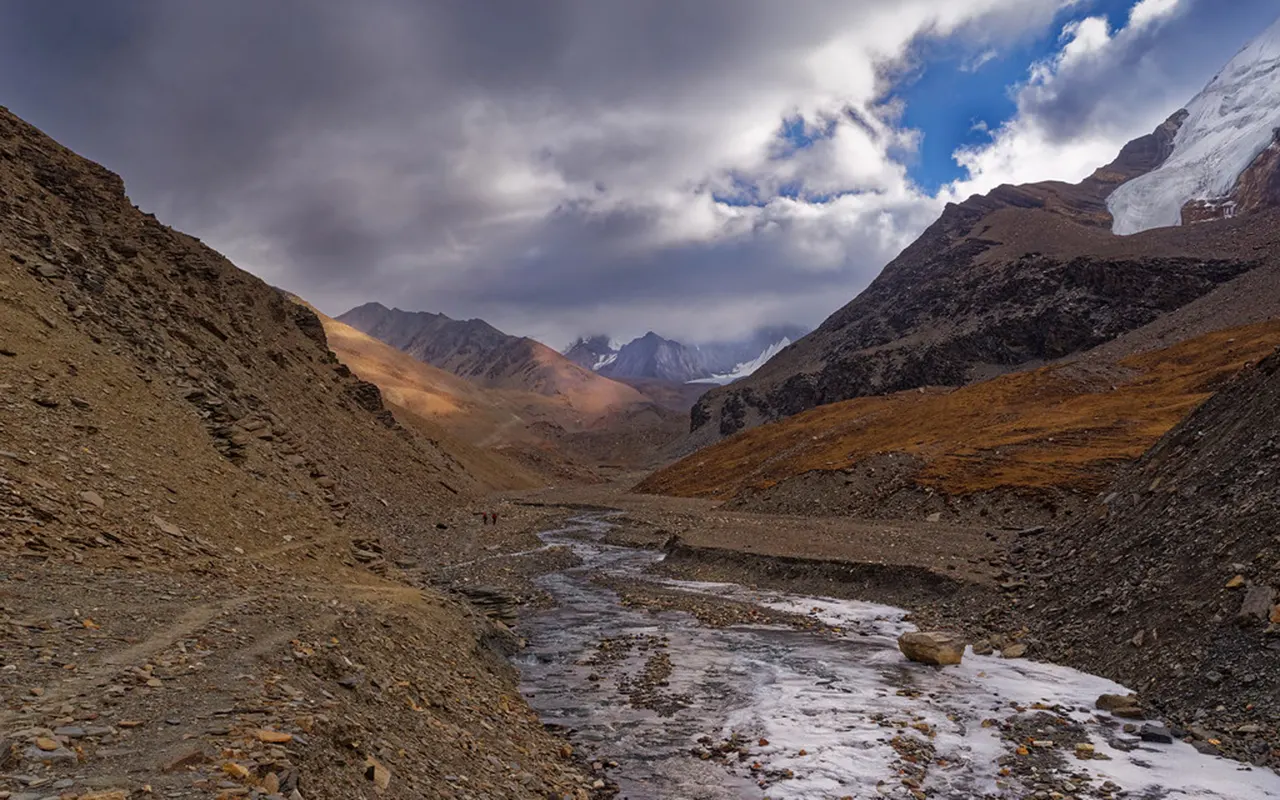
Nepal’s Big Trekking Rule Change

Limitations You Should Know

In spite of the advantages, the Nepal rule change for trekking in 2026 has certain limitations. Trekking is not totally autonomous and authorizations need to be registered via a registered trekking agency.

It is necessary to hire a licensed guide, which increases the final price. This is not always easy to afford among budget fliers as opposed to unrestricted fares.

Rules on permits are still in play, and some areas are still restricted. There are certain requirements that need to be adhered to in each region.

Planning is less flexible. Because you have to liaise with an agency and a guide, it can be harder to make impromptu changes to your itinerary.

Best Restricted Area Treks for Solo Travelers

One of the most suitable places to visit individually is Upper Mustang. It has its own desert-like features and a rich Tibetan culture. It is culturally important and scenic as the area is approximately 3,800 meters (12,467 ft) in elevation.

Another option is the Manaslu Circuit. It is a mix of long trekking paths and breathtaking mountainous landscapes. The Larkya La Pass is 5,160 meters (16,929 ft) and is a challenging and rewarding experience.

Tsum Valley is the place to go to experience a spiritual journey. It is characterized by its monasteries and tranquility, and its villages were found at an altitude of 3,700 meters (12,139 ft).

Upper Dolpo is an adventure lover’s paradise. It belongs to the most distant areas in Nepal, and the passes are over 5,000 meters (16,404 ft).

Essential Tips for Solo Trekking in Restricted Areas

  • It is important to select a good trekking agency. Ensure that the agency is established and receives positive reviews.
  • Ensure you check the license and experience of your guide. A well-versed guide can be of immense help in your quest.
  • Equip yourself for remote conditions. There are a few facilities around a restricted area, and you must be physically and mentally ready.
  • Be respectful of local customs and rules. These are culturally sensitive areas, and proper conduct matters.
  • Proper and positive thinking will aid in making the trek an easy experience.

FAQs

Can I trek alone all the way now?

No, you cannot walk all alone. All treks in the restricted areas of Nepal still require the services of a licensed guide.

Is a guide still mandatory?

Yes, even with the Nepal trekking rule change of 2026, when Nepal opens up to solo travelers, employing a licensed guide is mandatory.

What is the duration of obtaining permits?

The process of permit processing normally requires one to three working days with a registered trekking agency, based on the destination.

What are the best restricted area treks to do for beginners?

Trekking in the Manaslu region is thought to be favorable to beginners because of the ease of access and the fairly well-developed trekking infrastructure.

Is it safe to solo trek in Nepal?

Yes, in most cases, it is safe under the guidance of a licensed guide, adequate preparation, and understanding of altitude, weather, and remote conditions.

Should I have a trekking agency do the work?

Yes, one needs a registered trekking agency to process permits; one cannot obtain permits for restricted areas without going through a registered trekking agency.

Is the permit fee the same for all locations?

No, permit fees vary based on the area, the period of stay, and other details set by the Government of Nepal.

Is it possible to customise my itinerary when on the trek?

Only small adjustments can be made, and there is not much flexibility, as the permits, guides, and logistics are predefined.

What documents do you need for restricted area permits?

If you are processing the permit, you require a copy of your passport, a valid visa, the details of your travel insurance, and passport-size photographs.

In what season should one trek the restricted regions of Nepal?

Most of the restricted areas provide the most favorable trekking conditions, clear views of the mountains, and better weather during spring and autumn.
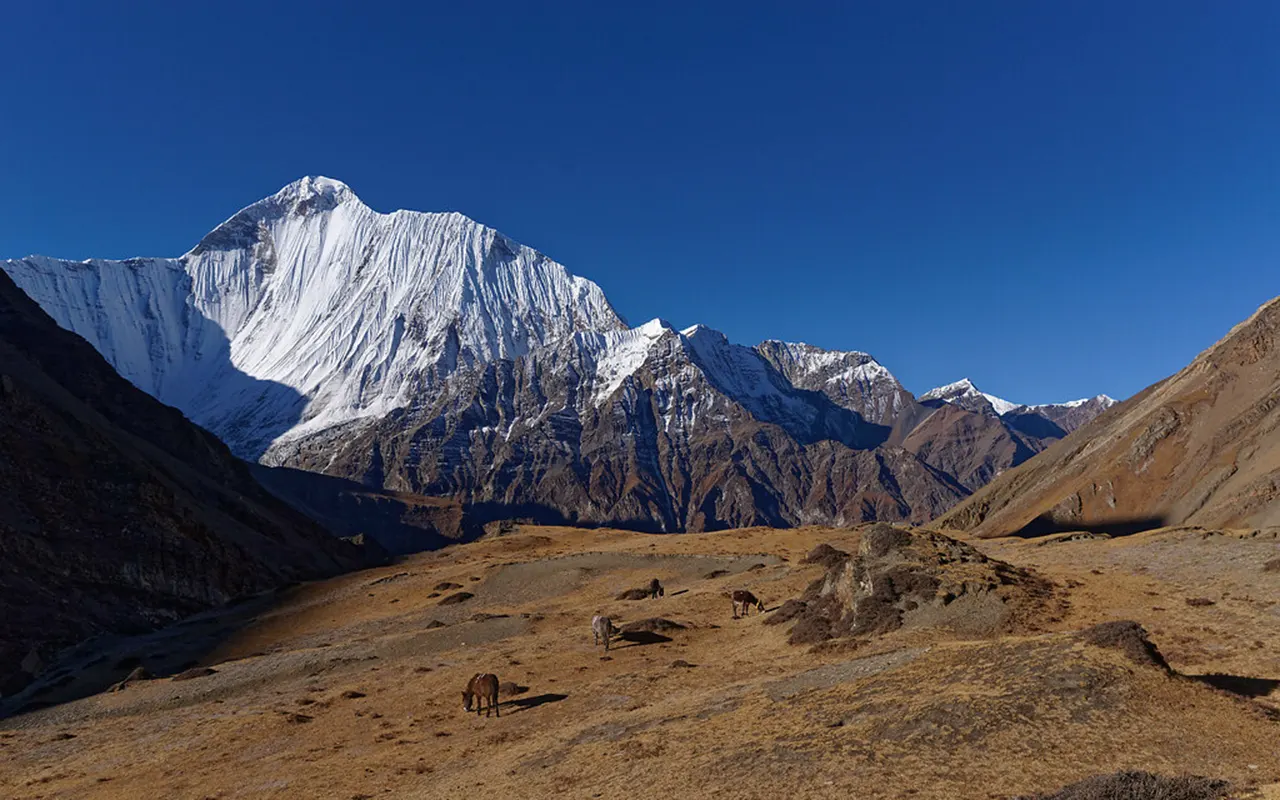
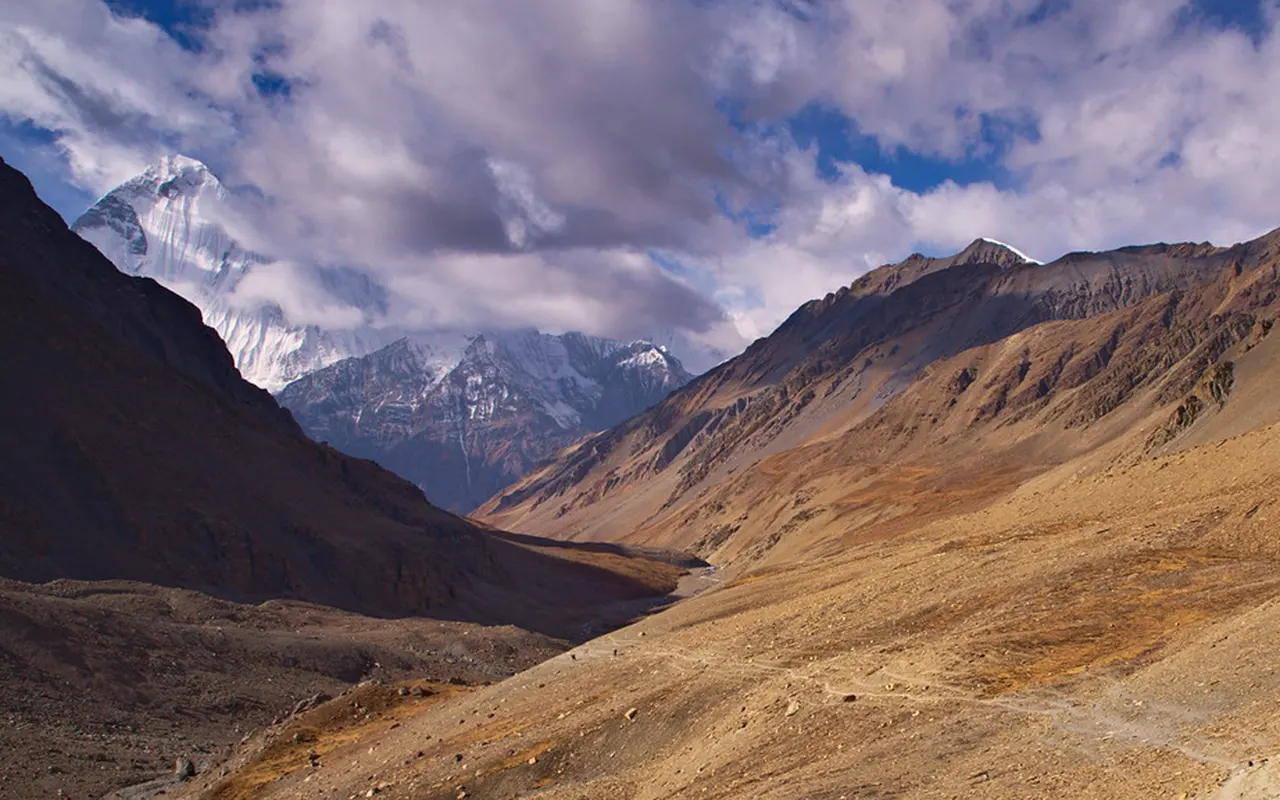
Solo Travelers Can Now Access Restricted Areas

Conclusion

The rule change of Nepal trekking 2026 is a big milestone in the history of Nepal trekking. The country has opened its remote areas to solo travelers, keeping the areas safe and controllable.

With this transformation, there exists a balance between freedom and responsibility. Trekkers now have more freedom as they can have the services of licensed guides.

Anyone who has decided to take an adventure in Nepal should not miss this chance of visiting these special places. Solo trekking in restricted locations can be an indelible experience when properly planned and with proper respect to the local culture.

When you are planning your next trek, this is the time you need to begin the planning, get in touch with one of the reliable trekking agencies, and enjoy the beauty of Nepal in a way you have never seen before.
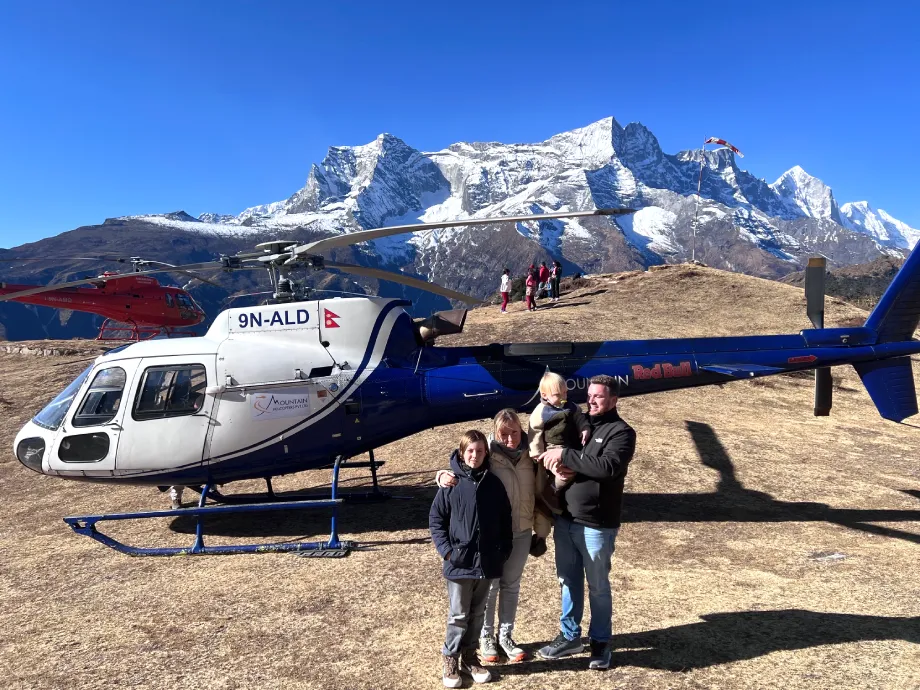
Luxury Everest Base Camp Trek – The Ultimate Premium Himalayan Adventure

The Luxury Everest Base Camp Trek is one of the most exclusive trekking experiences in the world. It combines the adventure of trekking in the Himalayas with the comfort of luxury accommodation, helicopter transportation, and professional guiding services. This premium trekking experience allows travelers to explore the legendary Everest region while enjoying high-end hospitality and safety.

The trek begins in Kathmandu, the vibrant capital city of Nepal. Travelers stay in luxury five-star hotels that provide international standards of comfort, including spacious rooms, excellent dining, spa services, and relaxing environments before beginning the Himalayan journey.

The main highlight of the trek is reaching the base of the world’s highest mountain, Mount Everest. For many travelers, standing in the shadow of Everest is a dream adventure. The luxury trek makes this dream possible without sacrificing comfort.

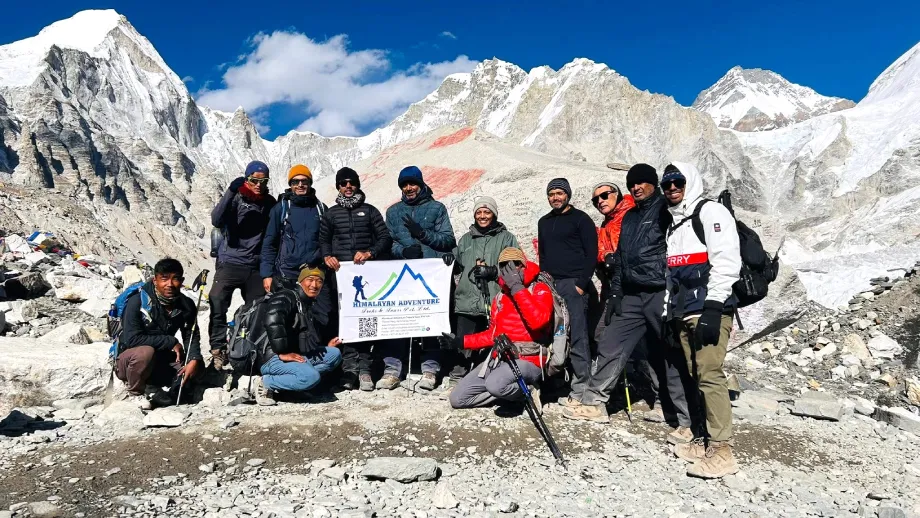
Group Photo at Everest Base Camp

Scenic Helicopter Flight to Lukla

The adventure usually begins with a spectacular helicopter flight from Kathmandu to Lukla. This short but exciting flight offers breathtaking aerial views of the Himalayas.

Flying by helicopter provides several advantages compared to standard domestic flights. Helicopters offer more flexibility with weather conditions and reduce travel delays. The scenic flight itself becomes one of the highlights of the entire journey.

During the flight, travelers can see snow-capped mountains, deep river valleys, terraced hillsides, and remote Himalayan villages.

Trekking Through the Beautiful Khumbu Region

After arriving in Lukla, trekkers begin their journey into the Khumbu region, following the famous Everest Base Camp trekking route.

The first stop is the village of Phakding, located along the beautiful Dudh Koshi River. From here the trail gradually ascends through forests of pine and rhododendron.

The next major destination is Namche Bazaar, the main trading center of the Everest region. Namche Bazaar is a vibrant Sherpa town filled with bakeries, cafes, gear shops, and stunning viewpoints.

Luxury trekkers stay in premium lodges such as Yeti Mountain Home, which offer exceptional comfort compared to traditional teahouses.

These lodges provide heated dining rooms, comfortable beds, attached bathrooms in some locations, and high-quality meals.

Cultural Highlights Along the Trek

The Everest region is not only famous for its mountains but also for its rich Sherpa culture and Buddhist traditions.

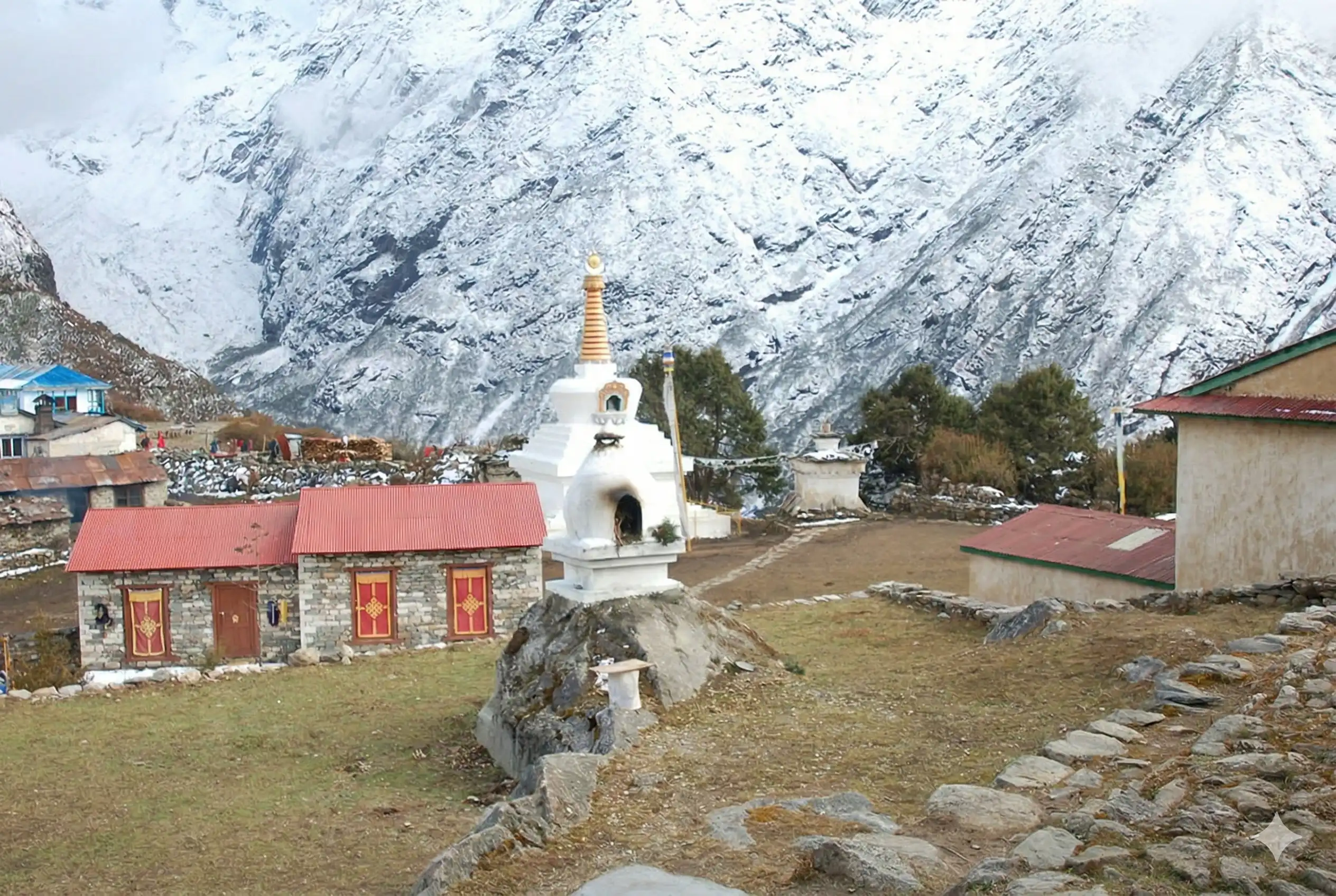
One of the most important cultural sites on the trek is Tengboche Monastery. This beautiful monastery is the spiritual center of the Khumbu region and sits in a spectacular location surrounded by Himalayan peaks.

Nearby, luxury trekkers stay at Himalayan Luxury Lodge, which offers breathtaking views of Mount Everest and other iconic mountains.

Visitors can experience Buddhist ceremonies, prayer chants, and the peaceful atmosphere of this sacred site.

Higher Himalayan Adventure

As trekkers ascend higher into the Khumbu Valley, the landscape becomes increasingly dramatic. Forests gradually disappear, replaced by rugged alpine terrain and glaciers.

Trekkers pass through villages such as Dingboche, where they spend time acclimatizing to the altitude.

The journey continues through the remote settlements of Lobuche and Gorak Shep.

At these high altitudes, temperatures can drop below freezing. Luxury trekking packages ensure the best possible accommodation available, including spacious rooms and electric blankets to keep trekkers warm.

Everest Base Camp and Kala Patthar

Reaching Everest Base Camp is one of the greatest achievements for any trekking enthusiast.

Trekkers also climb to Kala Patthar, which offers the best panoramic view of Mount Everest. Sunrise from Kala Patthar is considered one of the most spectacular mountain views in the world.

After this unforgettable experience, trekkers return to Kathmandu by helicopter, enjoying a breathtaking flight over glaciers, valleys, and towering peaks.

If visiting the Everest Base Camp and taking a photo against the backdrop of the Everest, the very top of […]
11 Days
Moderate

US$ 4200

View Detail

Journey Through the Legendary Everest Region

The adventure begins with a scenic helicopter flight to Lukla, the gateway to the Everest region. The helicopter journey provides spectacular aerial views of deep valleys, rivers, forests, and snow-covered peaks.

From Lukla, trekkers begin walking through traditional Sherpa villages and beautiful landscapes. The trail follows the Dudh Koshi River and passes through charming settlements such as Phakding and Namche Bazaar.

Namche Bazaar is the heart of the Khumbu region. It is a bustling mountain town surrounded by spectacular Himalayan scenery. Many trekkers spend an acclimatization day here to adapt to the altitude while enjoying cafes, bakeries, and panoramic viewpoints.

Luxury trekkers stay in premium lodges such as Yeti Mountain Home. These lodges provide warm hospitality, heated dining rooms, comfortable beds, and high-quality meals.

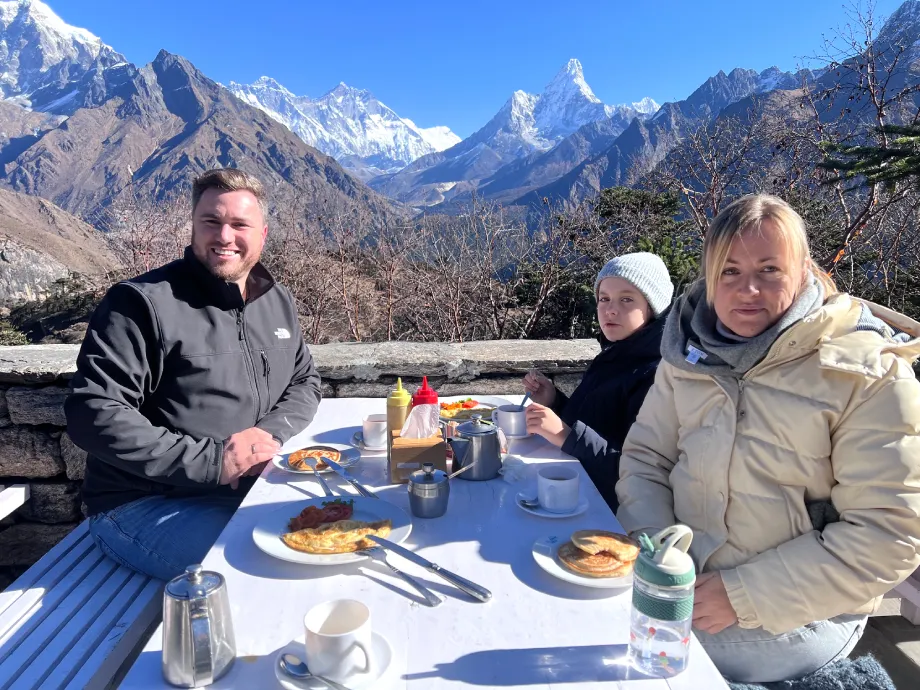
Breakfast at Hotel Everest View

Breakfast at Hotel Everest View

Why Choose Luxury Everest Base Camp Trek?

Luxury trekking offers many advantages:

• Comfortable lodges with high-quality services
• Helicopter flights to reduce travel time
• Professional guides and Sherpa support
• Smaller groups and personalized attention
• Safe and well-organized logistics

This type of trekking is ideal for travelers who want both adventure and comfort.

Luxury Everest Base Camp Trek Itinerary

Day 1 – Arrival in Kathmandu
Day 2 – Helicopter flight to Lukla and trek to Phakding
Day 3 – Trek to Namche Bazaar
Day 4 – Acclimatization day in Namche
Day 5 – Trek to Tengboche
Day 6 – Trek to Dingboche
Day 7 – Acclimatization day
Day 8 – Trek to Lobuche
Day 9 – Trek to Gorakshep and visit Everest Base Camp
Day 10 – Sunrise hike to Kala Patthar and helicopter return to Kathmandu
Day 11 – Departure

Luxury Everest Base Camp Trek Cost Breakdown

Typical luxury trek price ranges USD 4000 – USD 7000 per person.

Included Services

• Luxury hotels in Kathmandu
• Helicopter flights
• Premium mountain lodges
• Professional guide and Sherpa staff
• All meals during trekking
• Trekking permits
• Airport transfers
• Porter services

Major Cost Factors

Helicopter flights – $1200 to $2000
Luxury accommodation – $150 to $400 per night
Guides and porters – $30 to $80 per day
Permits and park fees – $100 to $200

Luxury vs Standard Everest Base Camp Trek

Feature Luxury Trek Standard Trek
Accommodation Luxury lodges Basic teahouses
Transportation Helicopter options Domestic flights
Comfort High Basic
Return Journey Helicopter Trek back
Cost $4500 – $7000 $1300 – $2500

Luxury trekking offers a more comfortable and efficient experience.

Luxury vs Everest Base Camp Helicopter Tour

Many travelers also compare the luxury trek with a helicopter tour.

Feature Luxury Trek Helicopter Tour
Duration 10–12 days 1 day
Experience Trekking adventure Scenic flight
Altitude experience Gradual Short visit
Physical effort Moderate Very easy
Price $4500 – $7000 $1200 – $1700

Helicopter tours are great for travelers with limited time, while luxury trekking offers a deeper Himalayan experience.

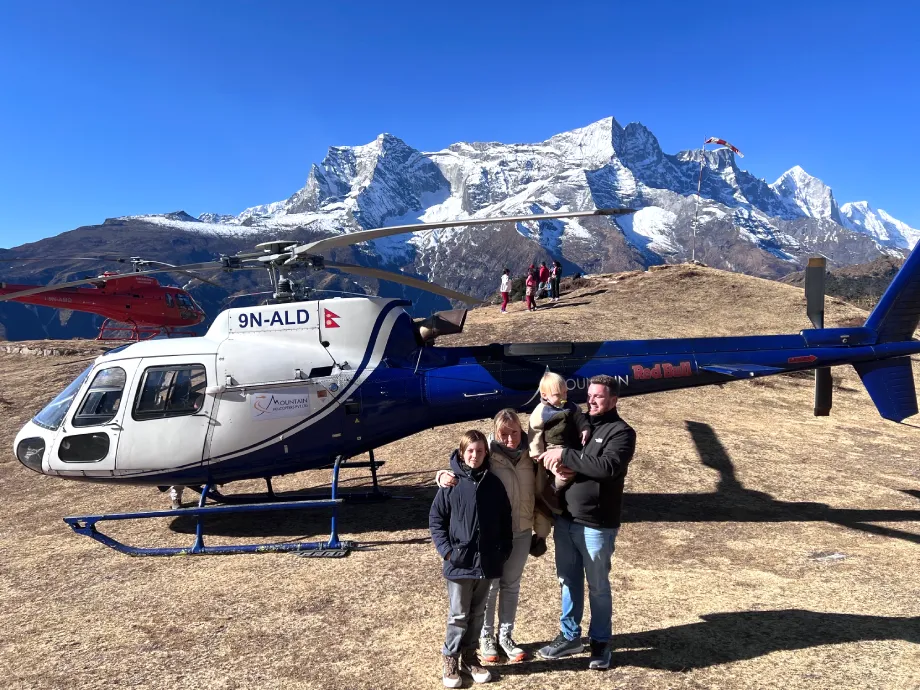
Group ready for Helicopter Tour

Luxury Everest Base Camp Trek – FAQ

1. Is the Luxury Everest Base Camp Trek difficult?
It is moderately challenging but manageable with proper preparation.

2. What is the highest altitude?
About 5,545 meters at Kala Patthar.

3. Do I need previous trekking experience?
Not necessarily, but good fitness is helpful.

4. When is the best time?
Spring and autumn.

5. Are luxury lodges available everywhere?
They are available in major villages.

6. Is WiFi available?
Yes, in most villages.

7. Are hot showers available?
Yes, in most luxury lodges.

8. Is altitude sickness a concern?
Yes, proper acclimatization is necessary.

9. What type of food is available?
International and local dishes.

10. How cold does it get?
Temperatures can drop below freezing at night.

11. Are electric blankets available?
Yes, in some luxury lodges.

12. Do I need travel insurance?
Yes, helicopter evacuation coverage is recommended.

13. Are guides required?
Yes, for safety and navigation.

14. How long is the trek?
About 10–12 days.

15. Can beginners do this trek?
Yes, with good physical preparation.

16. Is drinking water safe?
Filtered or boiled water is recommended.

17. Are charging facilities available?
Yes, but sometimes for an extra fee.

18. What permits are required?
Everest National Park permit and local permits.

19. What is the best view point?
Kala Patthar.

20. Why choose a luxury Everest Base camp trek?
For comfort, safety, and premium service.

Final Thoughts

The Luxury Everest Base Camp Trek offers an extraordinary opportunity to explore the Himalayas in comfort and style. Travelers can experience breathtaking mountain scenery, rich Sherpa culture, and the legendary Everest region while enjoying premium accommodation and professional service.

For adventurers who seek the ultimate Himalayan journey with comfort, safety, and unforgettable memories, the Luxury Everest Base Camp Trek is truly a once-in-a-lifetime experience.

Culture Experience Trekking in Nepal : A Complete Guide for First-Time Travelers

Introduction

Nepal is always known for its nature and ethnic diversity. It opened a gate to explore an authentic experience through Trekking in Nepal. Due to its cultural richness and merging nature, it is always an attractive aspect for travel enthusiasts. The trekking trails for you to explore different cultural destinations are all over the Himalayas.

Cultural trekking offers an enriching journey covering the rich cultural and traditional practices that live in the corners of the Himalayas. Unlike standard trekking, it gives travellers and trekkers an opportunity to explore and to know about the traditions and cultures that have lived back for centuries.

Nepal is a great destination for culturally focused trekking, with dozens of trekking routes that especially offer the cultural and traditional aspects during the journey.

Here, we are about to talk about the cultural trekking experience in Nepal. We will provide the insight about it, which will be helpful for first-time travellers, cultural explorers and those who seek soft adventures.

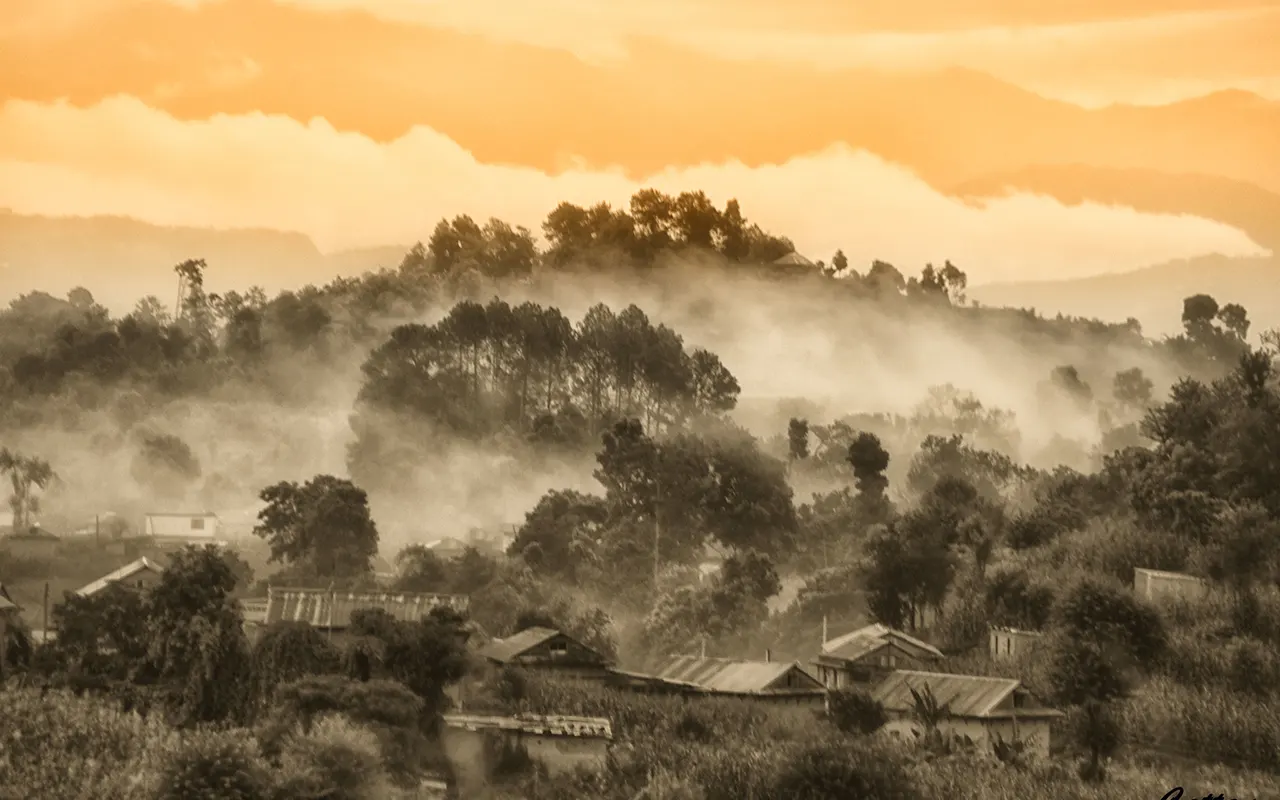
Village

What is Culture Experience Trekking in Nepal?

The cultural trekking in Nepal is a journey which takes you through the traditional trails and through the original habitat of ethnic people.

It combines with the landscapes of mountains, beautiful villages, traditional practices and daily life experience.

It is a bit different from classical trekking as it offers trekkers a different taste with authentic cultural aspects, which are mostly focused and designed to cover most of the cultural destinations. It also gives a chance to interact with locals and have a primary experience from the in-person experience.

Why Choose Culture Experience Trekking in Nepal?

As we know, Nepal is a diverse country in terms of ethnicity and has a huge collection of culture and traditions that have been practised for centuries.

The ethnic groups, like Gurung, Tamang, Sherpa, Thakali, Rai, Limbu, etc. These ethnic groups are themselves culturally diverse. The languages, cultural attire, architecture, traditions and even unique rituals each of them practices offer an ultimate experience.

Living Traditions and Ancient Heritage

Heritages like Buddhist monasteries, Hindu temples, prayer flags and mani walls reflect the living tradition and the amazing beauty of ancient heritage.

Most of the ethnic communities and people in remote areas and hilly parts still live with traditional farming lifestyles, as well as very vibrant village systems. It makes Nepal more feasible for a cultural trekking experience.

Warm Hospitality and Homestay Experiences

The hospitality of people in Nepal is always considered the best, with their cultural meaning too.

Among them, the teahouse culture in Nepal is a blooming cultural practice for travellers to stay and to offer services with traditional taste and styles.

As well, community-based tourism is now one of the most chosen bases for cultural experience in Nepal while on a trek.

Family-run lodges are also popular as they offer authentic village meals which are prepared with locally produced ingredients and traditional methods.

Teahouse

Best Regions for Culture Experience Trekking in Nepal

Annapurna Region

Besides the spectacular beauty, the Gurung and Magar communities, which are the majority of the ethnic community living in the region, make it an authentic cultural experience.

Destinations like Ghandruk village offer key features of Gurung cultural and traditional aspects, which are in practice with the majestic beauty of the snow-capped mountain range and terraced farms.

As well, the Annapurna region is known for its cultural festivals. So, good timing can make a better experience.

Langtang Valley

The Langtang Valley trek is popular for its Tamang heritage with Tibetan influence. It is full of monasteries which are significant for Buddhist flowers and traditions. The yak culture in there is also one of the most talked about.

Also, the unity of the community also has a strong presence. They proved it by rebuilding the heritages and villages which were damaged during the massive earthquake back in 2015.

Everest Region

Being the home of Everest, the highest peak in the world, it also holds the majestic beauty of nature and the Sherpa culture, which are mostly influenced by the Buddhist traditions.

The monasteries like Tengboche, which is one of the oldest and the largest monasteries, highlight the influence of the cultural and traditional lifestyle of people living there. The traditional lifestyle in the high-altitude stands the Everest region as a great region to travel for cultural experience.

Upper Mustang

Upper Mustang is an ancient Tibetan-influenced kingdom. Upper Mustang, also known as the forbidden kingdom, is a hidden gem inside the mountainous desert.

It consists of caves, monasteries, as well as amazing desert landscapes. The geography also offers a unique experience of the Himalayan desert at high altitude. It keeps the preserved culture and traditions. It is also a restricted area, which enhances the cultural trekking experience more.

Ghorepani Poon Hill Trek

Ghorepani Poon Hill Trek is a short and sweet trekking experience focused on cultural villages and is popular for its beauty. It lies inside the Annapurna region, which itself is considered a gem in the Himalayas for nature and scenic enthusiasts.

Tamang Heritage Trail

It is more focused on the Tamang culture and takes you through the Tamang villages.  The scenery, landscapes, nature, and tranquillity offer favour to cultural experience. It is also a less crowded trail, unlike what you see in Annapurna or in Everest, making it ideal for people who seek a silent journey.

Trekking in Nepal

Mardi Himal Trek with village extensions

Mardi Himal trek is a short trek which offers a massive altitude gain from 1000m to 4000m in just 3 days. And with the beauty as well, cultural villages, mostly admired for their teahouse experience, offer an authentic lifestyle experience very similar to the Himalayan people.

Everest Panorama Trek

Everest panorama circuits the Everest sanctuary and offers a scenic experience. It provides an opportunity to experience several Sherpa settlements and communities along the trail, making it one of the most diverse cultural trekking.

Helambu Cultural Trek

Another Helambu cultural trek, which follows the traditional trail that has been in use since ancient times, is the key feature of this trekking journey. The untouched nature and cultural combination offer a very unique and ultimate experience to remember.

What to Expect on a Cultural Trek?

Expect basic accommodations and challenges during the cultural trek if you seek adventure and an authentic experience.

Different trekking routes vary in duration. Most routes involve daily walks of about 5 to 6 hours.

Accommodations are typically teahouses and homestays, offering basic services and an authentic taste of traditional lifestyles.

It offers foods like dal bhat, momo, yak cheese, butter tea, and local cuisines, which are mostly produced locally.

These regions have rich cultural traditions, so show respect for local customs. Interact with villagers for insight, and meet monks for wisdom and blessings.

Best Time for Culture Experience Trekking in Nepal

Spring and Autumn are the best seasons for cultural experience trekking in Nepal, offering favorable conditions and aligning with most travelers’ preferences.

During the season of Spring, trekkers get stable weather and clear visibility. Longer days to enjoy the pace. Blossoming flowers all over landscapes. Refreshing atmosphere and much greenery. Overall, trekkers will enjoy the scenic trails and refreshing journey during the spring season. It is also a great time to attend the festival.

During Autumn, the weather will be at its most stable stage of the year. The trails will get colourful due to the falling season of dry leafs. The mesmerizing journey with warm hues, as well as the clearest visibility of the year, offers a vibrant journey during this season.

During winter, it is also considered due to the festival charm. Various festivals, which are mostly celebrated in the Himalayas by different communities, fall during the winter. Monsoon can also be taken as the best time if trekkers want to have a rainy journey with a cultural experience.

Safety Tips for First-Time Cultural Trekkers

Safety and precaution are crucial during trekking. Always follow safety measures to enhance your cultural experience.

Altitude sickness is a very necessary factor to consider and to keep safe from. The altitude sickness is vital after 3000m of eleveati6form the sea level. It can cause vomiting, nausea, headaches, etc. So, prefer not to do any activities that can trigger altitude sickness, like running, jumping, or any other activities that require frequent body movement.

Travel insurance is another important key to follow if you want to ensure your safety. The Himalayas are always uncertain about incidents. So, a good travel insurance can be helpful for safety, rescue coverage, and in any uncertain incidents.

Hydration and pacing are also important factors to keep yourself safe from altitude sickness and to ensure your body’s reaction. Keeping yourself hydrated and maintaining the pace during your journey can help you to avoid various risks.

Choosing a reliable trekking company is a necessary step if you want a guided, safe, navigated, and well managed journey. Always choose a trusted, well-certified, government-licensed, and reliable trekking company like ……..

Culture Experience Trekking in Nepal

FAQs

  • Is culture trekking suitable for beginners?

Yes, it is suitable for beginners, and it enhances the journey mostly for first-timers, if they want to have an authentic journey in the beginning.

  • Do I need prior trekking experience?

In most cases, you do not need to have prior experience for cultural trekking unless it’s a long trekking journey, such as a trek like ABC or EBC, and with a similar duration journey. The trekking, like Ghorepani Trek, Mardi Himal  Base  Camp Trek, Helambu, etc., can be more feasible.

  • Can I trek solo?

With some recent changes in rules and regulations in trekking, solo trekking is banned, ensuring the safety and safe navigation of the trekking journey for trekkers. There are very few trekking trails that do not require a guided journey.

  • Is it safe for female travelers?

Yes, it is safe for female travelers. You do not need to worry about your safety during your travel in the Himalayas. Also, people there are great and friendly with warm hospitality and supportive behaviour.

  • What level of fitness is required?

A good physique and basic fitness can be best for better results. You can also do some basic breathing exercises if you want your experience to be more enjoyable and at your own pace.

Final Thoughts: Why Culture Experience Trekking in Nepal is Life-Changing

Cultural trekking in Nepal is not just about understanding and exploring the cultural side of Nepal, but also helps with personal growth.

During your journey, you get to experience meaningful connections with nature that local people practice. The authentic taste of local culture and tradition is a big advantage. The local foods, too, are an ultimate experience to have, which are prepared with locally produced ingredients in untouched nature.

Cultural trekking in Nepal is not just about a lifetime experience but also a connection and a journey beyond the mountains.

Nepal Tea House Trek: Complete Guide for First-Time Trekkers (2026)

Trekking in Nepal is a widely done outdoor activity. The diverse Himalayan geography offers various trekking trails all across the mountain region. With a huge number of trekking trails across Annapurna, Everest, Manaslu, and other trekking regions, Nepal stands out as a trekking hub in the tranquil nature. In such a diverse nature trail, the tea house trek is now becoming a very vibrant choice among trekkers and travellers.

Teahouse Trek is basically a trek, where a trekker does trekking activity with the accommodation relying on teahouses or lodges across the routes. These teahouses provide basic services, but with a very close immersion in local lifestyle and an authentic taste of Himalayan life.

It is considered ideal mostly for beginners due to its flexibility as well as affordability. These teahouses in tea house treks are mostly owned and run by the local community and provide very affordable pricing in services, food, and lodging. It is also considered best for beginners because it provides an authentic taste of the local lifestyle during the trekking journey.

In this guide, we will talk about the Nepal Teahouse trek and provide you with some insights about its features and aspects. You will explore the idea and the taste of teahouse treks in Nepal before you plan to do one by yourself. Stick in here to get the proper insight.

What is Nepal Tea House Trek?

Briefly, the Tea House Trek is actually an old form of trekking, which includes the local teahouses and lodges as accommodation during long duration journey. Due to its traditional form and authentic taste, connecting the local lifestyle, it is now a popular option among travellers and trekkers, as well as those who seek to explore culture and traditions during their travel.

The history of the teahouse trek starts with the traditional routes, which were once used by the forefathers of the Himalayas for travelling across the hills for different purposes. Later same trail was followed by the first arrival of trekkers, who wanted to explore the Himalayas of Nepal, but added local stays as an option for accommodation. Later trend into teahouses and hence the teahouse trek begins.

It is a bit different from a camping trek, where you need to carry a bunch of trekking gear as well burden of spotting the proper spot for camping. While in teahouse trekking, you will find them across the trails and provide more than what you need to compromise with camping. Also, you will be free from unusual weight when you are on steep climbs.

Teahouses during the teahouse trek are mostly owned by the local community, as mentioned above and provide basic services. Most of the food menu consists of local dishes and cuisines with locally produced ingredients. As well as the lodging, it provides basic yet clean, simple bedroom services, sometimes shared.

Why choose a Nepal Tea House Trek as a Beginner?

Nepa tea house trek is considered an ideal choice for beginner trekkers. Unlike camping, you do not need to carry heavy camping gear and equipment. You will get comfortable accommodations along the route, which also come with traditional and authentic tastes.

The Teahouse trek is also more affordable compared to other trekking styles. It also provides trekkers a flexibility of itineraries as well socail and cultural experience along with the journey.

Best Routes for Nepal Tea House Trek

Inside the wide range of trekking trails in the Himalayas, there are several best routes for the teahouse trek in Nepal. Some of them are as follows,

Everest Base Camp Tea House Trek

Everest Base Camp Tea House Trek

Duration: 12 to 14 days

Difficulty Level: Moderate

Highlights

  • Scenic trail with sherpa villages and teahouses across the trail
  • Namche Bazar, a prime Himalayan Town located in the middle of the Himalayas
  • Moderate yet challenging trekking journey
  • Tranquil nature, cultural immersion and high-altitude trekking experience

Annapurna Circuit Tea House Trek

Annapurna Circuit Tea House Trek

Duration: 7 to 12 days

Difficulty Level: Moderate

Highlights

  • Spectacular scenery and majestic views
  • High-altitude trekking experience along with Thorang La Pass
  • Traditional villages with traditional lifestyles

Langtang Valley Tea House Trek

Langtang Valley Tea House Trek

Durations: 7 to 10 days

Difficulty Level: moderate

Highlights

  • Short-duration trek with diverse aspects
  • Fewer crowds and empty trails than Annapurna and Everest
  • Cultural Experience and traditional immersion

Short and Easy Tea House Treks

Ghorepani Poon Hill Trek

Shorter and ideal for a short vacation or for budget travel. Even in a short duration, the trail goes through the most scenic traditional villages surrounded by farming terraces. Within just 5 days of the trekking journey, it covers and passes through rhododendron forest, villages, and ridges with scenic landscapes.

Mardi Himal trek

Mardi Himal trek is another short-duration trek which is popular for its altitude gain from 1000 to 4000m in just 4 days of trekking journey. It is also one of the less-travelled trekking routes, which makes it an ideal choice if you like to have a more tranquil journey with a teahouse experience.

Helambu Trek

This heritage trek also offers a very vibrant cultural trekking journey with a teahouse experience. The trekking trails of Helambu pass through mostly Tamang villages.

What to Expect in Tea House

Teahouse trek is a traditional style trekking experience. It provides basic services with basic logistics. With affordable pricing, it comes with the traditional taste of living in the Himlayas.

Rooms and Facilities

As mentioned above, the rooms will be basic with simple facilities. You will get a twin-sharing room in most of the teahouses. A common dining area as well sharing toilets and showers. Some teahouse provides the room with a private bathroom at an additional cost. You will also get charging and WiFi availability.

Ghorepani Poon Hill Trek

Food on a Nepal Tea House Trek

The menu for food will consist of basic and mostly local items like Dal Bhat, noodles, eggs, as well as other snack items like noodles, pasta and a variety of soups. The meals will be available as breakfast, which mostly consists of noodles, bread, tea and coffee. As well as drinking water from spring which are mostly filtered later.

Best Time For a Nepal Tea House Trek

Trekking in Nepal is mostly welcoming for trekkers all around the year. Trekkers get to choose which features come along with the season they want to enjoy and embark on a journey with. Considering the choice of trekkers and most of the travelers the time of Spring and Autumn can be liked as the best Time for trekking in Nepal.

During spring, you will get a blossoming landscape as well as very stable weather. The visibility will be clearer due to pre-monsoon rain, as well as the greenery at lunch. You will also get longer days to have your trekking journey in slower pace, enjoying the daytime. And scenic trails will be the bonus feature during this time. You will get to enjoy a scenic and refreshing journey during spring.

In Autumn, the weather gets its finest stable stage as well as the clearest visibility of the yr. The trail gets colourful due to the falling season of dry leaves. You will get a picturesque and mesmerising journey if you choose to go trekking during Autumn.

During winter, some trekkers who seek an adventurous journey prefer to have it during the freezing season. The trails will be empty, and off-season brings some features like discount in accommodation, and transportation will be available. But also, the snow-covered trails, extreme cold and low availability of teahouses at higher altitudes can be challenging.

How difficult is a Nepal Tea House Trek?

Nepal Teahouse Trek and its difficulty depend upon the trail. Different trails have their own difficulty levels and factors accordingly.

You need to have good physical fitness for most of the trekking trails, more of its high altitude treks. Precautions and awareness about altitude can be more helpful.

It also depends upon the ability, experience and walling speed to consider the difficulty level for you.

Altitude considerations and acclimatisation in any trekking trails with different difficulty level plays different roles in this factor.

Essential Packing List for Nepal Tea House Trek

The packing for the Nepal Tea House Trek is also a necessary and important aspect to consider. And if you are doing long duration journey in diverse trail, then it is very important to follow proper preparation and packing essentials.

Here are some packing checklist for you.

  • Clothing (layered preferred)
  • Trekking Poles
  • Sleeping Bags
  • Trekking Boots
  • Glasses and Caps(optional)
  • Toiletries
  • Water Bottle
  • First Aid Kit
  • Backup battery charger
  • Documents and permits

Helambu Trek

Permits Required for a Nepal Tea House Trek

You will need to have some permits and entry permission to get access to the trekking trails of Nepal Teahouse treks. There are specif and trekking region-related permits you need to have during your journey. They are,

  • TIMS(Trekking Information Management System )
  • National Park Permits(rated region)
  • Restricted Area Permits(if applicable)

You can obtain them from the Nepal Tourism Board with your personal ID or legal documents like a valid visa.

Do you need a Guide for a Nepal Tea House Trek?

Yes, you need to have a trekking guide, not just for the regulation of the van on solo travelling in some regions, but for your own safety and proper guidance.

Hiring a Guide or porter is always beneficial for you during long-duration treks. Not just to navigate properly but also to understand the culture and traditions you will encounter during your journey.

Safety Tips for First-time Trekkers

Yes, you need to have some safety tips to follow during your journey. During long journeys or high altitude trekking, it is a very necessary precaution to take for your safety and health factors, as well to avoid unfortunate incidents.

Having altitude sickness awareness and being conscious about it’s precaution and safety can help you to avoid any kind of altitude issues during your trek. Always keep hydrating yourself and avoid any kind of activities that can trigger altitude sickness, like running, jumping or any activities which need you to have frequent body movements and require more respiration mostly in high altitudes.

Having travel insurance is also another important precaution to follow and to have  during your journey. Keeping a first aid kit and emergency contacts are always essential steps to follow before you head on your journey. Also, keep some awareness and stay conscious about weather changes and weather updates.

Culture Etiquette in Nepal Tea House

Culture immersion in teahouse treks in Nepal is a vibrant experience to have. You will encounter diverse cultural and traditional aspects of the ethnic people of the Himalayan regions.

So, you too can immerse yourself in it and experience it with closeness. Keeping cultural respect is always a good image of real travellers. Greeting locals is always a gesture of respect and connection. Always ask for permission before entering locals’ houses and religious sites, and asking before taking photographs of people can be a very kind gesture too. And recommending to support local businesses as well as with conservation initiatives will be even more appropriate.

Mardi Himal trek

Final Tips for Planning Your First Nepal Tea House Trek

Here are some final tips which you can follow before your journey to make your trekking experience more enjoyable and joyful.

Booking strategy

Ways to book a pioneer for your journey. Last-minute booking can be frustrating and can ruin your whole experience as well, during peak seasons like Autumn and Summer, it can also create issues.

Cash vs Card

Always carry Nepalese cash. It is more flexible in remote areas and can reduce the problem leaded from card, as there is always uncertainty about them.

Buffer Days

During buffer days, you can visit the heritage sites in Kathmandu and immerse yourself in historic and religious sites. So, during acclimatisation and gap days, you can explore more about the villages and people where you stay and make such a day into another great memory of your journey.

Mental preparation

This is also a very important aspect before you head on your journey. You need to have your mind made up for the whole journey. Most of the teahouse treks consist of remote areas, which means basic services, basic foods and low connectivity. Also, difficulty during steep climbs and longer walks can be challenging. So, mental preparation is a necessary step.

FAQs

  • Is the Nepal Tea House Trek suitable for beginners?
    Yes, teahouse trek is suitable for beginners, mostly the short ones like Ghorepani poon hill trek, Mardi Himal or Helambu Trek. Due to its affordability, flexibility and presence in a wide range across the Himalayas makes it even more ideal for beginners.
  • What food is available during the Nepal Tea House Trek?
    During the Nepal Teahouse trek, the food menu consists mainly of local dishes and foods that are locally prepared, including Dal Bhat Tarkari, Eggs, noodles, soups, roti and other local cuisines from different ethnic communities.
  • Can you do a Nepal Teahouse Trek without a Guide?
    With recent updates in regulations, solo trekking is banned in most of the best trekking trails due to trekkers’ safety and for proper navigation. So, without Guide it is not possible in the current scenario.
  • Is WiFi available during the Nepal Teahouse Trek?
    Yes, most Teahouse and lodges provides connectivity to Wi-Fi. But also one needs to know the speed could be a bit slower than in cities, as well could need to pay an extra charge or fee, which are basically cheap compared to the maintenance in such remote areas.
  • What is the best time for the teahouse trek in Nepal?
    The best time for the teahouse trek in Nepal is spring and autumn. During these times, you will get stable weather, better visibility, and scenic trails. These features enhance the trekking experience and can make your journey more memorable.

Mani Rimdu Festival – Confirmed Date for 2026

Tangboche Mani Rimdu Festival 2026

The Mani Rimdu Festival is the most important and spectacular event in the calendar of the Sherpa people, a profound and vibrant celebration of Tibetan Buddhism held in the majestic setting of the Everest (Khumbu) region. For those planning to witness this sacred occasion, the Tangboche Mani Rimdu Festival date in 2026 is confirmed to take place on October 26, 27, 28, and 29, which are the main public festival days at the famous Tengboche Monastery. This detailed explanation will explore every facet of the festival, from its ancient history and deep spiritual significance to the intricate rituals and practical information for visitors, weaving in the most searched keywords to provide a complete understanding of this “Mani Rimdu Trek” and cultural experience.

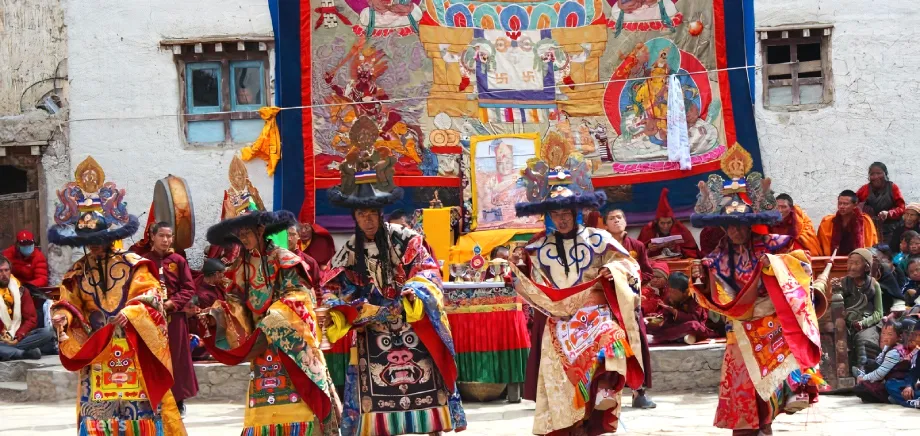
Monks at Tangboche Monastery

An Introduction to the Mani Rimdu Festival 2026

The Mani Rimdu Festival is an elaborate, nineteen-day religious event observed by the Buddhist communities, particularly the Sherpa people, in the Solu-Khumbu district of northeastern Nepal. While the entire festival spans over two weeks with closed-door monastic rituals, it culminates in a three-day public celebration filled with color, music, and profound spiritual meaning. The festival is celebrated at several monasteries in the region, including Thame and Chiwong, but the most famous and grandiose celebration occurs at the Tengboche Monastery, perched dramatically on a ridge with breathtaking views of the Himalayas, including the iconic peak of Ama Dablam and gateway to the Everest Base Camp Trek.

The very name Mani Rimdu unlocks the festival’s core purpose. “Mani” refers to the mantra of Chenrezig, the Buddha of Compassion, which is “Om Mani Padme Hum”. This mantra is chanted millions of times during the festival’s rituals. “Rimdu” (or Rilwu) translates to “sacred pills”—small, red pills that are blessed throughout the ceremonies and distributed to attendees, symbolizing the reception of blessings and spiritual accomplishment. Thus, Mani Rimdu is, at its heart, a festival of blessing, compassion, and the reaffirmation of Buddhist faith. It is a time when Lamas and Sherpas gather at the monastery not just for social celebration, but for the profound purpose of accumulating merits and praying for the welfare of the world.

The Rich History and Origin of Mani Rimdu

The history of Mani Rimdu is a fascinating journey of how a sacred ritual traveled across the Himalayas, adapting to new homes while preserving its core spiritual essence.

Origins in Tibet

The roots of the Mani Rimdu festival can be traced back to the early 20th century in Tibet. It was first established at the Rongbuk Monastery in Tibet, which sits at the base of Mount Everest’s north side. The festival was initiated by a renowned Tibetan Buddhist practitioner, Lama Ngawang Tenzin Norbu, who had studied at the prestigious Mindroling Monastery in Central Tibet, a great monastery of the Nyingma (or “Red Hat”) school of Tibetan Buddhism. The rituals and texts that form the foundation of Mani Rimdu are derived from this ancient lineage. The festival was created as a way to mark the founding of Buddhism in Tibet by the great 8th-century tantric master Guru Rinpoche Padmasambhava, who is credited with subduing local spirits and establishing the Buddhist doctrine.

Transmission to Nepal

The festival found its way to Nepal in the mid-20th century. In the 1940s, due to the changing political landscape in Tibet, the tradition was brought south to the Solukhumbu region of Nepal, home to a large Sherpa population. It was first established at the Chiwong Monastery and later, in 1940, the Tengboche Monastery, which had been founded in 1916 by Lama Gulu, became its new and most famous home. Since then, Mani Rimdu has become an integral part of the cultural and spiritual identity of the Sherpa community, preserving the Nyingma Buddhist traditions passed down through generations.

The Spiritual and Cultural Importance

The importance of the Mani Rimdu Festival is multi-layered, serving religious, social, and cultural functions for the Sherpa community and offering a profound experience for visitors.

Religious Significance

At its core, Mani Rimdu is a powerful religious ceremony with several key objectives:

  • Victory of Good over Evil: The festival reenacts and celebrates the triumph of Buddhism over the dark forces and negative energies that oppose enlightenment. This theme is most vividly portrayed in the famous masked dances (Chham), which depict the defeat of demons and the protection of the Buddhist faith.

  • Spiritual Empowerment: The entire 19-day ritual cycle is designed to generate immense spiritual energy. This energy is channeled into the sacred Mani Rilwu pills, which are then distributed to the public during the Wong (Empowerment Ceremony). Receiving these pills is believed to confer blessings, protection from harm, promote long life, and provide spiritual fortification for the year ahead.

  • Purification and World Peace: A key aim of the festival is to purify the environment and the minds of all beings. The intricate rituals, including the creation and subsequent destruction of the sand mandala and the final Fire Puja (Jinsak), are performed to dispel negative karma, remove obstacles, and bring peace, good fortune, and cosmic balance to the world.

Cultural Significance

For the Sherpa people, Mani Rimdu is the biggest event of the year. It is a time when scattered communities come together, strengthening social bonds and reinforcing their unique cultural identity. The festival is a living transmission of their heritage, passing down ancient stories, artistic skills (like mask-making and dance), and oral traditions to the younger generation. For the outside world, and especially for the thousands of trekkers who undertake the Everest Base Camp Trek during this period, the festival offers an unparalleled, authentic window into the spiritual soul of the Himalayas.

This trail in the Everest region of Nepal offers an insight into the vibrant cultural heritage and the deeply spiritual […]
11 Days
Moderate

US$ 1400

View Detail

The 19-Day Festival: From Secret Ritual to Public Spectacle

While visitors flock to Tengboche for the final three days, the full Mani Rimdu festival is a much longer, more complex affair. The first 16 days are known as the Drupchen (or “Great Accomplishment”), a period of intense, closed-door rituals and meditation performed by the monks.

The Creation of the Sand Mandala

One of the first and most important acts is the construction of the sacred sand mandala. Monks spend several days meticulously creating this intricate, multi-colored diagram out of colored sand. The sand, often sourced from a specific high point in the Himalayas, is carefully laid to form a symbolic cosmic palace of the deity. The mandala serves as the visual and spiritual focal point for all the meditations and prayers performed during the Drupchen. This entire preparatory phase is dedicated to invoking the deities and generating the blessings that will later be shared with the public.

The Three Main Public Days of Mani Rimdu Festival in 2026

The long period of internal practice concludes with three days of public ceremony, a vibrant and deeply moving experience that is the highlight of the Mani Rimdu Festival Trek. The dates you have specified, October 26-29, 2026, mark these main festival days at Tengboche. The schedule typically unfolds as follows:

Day 1: The Empowerment Ceremony (Wong)

The first public day is the Wong, or Empowerment Ceremony. This is a solemn and sacred ritual where the spiritual energy accumulated over the preceding weeks is shared with the community.

  • The Ritual: The head lama of Tengboche, the Tengboche Rinpoche, presides over the ceremony. Pilgrims and visitors gather inside or in the courtyard of the monastery to receive blessings. The Rinpoche, assisted by senior monks, performs tantric chantings and consecrates the Mani Rilwu (sacred long-life pills) and Tshereel (pills for long life).

  • Receiving Blessings: Attendees file past the Rinpoche to receive these blessed pills, which are believed to be imbued with protective and healing powers. It is a moment of profound personal connection and spiritual significance for devotees. This day marks the spiritual opening of the festival, drawing immense positive energy into the region.

Day 2: The Sacred Mask Dances (Chham)

The second day is the most visually stunning and famous part of the Mani Rimdu festival. This is the day of the Chham, or sacred masked dances.

  • The Performance: Monks, who have spent days in deep meditation to embody the deities, emerge from the monastery in elaborate, colorful costumes and large, expressive papier-mâché masks. The dances are performed in the monastery courtyard, with the towering peaks of the Himalayas, including Everest and Ama Dablam, serving as a breathtaking backdrop.

  • The Stories and Symbolism: Each dance tells a story, primarily enacting the victory of good over evil and the protection of the Buddhist faith. The dances are not mere entertainment; they are a form of meditation and a symbolic representation of complex Buddhist teachings. Viewers witness the subjugation of demons, who represent ignorance and ego, by fierce but compassionate deities.

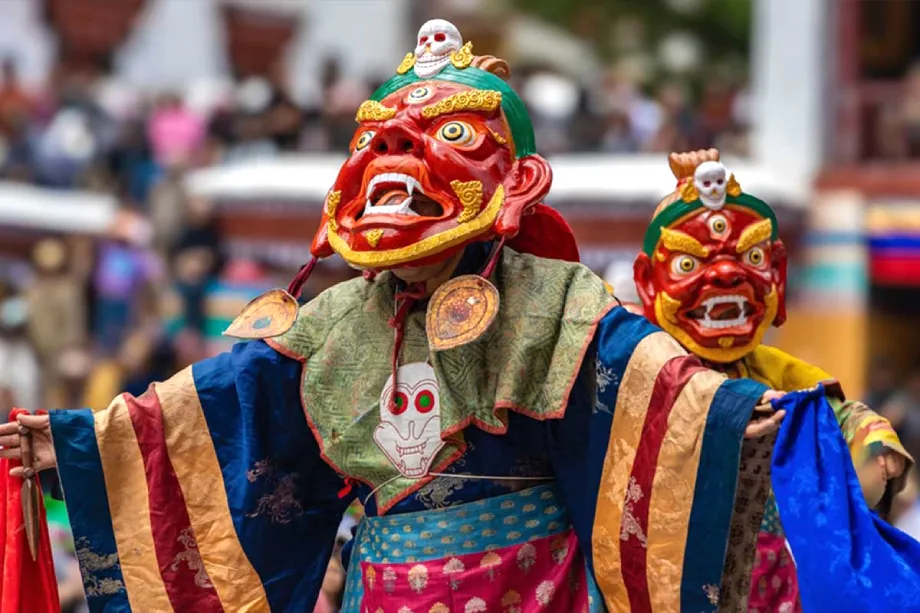
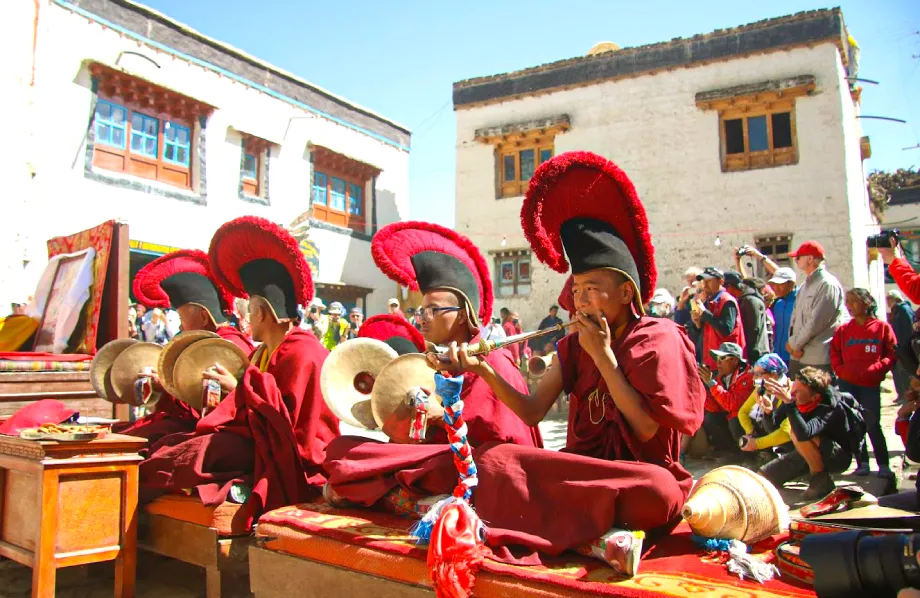
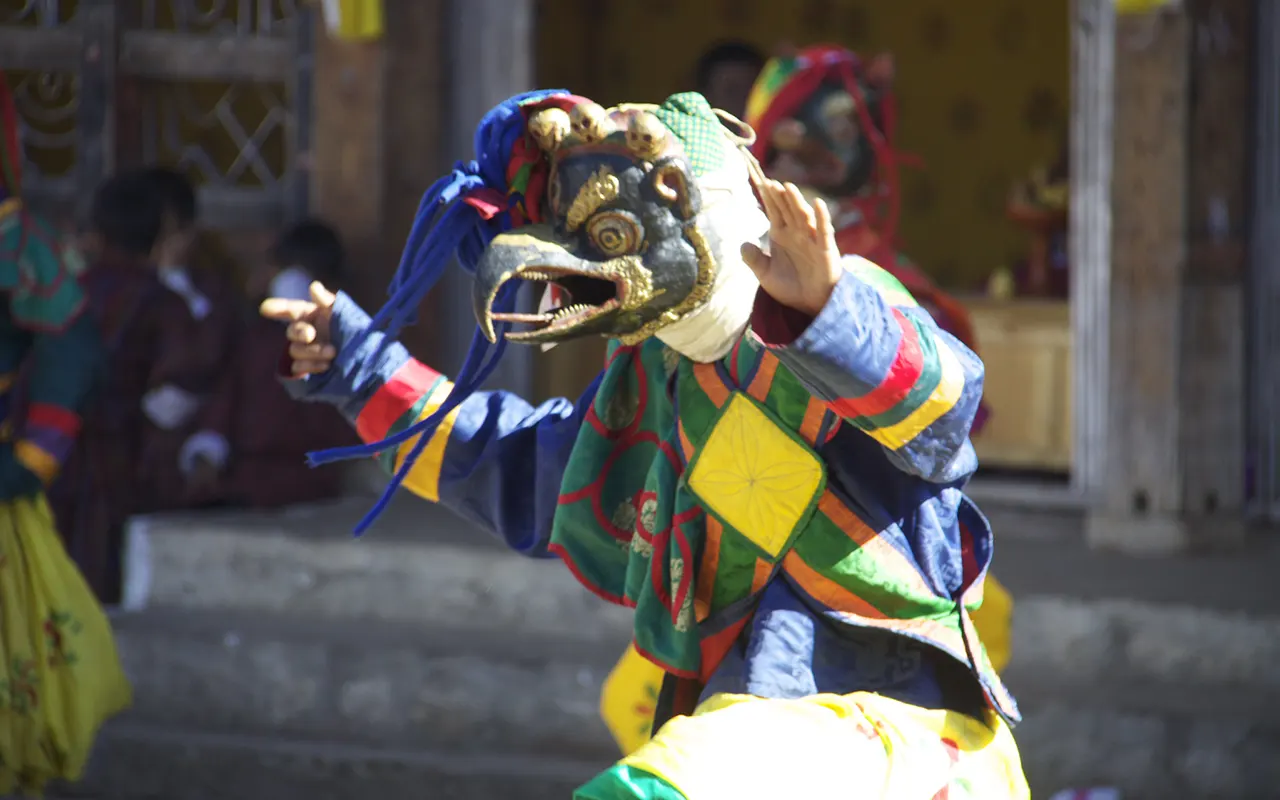
  • Key Dances: Some of the most important dances include the Shanak (Dance of the Black Hat Sorcerers), which ritually cleanses the space of negative spirits; the dances of the Dharma Protectors like Mahakala; and the captivating Dur-Dahk (Dance of the Skeletons), which serves as a powerful reminder of the impermanence of life. The dances are often interspersed with brief, comedic interludes that provide levity and sometimes offer social commentary. The atmosphere is made even more spectacular by the traditional Buddhist folk music played on instruments like drums, horns, and cymbals.

Day 3: The Fire Puja and Conclusion (Jinsak)

The final public day culminates with the Fire Puja, known as Jinsak.

  • The Ritual: This ceremony is performed in a sacred enclosure outside the main monastery. A large fire is consecrated, and the monks chant mantras while making offerings into the flames. These offerings include tormas (small ritual cakes made of barley flour and butter), grains, and other blessed substances.

  • Significance: The fire, often identified with Agni, the god of fire, acts as a purifying agent. The ritual symbolizes the burning away of all negative karma, evil spirits, and mental defilements that were gathered and transformed during the festival. The smoke carries these purified offerings to the spiritual world and dispels any remaining harm.

  • The Mandala’s Dissolution: After the Fire Puja, a final, poignant act takes place inside the monastery. The monks ritually dismantle the intricate sand mandala, sweeping the colored sand into a pile. This act is the ultimate lesson in Buddhist philosophy: a powerful, tangible reminder of the impermanence of all things. The sand is then ceremonially carried to a river and poured into the water, dispersing the festival’s blessings into the world for the benefit of all sentient beings.

Tengboche Monastery: The Heart of the Celebration

The Tengboche Monastery (also spelled Thyangboche) is not just the venue; it is an integral part of the Mani Rimdu experience. Situated at an altitude of 3,867 meters (12,687 feet), it is the largest gompa (monastery) in the Khumbu region. Founded in 1916, the monastery has a dramatic history, having been destroyed by an earthquake in 1934 and a devastating fire in 1989 before being rebuilt with international assistance. Its location, at the confluence of the Dudh Koshi and Imja Khola rivers and on the main trail to Everest Base Camp, makes it a spiritual and geographical crossroads. During Mani Rimdu, the monastery becomes a vibrant hub, its ornate interiors and the faith of the monks providing the sacred space for the rituals, while its courtyard becomes a stage for the timeless drama of the mask dances, watched by hundreds of local villagers and international visitors.

Mani Rimdu Festival Dance Performance

Planning Your Mani Rimdu 2026 Experience

Attending the Mani Rimdu Festival is a highlight of any Nepal tour, but it requires careful planning. The festival coincides with the peak autumn trekking season (October-November), offering stable weather and clear mountain views. This makes a Mani Rimdu Festival Trek an ideal combination of cultural immersion and Himalayan adventure.

Itinerary and Logistics

To be in Tengboche for the main festival days of October 26-29, 2026, you must plan your trek carefully. Reaching Tengboche involves a scenic flight from Kathmandu to Lukla, followed by a multi-day trek. It is crucial to build in extra days for acclimatization, especially in Namche Bazaar, to prevent altitude sickness. A typical itinerary would look like this:

  • Before Oct 26: Fly Kathmandu to Lukla, trek to Phakding, then to Namche Bazaar (allow an acclimatization day here), and finally trek to Tengboche.

  • Oct 26-29: Full days at Tengboche to witness the Wong, Chham, and Fire Puja ceremonies.

  • After Oct 29: Begin the trek back to Lukla for the flight to Kathmandu.

Tips for Visitors

  • Respectful Conduct: Remember that you are a guest at a sacred religious event. Dress modestly, always ask permission before taking photographs (photography is often restricted in certain areas during ceremonies), and maintain a respectful silence during rituals.

  • Accommodation: Teahouses (lodges) in Tengboche and Namche Bazaar fill up very quickly during the festival. It is highly recommended to book your Mani Rimdu festival trek package with a reputable trekking agency well in advance to secure your spot.

  • Preparation: This is a high-altitude trek. Ensure you are physically prepared and have the proper gear. Listen to your guide and prioritize acclimatization to fully enjoy this once-in-a-lifetime cultural experience.

    (FAQ) Mani Rimdu Festival 2026

    1. What are the exact dates for the Mani Rimdu Festival at Tengboche in 2026?
    The main public days of the Tengboche Mani Rimdu Festival will take place from October 26 to October 29, 2026.

    2. What is the main significance of the Mani Rimdu festival?
    Mani Rimdu is a sacred Tibetan Buddhist festival celebrating the victory of good over evil. It is a time for blessing, spiritual empowerment, and reaffirming the faith of the Sherpa community.

    3. What happens on the first public day (October 26)?
    The first day is the Wong (Empowerment Ceremony). The head lama consecrates sacred “Mani Rilwu” (blessed pills) and distributes them to the attendees for protection and good fortune.

    4. What are the famous Masked Dances, and when do they occur?
    The Masked Dances (Chham) occur on the second day (October 27). Monks dressed in colorful costumes and masks perform dances that depict the triumph of Buddhism over negative forces.

    5. What is the Fire Puja, and when does it take place?
    The Fire Puja (Jinsak) takes place on the final day (October 29). Offerings are burned in a consecrated fire to purify negative karma and dispel evil spirits, concluding the festival.

    6. Do I need to trek to attend the festival?
    Yes. Tengboche Monastery is located in the Everest (Khumbu) region. Visitors must take a flight to Lukla and then trek for several days to reach Tengboche.

    7. Is the Mani Rimdu festival only a tourist show, or is it religious?
    It is a deeply religious event for the Sherpa people. While it is spectacular for visitors, it is first and foremost a 19-day monastic ritual dedicated to praying for world peace and the welfare of all beings.

    8. What should I wear or avoid wearing at the monastery?
    You should dress modestly out of respect for the sacred occasion. It is also important to maintain silence during rituals and always ask for permission before taking photographs.

    9. Is it easy to find accommodation in Tengboche during the festival?
    No. Teahouses and lodges in Tengboche and nearby Namche Bazaar fill up very quickly. It is highly recommended to book a trek package with an agency well in advance.

    10. What does “Mani Rimdu” actually mean?
    “Mani” refers to the mantra “Om Mani Padme Hum” (the mantra of compassion), and “Rimdu” (or Rilwu) means “sacred pills”—the blessed pills distributed during the ceremony.

In conclusion, the Tangboche Mani Rimdu Festival is far more than a tourist attraction; it is the living, breathing heart of Sherpa Buddhist culture. For those fortunate enough to trek to Tengboche in late October 2026, the festival offers a profound glimpse into a world where ancient rituals, unwavering faith, and the majestic Himalayas converge, creating an experience that is both spiritually moving and visually unforgettable.

Bhutan Tshechu Festival – Travel Guide for 2026-2027

Introduction of Bhutan Tshechu Festival – 2026-2027

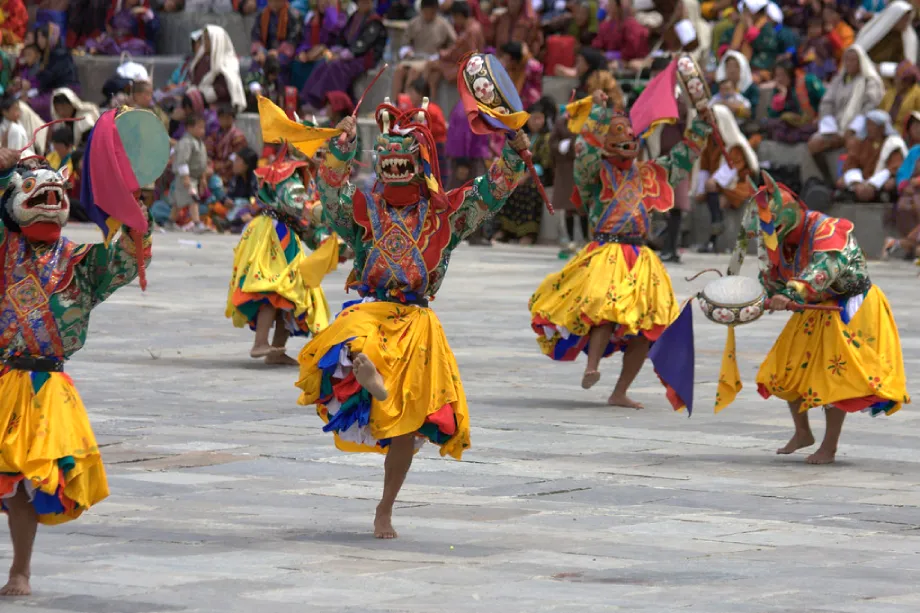
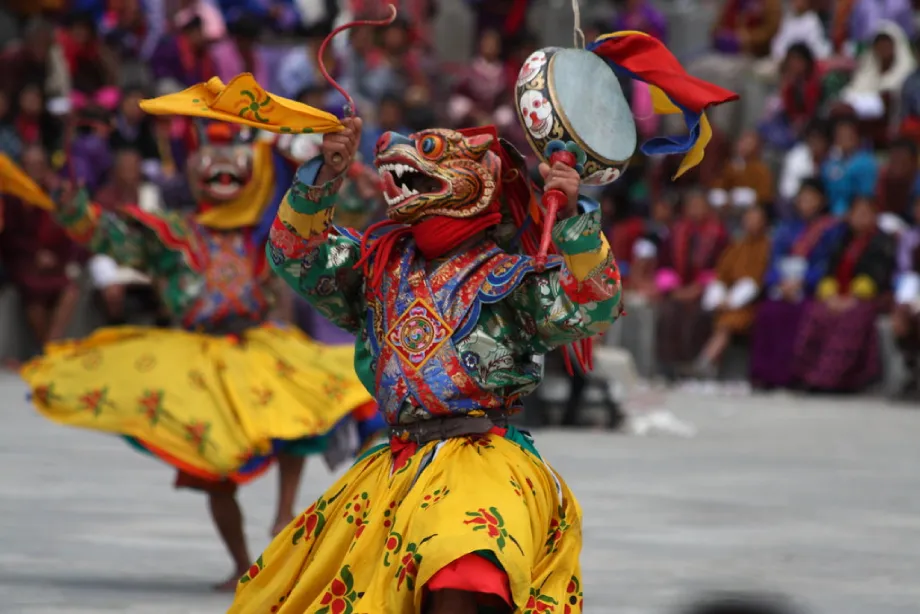
The Tshechu is a vibrant, sacred Buddhist religious Bhutan Tshechu festival held annually in each district to honor Guru Rinpoche, the 8th-century saint who introduced Tantric Buddhism to Bhutan. The significance of the Tshechu festival is deeply multifaceted, serving as a cornerstone of Bhutanese spiritual and cultural life. Primarily, it is a commemoration of Guru Rinpoche’s miraculous deeds, with each mask dance, or Cham dance, re-enacting events from his life and the revelations of great Buddhist masters.

Attending a Bhutan Tshechu Festival is believed to confer profound spiritual merits and blessings upon participants, cleansing them of past sins and accumulating good karma for future lives. The viewing of the sacred Thongdrel, a giant appliqué tapestry unveiled at dawn on the final day, is considered so powerful that it can liberate the beholder from the cycle of rebirth. Furthermore, Tshechus function as vital community gathering events in Bhutan, where people from remote villages don their finest traditional attire, or kira and gho, to socialize, reaffirm communal bonds, and receive blessings from monks.

The festivals are also a living museum of Bhutanese cultural heritage, transmitting Buddhist philosophy, history, and traditional values through dramatic performances to younger generations, ensuring the preservation of a unique national identity in the face of modernization. For the tourist, the Bhutanese Tshechu festival offers an unparalleled immersion into the kingdom’s living culture, with its mesmerizing mask dances, rhythmic monastic music, and deeply pious atmosphere.

When and Where It Is Held

The Bhutan Tshechu festival dates 2026-2027 vary by district and are determined by the traditional Bhutanese lunar calendar, often corresponding to specific days of a lunar month. The most famous and largest Tshechu is the Thimphu Tshechu, typically held in the capital city of Thimphu for three days beginning on the 10th day of the 8th lunar month, which usually falls in September or October.

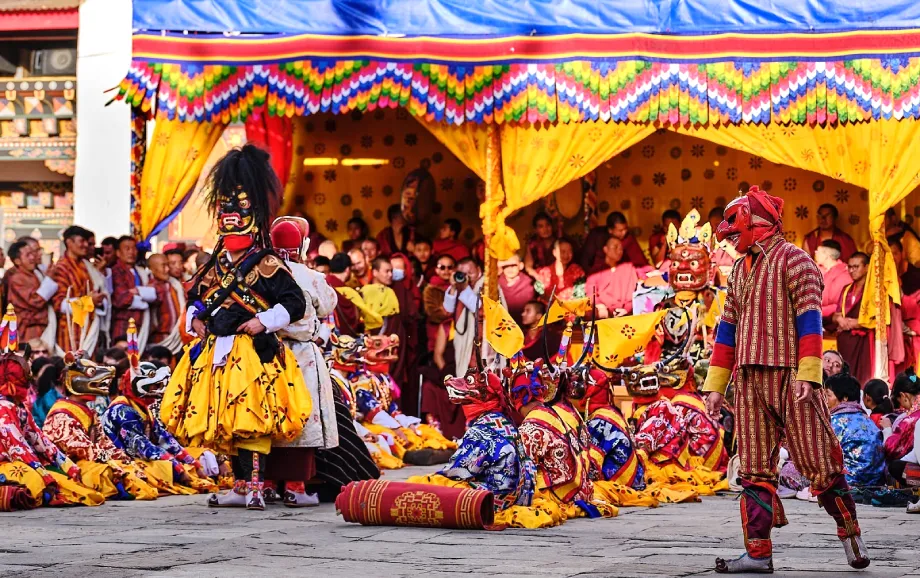
The Paro Tshechu is another major festival held in the picturesque Paro Valley at the stunning Rinpung Dzong, usually in spring (March or April). Other significant district Tshechus include the Punakha Drubchen and Tshechu in late winter (February/March), the Wangdue Phodrang Tshechu, and the Bumthang Jambay Lhakhang Drup in the central Bumthang valley, known for its unique Mewang fire ceremony and Tercham naked dance. Essentially, every district or Dzongkhag in Bhutan has its own Tshechu held at the local Dzong fortress monastery, which serves as the administrative and religious heart of the district, making the festival both a spiritual and civic occasion.

Festival Celebration in Bhutan

Best Month to Attend

Determining the best time to visit Bhutan for Tshechu depends on traveler preferences and festival logistics. For those seeking the grandest scale and vibrant atmosphere, the Thimphu Tshechu in September or October is a top choice, offering clear autumn skies and excellent photography conditions.

The Paro Tshechu in spring (March/April) coincides with beautiful blooming rhododendrons and pleasant hiking weather, ideal for combining the festival with a trek to the Tiger’s Nest Monastery or Paro Taktsang. However, these are also the peak Bhutan tourism seasons, requiring early booking for flights and hotels.

For a more intimate and less crowded experience, consider the Bumthang festivals in October-November or the Punakha Tshechu in February, which also offers milder winter weather in that valley. Ultimately, the best month for Bhutan Tshechu festival aligns with your desired balance between major event spectacle, regional exploration, and seasonal weather, with autumn (September to November) widely regarded as the overall optimal period for travel in Bhutan.

Reason to Celebrate

The core reason to celebrate Bhutan Tshechu festival is to honor Guru Rinpoche, also known as Padmasambhava, whose historical significance in Bhutan cannot be overstated. According to Buddhist texts, Guru Rinpoche visited Bhutan multiple times in the 8th century, subduing malevolent spirits and regional deities, binding them as protectors of the Dharma, and concealing sacred terma or treasure teachings for future discoverers.

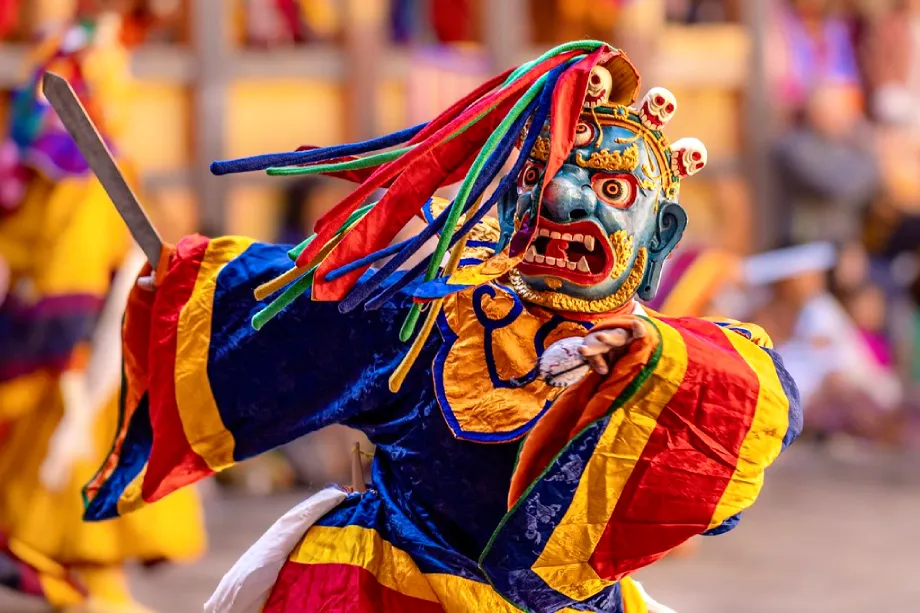
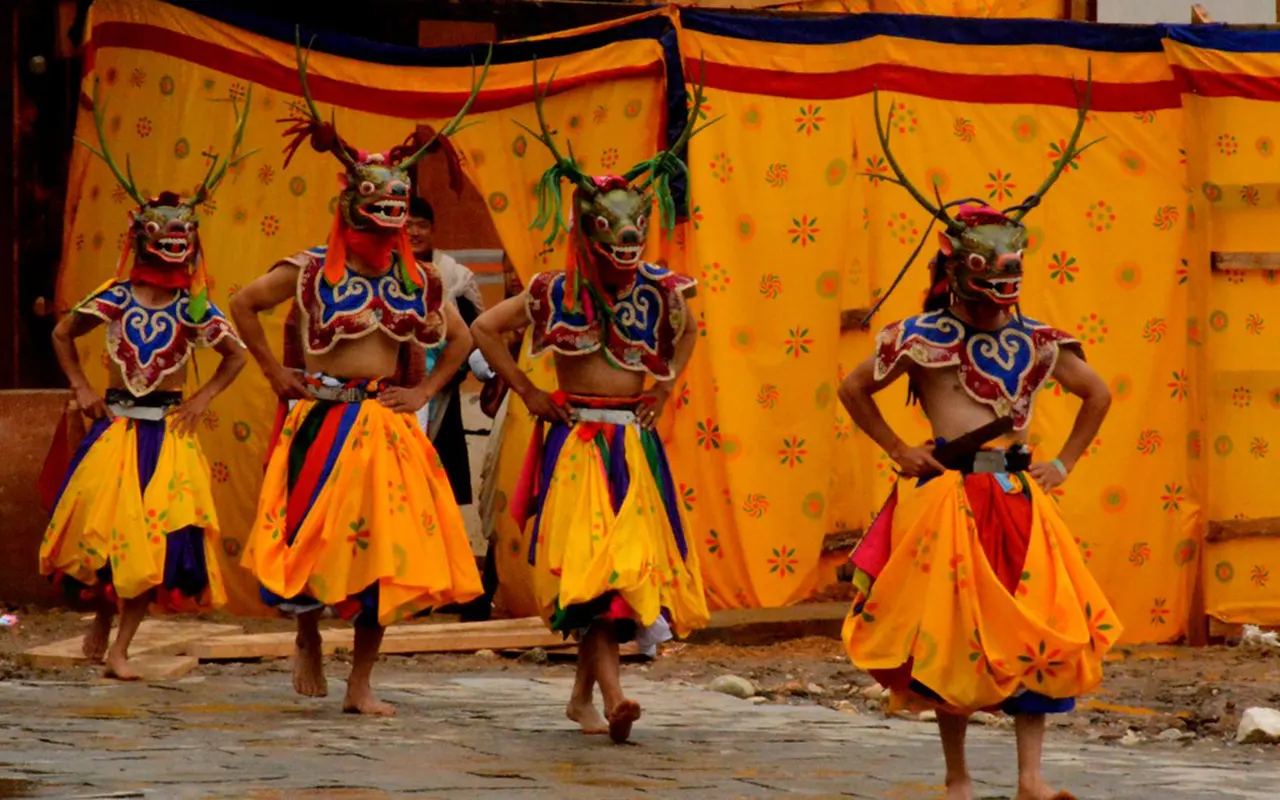
The Bhutan Tshechu festival celebrates his birth, his manifold manifestations, and his enlightened activities that established Buddhism in the Himalayas. Each Cham dance’s meaning is didactic; for instance, the Dance of the Eight Manifestations of Guru Rinpoche (Guru Tshengye) depicts his eight forms used to tame different beings, while the Dance of the Black Hats (Shana) symbolizes the triumph over evil and the ritual destruction of the ego. The Dance of the Stags and Hounds (Shawo Shachi) depicts the conversion of a hunter by a celestial being and conveys messages of compassion and non-violence.

The climax, the unveiling of the Thongdrel, typically depicts Guru Rinpoche surrounded by lineage holders, and its mere sight is an act of spiritual purification. Therefore, the celebration is not merely a cultural show but a dynamic Buddhist teaching through performance, a means to inspire faith, remind people of moral teachings, and provide a direct conduit for blessings, reinforcing the religious and social harmony in Bhutanese society.

When is the Bhutan Tshechu Festival 2026-2027?

2026 Bhutan Tshechu Festival Projected Dates:

  • Paro Tshechu: March 30 – April 3, 2026.

    • (The main mask dances typically start on the 10th day of the 2nd lunar month, with the unfurling of the Guru Thongdrel sacred tapestry on the final morning, April 3).

  • Thimphu Tshechu: September 27 – 29, 2026.

    • (Main dances from the 10th to 12th days of the 8th lunar month, with the Thongdrel on the 29th).

  • Punakha Tshechu & Drubchen: February 18 – 22, 2026.

    • *(Note: Punakha Drubchen is unique, preceding the Tshechu. It’s one of the oldest festivals, re-enacting a 17th-century battle).*

  • Wangdue Phodrang Tshechu: September 22 – 24, 2026.

  • Jambay Lhakhang Drup (Bumthang): November 8 – 12, 2026.

    • (Famous for the Mewang (Fire Ceremony) and the Tercham (Naked Dance) performed around midnight).

2027 Bhutan Tshechu Festival Projected Dates:

  • Paro Tshechu: March 19 – 23, 2027.

  • Thimphu Tshechu: October 16 – 18, 2027.

  • Punakha Tshechu & Drubchen: February 8 – 12, 2027.

  • Wangdue Phodrang Tshechu: October 11 – 13, 2027.

  • Jambay Lhakhang Drup (Bumthang): October 28 – November 1, 2027.

Festival in Bhutan
Festival in Bhutan

FAQs About Bhutan’s Tshechu Festival

1. What is a Bhutan Tshechu Festival, and why is it celebrated?
Answer: A Tshechu is a vibrant, annual religious festival held in each district (Dzongkhag) of Bhutan. It honors Guru Rinpoche (Padmasambhava), the 8th-century saint who introduced Tantric Buddhism to Bhutan. The festival is celebrated to commemorate his deeds, receive spiritual blessings, cleanse negative karma, and foster community unity. The sacred mask dances (Cham) are not mere performances but meditative acts believed to confer merit and bring enlightenment to both performers and viewers.

2. What are the main Tshechus and their projected dates for 2026 and 2027?
Answer: The two largest and most accessible festivals are the Paro and Thimphu Tshechus. Their projected dates are:

  • Paro Tshechu 2026: March 30 – April 3, 2026 (Final day with the Thongdrel unveiling is April 3).

  • Thimphu Tshechu 2026: September 27 – 29, 2026.

  • Paro Tshechu 2027: March 19 – 23, 2027.

  • Thimphu Tshechu 2027: October 16 – 18, 2027.
    *Note: Dates are lunar-based projections; confirm with your tour operator 6-9 months prior.*

3. Are these dates for 2026 and 2027 confirmed?
Answer: No, these are highly reliable projections based on the Bhutanese lunar calendar. The official dates are finalized and announced by the Central Monastic Body of Bhutan, typically 6-12 months in advance. Licensed Bhutanese tour operators are the best source for the confirmed calendar. It is safe to plan your travel around these projected windows.

4. Which Tshechu is best for first-time visitors?
Answer: Thimphu Tshechu is often recommended for first-timers. It is large, well-organized, held in the capital’s massive Tashichho Dzong, and offers good visitor facilities. Paro Tshechu, set in the stunning Rinpung Dzong, is equally magnificent and coincides with beautiful spring weather. For a more intimate and unique experience, consider the Punakha Drubchen & Tshechu (Feb 2026/2027) or the Jambay Lhakhang Drup in Bumthang (Nov 2026, Oct 2027).

5. What is the most important moment of a Bhutan Tshechu festival?
Answer: The climactic moment is the pre-dawn unfurling of the Thongdrel, a gigantic sacred tapestry, on the final day. Viewing this Thongdrel (which depicts Guru Rinpoche and his mandala) is believed to liberate one from sins and grant blessings. In Thimphu and Paro, this happens on the final morning (e.g., April 3, 2026, in Paro). Be prepared to join locals at the Dzong very early (around 4-5 AM).

6. How far in advance should I book my trip for a Tshechu?
Answer: Book as early as possible, ideally 6 to 9 months in advance. Flights into Paro International Airport and hotels in Thimphu and Paro during these major festivals sell out extremely quickly. Working with a licensed Bhutan tour operator early ensures you secure the mandatory Bhutan visa, flights, accommodations, and festival viewing arrangements.

7. What should I wear to a Bhutan Tshechu Festival?
Answer: While there is no strict dress code for tourists, modest and respectful clothing is required. Given the sacred nature and the fact that you will be sitting on the ground for hours, comfortable, layered clothing is best. You are welcome to wear formal Bhutanese attire (Gho for men, Kira for women), which can often be rented or purchased in Thimphu. It is highly appreciated and enhances your experience.

8. What are the practical tips for attending a Bhutan Tshechu festival?
Answer:

  • Arrive Early: Securing a good viewing spot is crucial, especially on the final day.

  • Be Prepared to Sit: Bring a small cushion or mat for comfort on the stone courtyards.

  • Respect Photography Rules: Always ask before photographing people, especially monks. Never use flash during dances or inside temples. Video recording may require a special permit.

  • Stay Hydrated and Protected: Bring water, sunblock, and a hat for the daytime.

  • Follow Local Guidance: Your guide will know the best times to view specific dances and manage crowds.

9. Can I attend a Tshechu independently, or do I need a tour?
Answer: All tourists (except those from India, Bangladesh, and the Maldives) must travel to Bhutan through a licensed Bhutanese tour operator. This policy includes obtaining a visa and paying the mandatory Sustainable Development Fee (SDF). Therefore, you will be on a pre-arranged tour, and your guide will be essential for navigating the festival logistics, explaining the dances, and ensuring a respectful and smooth experience.

10. Besides the mask dances, what else happens at a Bhutan Tshechu festival?
Answer: Beyond the mesmerizing Cham dances, Tshechus are vibrant social gatherings. You’ll see families in their finest clothes enjoying picnics, children playing, and locals receiving blessings from monks. Atsaras (clown-like figures in masks) roam the crowds, providing comic relief while also performing spiritual guardianship. The atmosphere is a unique blend of deep reverence, community joy, and cultural pride, making it a holistic cultural immersion.

Tshechu Festival in Bhutan
Performance Tshechu Festival Dance

Conclusion

In essence, the Bhutan Tshechu festival is far more than a tourist attraction; it is the pulsating heart of Bhutanese traditions and customs, a profound spiritual gathering, and a vibrant social event rolled into one. From the solemn, sacred masked dance rituals performed by monks to the joyous, colorful picnics of families, it encapsulates the essence of Gross National Happiness philosophy by nurturing spiritual well-being and cultural continuity.

Planning a trip requires consulting the official Bhutan festival calendar 2026 – 2027 from the Tourism Council of Bhutan, securing travel through a licensed Bhutan tour operator, and preparing for an experience that engages all senses. Whether witnessing the Atsara clown performers providing comic relief and spiritual commentary or losing oneself in the hypnotic drumbeats of the Drametse Ngacham (a UNESCO Intangible Cultural Heritage dance), attending a Tshechu offers a deep, unforgettable window into the soul of the Dragon Kingdom, making it a quintessential experience for any visitor seeking to understand this Himalayan jewel.

Best Time to Visit Bhutan : A Month-by-Month Travel Guide

Bhutan is a peaceful Himalayan kingdom that is characterised by festivals, ancient monasteries, colourful landscapes, and a beautiful atmosphere. It is important to make a correct decision on the best time to visit Bhutan due to the fact that the weather varies considerably throughout the year.

Every season features a new experience of travelling, with its mountain views and flowers in blossom, and cultural holidays and snow-covered winters. This monthly travel guide will help you realise what to anticipate in each season to be able to prepare the best trip.

Bhutan’s climate is largely determined by season and elevation. There are months of sun, blue skies and air, and those when downpour comes and fills all the gullies.

Some of the reasons why travellers visit Bhutan are to do trekking, sightsee, take photos, fish, and attend local festivals known as Tshechus. Depending on the things you wish to engage in, the most appropriate time may vary. Knowing the timestamps of weather, temperature, and the festival seasons will enable you to make the right choice depending on your interests.

This guide will take you through the months one by one in clear and easy-to-understand language that will help you make your decision when to make the memorable trip to Bhutan.

January

It is deep winter in Bhutan in January. The climate is arid and chilly, and most of the days have clear blue skies. In high mountainous regions, snow is present, and in low valleys, it is sunny but cold. During the day, Thimphu and Paro are cool, although nights regularly drop below freezing point. Punakha Valley is warmer; thus, it is more comfortable in the daytime. Even better is Southern Bhutan, which is a good getaway from the cold.

manas national park


It is quiet and peaceful in January, as there are no large national festivals. There are some minor local religious ceremonies that allow the visitor the opportunity to observe the basic village customs in small groups.

The month is the most appropriate to explore lower regions such as Punakha, Wangdue, and the southern national parks. The mountainous view is amazing and can be photographed in the clear air.

Wildlife tours in Royal Manas National Park are good in the sense that animals move about during the colder seasons. Light hiking, bird watching in Phobjikha Valley, and cultural sightseeing are pleasant. Evening is too chilly, thus spending time in a hotel and enjoying a traditional hot stone bath is an ideal winter adventure.

February

It is still winter, but the weather is gradually becomingwarmer in February. Days are sunnier, and the cold is not as harsh as in January, particularly in lower valleys. Even now, it is cold at night in such areas as Thimphu and Paro, whereas Punakha and southern Bhutan are pleasant in the daytime. There is no cloudy weather, and so the mountain views are beautiful.

It is the time of the festival season. Punakha has significant festivals such as Punakha Drubchen and Punakha Tshechu, during which the masked dances of the monks and the locals are held. Such festivals are not overcrowded or too colourful. It is also during this period that the families observe the Losar, the Lunar New Year, when they feast and pray.

Punakha is the most suitable place to visit during the month of February due to the warm climate and celebrations. In Paro and Thimphu, cultural tourism is comfortable. The climb to the Nest Monastery of Tiger can also be done, but it is still cool. Phobjikha Valley can be used to view black-necked cranes before they go. Sightseeing with short and low-altitude walks and village walks is also good.

A combination of culture, scenery, and serene travellingis available during February, and the spring season is yet to start the rush.

March

Bhutan’s winter ends in March and spring begins. The climate warms up, and nature starts to blossom. It is still cold at the beginning of March, yet in the middle of the month, the weather is pleasant and sunny during the day. The valleys such as Punakha are warm, whereas the valleys such as Paro and Thimphu have clean air. The skies are mostly clear with excellent mountain scenery.

It is a season of vibrant festivals. One of the largest religious festivals in Bhutan is known as Paro Tschechu which is usually held in March. The sacred mask dances are done by monks, and the locals come together in traditional attire. It is a vivid and religious festival, and various tourists take pleasure in it.

It is also the start of the trekking season in March. The trails become parched, and the rhododendron in the hills begins to bloom. Demandingtreks and day hikes are once more available. In Thimphu, Paro, and Punakha, the cultural tours are comfortable during the mild weather. Birdwatching is also good because the migratory birds pass through the valleys.

March is a perfect season with good weather, natural beauty, and rich culture.

April

April is also one of the months when one should visit Bhutan. It is the month of spring, and it is hot in the daytime and cool at night. The air is normally clear, particularly at the beginning of the month, thus mountain views are bright and clear. The valleys are green, and flowers are on the hillsides.

In April, festivals are typical. This month is sometimes during which Paro Tshechu is celebrated with big mask dances and religious ceremonies. Another event is the Rhododendron Festival, which is the festival of the colourful spring flowers of Bhutan, accompanied by music, food, activities, and nature walks.

Paro Trekking


The travel conditions in the country are excellent everywhere. The roads are clear, and the trekking paths are in excellent shape. The best months to visit are in April, when one can engage in trekking, hiking, bicycle riding and sightseeing. It is not hard to get to popular destinations such as Paro, Thimphu, Punakha, Bumthang, and even eastern Bhutan.

This is the favourite period of photographers who deal with landscapes and cultures. The only disadvantage is that it is a peak season, hence it is essential to plan. All in all, April promises to be ideal in terms of weather, nature, and cultural life.

May

It is late spring in May and approaches the rainy season. The beginning of the month remains hot and mostly sunny; however, in the latter part of the day, it gets more humid and is occasionally accompanied by rain. It gets hot, particularly in Punakha and the southern Bhutan. The mountain views are also clear in the mornings, but can be obscured by clouds later.

Big festivals are not as numerous, and May is less tense. Other religious rituals and local customs are still practised in monasteries and villages in silence.

Nature appears to be so green due to early rains. Landscapes are clean, and waterfalls are more powerful. The season is still pleasant in early May, though later on the trails may turn muddy.

Cultural touring in Paro, Thimphu, and Bumthang is still good with fewer tourists. Visiting villages, observing everyday life, including farming activities are also a good time. The South has wildlife parks that are active yet warm and moist. May suits are for those who like greenery and peaceful travelling before the onset of heavy monsoon rains.

June

The monsoon season starts in June in Bhutan. It is followed by very common rain, particularly during afternoons and evenings. It is a warm and humid climate, especially in the lower valleys and the south. There are frequently cloudy skies, and mountain vistas are not very common. Nevertheless, the rural setting is extremely green and natural, and the rice fields are sparkling, with forests alive.

Local religious events are also held in central Bhutan, with only a couple of festivals. These minor festivals are non-crowded and are mainly attended by the locals.

June needs flexibility as far as travel is concerned. The roads are often muddy, and travel may be delayed due to heavy rain. Trekking is discouraged since the paths are very slippery and there is not much scenery.

Nevertheless, at times, between rain, it is possible to do cultural sightseeing in some of the towns, such as Paro and Thimphu. It is not a bad idea to visit monasteries, museums, and markets. When it is lightly raining over valleys, nature can be magical because of the mist and the fresh air.

The time in June is not busy, and the number of tourists is minimal, which is why it is the time when the person prefers to be alone and realise the beauty of the surrounding world despite the downpour.

July

The monsoon in Bhutan occurs in July. It is the most humid and wet month of the year. Rain is abundant, and it may also take hours or even days. The roads are likely to be muddy, rivers full, and mountain scenes generally concealed under clouds and mist. Temperatures stay warm. Thimphu and Paro are mild and humid, whereas Punakha and the south of Bhutan are hot and tropical. Due to rain and landslides, travelling may be slow.

Tourism is extremely minimal, and thus, locations are serene and calm. It is primarily the Haa Summer Festival in which local people demonstrate traditional foods, music, dances, and the culture of yak.

Haa Festival

Cultural sightseeing is a better thing to do in the month rather than trekking. Excursions to museums, dzongs, monasteries, and cafes in Paro and Thimphu. Punakha Valley appears quite green with scenes of rice farming.

July is a good month to travel to when you like nature, greenery, and fewer people around; however, you should be flexible with your plan and prepared for rain.

August

August is a month in the monsoon season, and the rain gradually becomes lighter at the end of the month. The climate is hot, humid and usually cloudy. The showers are common, particularly at the beginning of the month. By the end of August, it is possible that some mornings are clearer, with the sky possibly opening briefly. The rural landscape is extremely green and damp following the rain. Strong rivers and beautiful fallscan be seen.

One of the events is the Mushroom Festival in Ura, Bumthang, which occurs in August. The locals feast on wild mushrooms through food, music, and cultural performances. Tourists will be able to learn about the gathering of mushrooms and sample local foods. It is an original village experience.

Travel is based on cultural visits and strolls. Good overnight places are Paro and Thimphu, which have museums, temples, and markets. Bumthang is serene and full of history. Even trekking is not the best choice because of the wet trails.

The month of August has a few tourists and also less cost of travelling. It is suitable fortravellers who prefer nature and a local lifestyle, and who do not want to travel in large crowds.

September

In Bhutan, the autumn begins in September. At the beginning of the month, there might be some rain, but by mid-September, there is a clear sky. It becomes fresh, the humidity is decreased, and mountain landscapes start revealing themselves. Days are warm and pleasant, and nights are cold. Fields are green, though they gradually turn to a golden colour as the harvest time approaches. The conditions of travelling are much better.

Festival season begins. The popular Thimphu Tshechu usually takes place at the end of September. There are colourful masked dances by monks, and people are assembled in traditional clothing. It is a dynamic and spiritual affair. Other valleys also have smaller festivals.

It is an excellent month in September to go sightseeing, hiking, and taking photographs. The hike to Tiger Nest in Paro is again made fun with better views. Punakha Valley is in a beautiful state, and Bumthang opens. The season of trekking begins, and all the trails become dry. The number of tourists rises at the end of the month.

September is a great combination of both culture, scenery, and good weather, which makes it one of the most even seasons to visit Bhutan.

October

October is said to be the best month to visit Bhutan. It is sunny, dry, and clear. The skies are deep blue, and the mountain sceneries are sharp and beautiful. The weather is pleasant by day and cool by night. Rain is very rare. During harvest times, the rice fields are golden, and the landscape appears to be bright and cheery.

This is the month of many significant festivals. Jambay Lhakhang Drup and fire ceremony are held in Bumthang. Smaller festivals take place at such places as Gangtey and eastern Bhutan. The events demonstrate the rich spiritual practices of Bhutan through music, masked dances and rituals.

Jambay Lhakhang Drup

Travelling is convenient to all parts of the country. Excellent activities are hiking, trekking, cycling, and sightseeing. Tiger Nest, high mountain passes, and Punakha Dzong are beautiful. Hiking trails are in ideal conditions. Tourists are also present during October, and therefore, prior planning is very crucial.

The experience is memorable even with an increased number of visitors. The month of October is the perfect combination of ideal weather, clear sightseeing, vibrant culture, and outdoor adventure.

November

The month of November is the continuation of the season of autumn; this period is cool, dry and sunny. Days are good, mornings and nights are colder, particularly in Thimphu and Paro. The skies are extremely clear and provide spectacular Himalayan scenery. Rain is rare. Harvests are done, and landscapes appear to be peaceful and transparent.

One of the special occasions is the Black-Necked Crane Festival in Phobjikha Valley on November 11. The children of the schools and village people dance the crane dance to attract the rare birds that come to this country in the winter. It is a festive occasion that is nature-oriented and conservation-oriented. There are also some regional festivals held in eastern Bhutan.

Sightseeing and photography are good. Phobjikha Valley is serene and scenic. Paro and Thimphu are not as crowded as they are in October. Day hikes and walks in nature are great, and camping is not very pleasant at night.

November is ideal as a vacation destination when people prefer to see clear mountain views, cultural sites, and fewertourists before the winter season sets in.

December

In Bhutan, winter begins in December. The weather gets cold, particularly during the night, but days are frequently dry and sunny. During the day, cities such as Thimphu and Paro are approximately 11-15 °C in temperature, and the daytime temperatures usually drop below the freezing point.

Places further up, such as Bumthang, are considerably colder in the morning. In thelower valleys, such as Punakha, the days will remain pleasant at 20 °C. The sky is extremely clear, and the mountain scenery is as sharp as possible in the year. The days are not long, and therefore, there is less time to sightsee.

There are significant events in December. On December 13 the Dochula Druk Wangyel Festival, mask dances are performed by the soldiers at one of the high mountain passes. The Bhutan National Day takes place on December 17 and is followed by parades and celebrations. The Trongsa Tschechu is also held at the end of December.

The month is quiet and has very few tourists. Punakha is a better place to stay during warmer seasons. It is not impossible to have the Tiger Nest hike in Paro, provided that you wear warm clothing. Wildlife trips are also good in Southern Bhutan.

Tourists need to be prepared for cold weather, short days, and the snow on mountain roads.

What is the Best Time to Visit Bhutan?

Autumn (September to November) and spring (March to May) are the most appropriate seasons to visit Bhutan. These are the best seasons because they present the best weather, clear skies, and comfortable weather conditions that would make sightseeing, trekking, and exploring cultures easy.

The spring is particularly beautiful because valleys and hillsides are filled with flowering rhododendrons, magnolias and wildflowers. It is not hot, and those who love nature will see colourful scenery and various active birds. It is also a very good time to make short hikes and participate in outdoor activities.

Best Time to Visit Bhutan

The season of autumn is regarded as the most important travel season. The clouds are bright and clear, with a beautiful view of the Himalayas, with snow-white peaks. The most significant festivals in Bhutan, like Thimphu Tshechu and Paro Tshechu, are held during this period, and visitors have the opportunity to witness the traditional music, dance and rituals.

During winter, it is cold and quiet, and during summer, there is monsoon rainfall, so it is not so easy to get anywhere.

Conclusion

In conclusion, the time to visit Bhutan is indeed up to you and what experience you want to get. The Himalayan country is a serene place that has something to give in all seasons. The spring can be described with flowers, warm weather, and the fall can be characterisedby the view of the clear mountains and colourful festivals. These are the most popular months since the conditions of the travel are good, and nature is at its best.

The rainy summer season makes Bhutan greener and much quieter, and thus it is a good destination for the traveller who is fond of an ambience of peace and less congestion. It is cold in the winter but offers good, clear skies, mountain scenery, and cultural shows, which are rare in other seasons, particularly in the lower valleys where the climatic conditions are milder. Every month is beautiful, with its festival parties and quiet village life.

Knowing the weather of every month, festivals, and travelling conditions, you can organise a trip that suits you best: want to go trekking, take photos, explore the culture, or just relax in nature. Bhutan is not a place to visit only one season; it is a full year-long unforgettable experience with exotic nature, religious heritage, and homeland hospitality.

Eco Tour in Nepal: Everything You Need to Know

ABC Panorama
ABC Panorama

The country of Nepal, the country of sky-embracing mountain ranges, jungles, and living traditions, is a natural eco-tourist country. An eco tour in Nepal is a form of traveling that places the community and nature at the center stage. Rather than augmenting the others in the attraction sites, it is keen on responsible experiences that conserve the environment and sustain the people residing in it.

This in Nepal usually includes walking through untouched sceneries without footprints, staying in village homestays as opposed to big hotels, and appreciating culture in an appreciative and meaningful manner.

The country of Nepal is particularly apt for eco tours due to the stunning variety. You can travel from snow mountains to subtropics full of wildlife in a short distance. This Natural diversity is a source that attracts tourists who would like to enjoy nature and preserve it. The cultural diversity in the country is equally impressive.

There are over a hundred ethnic communities residing in Nepal, and many of them inhabit isolated areas where people still stick to their ancient ways of life. Eco tours will provide an opportunity to experience everyday life with these people, whether it is a local meal or a festival.

Nepal is focusing on sustainable tourism so that it preserves the environment and is conscious of cultural heritage and traditions being adopted, and tourism has a tangible advantage to the villagers. An eco tour, in this case, implies responsible traveling and possibly aiding in conserving the beauty of Nepal in the future.

What is eco tourism? (Concept & meaning)

Eco tourism is not just a trend in traveling. It is a conscious approach to the exploration of the world in a manner of taking care of nature and human beings that dwell near it.

Eco tourism is simply visiting the natural locations responsibly in such a way that ensures that the environment, the local community, and also provides education in the process. An eco-tour does not simply mean visiting beautiful places. It is about how you visit them.

Eco tourism promotes careful decisions, rather than concentrating on comfort or speed. This could involve staying in locally owned lodges, engaging in nature-friendly trekking methods, and getting to know your environment and culture as you enter it. Education plays a key role.

In contrast to mass tourism, which places a great emphasis on volume and profitability, eco-tourism appreciates balance. The point is easy: leave things better than you discovered them, and at least, undamaged.

Eco-tourism tries to uphold the following main principles:

  • Reduce impact: Travel so as to impact the natural environment minimally, including being mindful of where one walks, taking care of the waste, and not encountering wildlife due to carelessness.
  • Enhance environmental and cultural consciousness: Tracing local Biomes and cultures: experience the stories, the guides, and focus on precedent through shared experiences.
  • Conservation direct benefits: Contribute to conservation by means of park, forest, and wildlife protection fees, and responsible operators.
  • Bring economic gain and empowerment to locals: Guarantee the local families retain tourism income by way of guides, homestays, and local businesses.
  • Provide positive experiences to both the visitor and the host: Transform considerate, fulfilling interactions that will be mutually beneficial.

Why should we use an Eco tour in Nepal?

By opting to take an eco tour in Nepal, the rewards will be much more than sightseeing. It gives you the opportunity to explore the beauty and the richness of the country. This makes you aware of the fact that if you visit, you will be contributing to the good. Nepal is an ideal destination to visit in regard to sustainable tourism due to its diverse topography, traditional society, and excellent conservation activities.

Eco tours in Nepal done here are aimed at safeguarding delicate ecosystems and empowering the local people. Every time you trek through the highlands of the village in the mountains, or on your jungle ecology can contribute to conservation and community building. This means no huge resort, mass tourism, and instead a type of slower and more respectful traveling where being connected is more important than consumption.

The model of eco tourism in Nepal also helps to build a close connection between the visitors and locals. You are not merely looking into life. You are eating, trying out adventures, and living together. This brings respect to one another and long memories.

An Eco tour in Nepal is not merely a destination, but the experience that you have in detail.

  • Natural landscape and rich biodiversity: Nepal has a wide variety of ecosystems; whether it is the Himalayas or the Terai jungles, Nepal has it all, with the help of responsible tourism.
  • Cultural diversity and traditional ways of living: Get to know ethnic communities that do not abandon centuries-old traditions they keep, and which are connected closely with nature.
  • Support local communities: Travel on your part directly creates employment and income in comparison to local guides, homestays, and small businesses.
  • Environmental conservation benefits: The park fees and eco activities contribute to the conservation of the wildlife, forest, and sensitive mountain environment.

Ultimately, an eco-tour in Nepal will see you spending the right way, leaving more than footprints.

Nepal has a diverse number of eco-tourism sites at which the activities of conservation of nature and community co-exist. Eco travelers can enjoy Nepal in high Himalayan trails, low-lying jungles, and rural villages quietly with their travel, one that helps the locals earn a living.

Annapurna Conservation Area

Mt Annapurna
Mt Annapurna

The biggest conservation area in Nepal, as well as an international testament to community-based eco-tourism, is Annapurna. Trekkers explore forests, the Alps, and the traditional villages, and spend their time in the locally managed lodges and homestays. Permit fees help in conservation, schools, clean water projects, and garbage collection; hence, tourism is a plus to people and nature.

Langtang Region

Langtang
Langtang

Langtang is north of Kathmandu, but it is serene, allowing mountain scenery with a good cultural immersion. The Tamang Heritage Trail emphasizes homestays, traditional food, monasteries, and life in the village. The area has also been able to rebuild and recover following the earthquake of 2015 through sustainable tourism.

Chitwan National Park

Elephant Safari in Chitwan National Park

One of the most popular eco tourism attraction sites in Nepal is Chitwan. The responsible safaris, jungle walks, and canoe rides are conservation-oriented, involving the local people, the Tharu, through the homestays and cultural programs.

Bardia National Park

One Horned Rhino spotted in Bardia National ParkOne Horned Rhino spotted in Bardia National Park
One Horned Rhino spotted in Bardia National Park

Bardia is more secluded and peaceful in the jungle. Community homestays, small-group safaris, and walking tours offer in-depth wildlife experiences, as well as boost the strength of the local villages.

Rural Villages & Homestays

Ghale gaun, Eco tour in Nepal

Sirubari and Ghalegaun are two examples of village tourism that allow one to taste the real life of a rural setting. Homestays distribute revenue, save culture, and facilitate low-impact and sustainable travel throughout Nepal.

Eco-Friendly Activities in Nepal

The activity involved in an eco tour in Nepal makes it one of the best. Rather than inactive tourism, you are involved in activities that are eco-friendly to nature and promote local populations.

  • Eco Trekking and Hiking: Responsible trekking refers to following trails, not using plastic waste, staying in sustainable teahouses, and having small groups. Environmentally friendly tours encourage the use of reusable water containers, solar energy, and local guides. This type of mountain tour is meaningful and gratifying.
  • Homestay programmes in the community: The Level of cultural immersion is important in village homestays. You eat with families and assist them with their daily chores, you learn local cooking, and you can attend cultural events. The direct impact of your stay is brought to households and the preservation of traditions.
  • Wildlife viewing and bird watching: Guided walks, Jeep safari, Canoe Ride, in the forests such as Chitwan and Bardia are dedicated towards ethically responsible viewing of wildlife. The practice of bird watching in wetlands, forests, and hills is particularly low-impact learning and educational.
  • Cultural exchange programs: These involve monastery stay, village volunteering, cooking classes, weaving classes, and evenings of storytelling, which promote true cultural exchange.
    Agro-tourism and village tours: When you visit farms, tea gardens, coffee plantations, and orchards, you get to experience the agricultural life of Nepal and, at the same time, ensure sustainable farming.

The combination of these activities results in a meaningful, intimate, and strongly Nepalese travel.

Best Time for Eco Tour in Nepal

The climate of Nepal varies radically according to the altitude, and therefore, the season of your eco tour activities is what you are planning. Both seasons present different activities to nature enthusiasts and environmentally conscious visitors.

Spring season (March -May): The spring is lively and vibrant. Hills and hiking paths are covered with rhododendrons, forests are fresh, and wildlife becomes more active. In hills and mountains, it has moderate temperatures and hence a good season to go eco trekking and visit birds. Cultural festivals such as the Holi and Nepali New Year enhance the trip.

Autumn season (September-November): Autumn (September–November) is the most popular time of the year when people go on eco-tours. It is trekking and sightseeing because of the clear skies, good weather, and clear mountain views. Principal festivals such as Dashain and Tihar are more deeply cultural, but just in time trails are more popular.

Unique eco travel off-season: jungle safaris and quiet hikes (low altitude) are best in the winter (December-February) and rain-shadow areas and green havens in the monsoon (June-August). Off-season travel reduces crowding and enables the locals to earn a living throughout the year.

Altogether, eco-tourism does not have a bad season in Nepal. The optimal time is relative to your interests, speed, and the type of experience that you would want.

How Eco-tourism Benefits Local Communities

Eco-tourism in Nepal brings benefits to the local communities besides providing benefits via meaningful traveling.

Employment: It generates guides, porters, cooks, and hosts for the homestay. A locally owned project has the advantage of keeping income inside the community, which enables families to afford education, healthcare, and home improvements. In walking areas such as Annapurna, tourism part of a living for many.
Women’s empowerment: Income and confidence through the homestays and community tourism support women’s empowerment. They take care of reservations, prepare dishes, sell goods, and occasionally take the role of a guide. The money earned usually finances the education of children and the well-being of the family, which could slowly alter traditional functions.
Preservation of culture: Tourism also helps in preserving cultural practices among societies, such as dances, festivals, and handicrafts. The museums and cultural centers established through tourism funding assist in maintaining a pure heritage.
Local economy: Local products have their markets enforced through eco-tourism, including honey, tea, and farm produce. When properly managed, it will alleviate poverty, empower women, sustain culture, and ensure the boosting of economies, such that every visit will be a valuable input.

Environmental Impact of Eco-tours

Eco-tours in Nepal strive to do little harm and may do better for the environment.

  • Decreasing carbon footprint: Trekking, walking, cycling, and paddling will substitute vehicles and ensure a low emission level. Solar panels, biogas, and better cookstoves are being used by many lodges. Carbon is further reduced by slow travel, vegetarian meals, and public transport. Tourists can also contribute to planting trees or cancel flights.
  • Waste management: Eco-tours promote pack in, pack out. Overuse of single-use plastics by means of bans, reusable water bottles, and refill stations minimizes litter. Trekkers can also bring along trash bags that are very small, engage in cleaning activities, and contribute to composting and recycling activities within the villages.
  • Conservation awareness: Guides teach the wildlife, endangered species, climate change, and conservation initiatives in the locality to the traveler. Tourists tend to exchange information and go green in their home countries.

Eco-tours will achieve this by maintaining the environment of Nepal through low-impact travel, minimizing waste, using renewable energy, and educating people about the environment, encouraging people to establish a culture of environmental care.

How to plan an eco-tour in Nepal?

In Nepal, planning an eco-tour can be challenging, but it is highly rewarding. The first step would be to select a responsible tour operator or trekking agency. Raise the point of sustainability policy, treatment of guides and porters fairly, utilization of eco lodges, and the community. The locally owned agencies tend to guarantee better local benefits to villages.

The accommodation decisions are important. Use homestays, teahouses, or eco-lodges which are powered by the sun, composting, or by a low consumption of energy. Little guesthouses found in urban areas are preferable compared to large resorts, which are green. The use of camping must be environmentally friendly: one should not chop firewood, carry portable toilets, or pick up all waste.

The other issue is transportation. Prefer walking, cycling, trekking, or transport. It should never be used to take up helicopter flights unless there is some emergency, and the use of overland routes is needed in order to cut down the carbon emissions. Hitchhiking and using slow travel are also beneficial.

Lastly, comply with the following permits and local regulations. Conservation and protection of wildlife involve targeting TIMS cards, park permits, and community rules. Show respect to signs, dress, and policies on trash disposal.

You can be mindful of your footprint by making well-thought-out and considered decisions, which will enable you to be a sustainable tourist enjoying Nepal.

Eco Travel Tips for Visitors

Environmentally-friendly traveling in Nepal is primarily concerned with behavior. Begin by being respectful towards local culture and practices. Get to know some of the Nepali expressions, such as “Namaste,” dress simply, use shoes where they are not allowed, and ask people before you take their photos. Strictly adhere to the local etiquette concerning religious places and village conventions to demonstrate respect and build goodwill.

Reduce plastic use. Always come with reusable water bottles, purification solutions, single-use cups and bags, and always bring your toiletries. Minimize your impact at lodges or cafes. Refill bottles when at the lodge or cafes and pack out any trash you produce.

Other things to support local businesses include staying in family-owned lodges, dining in local restaurants, and purchasing handicrafts directly from the artisans. Get the local guides and use the Nepali travel agencies, and make your money work towards the community.

Adhere to the rules of leave no trace, follow trails, do not pick the vegetation, as well as disturb a creature, use a toilet where possible, and take away the trash. Remember to keep the noise to a minimum and do not take any plant, wildlife, or cultural artifacts.

The practices are designed to conserve the environment and culture of Nepal and add more flavor to your experience during the trip, which creates a positive experience among both the locals and the visitors.

Nepal Eco Tour vs Traditional Tour

Sustainability and Impact: Eco-tours reduce environmental degradation and help in the empowerment of the local communities, whilst traditional tours tend to emphasize comfort and speed.

An example is hiking to the lower trailheads, accommodation in solar-powered lodges, local food consumption, and participation in conservation efforts, all of which help lower the carbon footprint and positively impact villagers.

Experience and Engagement: Conventional tours are structured and lack interaction with local people. The eco-tours move at a slower pace, and they provide homestays, attend festivals, cook with locals, and volunteer. Tourists receive a better cultural understanding and experience.

Cost and Value: Eco-tours are often affordable, and sometimes it is cheaper than the traditional touring experience, and the money that is usually paid directly to guides, families, and conservation projects is the true value at a low price.

Long-Term Benefits: Eco-tourism conserves the environment and culture, making tourism sustainable. Visitors also go home with more experiences, and classical tourism may go to lengths of overstraining facilities and undermining authenticity.

Eco-tours in Nepal offer meaningful activities, sustainability, and fostering of the local community, therefore making them a better alternative that should be adopted by the travelers who wish to witness how the country survives.

Eco-tourism challenges in Nepal

The eco-tourism in Nepal is facing a number of challenges, even though it has potential. Poor roads, electricity, inconsistent communication, and insufficient healthcare in remote parts of these nations are limitations to infrastructure, which make it challenging to deliver comfortable and environmentally friendly experiences.

Another problem is the awareness of tourists; most of them do not follow the principles of eco-tourism, litter, or the desire to respect local culture, which in turn needs constant education and qualified guiding services.

Finding a balance between tourism and planned conservation is a fine task- congestion, trail destruction, deforestation, and wildlife disruption need to be controlled as the local income would need to be sustained.

The environment and weather patterns are also hazardous, like climate change, landslides, floods, and earthquakes, which present a threat to trails, heritage sites, and visitor safety, and require robust planning.

There are also barriers related to the economy and marketing; most treks and homestays are in communities and are not promoted, and tend to be hard to lure visitors during lean times, such as pandemics.

These problems can only be solved by the government, the community, the responsible traveler, and investment in sustainable infrastructure. Nevertheless, the eco-tourism in Nepal is changing with challenges, with innovation, and dedicated partnerships with the objective of realizing a sustainable future.

Future of Eco Tourism in Nepal

The future of eco-tourism in Nepal is a bright one because of the favorable government policies, empowerment of the community, and innovation. Environmental regulations, sustainable village tourism, carrying-capacity limits, and incentives for green businesses are government initiatives.

There is increasing community participation whereby local villagers are running homestays, guiding, and marketing with the majority of the women-led or youth-based ventures. Eco experiences are becoming more diversified than trekking to agro-tourism, wellness retreats, spiritual journeys, adventure sports, and cultural workshops.

The integration of technology will make the marketing, control, and monitoring of ecotourism, including apps, previews in VR, online booking, and GIS-controlled trails, accessible and maintain the human aspect as the fundamental one. Low-carbon treks, renewable-energy lodges, seasonal changes, and carbon offset programs will be steered by climate resiliency.

New locations such as Karnali, Rara, Dolpo, and Makalu-Barun will be developed sustainably, and international partnerships with such organizations as WWF and UNESCO will be involved in conservation-based tourism. The trends equip Nepal to be equipped to provide meaningful, responsible travelling experiences that see communities and nature flourish with tourism.

Conclusion

Eco tourism in Nepal is not just sightseeing, but is responsible and meaningful traveling. When you opt to do an eco tour in Nepal, you will not only be helping in conservation and empowering local communities, preserving culture, but also having a wonderful time of trekking, wildlife, and village life.

Your trip will have a direct impact on national parks, rural people, and the environmental initiatives that will impact positively, even as you go back home.

As difficult as this may seem, the collaboration between governments, communities, travel operators, and travelers can guarantee a successful, robust tourism model. Utilize homestays, employ local guides, and promote sustainability.

In Nepal, eco-tourism relates you not only to nature and culture, but to the purpose, and hence your travel not only to Nepal but to generations to come can have an enduring impact.

FAQs

Is Nepal’s eco-tourism costly?

Eco-tourism is generally affordable, and homestays and local guides can be cheaper than regular tours, but more specific experiences are expensive.

Do families fit well in eco-tours?

Yes, eco tours are suitable for family activities that can be enjoyed by children and elderly members as they get to explore nature, culture, and village life.

What can tourists do to help with eco-tourism?

Eco tourists can also contribute towards conserving the environment by selecting good operators, observing the locals, and giving back to the local societies, as well as embracing sustainability.

Is eco tourism safe in Nepal?

Of course, eco tourism is safe, but with the appropriate preparation, guides, and obedience to the rules of the locals, tourists can have a secure experience in the village, trends, and wildlife.

EBC vs ABC Trekking: A Comprehensive Comparative Analysis

Introduction: The Call of the Himalayas

The Nepalese Himalayas, home to eight of the world’s fourteen 8,000-meter peaks, represent the ultimate pilgrimage for mountain enthusiasts. Two iconic treks dominate this landscape: Everest Base Camp (EBC) Trek and Annapurna Base Camp (ABC) Trek. Each offers a profoundly distinct experience, catering to different aspirations, fitness levels, and cultural appetites. Choosing between them is not merely selecting a route; it’s choosing a narrative—one of high-altitude grandeur and Sherpa culture, or one of breathtaking diversity and accessible beauty.

This analysis will dissect every facet of these legendary journeys, from geography and culture to logistics and personal challenge, culminating in a clear guide to help you decide which path is yours to walk.

Everest Base Camp
Everest Base Camp

The Everest Base Camp (EBC) Trek – A Journey to the Roof of the World

Overview and Core Appeal

The EBC trek is more than a hike; it’s an iconic expedition to the foot of the world’s highest mountain, Sagarmatha (Mt. Everest – 8,848.86m). Starting with a thrilling flight into the Tenzing-Hillary Airport at Lukla, the trek traverses the heart of the Sagarmatha National Park (a UNESCO World Heritage Site), culminating at Base Camp (5,364m). The primary allure is monumental: standing in the shadow of Everest, surrounded by the giants of the Khumbu region—Lhotse, Nuptse, and Ama Dablam. It’s a test of endurance and acclimatization, steeped in the history of Himalayan climbing.

Detailed Route and Key Highlights

  • Standard Duration: 12-14 days (Lukla to Lukla).

  • Starting Point: Lukla (2,860m), reached by a dramatic 35-minute flight from Kathmandu or Ramechhap.

  • Key Stages & Highlights:

    • Phakding to Namche Bazaar (3,440m): The gateway to the high Khumbu, a bustling Sherpa hub with markets, museums, and the first breathtaking views of Everest.

    • Acclimatization at Namche: Essential rest day with hikes to the Everest View Hotel or the Sherpa Cultural Museum.

    • Tengboche (3,867m): Spiritual heart of the region, home to its most important monastery with a stunning backdrop of Ama Dablam.

    • Dingboche (4,410m) or Pheriche (4,371m): Second acclimatization stop, with hikes to Nangkartshang Peak for panoramic views.

    • Lobuche (4,940m) to Gorak Shep (5,164m): The final settlement, a stark, high-altitude landscape.

    • Everest Base Camp (5,364m): The goal—a surreal, rocky, glacial moraine beside the towering Khumbu Icefall (accessible only in pre-/post-monsoon seasons; not during climbing season for non-expedition members).

    • Kala Patthar (5,644m): The undisputed viewpoint highlight. A pre-dawn climb rewards the trekker with sunrise over Everest’s summit, illuminating the entire Himalayan panorama.

    • Return via Namche: Often includes a variation through the beautiful village of Khumjung.

Terrain, Altitude, and Difficulty

  • Terrain: A well-defined, often busy trail. It involves long, steady ascents and descents along river valleys, crossing numerous suspension bridges (including the famous Hillary Bridge). The final section to EBC is rocky and glacial.

  • Altitude: This is the defining challenge. The trek rapidly gains altitude, with sleeping above 5,000m at Gorak Shep. Proper acclimatization is non-negotiable. Acute Mountain Sickness (AMS) is a serious risk.

  • Difficulty: Strenuous. The combination of sustained altitude, long walking days (4-7 hours), and basic tea-house conditions demands excellent physical fitness, mental fortitude, and preparation.

Cultural and Scenic Immersion

  • Culture: Deep immersion into Sherpa culture. Pass countless Buddhist stupasmani walls, and prayer wheels. Visit ancient monasteries like Tengboche and observe the profound influence of Tibetan Buddhism. Interact with the resilient Sherpa people, whose lives are intrinsically linked to the mountains.

  • Scenery: The scenery is epic and vertical. It’s a world of glacial valleys, colossal icefalls (like the Khumbu), and soaring peaks. The tree line is left behind early, leading to a majestic, alpine, and arctic landscape dominated by rock and ice.

Logistical Considerations

  • Access: The flight to/from Lukla is a crucial and weather-dependent element. Delays are common, requiring buffer days in Kathmandu.

  • Accommodation & Food: Basic tea houses with shared bathrooms (especially at higher altitudes). Menus are extensive but repetitive (dal bhat, noodles, soups, simple Western food). Prices increase exponentially with altitude.

  • Best Seasons: Pre-Monsoon (March to early June) and Post-Monsoon (late September to November). Winter (Dec-Feb) is possible but extremely cold. Monsoon (June-Sept) is not recommended.

  • Permits: Sagarmatha National Park Permit and Khumbu Pasang Lhamu Rural Municipality Entrance Permit (replacing the former TIMS).

The Annapurna Base Camp (ABC) Trek – A Symphony of Diversity

Overview and Core Appeal

The ABC trek, often called the Annapurna Sanctuary Trek, is a journey into the sacred amphitheater surrounded by a horseshoe of towering peaks. Its appeal lies in its incredible diversity—from lowland villages and rice terraces to dense rhododendron forests, and finally, a dramatic glacial basin beneath the icy flanks of Annapurna I (8,091m). It’s more accessible than EBC, offering a rich blend of nature and culture without the extreme altitude.

Detailed Route and Key Highlights

  • Standard Duration: 7-10 days (Pokhara to Pokhara).

  • Starting Points: Typically Nayapul (1-2 hour drive from Pokhara) or Phedi/Kande. The Ghorepani-Poon Hill route is a popular alternative start.

  • Key Stages & Highlights:

    • Tikhedhunga to Ghorepani (2,874m): A steep climb through beautiful forests to a major trail junction.

    • Poon Hill (3,210m): An optional but highly recommended pre-dawn detour for a 360-degree sunrise vista over the Dhaulagiri and Annapurna ranges.

    • The Modi Khola Valley: The trek’s core, leading from lush forests (Chhomrong) into the increasingly narrow and dramatic gorge.

    • Machhapuchhre Base Camp (MBC – 3,700m): The stunning vantage point directly beneath the iconic “Fishtail” mountain (Machhapuchhre, 6,993m), sacred and unclimbed.

    • Annapurna Base Camp (4,130m): The destination—a spectacular, open glacial basin surrounded by the near-vertical south face of Annapurna I, Annapurna South, Hiunchuli, and Machhapuchhre. The sense of enclosure by giants is profound.

    • Return via Jhinu Danda: Often includes a stop at the natural hot springs, a perfect post-trek reward.

Terrain, Altitude, and Difficulty

  • Terrain: Extremely varied. The trail involves countless stone steps (especially around Chhomrong), forest paths, riverbed walks, and a final ascent through a moraine valley. It feels more like a “mountain trek” in the traditional sense.

  • Altitude: The maximum altitude of 4,130m at ABC is significantly lower than EBC. While AMS is still a risk, it is less severe and more manageable with a sensible ascent profile.

  • Difficulty: Moderate to Strenuous. The challenge comes from the relentless ascents and descents (thousands of stone steps) rather than extreme altitude. It is physically demanding but achievable for well-prepared beginners.

Cultural and Scenic Immersion

  • Culture: A fascinating cultural mosaic. The trail passes through villages of the Gurung and Magar ethnic groups, known for their hospitality and distinct traditions (many Gurkha soldiers hail from these communities). The lower regions feature Hindu influences. The Sanctuary itself is considered a sacred place to the local people.

  • Scenery: The scenery is constantly evolving and lush from subtropical forests and cascading waterfalls to bamboo groves and blooming rhododendrons (spectacular in April), culminating in the stark, high-mountain grandeur of the Sanctuary. The variety is its greatest scenic asset.

Logistical Considerations

  • Access: The trek starts and ends near Pokhara, Nepal’s second city and a lakeside paradise of relaxation. Access is via a 25-minute flight or a 6-7 hour scenic drive/bus ride from Kathmandu, offering more flexibility than the Lukla flight.

  • Accommodation & Food: Tea houses are generally better developed and offer more comfort than on EBC, with a greater likelihood of attached bathrooms at lower altitudes. Food is similar but often perceived as slightly better and more varied.

  • Best Seasons: Same as EBC: Pre-Monsoon and Post-Monsoon. The rhododendron bloom in spring is a major attraction. The trek is also possible in winter, though the Sanctuary will be very cold.

  • Permits: Annapurna Conservation Area Permit (ACAP) and Trekkers’ Information Management System (TIMS) card.

Head-to-Head Comparison of EBC & ABC Trekking

Aspect Everest Base Camp (EBC) Annapurna Base Camp (ABC)
Core Appeal Iconic high-altitude challenge; standing before Everest; mountaineering history. Incredible ecological & cultural diversity; intimate peak immersion; accessibility.
Max Altitude Kala Patthar (5,644m), Sleep at ~5,000m. ABC (4,130m), Sleep at ~4,100m.
Primary Difficulty Extreme Altitude. Risk of AMS is high and paramount. Sustained Ascents/Descents. Thousands of stone steps; physically taxing.
Fitness Required Very High. Excellent cardio, endurance, and mental resilience needed. Moderate to High. Good general fitness and leg strength sufficient.
Typical Duration 12-14 days (excluding int’l travel & buffers). 7-10 days (excluding int’l travel).
Scenery Epic, vertical, alpine/arctic. Grand vistas of the world’s highest peaks. Diverse, intimate, lush. Forests, villages, waterfalls, culminating in an amphitheater of peaks.
Cultural Focus Sherpa (Tibetan Buddhist) culture. Monasteries, prayer flags, stupas. Gurung/Magar (Hindu & Animist influences) culture. Traditional villages, terraced farms.
Trail Condition Well-trodden, often busy (especially in season). Long days between stops. Well-defined but rugged with endless stone steps. Can be busy near Poon Hill/Chhomrong.
Logistics & Access Dependent on Lukla flight (weather delays common). Starts from Kathmandu. Accessible from Pokhara by road. More flexible, less prone to major delays.
Tea-house Comfort Basic, especially at high altitudes. Shared facilities standard. Heating in dining room only. Generally more comfortable. More options for attached bathrooms at lower elevations.
Crowds Very high. One of the world’s most popular treks. High, but the diversity of routes spreads people out. Poon Hill and ABC can be busy.
“Wow” Factor The sheer scale of Everest and the Himalayas. Sunrise from Kala Patthar is unparalleled. The dramatic entry into the Sanctuary and the 360-degree wall of peaks at ABC. Poon Hill sunrise.
Overall Cost Higher. Due to longer duration, flight costs, and more expensive food/lodging in Khumbu. Lower. Shorter duration, no internal flight required (if driving), cheaper overall costs.

Critical Considerations for Your Choice of EBC VS ABC Trekking

Altitude Tolerance

This is the single most important factor.

  • Choose EBC if: You are confident in your body’s ability to acclimatize, understand AMS protocols, and are prepared for the physical and mental demands of high altitude. Do not choose EBC simply for bragging rights; respect the altitude.

  • Choose ABC if: You are uncertain about altitude, have had issues before, or prefer a trek where the primary challenge is physical exertion rather than hypoxia.

Time and Budget

  • EBC requires a minimum of 16-18 days total (including international flights, buffers, Kathmandu). It is more expensive.

  • ABC can be done in 10-14 days total. It is more budget-friendly and time-efficient.

Desired Experience

  • Seek the Ultimate High-Altitude Test & Iconic Goal: EBC.

  • Seek Variety, Cultural Richness, & a “Classic” Trekking Feel: ABC.

Physical Fitness vs. Acclimatization Capacity

  • A very fit person prone to altitude sickness might still struggle on EBC.

  • A person with good stamina and strong legs who acclimatizes well might find ABC physically tougher on the joints but easier to breathe.

The “X” Factors

  • Solitude: Neither trek offers true solitude, but ABC’s alternative routes (like starting from Landruk or via Mardi Himal) offer more chances for quieter trails than the classic EBC route.

  • Flexibility: ABC’s road access offers more itinerary flexibility and less anxiety about flight cancellations.

  • The Gateway Cities: Kathmandu (chaotic, historic, vibrant) vs. Pokhara (tranquil, scenic, relaxed). Your start/end point influences the overall trip vibe.

Beyond the Classic – Variations and Add-ons

  • EBC Variations: The Three Passes Trek (Kongma La, Cho La, Renjo La) is a far more challenging and remote circuit for experienced trekkers. The Gokyo Lakes trek offers an alternative with stunning turquoise lakes and a viewpoint (Gokyo Ri) rivaling Kala Patthar.

  • ABC Variations: Starting with the Ghorepani-Poon Hill loop is classic. The Mardi Himal Trek is a fantastic, less-crowded ridge-walk with phenomenal Machhapuchhre views that can be linked or done separately. The longer Annapurna Circuit (though now road-affected) is a totally different, epic journey around the massif.

EBC vs ABC Trekking (FAQs)

1. Which trek is easier: EBC or ABC?

The Annapurna Base Camp trek difficulty is generally considered easier than the Everest Base Camp trek difficulty due to its lower maximum altitude (4,130m vs 5,645m), making ABC better for beginners who are concerned about altitude sickness but still want a challenging and rewarding Himalayan experience.

2. Which trek is more expensive: EBC or ABC?

The EBC trek cost is typically higher than the ABC trek cost due to the expensive Lukla flight, longer overall duration (12-14 days vs 7-10 days), and pricier tea houses in the Khumbu region, making ABC the more budget-friendly trek in Nepal for most travelers.

3. Which has better scenery: Annapurna or Everest?

Both offer spectacular but different scenery: EBC trek views feature dramatic, high-altitude glacial landscapes with iconic peaks like Everest and Lhotse, while ABC trek scenery provides incredible diversity from rice terraces and rhododendron forests to the intimate amphitheater of the Annapurna Sanctuary.

4. How cold does it get at Everest Base Camp vs Annapurna Base Camp?

Temperature at EBC can drop to -10°C to -15°C (14°F to 5°F) at night during peak seasons, while ABC temperature is generally milder at -5°C to 5°C (23°F to 41°F) due to the lower altitude, making packing for EBC require warmer trekking gear for high altitude.

5. Which trek has better tea house accommodation?

ABC tea houses generally offer better facilities with more options for attached bathrooms at lower elevations, while EBC accommodation becomes increasingly basic at higher altitudes with shared facilities standard above Namche Bazaar, though both provide the essential tea house experience in Nepal.

6. Is altitude sickness worse on EBC or ABC?

Altitude sickness risk is significantly higher on the EBC trek due to sleeping above 5,000m at Gorak Shep versus ABC’s maximum sleeping altitude of 4,130m, making proper acclimatization for Everest Base Camp absolutely critical for all trekkers attempting this route.

7. Can I do EBC or ABC as a solo trekker?

Yes, both EBC solo trekking and ABC solo trekking are possible and common, with well-marked trails and frequent tea houses, though hiring a guide is now mandatory in some regions and provides valuable support for navigation, accommodation, and emergency situations.

8. What is the best time to trek to EBC vs ABC?

The best time for EBC trek and best season for ABC trek are identical: pre-monsoon (March to May) for warmer weather and rhododendron blooms, and post-monsoon (September to November) for stable conditions and clear skies, with both avoiding the monsoon months of June through August.

9. Which trek is less crowded: Annapurna or Everest region?

While both are popular, the Everest region trekking crowds tend to be more concentrated on the single main trail to base camp, whereas Annapurna region trails offer more route variations (like starting from Poon Hill or Landruk) that can provide quieter alternatives during peak seasons.

10. Do I need training for EBC or ABC trekking?

Yes, training for EBC should focus on high-altitude cardio endurance with significant elevation gain practice, while preparation for ABC requires strong legs for thousands of stone steps, making both treks demanding but achievable with proper physical preparation for Himalayan trekking.

Conclusion: Which Trek is Your Mountain Calling?

The choice between EBC and ABC is not about which is “better,” but which is better for you.

Choose the Everest Base Camp Trek if:
You are drawn by the legend of Everest. You are physically and mentally prepared to confront and respect extreme altitude. You wish to immerse yourself in the iconic Sherpa culture and follow in the footsteps of mountaineering history. You have the time, budget, and resilience for a demanding high-altitude expedition where the reward is standing in the planet’s most famous mountain shadow.

Choose the Annapurna Base Camp Trek if:
You seek a rich and varied introduction to Himalayan trekking. You want to experience a spectacular cross-section of Nepal’s landscapes and cultures within a shorter timeframe. You prefer a trek where the challenge stems more from muscle power than thin air. You desire the awe of being surrounded by towering peaks but from a more accessible and forgiving altitude.

Both treks are life-changing journeys that offer profound rewards. EBC delivers a powerful, awe-inspiring punch at the top of the world. ABC weaves a beautiful, intricate tapestry of all that makes Nepal magical. One is a summit of ambition; the other is a journey of discovery.

Listen to what you seek: the call of the highest peak, or the song of the hidden sanctuary. Your answer will guide your first, but likely not your last, steps into the heart of the Himalayas.

The Hillary Step: Mount Everest’s Legendary Final Obstacle

Mount Everest
Mount Everest

Mount Everest is known for its daunting challenges and iconic landmarks. Among these, one name stands out as particularly legendary: the Hillary Step. For decades, climbers spoke of the Hillary Step with a mix of reverence and apprehension. But what is the Hillary Step exactly? And why did it become such a famous and sometimes feared part of the Everest climb?

In this blog, we will be discussing the story of the Hillary Step. We will describe how it came to be named during the first successful ascent of Everest in 1953, and where it was found on the mountain. We will also see why it was so significant to the climbers and came to be referred to as the last challenge on the way to the summit.

Lastly, we will talk about the developments following the 2015 Nepal earthquake, the transformation or even evolution of the Hillary Step, and the implications of it to the present-day climbers. We will also tell you interesting stories and facts about Everest on the way in a very easy and understandable manner. We should discuss the history of the most popular step on Everest.

What Is the Hillary Step?

Put simply, the Hillary Step was a nearly vertical rocky outcrop high on Mount Everest, one of the last obstacles climbers faced before reaching the summit. It stood at an altitude of about 8,790 meters (around 28,840 feet) above sea level, just above the South Summit (~8,749 meters) and roughly 60 meters below Everest’s 8,849-meter summit. In mountaineering terms, it was a short rock wall (approximately 12 meters or 40 feet high), perched along the mountain’s southeast ridge.

The Hillary Step was situated between Everest’s South Summit (a secondary peak) and the true summit. On one side of this ridge is Nepal, and on the other side is Tibet; the Step itself was like a narrow gateway on this knife-edge ridge with dizzying drops on both sides.

Climbers who approached the Hillary Step encountered a steep wall of rock and ice in front of them. Only one person at a time could climb up or down through this section, which meant it often turned into a climbers’ bottleneck during busy summit days.

Ascending the Hillary Step required care and a bit of nerve: you’d have to pull yourself up using whatever handholds and footholds you could find on the rock, often with the help of fixed ropes placed there by Sherpas.

At that extreme altitude – deep in Everest’s “death zone” where oxygen is scarce – even a relatively short climb like this feels exhaustingly difficult. The Hillary Step’s reputation grew because it was the final real test of a climber’s skill, strength, and determination right before gaining the rooftop of the world.

In case you are wondering how it came to be so named, it has everything to do with the first successful ascent of Mount Everest. The Hillary Step is named after Sir Edmund Hillary, a New Zealand mountaineer, who in 1953 became the first person to summit Everest alongside a Nepalese sherpa, Tenzing Norgay.

This was the final significant obstacle that Hillary and Tenzing had to overcome during that historic climb. The point on the mountain has ever since been referred to as the Hillary Step in recognition of the name of the man who was the first person to climb it. Even people who are not mountaineers tend to have heard of the Hillary Step – it’s a name that became synonymous with the final push to Everest’s summit.

Mountaineers from all over the world are no doubt drawn by the vertigo and unattainable height of Mount Everest. If […]
58 Days
Challenging

US$ 43000

View Detail

The First Ascent and Naming of the Hillary Step (1953)

The Hillary Step story indeed starts on May 29, 1953, when Sir Edmund Hillary and Tenzing Norgay made history in mountaineering by becoming the first to reach the summit of Everest.

When they were within reach of the summit on that last morning, they met with a magnificent obstruction: a wall forty feet of rock and ice crossing the passage along the small ridge.

It was an unforeseen difficulty so near the summit, and it must have seemed, for a moment, daunting. Hillary subsequently wrote that he spotted this steep rock buttress and knew that it was the final major obstacle between them and the peak of Everest.

Determined to press on, Hillary looked for any possible route up the obstacle. He noticed a small crack between the rock outcrop and a sheet of ice plastered on its side. With no time to waste at nearly 8,800 meters altitude, Hillary wedged himself into that crack and began to climb.

In classic climber’s style, he used a technique called “chimneying” – bracing his back against one side and his boots against the other – while also chopping steps in the ice with his axe.

It was an incredibly strenuous effort, made even harder by the thin air and exhaustion of the high altitude. Hillary managed to pull himself up this narrow gap bit by bit. Tenzing Norgay, right behind him, ascended using the rope Hillary fixed and the steps cut into the ice.

At the top of this rock face, they finally stood above the Hillary Step, with only a relatively easier slope ahead leading to the true summit. Overcoming that hurdle was a pivotal moment.

In fact, Sir Edmund Hillary later recounted that once he and Tenzing conquered this obstacle, he felt confident they would reach the summit. And he was right – shortly afterwards, at 11:30 am, the pair stood on the highest point on Earth.

News of their successful ascent spread around the world, and along with it the story of that tricky rock step they had overcome just below the summit. In the years that followed, climbers and expedition chroniclers began referring to that section of the climb as the Hillary Step, honoring the man who led the first ascent up it.

Hillary himself was a humble character, and he didn’t go around naming features after himself – but the mountaineering community bestowed the name in recognition of his achievement. So, the myth of the Hillary Step was created, along with the victory of the Everest conquest.

Why the Hillary Step Became Legendary

The Hillary Step
The Hillary Step

As decades passed, the Hillary Step became more than a physical feature; it became a symbol of the challenge of Everest. It was legendary to mountaineers for a number of reasons. Firstly, the historical aspect: this was precisely the point where the expedition of Hillary and Tenzing had culminated in 1953 and made the place a dramatic and glorious part of the story.

All of the climbers who came after them knew that when they reached the Hillary Step, they were following in the footsteps of Hillary and Tenzing, just a few meters from the summit themselves. It was a rite of passage into the journey to the summit of Everest – a place where every climber could place their mark against the mountain and history.

Secondly, the Hillary Step was known for its technical challenge and exposure. Even though, by rock climbing grades, it wasn’t extremely difficult (some experts rated it as a modest climb at sea level), at nearly 8,800 meters, it became an exhausting and dangerous challenge.

Climbers often arrived at the Step in a state of extreme fatigue and oxygen deprivation, with adrenaline running high due to the extreme conditions of the death zone. Facing a near-vertical rock section with a 10,000-foot drop on one side and an 8,000-foot drop on the other definitely focuses the mind!

Seasoned mountaineers would feel their hearts pound not just from the exertion but from the sheer exposure and consequence of every move at that spot. In short, it was intimidating – one of those sections where your brain is yelling, “Don’t look down!”

The narrowness of the Hillary Step added to its notoriety. Because only one climber at a time could go up or down, it naturally created a bottleneck. On crowded summit days (and Everest has experienced many crowded summit days in recent decades), climbers sometimes had to queue up below the Step, waiting their turn to ascend or descend.

These delays could become dangerous, since every minute spent waiting in the “death zone” saps energy and precious oxygen. In fact, the Hillary Step has been a factor in some of Everest’s most famous episodes.

The Everest disaster of 1996 was a tragic event where a combination of factors, including sudden storms, exhaustion, oxygen depletion, and delays at the Hillary Step, led to fatalities among climbers.

More recently, a widely-circulated photograph in 2019 showed a huge line of climbers snaking down from the summit ridge, many of them waiting at the Hillary Step area to either go up or come down. Those images underscored how this spot, although small in size, played an outsized role in the flow of climbers on Everest.

For many Everest aspirants, successfully climbing the Hillary Step was emotionally significant. It marked the moment of “I’m really going to make it.” When climbing the Everest slopes, it took weeks to endure the icefalls, camp, and high-altitude treks. Achieving the Hillary Step was the gateway to success.

A few more steps beyond it, and the loftiest goal in mountaineering – standing on the summit of Everest – would be within reach. This psychological boost was huge, but so was the risk: until you cleared the Step, you couldn’t quite celebrate.

It has been said by many climbers that the victory over the Hillary Step was one of the most memorable and rewarding moments of their climb, exactly because it required so much at the very end of their journey.

The 2015 Nepal Earthquake and the Fate of the Hillary Step

The Hillary Step remained the same silent challenge to every new generation of climbers over many years. But nature had a surprise. In April 2015, Nepal experienced a large 7.8 magnitude earthquake, which led to extensive destruction in the country and the Himalayas.

Mount Everest shook violently during that quake, triggering avalanches and sadly ending the climbing season that year. In the aftermath, climbers and scientists speculated that such a powerful event might have altered features high on the mountain. One particular question on the minds of the mountaineering community was: What happened to the Hillary Step?

When Everest expeditions resumed in 2016 (the year after the earthquake), whispers began circulating that the Hillary Step didn’t look the same anymore. Some climbers who summited in 2016 reported that the familiar rock step appeared altered or ‘gone’ – replaced by a slope of snow and broken rock, possibly due to the 2015 earthquake. This was met with a lot of curiosity and a bit of skepticism. Was the Hillary Step truly collapsed, or was it simply buried under heavy seasonal snow?

The high winds and heavy snowfall near Everest’s summit can sometimes pack snow into rocky sections, making them look different from year to year. Because 2016 had a lot of snow up high, it was hard to be certain.

Photographs taken that year were inconclusive; the spot where the Hillary Step should be looked smoother and more rounded, but it was hard to tell if the underlying rock was still intact underneath.

Then came May 2017, when clearer evidence emerged. During that spring’s climbing season, conditions allowed better looks at the area, and several mountaineers confirmed that the Hillary Step’s iconic rock structure had indeed been altered dramatically – essentially, the iconic rock outcrop had collapsed or been destroyed.

British climber Tim Mosedale, after summiting Everest again, announced that “the Hillary Step is no more,” sharing photographs showing the slope of snow and broken rocks where it once stood.

The large boulder that once jutted out as the key part of the Step wasn’t there; instead, there was a jumble of smaller rocks and a snow ramp. Mosedale’s revelation made international news. Many in the climbing world felt a tinge of sadness – an iconic piece of Everest (and mountaineering history) had literally crumbled, likely as a result of the earthquake’s tremors loosening the formation.

Initially, there was some confusion. Nepalese authorities and experienced Sherpas reported that the Hillary Step might still be intact but covered in snow, making it hard to confirm its status immediately.

It’s understandable – admitting that a famous part of the route had collapsed might worry future climbers, and the heavy snow did make it hard to see the rocks clearly. But over time, as more climbers went up and more photos came out, the reality became clear.

By the late 2010s, most experts and Everest guides agreed that the Hillary Step, as it existed for decades, was effectively gone or at least greatly changed. The likely scenario is that the earthquake dislodged the huge chunk of rock that formed the Step, sending it down the side of the mountain. What remained was a reshaped slope where that rock used to be.

How Climbing Everest Has Changed Without the Hillary Step

The Hillary Step ropes

With the Hillary Step’s transformation, climbers today have a somewhat different experience on the final leg of Everest’s South Col route. So, what is it like now? In simple terms, that once-vertical rock hurdle is now essentially a slope.

Instead of having to scale a sheer rock face using hands and feet, climbers can ascend more by walking or stepping up (often kicking steps in the snow) on an inclined surface. In 2017 and the years just after, many climbers noted that this section was physically easier to climb than before.
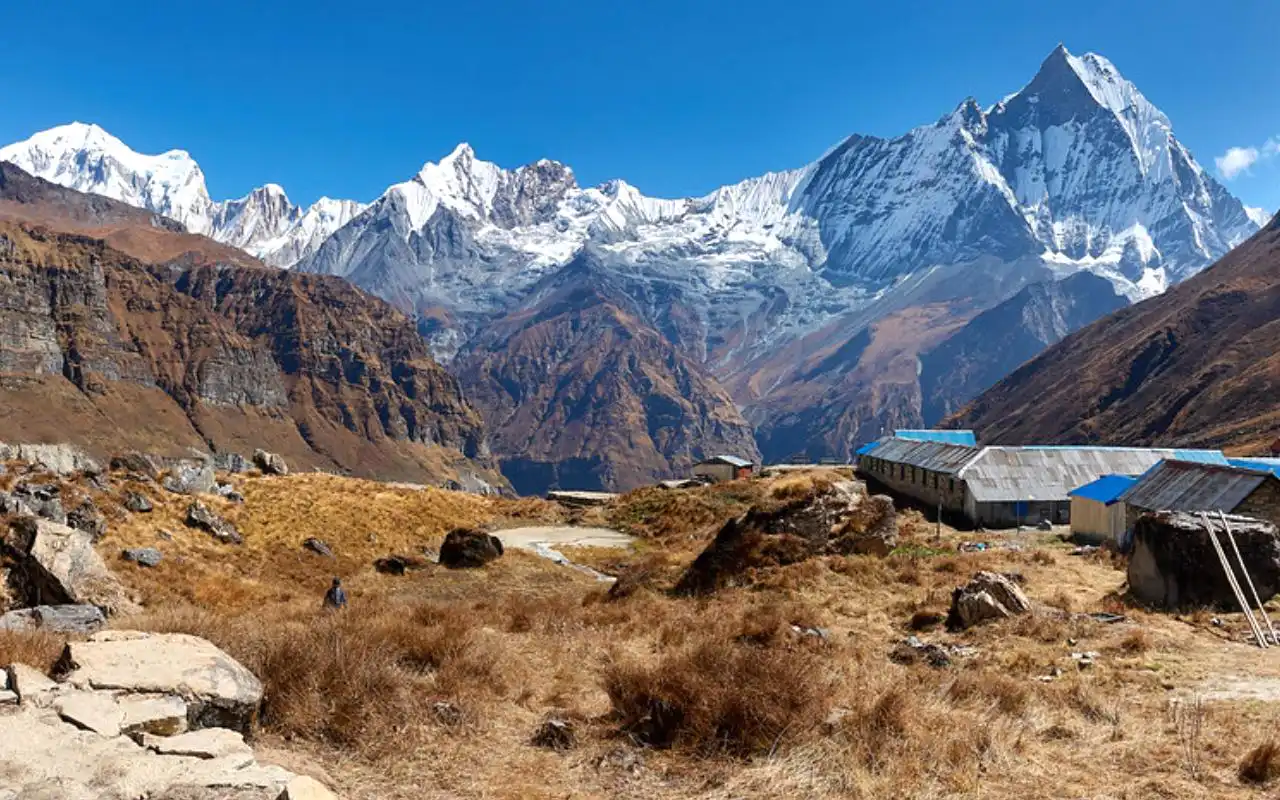
Without the big rock in the way, there was no need for the same kind of technical maneuvering – no chimney technique, no hoisting oneself over a ledge. This undoubtedly comes as a relief to less experienced mountaineers or those absolutely exhausted in the thin air. In that sense, the alteration of the Hillary Step has slightly “tamed” that particular crux of the climb.

However, easier does not always mean safer or better in the world of high-altitude climbing. One consequence of the Hillary Step’s disappearance is that the route can actually become more complicated in terms of traffic management.

When the Step was intact, guides often set up separate fixed ropes – one for ascending and one for descending – so that climbers could go up and down somewhat efficiently one at a time. With the Step gone, the terrain turned into an open snow slope, which sounds simple, but it also means there’s no obvious single choke-point to clip into.

Climbers still have to go one by one in many spots because the ridge is narrow, but establishing two distinct paths is trickier. The result? There can still be bottlenecks, and possibly even more confusion as people pick their way up or down the new slope. In seasons when the snow is not well-packed, that area might be littered with loose rocks from the collapsed Step, adding to the challenge and hazard.

There’s also the factor of stability. The Hillary Step in its rock form was solid (albeit demanding to climb). In its current form, depending on conditions, climbers might be dealing with deep snow or unstable debris.

If snow conditions are poor (imagine a sugary, unstable snowpack), climbers could expend a lot of energy wallowing up the slope, or even trigger a small avalanche. If the snow is melted or blown off, they might be scrambling over rock fragments that aren’t firmly attached. Some guides have expressed concern that the changed terrain could be dangerous, especially if climbers bunch up there in a queue.

Mentally and culturally, the change in the Hillary Step is a mixed bag for mountaineers. On one hand, a daunting obstacle has been removed, which might slightly increase summit success rates because one less technical barrier exists to turn people back.

On the other hand, many climbers feel a sense of loss that they didn’t get to climb the famous Hillary Step in its original form. For years, climbers would come home with tales of how they tackled the Hillary Step; now their stories are a bit different.

Regardless, every person who reaches that spot still knows they’re at the final gateway to the summit of Everest. Whether it’s a steep snow incline or a rock wall, at nearly 8,800 meters, it remains a serious endeavor.

Climbers must stay focused and patient, especially if they find themselves in a line of people in the cold dawn waiting to ascend that last stretch. In short, while the character of the climb has changed, the significance of that location – and the need for determination and care – is as strong as ever.

The Legacy of the Hillary Step

Today, when you ascend Everest by the Southeast Ridge, you find yourself going by the place where the Hillary Step was, though it is no longer quite the walk it was. Out of respect to history and habit, many climbers and guides refer to that section as the Hillary Step. The Hillary Step, in some sense, continues to exist as a concept and a place, though it may not refer to that physical feature.
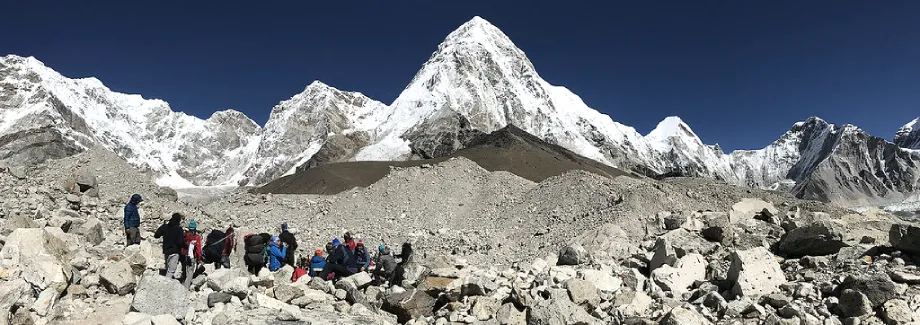
Its history is included in all the tales of the Everest top since the year 1953 to date. Even those who make it today often repeat in their stories how the region once called the Hillary Step has tested them, in a friendly or unfriendly way.
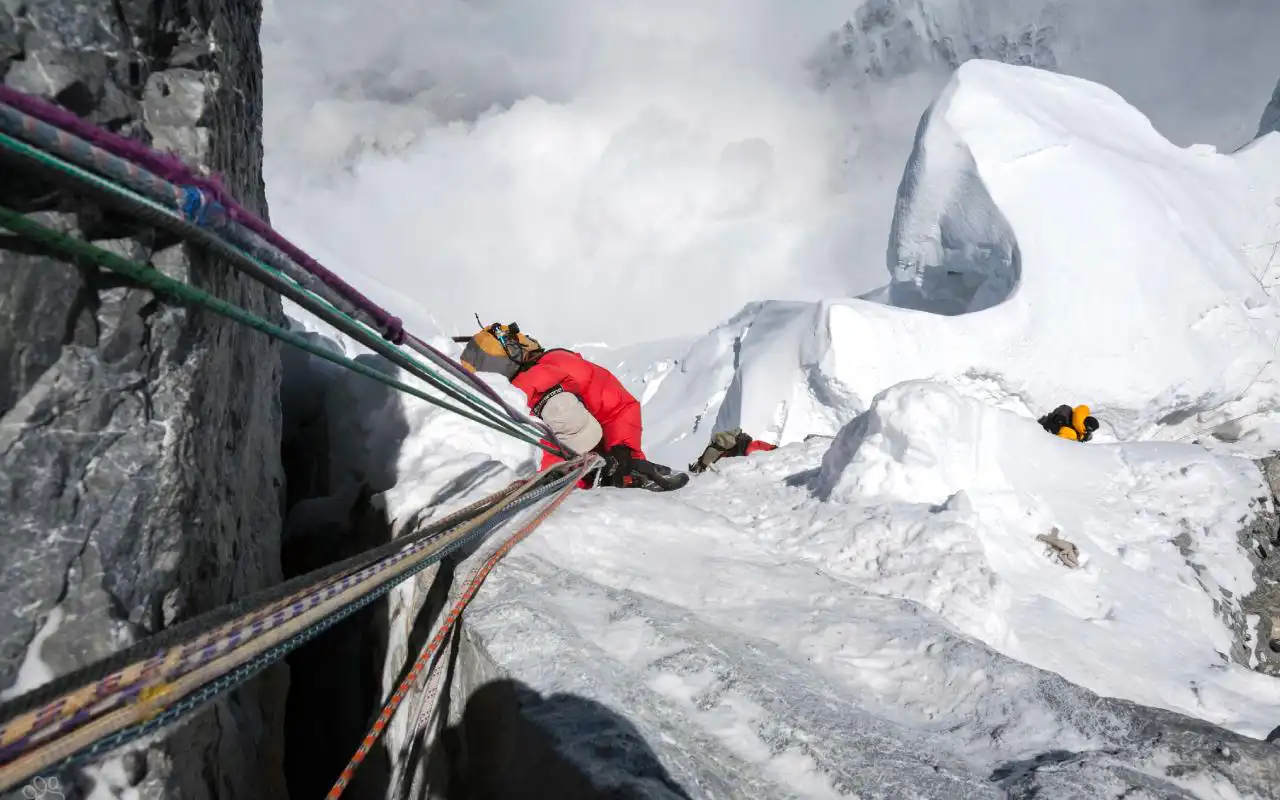
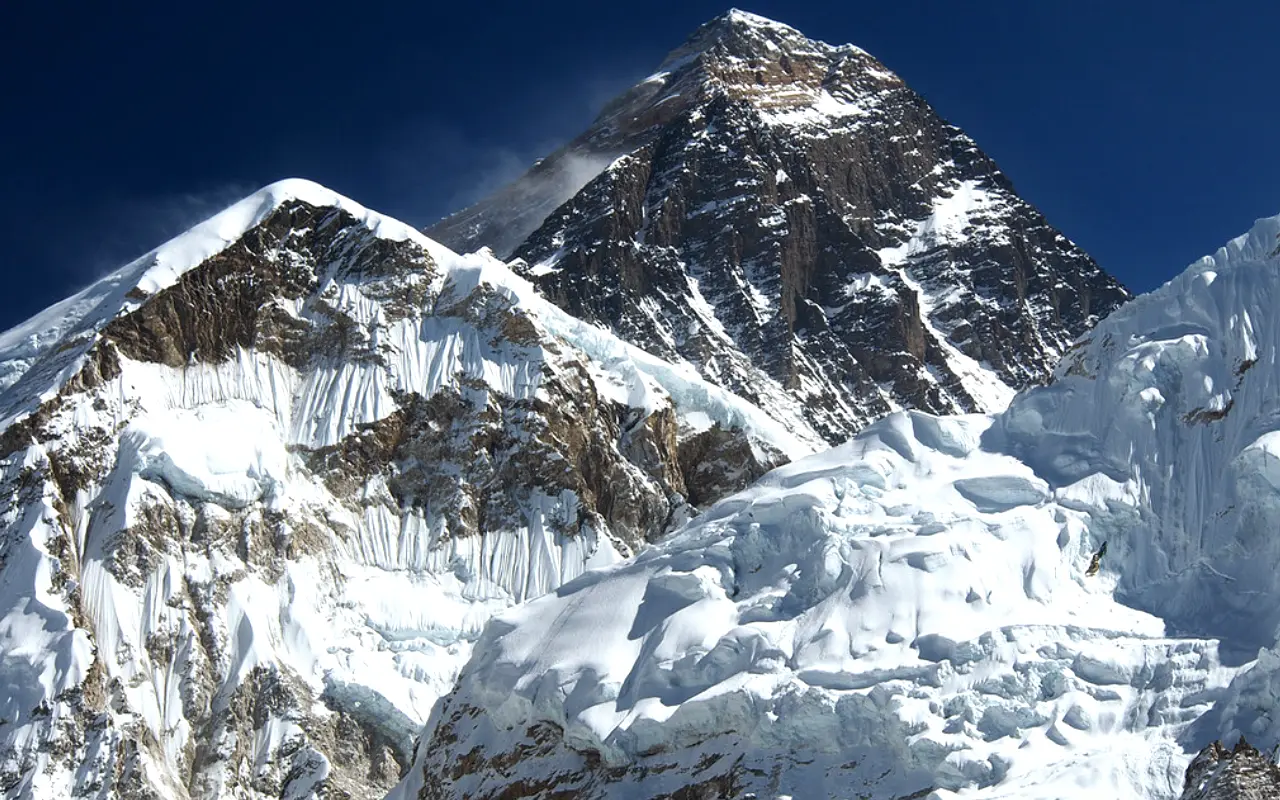
This rocky part, or, more precisely, the memory of it, symbolizes the human struggle to overcome the barriers of nature. That it existed so long as an actual stepping stone to the summit of the world, and then vanished through the action of natural forces, is a reminder of the dynamism of the planet upon which we live.

The routes to Everest may vary, but the adventure and challenge remain the same. These slopes will keep being tested by future climbers as they get accustomed to new challenges that the mountain throws at them.

The tale of the Hillary Step makes an intriguing Everest history to the casual reader and mountain lover. It possesses all of them: historic victory, risk and adventure, the development of nature, and even a certain enigma.

Since Hillary and Tenzing first ascended it in 1953, through the mountaineers who followed and the earthquake that transformed the familiar face of Everest, the Hillary Step has been the center of it all.

It also reminds us of the fact that on Everest, as in life, the greatest of all things is achievable, and what we have today may be gone tomorrow. But the tales of our predecessors serve to direct our successors.

The Hillary Step is an interesting chapter in the history of Mount Everest, whether you are an aspiring climber, a student researching Everest, or simply someone who enjoys a good adventure story. Its rock may be gone, but its myth is still alive, still a source of wonder, respect, and awe of what it requires to be on top of the world.

Free Travel Guide
Your Perfect, Personalized Journey Awaits
profile
Bhagwat Simkhada Seasoned Travel Expert with Years of Experience